Cosopt PF 20 mg/ml + 5 mg/ml eye drops in solution
Spain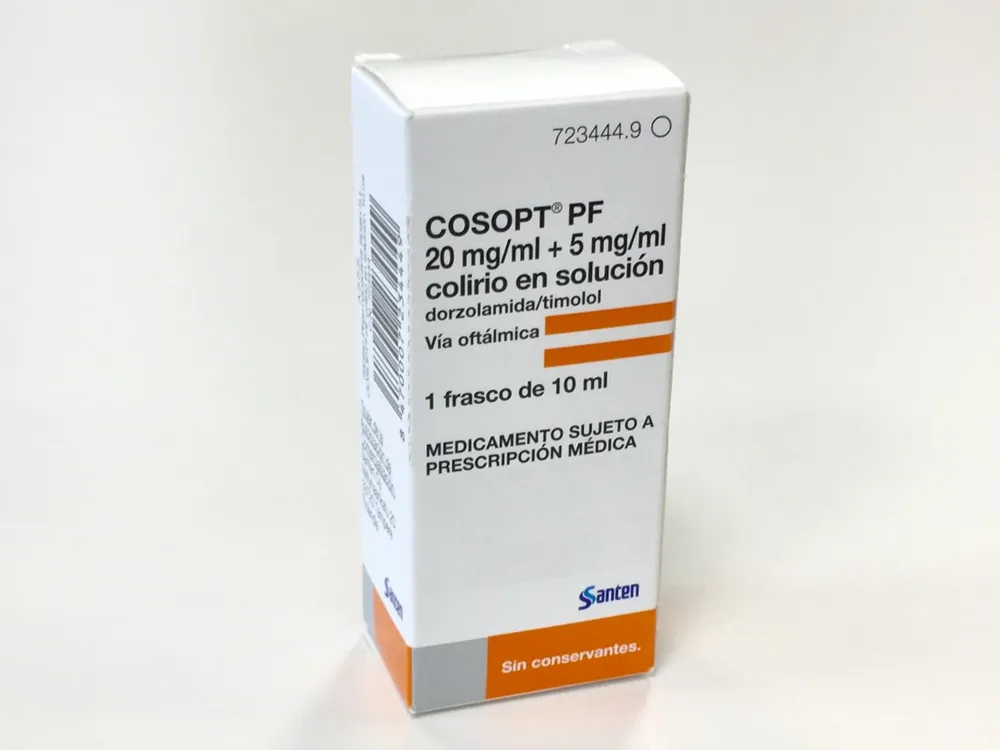
Table of Contents
Package leaflet: Information for the user
Introduction
Package leaflet: Information for the user
COSOPT PF 20 mg/ml + 5 mg/ml eye drops solution
dorzolamide/timolol
Read this entire leaflet carefully before you start using this medicine, because it contains important information for you.
- Keep this leaflet, as you may need to read it again.
- If you have any questions, ask your doctor or pharmacist.
- This medicine has been prescribed for you only, and you should not give it to other people, even if they have the same symptoms as you, because it could harm them.
- If you experience any adverse effects, consult your doctor or pharmacist, even if they are effects not listed in this leaflet. See section 4.
Contents of the leaflet
- What COSOPT PF is and what it is used for
- What you need to know before using COSOPT PF
- How to use COSOPT PF
- Possible adverse effects
- How to store COSOPT PF
- Contents of the pack and other information
1. What COSOPT PF is and what it is used for
COSOPT PF contains two medicines: dorzolamide and timolol.
- Dorzolamide belongs to a group of medicines known as "carbonic anhydrase inhibitors".
- Timolol belongs to a group of medicines known as "beta-blockers".
These medicines reduce eye pressure in different ways.
COSOPT PF is prescribed to lower elevated intraocular pressure in the treatment of glaucoma when the use of a single beta-blocker eye drop is not appropriate.
COSOPT PF eye drop solution is a sterile solution that contains no preservatives.
2. What you need to know before using COSOPT PF
Do not use COSOPT PF
- if you are allergic to hydrochloride dorzolamide, maleate timolol, or any of the other components of this medicine (listed in section 6).
- if you currently have or have previously had breathing problems such as asthma or severe chronic obstructive bronchitis (a serious lung disease that may cause wheezing, difficulty breathing, and/or long-lasting cough).
- if you have a slow heartbeat, heart failure, or heart rhythm disorders (irregular heartbeats).
- if you suffer from severe kidney disease or have a history of kidney stones.
- if you have excess blood acidity caused by an accumulation of chlorides in the blood (hyperchloremic acidosis).
If you are unsure whether you should use this medicine, consult your doctor or pharmacist.
Warnings and precautions
Consult your doctor before starting to use COSOPT PF if you have or have previously had:
- coronary heart disease (symptoms may include chest pain or tightness, difficulty breathing, or shortness of breath), heart failure, or low blood pressure.
- heart rhythm disorders such as decreased heart rate.
- breathing problems, asthma, or chronic obstructive pulmonary disease.
- circulatory disorders (such as Raynaud's disease or Raynaud's syndrome).
- diabetes, as timolol may mask signs and symptoms of low blood sugar.
- overactivity of the thyroid gland, as timolol may mask signs and symptoms.
- any allergy or anaphylactic reaction.
- muscle weakness or if you have been diagnosed with myasthenia gravis.
- if you wear soft contact lenses, COSOPT PF has not been studied in patients who use contact lenses.
Do not use this medicine if you have a history of contact hypersensitivity to silver, as the dispensed drops may contain traces of silver from the container closure.
Inform your doctor before undergoing surgery that you are using COSOPT PF, as timolol may alter the effects of certain medications used during anesthesia.
When COSOPT PF is instilled into the eye, it may affect the entire body.
Inform your doctor if, during treatment with COSOPT PF, you:
- develop any eye irritation or any new eye problems, such as eye redness or eyelid swelling.
- suspect that COSOPT PF is causing you an allergic reaction or hypersensitivity (e.g., skin rash, severe skin reaction, or redness and itching in the eye). Stop using this medicine and consult your doctor immediately.
- develop an eye infection, suffer an eye injury, undergo eye surgery, or develop a reaction involving new symptoms or worsening of existing ones.
Children
Limited experience is available with COSOPT (preserved formulation) in infants and children.
Use in elderly patients
In studies with COSOPT (preserved formulation), effects were similar in elderly patients and younger patients.
Use in patients with hepatic impairment
Inform your doctor if you have or have had liver problems.
Other medicines and COSOPT PF
COSOPT PF may affect or be affected by other medicines you are taking, including other eye drops for glaucoma treatment. Inform your doctor if you are taking or plan to take medicines to lower blood pressure, heart medications, or medicines to treat diabetes. Inform your doctor or pharmacist if you are taking, have recently taken, or might need to take any other medicines. This is particularly important if you are:
- taking medicines to lower blood pressure or to treat heart conditions (such as calcium channel blockers, beta-blockers, or digoxin).
- taking medicines to treat heart rhythm disorders such as calcium channel blockers, beta-blockers, or digoxine.
- using another eye drop containing beta-blockers.
- taking another carbonic anhydrase inhibitor such as acetazolamide.
- taking monoamine oxidase inhibitors (MAOIs).
- taking a parasympathomimetic drug that may have been prescribed to help you urinate. Parasympathomimetics are also a specific type of medicine sometimes used to help restore normal intestinal movements.
- taking narcotics such as morphine used to treat moderate to severe pain.
- taking medicines to treat diabetes.
- taking antidepressants known as fluoxetine and paroxetine.
- taking a sulfonamide.
- taking quinidine (used to treat heart disorders and some types of malaria).
Pregnancy and breastfeeding
If you are pregnant or breastfeeding, think you may be pregnant, or plan to become pregnant, consult your doctor or pharmacist before using this medicine.
Use during pregnancy
Do not use COSOPT PF if you are pregnant unless your doctor considers it necessary.
Use during breastfeeding
Do not use COSOPT PF if you are breastfeeding. Timolol may pass into breast milk.
Driving and using machines
No studies have been conducted on the effects on the ability to drive or use machines. Adverse effects associated with COSOPT PF, such as blurred vision, may affect your ability to drive and/or operate machinery. Do not drive or operate machinery until you feel well or your vision is clear.
3. How to use COSOPT PF
Follow exactly the administration instructions for this medicine as given by your doctor. If in doubt, consult your doctor or pharmacist again. The appropriate dosage and duration of treatment will be determined by your doctor.
Recommended dose: One drop into the affected eye or eyes in the morning and at night.
If you are using COSOPT PF at the same time as another eye drop, the drops should be administered at least 10 minutes apart.
Do not change the dose of this medicine without consulting your doctor.
If you have difficulty administering the eye drops, ask a family member or caregiver for help.
Do not allow the tip of the multidose container to touch the eye or areas around the eye. This could cause injury to your eye. In addition, the eye drop solution could become contaminated with bacteria that may lead to eye infections causing serious eye damage, and even loss of vision. To avoid possible contamination of the multidose container, wash your hands before using this medicine and avoid letting the tip of the container come into contact with any surface.
Instructions for use
Before dispensing drops into the eye:
- Wash your hands before opening the bottle.
- Do not use this medicine if you notice that the tamper-evident seal on the neck of the bottle is broken before first use.
- When used for the first time, before dispensing a drop into the eye, practice using the dropper by slowly squeezing it to dispense one drop outside the eye.
- Once you are confident that you can dispense one drop at a time, position yourself comfortably for administering the drops (you may sit, lie down, or stand in front of a mirror).
- Each time you open a new bottle, discard one drop to prime the bottle.
Dispensing:
- Hold the bottle just below the cap and twist the cap to open the bottle. Do not touch anything with the tip of the bottle to avoid contaminating the solution.
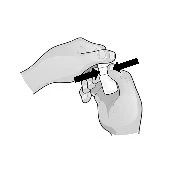
-
Tilt your head backward and hold the bottle above your eye.
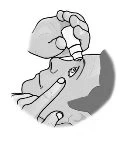
-
Pull down the lower eyelid and look upward. Gently squeeze the center of the bottle and let one drop fall into the eye. Please note that there may be a slight delay between squeezing the bottle and the drop falling. Do not squeeze too hard.
- Close your eye and press with your finger on the inner corner of the eye for about two minutes. This helps prevent the drop from draining into the rest of the body.
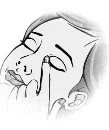
-
Repeat steps 2–4 to instill one drop into the other eye, if so directed by your doctor. Sometimes treatment is needed in only one eye, and your doctor will inform you if this applies to you and which eye requires treatment.
-
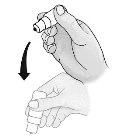
After each use and before replacing the cap, shake the bottle once downward, without touching the dropper tip, to remove any remaining liquid from the tip. This is necessary to ensure proper delivery of subsequent drops.
-
Wipe away any excess solution from the skin around the eye.
-
At the end of the 2-month period of validity of the medicine after first opening, there will still be some COSOPT PF remaining in the bottle. Do not attempt to use the leftover medicine remaining in the bottle after completing your treatment course. Do not use the eye drops for more than 2 months after the first opening of the bottle.
If you have any doubts about how to administer your medicine, ask your doctor, pharmacist, or nurse.
If you use more COSOPT PF than you should
If you apply too many drops into the eye or accidentally swallow some of the contents of the bottle, you may experience, among other effects, dizziness, difficulty breathing, or a slower heartbeat. Contact your doctor immediately.
In case of overdose or accidental ingestion, contact your doctor or pharmacist immediately or call the Toxicology Information Service at telephone number: 91 562 04 20. Provide information on the medicine taken and the amount ingested. It is recommended to bring the medicine container and package leaflet to the healthcare professional.
If you forget to use COSOPT PF
It is important to use COSOPT PF as prescribed by your doctor.
If you forget to apply a dose, apply it as soon as possible. However, if it is almost time for the next dose, do not take the missed dose and continue with your regular dosing schedule.
Do not use a double dose to make up for a missed dose.
If you stop using COSOPT PF
If you wish to discontinue treatment with this medicine, consult your doctor first.
If you have any further questions about the use of this medicine, ask your doctor or pharmacist.
4. Possible adverse effects
Like all medicines, this medicine can cause adverse effects, although not everyone experiences them.
Serious adverse effects:
If you experience any of the following adverse effects, stop using this medicine and seek immediate medical help, as these may be signs of a drug reaction.
Rare (may affect up to 1 in 1,000 people):
- Chest pain, edema (fluid accumulation), changes in heart rate or rhythm, congestive heart failure (heart disease with difficulty breathing and swelling of feet and legs due to fluid buildup), heart attack, heart block, low blood pressure, cerebral ischemia (reduced blood flow to the brain), stroke.
- Difficulty breathing, respiratory failure, constriction of the airways in the lungs.
- Signs and symptoms of systemic allergic reactions, including angioedema, urticaria, pruritus, rash, anaphylaxis.
- Severe skin reactions, including swelling beneath the skin.
Other adverse effects:
You may continue using the eye drops unless the effects are severe. If you are concerned, consult your doctor or pharmacist. Do not stop using COSOPT PF without speaking to your doctor.
The following adverse reactions have been reported with COSOPT PF or with one of its components during clinical trials or after marketing:
Very common (may affect more than 1 in 10 people):
- Burning and stinging of the eyes, altered taste.
Common (may affect up to 1 in 10 people):
- Eye effects: redness in and around the eye(s), tearing or eye itching, corneal erosion (damage to the front layer of the eyeball), swelling and/or irritation in and around the eye(s), sensation of a foreign body in the eye, decreased corneal sensitivity (inability to feel something in the eye), eye pain, dry eyes, blurred vision.
- General effects: headache, sinusitis (feeling of pressure or congestion in the nose), nausea, weakness/tiredness, fatigue.
Uncommon (may affect up to 1 in 100 people):
- Eye effects: inflammation of the iris, visual disturbances including changes in refraction (in some cases due to discontinuation of miotic therapy).
- General effects: dizziness, depression, decreased heart rate, fainting, shortness of breath, indigestion, kidney stones.
Rare (may affect up to 1 in 1,000 people):
- Eye effects: transient myopia that may resolve when treatment is discontinued, detachment of the inner vascular layer of the retina after filtration surgery which may cause visual disturbances, drooping eyelid (causing the eye to remain partially closed), double vision, eyelid crusting, corneal swelling (with symptoms of visual disturbances), low eye pressure.
- General effects: strong heartbeats that may be rapid or irregular (palpitations), Raynaud's phenomenon, swollen or cold hands and feet and decreased circulation in arms and legs, leg cramps and/or leg pain when walking (claudication), cough, throat irritation, dry mouth, insomnia, nightmares, memory loss, tingling or numbness in hands or feet, increased signs and symptoms of myasthenia gravis (a muscle disorder), decreased sexual desire, systemic lupus erythematosus (an immune disease that may cause inflammation of internal organs), ringing in the ears, rinitis, nosebleeds, diarrhea, contact dermatitis, hair loss, skin rash with a silvery-white appearance (psoriasiform rash), Peyronie's disease (which may cause penile curvature), allergic-type reactions such as rash, hives, itching, and in rare cases possible swelling of lips, eyes and mouth, ringing sounds.
Like other eye medications, timolol may be absorbed into the bloodstream. This can cause adverse effects similar to those seen with oral beta-blockers. The incidence of adverse effects after topical ophthalmic administration is lower than when medicines are taken orally or injected. The additional adverse effects listed include reactions occurring within the beta-blocker class when used to treat ocular disorders.
Frequency not known (frequency cannot be estimated from available data):
Low blood glucose levels, abdominal pain, vomiting, muscle pain not caused by exercise, sexual dysfunction, hallucinations, sensation of foreign body in the eye (feeling of something in the eye), abnormal sensitivity of the eyes to light, increased heart rate, and increased blood pressure.
Reporting of adverse effects
If you experience any adverse effect, talk to your doctor or pharmacist, even if it is a possible adverse effect not listed in this leaflet. You may also report them directly through the Spanish Pharmacovigilance System for Human Medicines: https://www.notificaram.es. By reporting adverse effects, you can help provide more information on the safety of this medicine.
5. Storage of COSOPT PF
Keep this medicine out of the sight and reach of children.
Do not use this medicine after the expiry date stated on the carton and bottle after EXP. The expiry date refers to the last day of the month indicated.
Do not store above 25°C.
After first opening the bottle, the solution can be used for 2 months. The bottle should be kept tightly closed.
Do not use this medicine if you notice that the seal is broken before first use.
Medicines must not be disposed of via wastewater or household waste. Dispose of unused medicines and their containers at the SIGRE collection point at your pharmacy. If you are unsure, please ask your pharmacist how to dispose of unused medicines and their containers. This will help protect the environment.
6. Contents of the pack and other information
Composition of COSOPT PF
- The active substances are dorzolamide and timolol.
Each ml contains 20 mg of dorzolamide (as 22.26 mg of dorzolamide hydrochloride) and 5 mg of timolol (as 6.83 mg of timolol maleate).
- The other components are hydroxyethylcellulose, mannitol, sodium citrate, sodium hydroxide, and water for injections.
Presentation of the product and contents of the container
COSOPT PF is a clear, colourless or almost colourless, slightly viscous solution, practically free from visible particles, supplied in a white plastic bottle with a white Novelia dropper cap and a white plastic screw cap, child-resistant.
Pack sizes: 1, 2 or 3 bottle(s) in a box.
Only certain pack sizes may be marketed.
Marketing Authorisation Holder and Manufacturer
Marketing Authorisation Holder
Santen Oy
Niittyhaankatu 2
33720 Tampere
Finland
Manufacturer
Santen Oy
Kelloportinkatu 1
33100 Tampere
Finland
or
Tubilux Pharma, S.p.A.
Via Costarica 20/22
00071 Pomezia, Rome
Italy
For further information about this medicinal product, please contact the local representative of the Marketing Authorisation Holder:
Santen Pharmaceutical Spain, S.L.
Acanto, 22, 7th floor
28045 – Madrid
Tel.: 91 414 24 85
This medicinal product is authorised in the European Economic Area (EEA) Member States and the United Kingdom (Northern Ireland) under the following names:
Bulgaria, Croatia, Cyprus, Greece, United Kingdom (Northern Ireland): COSOPT iMulti
Belgium, Luxembourg: COSOPT Sine Conservans
Czech Republic: COSOPT bez konzervacních přísad
Denmark: COSOPT Multi ukonserveret
Sweden: Cosopt sine
Finland, Germany, Iceland, Norway, Lithuania: COSOPT sine
Hungary, Portugal: COSOPT Multi
Italy: COSOPT senza conservante
Latvia, Spain: COSOPT PF
Netherlands: COSOPT Multidose conserveermiddelvrij
Poland: COSOPT PF Multi
Romania: COSOPT fara conservant
Slovakia: COSOPT Multi Dose Free
Slovenia: COSOPT brez konzervansa
France: COSTEC
Date of the most recent revision of this leaflet: January 2026
Detailed information on this medicinal product is available on the website of the Spanish Agency of Medicines and Health Products (AEMPS) (http://www.aemps.gob.es/)