Cosentyx 150 mg solution for injection in pre-filled syringe
Spain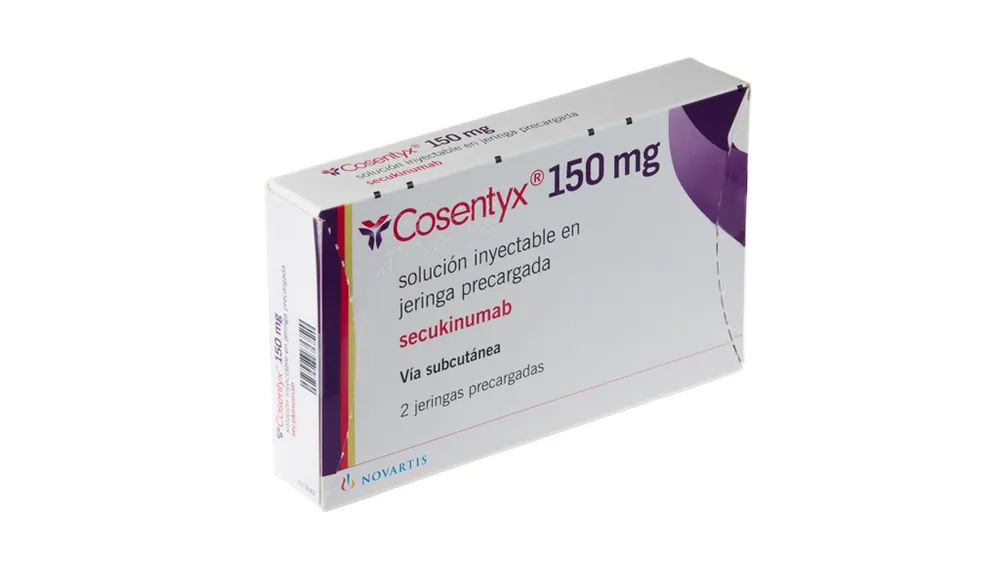
Table of Contents
Package leaflet: Information for the user
Introduction
Package leaflet: information for the user
Cosentyx 150mg solution for injection in pre-filled syringe
secukinumab
Read the entire leaflet carefully before you start using this medicine, because it contains important information for you.
- Keep this leaflet, as you may need to read it again.
- If you have any questions, ask your doctor, pharmacist or nurse.
- This medicine has been prescribed for you only, and you must not give it to other people, even if they have the same symptoms as you, because it may harm them.
- If you experience any adverse reactions, consult your doctor, pharmacist or nurse, even if they are adverse reactions not listed in this leaflet. See section 4.
Leaflet contents
- What Cosentyx is and what it is used for
- What you need to know before using Cosentyx
- How to use Cosentyx
- Possible side effects
- How to store Cosentyx
- Contents of the pack and other information
1. What Cosentyx is and what it is used for
Cosentyx contains the active substance secukinumab. Secukinumab is a monoclonal antibody belonging to a group of medicines known as “interleukin inhibitors”. It works by neutralizing the activity of a protein called IL-17A, which is present at elevated levels in conditions such as psoriasis, hidradenitis suppurativa, psoriatic arthritis, and axial spondyloarthritis.
Cosentyx is used to treat the following inflammatory diseases:
- Plaque psoriasis
- Hidradenitis suppurativa
- Psoriatic arthritis
- Axial spondyloarthritis, including ankylosing spondylitis (radiographic axial spondyloarthritis) and non-radiographic axial spondyloarthritis
- Juvenile idiopathic arthritis, including enthesitis-related arthritis and juvenile psoriatic arthritis
Plaque psoriasis
Cosentyx is used to treat a skin disorder known as “plaque psoriasis”, which causes inflammation of the skin. Cosentyx reduces inflammation and other symptoms of the disease. It is used in adults, adolescents, and children (from 6 years of age) who have moderate to severe plaque psoriasis.
Using Cosentyx for plaque psoriasis will benefit you by improving the appearance of your skin and reducing symptoms such as scaling, itching, and pain.
Hidradenitis suppurativa
Cosentyx is used to treat a condition known as hidradenitis suppurativa, sometimes also called inverse acne or Verneuil’s disease. This is a chronic, painful inflammatory skin disease. Symptoms may include painful nodules (lumps) and abscesses (boils) that may discharge pus. It commonly affects specific areas of the skin, such as under the breasts, armpits, inner thighs, groin, and buttocks. Scarring may also occur in affected areas.
Cosentyx can reduce the number of nodules and abscesses you have, as well as the pain often associated with the disease. If you have hidradenitis suppurativa, you will first be given other medications. If you do not respond adequately to these treatments, Cosentyx will be prescribed.
Cosentyx is used in adults with hidradenitis suppurativa and may be used alone or in combination with antibiotics.
Psoriatic arthritis
Cosentyx is used to treat a condition known as “psoriatic arthritis”. This is an inflammatory joint disease, often accompanied by psoriasis. If you have active psoriatic arthritis, you will first be given other medications. If you do not respond adequately to these treatments, you will be given Cosentyx to reduce the signs and symptoms of active psoriatic arthritis, improve physical function, and slow down damage to joint cartilage and bone.
Cosentyx is used in adults with active psoriatic arthritis and may be used alone or in combination with another medicine called methotrexate.
Using Cosentyx for psoriatic arthritis will benefit you by reducing the signs and symptoms of the disease, slowing down damage to joint cartilage and bones, and improving your ability to perform normal daily activities.
Axial spondyloarthritis, including ankylosing spondylitis (radiographic axial spondyloarthritis) and non-radiographic axial spondyloarthritis
Cosentyx is used to treat conditions known as “ankylosing spondylitis” and “non-radiographic axial spondyloarthritis”. These are inflammatory diseases that primarily affect the spine, causing inflammation of the spinal joints. If you have ankylosing spondylitis or non-radiographic axial spondyloarthritis, you will first be given other medications. If you do not respond adequately to these treatments, you will be given Cosentyx to reduce the signs and symptoms of the disease, reduce inflammation, and improve physical function.
Cosentyx is used in adults with active ankylosing spondylitis and active non-radiographic axial spondyloarthritis.
Using Cosentyx for ankylosing spondylitis and non-radiographic axial spondyloarthritis will benefit you by reducing the signs and symptoms of the disease and improving physical function.
Juvenile idiopathic arthritis, including enthesitis-related arthritis and juvenile psoriatic arthritis
Cosentyx is used in patients (from 6 years of age) to treat juvenile idiopathic arthritis in the categories known as “enthesitis-related arthritis” and “juvenile psoriatic arthritis”. These are inflammatory diseases affecting the joints and the sites where tendons attach to bone.
Using Cosentyx for enthesitis-related arthritis and juvenile psoriatic arthritis will benefit you (or your child) by reducing symptoms and improving physical function (or your child’s physical function).
2. What you need to know before using Cosentyx
Do not use Cosentyx:
- if you are allergic to secukinumab or to any of the other ingredients of this medicine (listed in section 6).
If you suspect you are allergic, consult your doctor before using Cosentyx.
- if you have an active infection that your doctor considers significant (e.g., active tuberculosis).
Warnings and precautions
Talk to your doctor, nurse, or pharmacist before using Cosentyx:
- if you have had an infection.
- if you suffer from repeated or prolonged infections.
- if you have ever had a latex allergy.
- if you have an inflammatory bowel disease called Crohn's disease.
- if you have a condition involving inflammation of the large intestine called ulcerative colitis.
- if you have recently been vaccinated or are scheduled to be vaccinated during treatment with Cosentyx.
- if you are receiving any other treatment for psoriasis, such as other immunosuppressants or ultraviolet (UV) phototherapy.
Tuberculosis
Inform your doctor if you currently have or have previously had tuberculosis, or if you know you have recently been in close contact with someone who has tuberculosis. Your doctor will examine you and may perform a tuberculosis test before you receive Cosentyx. If your doctor believes you are at risk of tuberculosis, you may be given medication to treat it. If symptoms of tuberculosis develop during treatment with Cosentyx (such as persistent cough, weight loss, apathy, or low-grade fever), inform your doctor immediately.
Hepatitis B
Inform your doctor if you currently have or have previously had hepatitis B infection. This medicine may cause reactivation of the infection. Before and during treatment with secukinumab, your doctor may monitor you for signs of infection. Inform your doctor if you experience any of the following symptoms: worsening fatigue, yellowing of the skin or whites of the eyes, dark urine, loss of appetite, nausea, and/or pain in the upper right part of the abdomen.
Inflammatory bowel disease (Crohn’s disease or ulcerative colitis)
Stop using Cosentyx and inform your doctor or seek immediate medical help if you experience abdominal cramps and pain, diarrhea, weight loss, blood in the stool, or any other signs of intestinal problems.
Monitor for infections and allergic reactions
Cosentyx may potentially cause serious adverse effects, including infections and allergic reactions. You should monitor for signs of these conditions while using Cosentyx.
Discontinue treatment with Cosentyx and contact your doctor or seek immediate medical assistance if you notice any signs indicating a possible serious infection or allergic reaction. These signs are listed in section 4, “Possible side effects.”
Children and adolescents
The use of Cosentyx is not recommended in children under 6 years of age with plaque psoriasis, as the medicine has not been studied in individuals of this age.
The use of Cosentyx is not recommended in children under 6 years of age with juvenile idiopathic arthritis (enthesitis-related arthritis and juvenile psoriatic arthritis).
The use of Cosentyx is not recommended in children and adolescents (under 18 years of age) for other indications, as the medicine has not been studied in individuals of this age.
Other medicines and Cosentyx
Inform your doctor or pharmacist:
- if you are taking, have recently taken, or might need to take any other medicines.
- if you have recently been vaccinated or are scheduled to be vaccinated. You should not receive certain types of vaccines (live vaccines) while using Cosentyx.
Pregnancy, breastfeeding, and fertility
- It is preferable to avoid using Cosentyx during pregnancy. The effect of this medicine in pregnant women is unknown. If you are a woman of childbearing potential, you are advised to avoid becoming pregnant and should use an appropriate contraceptive method while using Cosentyx and for at least 20 weeks after the last dose of Cosentyx. Consult your doctor if you are pregnant, think you might be pregnant, or plan to become pregnant.
- Consult your doctor if you are breastfeeding or plan to breastfeed. You and your doctor must decide whether you will breastfeed or use Cosentyx—you cannot do both. You should not breastfeed for at least 20 weeks after the last dose of Cosentyx.
Driving and using machines
It is unlikely that Cosentyx will affect your ability to drive or operate machinery.
3. How to use Cosentyx
Follow exactly the administration instructions for this medicine as given by your doctor. If in doubt, consult your doctor, pharmacist, or nurse again.
Cosentyx is administered by injection under the skin (i.e., subcutaneously). You and your doctor should decide whether you will self-inject Cosentyx.
It is important that you do not attempt to inject the medicine yourself until your doctor, nurse, or pharmacist has trained you to do so. A caregiver may also administer the Cosentyx injection after receiving appropriate training.
Detailed instructions on how to administer Cosentyx are provided in the section “Instructions for use of Cosentyx 150 mg in pre-filled syringe” at the end of this leaflet.
Instructions for use can also be found via the following QR code and website:
‘QR code to be included’
www.cosentyx.eu
How much Cosentyx should be administered and for how long
Your doctor will decide how much Cosentyx you need and for how long.
Plaque psoriasis
Adults
- The recommended dose is 300 mg by subcutaneous injection.
- A 300 mg dose is administered using two 150 mg injections.
After the first dose, you will receive weekly injections at weeks 1, 2, 3, and 4, followed by monthly injections. Depending on your response, your doctor may recommend additional dose adjustments. At each visit, you will receive a 300 mg dose given as two 150 mg injections.
Children from 6 years of age
- The recommended dose is based on body weight as follows:
- Weight below 25 kg: 75 mg by subcutaneous injection.
- Weight between 25 kg and below 50 kg: 75 mg by subcutaneous injection.
- Weight 50 kg and above: 150 mg by subcutaneous injection.
Your doctor may increase the dose to 300 mg.
- Each 150 mg dose is administered as a single 150 mg injection. Other dosage forms/concentrations may be available for administration of 75 mg and 300 mg doses.
After the first dose, you will receive weekly injections at weeks 1, 2, 3, and 4, followed by monthly injections.
Hidradenitis suppurativa
- The recommended dose is 300 mg by subcutaneous injection.
- Each 300 mg dose is administered as two 150 mg injections.
After the first dose, you will receive weekly injections at weeks 1, 2, 3, and 4, followed by monthly injections. Depending on your response, your doctor may recommend additional dose adjustments.
Psoriatic arthritis
If you have psoriatic arthritis and also moderate to severe plaque psoriasis, your doctor may adjust the recommended dose as needed.
For patients who did not respond well to medicines known as tumour necrosis factor (TNF) blockers:
- The recommended dose is 300 mg by subcutaneous injection.
- Each 300 mg dose is administered using two 150 mg injections.
After the first dose, you will receive weekly injections at weeks 1, 2, 3, and 4, followed by monthly injections. At each visit, you will receive a 300 mg dose given as two 150 mg injections.
For all other patients with psoriatic arthritis:
- The recommended dose is 150 mg by subcutaneous injection.
After the first dose, you will receive weekly injections at weeks 1, 2, 3, and 4, followed by monthly injections.
Depending on your response, your doctor may increase your dose to 300 mg.
Ankylosing spondylitis (radiographic axial spondyloarthritis)
- The recommended dose is 150 mg by subcutaneous injection.
After the first dose, you will receive weekly injections at weeks 1, 2, 3, and 4, followed by monthly injections.
Depending on your response, your doctor may increase your dose to 300 mg. Each 300 mg dose is administered using two 150 mg injections.
Non-radiographic axial spondyloarthritis
- The recommended dose is 150 mg by subcutaneous injection.
After the first dose, you will receive weekly injections at weeks 1, 2, 3, and 4, followed by monthly injections.
Juvenile idiopathic arthritis (enthesitis-related arthritis and juvenile psoriatic arthritis)
-
The recommended dose is based on body weight as follows:
- Weight below 50 kg: 75 mg by subcutaneous injection.
- Weight 50 kg and above: 150 mg by subcutaneous injection.
-
Each 150 mg dose is administered as a single 150 mg injection. Other dosage forms/concentrations may be available for administration of the 75 mg dose.
After the first dose, you (or your child) will receive weekly injections at weeks 1, 2, 3, and 4, followed by monthly injections.
Cosentyx is a long-term treatment. Your doctor will periodically monitor your disease status to assess whether the treatment is achieving the desired effect.
If you use more Cosentyx than you should
If you receive more Cosentyx than you should, or if the dose was administered earlier than scheduled, inform your doctor.
If you forget to use Cosentyx
If you have missed a dose of Cosentyx, administer the next dose as soon as you remember. Then speak with your doctor to determine when you should receive the following dose.
If you stop using Cosentyx
It is not dangerous to stop using Cosentyx. However, if you do stop, symptoms of psoriasis, psoriatic arthritis, or axial spondyloarthritis may return.
If you have any further questions about the use of this medicine, ask your doctor, pharmacist, or nurse.
4. Possible adverse effects
Like all medicines, this medicine can cause adverse effects, although not everyone will experience them.
Serious adverse effects
Stop treatment with Cosentyx and contact your doctor or seek immediate medical help if you notice any of the following serious adverse effects:
Possible serious infection – signs may include:
- fever, flu-like symptoms, night sweats
- feeling tired or short of breath, persistent cough
- skin that is warm, red, and painful to touch, or a painful rash with blisters
- burning sensation when urinating
Severe allergic reaction – signs may include:
- difficulty breathing or swallowing
- low blood pressure, which may cause dizziness or mild lightheadedness
- swelling of the face, lips, tongue, or throat
- severe itching (pruritus) of the skin accompanied by rash or blisters
Your doctor will decide whether and when treatment should be restarted.
Other adverse effects
Most of the following adverse effects are mild or moderate. If any of them become severe, inform your doctor, pharmacist, or nurse.
Very common (may affect more than 1 in 10 people):
- upper respiratory tract infections with symptoms such as sore throat and nasal congestion (nasopharyngitis, rhinitis)
Common (may affect up to 1 in 10 people):
- mouth ulcers (oral herpes)
- diarrhea
- runny nose (rhinorrhea)
- headache
- nausea
- fatigue
- itching, redness, and dryness of the skin (eczema)
Uncommon (may affect up to 1 in 100 people):
- mouth sores (oral candidiasis)
- signs of low white blood cell count, such as fever, sore throat, or mouth ulcers due to infections (neutropenia)
- outer ear infection (otitis externa)
- eye discharge with itching, redness, and swelling (conjunctivitis)
- itchy rash (urticaria)
- lower respiratory tract infections
- abdominal cramps, stomach pain, diarrhea, weight loss, or blood in the stool (signs of intestinal problems)
- small itchy blisters on the palms of the hands, soles of the feet, and edges of fingers and toes (dyshidrotic eczema)
- athlete's foot (tinea pedis)
Rare (may affect up to 1 in 1,000 people):
- severe allergic reaction with shock (anaphylactic reaction)
- red, peeling skin over a large area of the body, which may be itchy or painful (exfoliative dermatitis)
- inflammation of small blood vessels, which may cause a skin rash with small red or purple spots (vasculitis)
- swelling of the neck, face, mouth, or throat that may lead to difficulty swallowing or breathing (angioedema)
Frequency not known (cannot be estimated from available data):
- fungal infections of the skin and mucous membranes (including esophageal candidiasis)
- painful swelling and ulceration of the skin (pyoderma gangrenosum)
Reporting of adverse effects
If you experience any adverse effect, talk to your doctor, pharmacist, or nurse, even if it is a possible adverse effect not listed in this leaflet. You can also report them directly through the national reporting system included in Appendix V. By reporting adverse effects, you can help provide more information on the safety of this medicine.
5. Storage of Cosentyx
Keep this medicine out of the sight and reach of children.
Do not use this medicine:
- after the expiry date stated on the carton or on the label of the syringe following “EXP”.
- if the solution contains clearly visible particles, is cloudy, or has a distinctly brown colour.
Store the pre-filled syringe in its original carton to protect it from light. Store in a refrigerator between 2 °C and 8 °C. Do not freeze. Do not shake.
If necessary, Cosentyx may be kept outside the refrigerator for a single period of up to 4 days at room temperature not exceeding 30 °C.
This medicine is for single use only.
Medicines must not be disposed of via wastewater. Ask your pharmacist how to dispose of medicines you no longer need. These measures help protect the environment.
6. Contents of the pack and other information
Composition of Cosentyx
- The active substance is secukinumab. Each pre-filled syringe contains 150 mg of secukinumab.
- The other components are trehalose dihydrate, histidine, histidine hydrochloride monohydrate, methionine, polysorbate 80, and water for injections.
Appearance of Cosentyx and contents of the pack
Cosentyx solution for injection is a clear liquid. Its colour ranges from colourless to slightly yellow.
Cosentyx 150 mg solution for injection in pre-filled syringe is available in packs containing 1 or 2 pre-filled syringe(s) and in multipacks containing 6 (3 packs of 2) pre-filled syringes.
Not all pack sizes may be marketed.
Marketing Authorization Holder
Novartis Europharm Limited
Vista Building
Elm Park, Merrion Road
Dublin 4
Ireland
Manufacturer
Sandoz GmbH
Biochemiestrasse 10
6336 Langkampfen
Austria
Novartis Pharmaceutical Manufacturing GmbH
Biochemiestrasse 10
6336 Langkampfen
Austria
Novartis Pharma GmbH
Sophie-Germain-Strasse 10
90443 Nuremberg
Germany
For further information about this medicinal product, please contact the local representative of the Marketing Authorization Holder:
Belgium/Belgium/Belgium Novartis Pharma N.V. Tel/Tel: +32 2 246 16 11 | Lithuania SIA Novartis Baltics Lithuania Branch Tel: +370 5 269 16 50 |
| Luxembourg/Luxembourg Novartis Pharma N.V. Tel/Tel: +32 2 246 16 11 |
Czech Republic Novartis s.r.o. Tel: +420 225 775 111 | Hungary Novartis Hungária Kft. Tel.: +36 1 457 65 00 |
Denmark Novartis Healthcare A/S Tlf.: +45 39 16 84 00 | Malta Novartis Pharma Services Inc. Tel: +356 2122 2872 |
Germany Novartis Pharma GmbH Tel: +49 911 273 0 | Netherlands Novartis Pharma B.V. Tel: +31 88 04 52 111 |
Estonia SIA Novartis Baltics Estonia Branch Tel: +372 66 30 810 | Norway Novartis Norge AS Tlf: +47 23 05 20 00 |
Greece Novartis (Hellas) S.A. Tel: +30 210 281 17 12 | Austria Novartis Pharma GmbH Tel: +43 1 86 6570 |
Spain Novartis Farmacéutica, S.A. Tel: +34 93 306 42 00 | Poland Novartis Poland Sp. z o.o. Tel.: +48 22 375 4888 |
France Novartis Pharma S.A.S. Tel: +33 1 55 47 66 00 | Portugal Novartis Farma ‑ Pharmaceutical Products, S.A. Tel: +351 21 000 8600 |
Croatia Novartis Hrvatska d.o.o. Tel. +385 1 6274 220 | Romania Novartis Pharma Services Romania SRL Tel: +40 21 31299 01 |
Ireland Novartis Ireland Limited Tel: +353 1 260 12 55 | Slovenia Novartis Pharma Services Inc. Tel: +386 1 300 75 50 |
Iceland Vistor hf. Tel: +354 535 7000 | Slovakia Novartis Slovakia s.r.o. Tel: +421 2 5542 5439 |
Italy Novartis Farma S.p.A. Tel: +39 02 96 54 1 | Finland Novartis Finland Oy Tel: +358 (0)10 6133 200 |
Cyprus Novartis Pharma Services Inc. Tel: +357 22 690 690 | Sweden Novartis Sverige AB Tel: +46 8 732 32 00 |
Latvia SIA Novartis Baltics Tel: +371 67 887 070 |
Date of the most recent review of this leaflet:
Other sources of information
Detailed information on this medicine is available on the European Medicines Agency website: http://www.ema.europa.eu
Instructions for use of Cosentyx 150 mg in pre-filled syringe
Read ALL instructions before injecting the medicine. It is important that you do not attempt to inject the medicine yourself or administer it to someone under your care until a doctor, nurse, or pharmacist has shown you how to do so. The pack contains the Cosentyx 150 mg pre-filled syringe(s) inside a plastic blister.
Your Cosentyx 150 mg pre-filled syringe
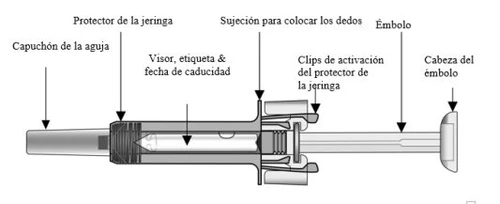
Once the medicine has been injected, the needle cover shield will be activated. This is designed to protect healthcare professionals, patients who self-inject the medicine prescribed by their doctor, and individuals assisting patients with self-injection, from accidental needlestick injuries.
What else you need for the injection:
|
|

Important safety information
Warning: Keep the syringe out of sight and reach of children.
- The needle cap of the syringe may contain dried rubber (latex), which should not be touched by individuals sensitive to it.
- Do not open the carton until you are ready to use this medicine.
- Do not use this medicine if the carton seal or blister pack is broken, as it may not be safe to use.
- Do not use the syringe if it has been dropped on a hard surface or if it has been dropped after removing the needle cap.
- Never leave the syringe where others could touch it.
- Do not shake the syringe.
- Take great care not to touch the activation clips before use. If you do, the needle safety guard will be prematurely activated.
- Do not remove the needle cap until immediately before administering the injection.
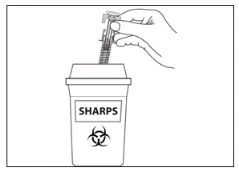
- The syringe cannot be reused. After use, dispose of the syringe in a sharps disposal container.
Storage of Cosentyx 150 mg in pre-filled syringe
- Store this medicine sealed in its carton to protect it from light. Store in a refrigerator between 2°C and 8°C. DO NOT FREEZE.
- Remember to remove the syringe from the refrigerator to allow it to reach room temperature before preparing the injection (15–30 minutes).
- Do not use the syringe after the expiry date stated on the carton or on the syringe label after “CAD”/”EXP”. If expired, return the entire package to the pharmacy.
Injection sites
| The injection site is where you will administer the injection.
|
| If the injection is administered by the patient's caregiver, the upper arm may also be used. |
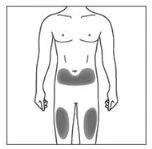
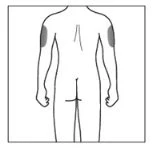
Preparation of Cosentyx 150 mg in prefilled syringe ready for use
Note: For a 150 mg dose, prepare 1 prefilled syringe and inject the entire content. For a 300 mg dose, prepare 2 prefilled syringes and inject the content of both.
- Remove the box containing the syringe from the refrigerator and leave it unopened for 15–30 minutes to allow it to reach room temperature.
- When ready to use the syringe, wash your hands thoroughly with water and soap.
- Clean the injection site thoroughly with an alcohol wipe.
- Remove the syringe from the box and take it out of the blister pack by holding the protective body of the syringe.
- Inspect the syringe. The liquid should be clear and may vary in color from colorless to slightly yellowish. Small air bubbles may be present, which is normal. DO NOT USE if the liquid contains particles, is cloudy, or has a clearly brown color. DO NOT USE if the syringe is damaged. In all these cases, return the complete package to the pharmacy.
How to use the Cosentyx 150 mg prefilled syringe
| Carefully remove the needle cap from the syringe by holding the syringe body. Discard it. You may see a drop at the tip of the needle. This is normal. |
| Gently pinch the skin at the injection site and insert the needle as shown in the figure. Insert the needle completely to ensure the full dose of medication is delivered. Hold the syringe as shown. Slowly push the plunger all the way down until the plunger head clicks into the activation clips of the safety shield. Keep holding the plunger while maintaining the syringe in position for 5 seconds. |
| Without releasing the plunger, carefully withdraw the needle from the injection site. |
| Slowly release the plunger and allow the safety shield to automatically cover the needle. There may be a small amount of blood at the injection site. You may press a cotton ball or gauze pad over the injection site for 10 seconds. Do not rub the injection site. You may apply a bandage if needed. |
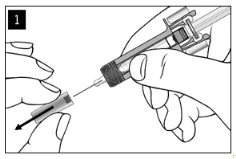
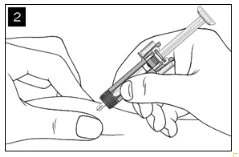
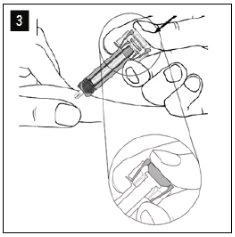
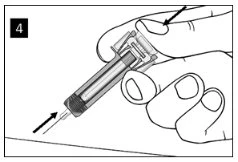
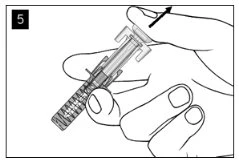
Removal Instructions
| Dispose of the used syringe in a sharps disposal container (a closed, puncture-resistant container). For safety and health reasons (for you and others), used needles and syringes must never be reused. |