Corotrope 1 mg/ml solution for injection
Spain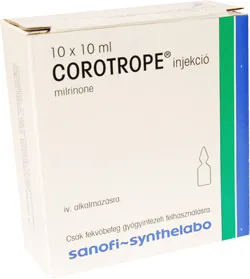
Table of Contents
Patient Information Leaflet
Introduction
Patient Information Leaflet
Corotrope 1 mg/ml injection solution
Milrinone lactate
Read the entire leaflet carefully before you start using this medicine, because it contains important information for you.
- Keep this leaflet as you may need to read it again.
- If you have any questions, ask your doctor or pharmacist.
- This medicine has been prescribed for you only, and you should not give it to other people even if they have the same symptoms as you, because it could harm them.
- If you experience any adverse reactions, consult your doctor or pharmacist, even if they are adverse reactions not listed in this leaflet. See section 4.
Leaflet Contents
- What Corotrope is and what it is used for
- What you need to know before using Corotrope
- How to use Corotrope
- Possible side effects
- How to store Corotrope
- Contents of the pack and other information
1. What Corotrope is and what it is used for
Corotrope belongs to a group of medicines known as cardiac stimulants (used to increase the force with which the heart contracts).
Corotrope is used in the short-term treatment of acute congestive heart failure (the heart cannot pump enough blood to the body).
Corotrope may be used in children for:
- short-term treatment (up to 35 hours) of severe congestive heart failure (the heart cannot pump enough blood to the rest of the body) when other medicines have not worked;
- short-term treatment (up to 35 hours) of acute heart failure after heart surgery, that is, when the heart has difficulty pumping blood to the entire body.
2. What you need to know before using Corotrope
Do not use Corotrope
- if you are allergic to the active substance or to any of the other components of this medicine (listed in section 6).
- if your total blood volume is reduced (hypovolemia)
Warnings and precautions
Consult your doctor before starting to use Corotrope:
- if you are pregnant or breastfeeding (see section “Pregnancy and breastfeeding”).
- if you have had a heart attack.
- if you have an abnormal heart rhythm.
- if you have serious heart problems.
- if you have low blood pressure (hypotension).
Inform your doctor if you suffer from severe kidney disease.
When you are administered Corotrope, your doctor will continuously monitor your blood pressure, heart rate, general clinical condition, electrocardiogram, fluid levels in your body, and/or kidney function. Blood tests may also be performed to monitor your platelet levels (blood components that contribute to blood clotting) and hemoglobin levels (a component of red blood cells).
Children
The following information should be considered in addition to the warnings and precautions described above for adults.
Before administering Corotrope infusion, your doctor will monitor several parameters such as heart rate and blood pressure. Blood tests will also be performed.
Infusion will not be initiated if heart rate and blood pressure are not stable.
Please inform your doctor if:
- your child has kidney problems
- your child is premature or has a low birth weight
- your child has a heart condition called patent ductus arteriosus: a connection between two major blood vessels (aorta and pulmonary artery) that persists when it should have closed.
In these cases, your doctor will decide whether your child should be treated with Corotrope.
Use of Corotrope with other medicines
Inform your doctor or pharmacist if you are taking, have recently taken, or might need to take any other medicines.
When furosemide (a diuretic: a medicine used to eliminate fluid) is administered intravenously together with milrinone, an immediate chemical interaction occurs, forming a precipitate. Therefore, furosemide must not be administered intravenously together with milrinone. Milrinone lactate must not be diluted in intravenous infusion solutions containing sodium bicarbonate.
Pregnancy and breastfeeding
If you are pregnant or breastfeeding, think you may be pregnant, or plan to become pregnant, consult your doctor or pharmacist before using this medicine.
There are no adequate, well-controlled studies in pregnant or breastfeeding women. Milrinone lactate may be used during these periods at the physician's discretion and only when the potential benefit justifies the possible risks to the fetus. The conditions for use and the benefit of milrinone in acute-phase myocardial infarction in children have not yet been established; therefore, milrinone is not recommended in these cases.
Corotrope contains glucose
This medicine contains glucose. Patients with diabetes mellitus should be aware that this medicine contains 0.47 g of glucose per 10 ml vial.
Corotrope contains sodium
This medicine contains less than 1 mmol of sodium (23 mg) per ml of injectable solution; therefore, it is essentially “sodium-free”.
3. How to use Corotrope
Follow exactly the administration instructions for this medicine as given by your doctor. If in doubt, consult your doctor or pharmacist.
Treatment with Corotrope will only be carried out in hospitalized patients in the intensive care unit and under continuous hemodynamic monitoring. The medicine will be administered by a healthcare professional.
It may be administered directly or diluted in 5% sterile glucose solution, 0.45% sodium chloride, or 0.9% sodium chloride. The infusion (method of administering the medicine) will be delivered via a constant-flow pump connected to a needle or catheter placed in as large a vein as possible. Before administration, the solution should be inspected under light and must not be used if discoloration is observed.
The diluted solution should be used within 24 hours of preparation.
Treatment with milrinone lactate should begin with a loading dose, followed by continuous infusion (maintenance dose), according to the following guidelines:
Loading dose: 50 micrograms/kg, administered slowly over ten minutes.
Maintenance dose: 0.375 to 0.75 micrograms/kg/min. The infusion rate should be adjusted according to the patient's clinical and hemodynamic response.
Do not exceed the maximum dose of 1.13 mg/kg/day.
Dose adjustments in patients with renal impairment: Data obtained in patients with severe renal impairment but without heart failure have shown that renal impairment significantly increases the terminal elimination half-life of milrinone; therefore, dose reduction may be necessary.
The duration of treatment will depend on the patient's response: the usual period is 48 to 72 hours.
If you feel that the effect of Corotrope is too strong or too weak, inform your doctor or pharmacist.
Use in children
- Your doctor should administer an initial dose of 50–75 micrograms per kilogram of body weight to your child, given over a period of 30 to 60 minutes.
- Afterwards, a dose of 0.25–0.75 micrograms per kilogram of body weight per minute will be administered, depending on your child's response to treatment and the occurrence of adverse effects. Corotrope may be administered for up to 35 hours.
During the infusion, your child will be continuously monitored: your doctor will check several parameters such as heart rate and blood pressure, and blood tests will be performed to assess treatment response and the occurrence of adverse effects.
Use in elderly patients
If the patient does not have renal impairment, no dose adjustment is necessary.
If you use more Corotrope than you should
High doses of milrinone may cause hypotension (abnormally low blood pressure) and cardiac arrhythmias (changes in heart rhythm). In case of overdose, administration of Corotrope will be reduced or temporarily discontinued. There is no known antidote, and general supportive measures will be taken as needed to stabilize the patient.
In case of overdose or accidental ingestion, contact the Toxicology Information Service at telephone number 91 562 04 20, indicating the medicine and the amount taken.
If you forget to use Corotrope
Do not use a double dose to make up for missed doses.
If you have any further questions about the use of this medicine, ask your doctor or pharmacist.
4. Possible adverse effects
Like all medicines, this medicine can cause adverse effects, although not everyone will experience them.
The adverse effects observed, according to their frequency of occurrence: very common (may affect more than 1 in 10 patients); common (may affect up to 1 in 10 patients); uncommon (may affect up to 1 in 100 patients); rare (may affect up to 1 in 1,000 patients); very rare (may affect up to 1 in 10,000 patients); frequency not known (cannot be estimated from available data), have been:
Cardiovascular adverse effects:
-
Common:
-
Ventricular ectopic activity (heartbeats originating from an abnormal site).
-
Sustained or non-sustained ventricular tachycardia (abnormally rapid heartbeat).
-
Supraventricular arrhythmia (change in heart rhythm).
-
Hypotension (abnormally low blood pressure).
-
Uncommon:
-
Ventricular fibrillation (very rapid, uncontrolled irregular heartbeat).
-
Angina/chest pain.
-
Very rare: “Torsades de pointes” (a form of ventricular tachycardia: abnormally rapid heartbeat).
The occurrence of ventricular and supraventricular arrhythmias has not been related to dose or plasma (blood) levels of milrinone. Severe arrhythmias that may be life-threatening are often associated with certain factors such as: history of arrhythmias, metabolic disturbances (e.g. hypokalaemia: low potassium levels), abnormal digoxin levels (a medicine indicated for heart problems), and catheter insertion.
Haematological adverse effects:
- Uncommon: Thrombocytopenia (reduced number of platelets).
General and administration site adverse effects:
- Frequency not known: Reactions at the administration site.
- Very rare: Anaphylactic shock (a severe allergic reaction that may be life-threatening).
Respiratory adverse effects:
- Very rare: Bronchospasm (contraction of bronchial muscles).
Hepatic adverse effects:
- Uncommon: Alterations in liver function tests.
Nervous system adverse effects:
- Common: Headache.
- Uncommon: Tremor.
Skin adverse effects:
- Very rare: Skin reactions such as rash.
Renal and urinary adverse effects:
- Frequency not known: Renal failure, as a consequence of concomitant hypotension.
Metabolic adverse effects:
- Uncommon: Hypokalaemia (decrease in potassium levels).
Other adverse effects in children
In addition to the adverse effects observed in adults, the following have been reported in children:
Frequency not known:
- Bleeding in fluid-filled areas (ventricles) surrounding the brain (intraventricular haemorrhage).
- A heart problem known as persistent ductus arteriosus: a connection between two major blood vessels (aorta and pulmonary artery) that persists when it should have closed. This may cause excess fluid in the lungs, bleeding, intestinal damage or necrosis of part of the intestine, which could lead to death.
In addition, compared to adults, a decrease in the number of blood platelets appears to occur more frequently in children, and the risk of this adverse effect increases with the duration of Corotrope infusion. Cardiac rhythm problems appear to occur less frequently in children than in adults.
Reporting of adverse effects:
If you experience any type of adverse effect, consult your doctor or pharmacist, even if it is a possible adverse effect not listed in this leaflet. You may also report them directly via the Spanish Pharmacovigilance System for Human Medicines: https://www.notificaram.es. By reporting adverse effects, you can help provide more information on the safety of this medicine.
5. Storage of Corotrope
Keep this medicine out of the sight and reach of children.
Store below 25°C.
Do not use this medicine after the expiry date stated on the packaging and on the ampoules after EXP. The expiry date refers to the last day of the month indicated.
Medicines must not be disposed of via wastewater or household waste. Dispose of empty containers and unused medicines at a SIGRE collection point at your pharmacy. If you are unsure, ask your pharmacist how to properly dispose of containers and unused medicines. This will help protect the environment.
6. Contents of the pack and other information
Composition of Corotrope
- The active substance is milrinone lactate. Each millilitre of solution contains 1 mg of milrinone.
- The other components (excipients) are: lactic acid, anhydrous glucose, and water for injections.
Nature of the product and pack contents
The injectable solution is a clear, colourless to pale yellow liquid.
Each pack contains 10 colourless glass ampoules.
Standard pack with 10 ampoules of 10 ml.
Marketing Authorization Holder and Manufacturer
Marketing Authorization Holder:
sanofi-aventis, S.A.
C/ Roselló i Porcel, 21
08016 Barcelona
Spain
Manufacturer:
Delpharm Dijon
6, Boulevard L’Europe
F-21800 Quétigny (France)
Date of the most recent review of this summary: October 2022
Detailed information about this medicine is available on the website of the Spanish Agency of Medicines and Health Products (AEMPS) http://www.aemps.gob.es/