Cordiplast 10 mg/24 h transdermal patches
SpainTable of Contents
Package leaflet: Information for the user
Introduction
Package leaflet: Information for the patient
Cordiplast 10mg/24 h transdermal patches
Nitroglycerin
Read the entire leaflet carefully before you start using this medicine, because it contains important information for you.
- Keep this leaflet, as you may need to read it again.
- If you have any questions, consult your doctor or pharmacist.
- This medicine has been prescribed for you only, and you should not give it to others, even if they have the same symptoms as you, because it could harm them.
- If you experience any adverse effects, consult your doctor or pharmacist, even if they are adverse effects not listed in this leaflet. See section 4.
Leaflet contents:
- What Cordiplast is and what it is used for
- What you need to know before using Cordiplast
- How to use Cordiplast
- Possible side effects
- How to store Cordiplast
- Contents of the pack and other information
1. What Cordiplast is and what it is used for
Preventive treatment of angina pectoris, used either as monotherapy or in combination with other antianginal treatments.
Cordiplast is a transdermal patch containing nitroglycerin, intended for the prevention of angina pectoris, but not for the treatment of acute attacks.
Nitroglycerin dilates blood vessels and improves heart performance.
When applied to the skin, Cordiplast releases nitroglycerin at a constant rate throughout the recommended application period.
2. What you need to know before using Cordiplast
Do not use Cordiplast:
- if you are allergic to nitroglycerin, nitrates, or any of the other ingredients of this medicine listed in section 6,
- if you have diseases associated with increased intracranial pressure,
- if you have heart failure due to valvular obstruction (narrowing of the heart valves) or pericarditis compressing the heart,
- if you have obstructive hypertrophic cardiomyopathy (thickening of the heart muscle that impairs circulation),
- in cases of severe hypotension (systolic blood pressure below 90 mm Hg),
- in cases of acute circulatory failure associated with marked hypotension (shock, collapse),
- in cases of severe hypovolemia (decreased total blood volume),
- in cases of severe anemia,
- in cases of cardiogenic shock (circulatory collapse of cardiac origin), unless adequate measures maintain diastolic filling pressure,
- in cases of cardiac tamponade (acute compression of the heart),
- if you are taking medicines containing sildenafil, tadalafil, or vardenafil (medicines used to treat erectile dysfunction or pulmonary arterial hypertension).
- do not use Cordiplast simultaneously with medicines containing riociguat (a medicine used to treat pulmonary arterial hypertension and chronic thromboembolic pulmonary hypertension).
Warnings and precautions:
Consult your doctor or pharmacist before starting to use Cordiplast:
- if you have reduced cardiac filling pressure, e.g., acute myocardial infarction or left ventricular failure. Systolic blood pressure should not be allowed to fall below 90 mm Hg,
- if you suffer from orthostatic hypotension (drop in blood pressure upon standing),
- if you have anemia, consult your doctor, as Cordiplast may not be an appropriate treatment for you,
- if you have or have had any lung or heart disease. Patients with angina pectoris, myocardial infarction, or cerebral ischemia may experience disturbances in small airways,
- in patients with angina pectoris caused by thickening of the heart muscle (hypertrophic cardiomyopathy), treatment with Cordiplast may worsen the condition,
- there is a possibility of increased frequency of angina during the patch-free interval. Your doctor may consider additional antianginal therapy alongside Cordiplast,
- loss of efficacy may occur with continuous treatment with other nitrate-containing medicines.
- methemoglobinemia (an increase in methemoglobin, the oxidized form of hemoglobin, the blood pigment) may occur.
Cordiplast should only be used under strict clinical supervision and/or hemodynamic monitoring in patients with acute myocardial infarction or congestive heart failure.
Treatment with Cordiplast must not be stopped abruptly. Your doctor will gradually reduce the dose and increase the dosing intervals. If starting another treatment for angina pectoris, you may need to use both medicines for a period of time.
Cordiplast does not contain aluminum or other metals and therefore it is not necessary to remove the patch before magnetic resonance imaging or cardioversion procedures, as there is no risk of skin burns due to the presence of the patch.
Children and adolescents
The safety and efficacy in children and adolescents (under 18 years of age) have not been established.
Use of Cordiplast with other medicines
Inform your doctor or pharmacist if you are taking, have recently taken, or might need to take any other medicines.
Using nitrates together with other vasodilating agents, such as antihypertensive medicines, phosphodiesterase-5 (PDE5) inhibitors, calcium antagonists, ACE inhibitors, monoamine oxidase inhibitors, beta-blockers, diuretics, certain antidepressants, and major tranquilizers, may cause excessive lowering of blood pressure.
Patients receiving Cordiplast must never (even after removing the patch) take medicines that are phosphodiesterase-5 (PDE5) inhibitors, such as those containing sildenafil, vardenafil, or tadalafil (medicines used to treat erectile dysfunction and pulmonary arterial hypertension), as this may lead to life-threatening cardiovascular complications. For further information, consult your doctor or pharmacist.
Patients who have recently taken phosphodiesterase inhibitors (e.g., sildenafil, vardenafil, tadalafil) must not be treated with nitroglycerin solutions within the following 24 hours (48 hours for tadalafil).
Non-steroidal anti-inflammatory drugs (NSAIDs), except acetylsalicylic acid (aspirin), may reduce the effect of Cordiplast.
Concomitant administration with acetylsalicylic acid (aspirin) may enhance the effect of Cordiplast.
Using Cordiplast together with riociguat (a medicine used to treat pulmonary arterial hypertension and chronic thromboembolic pulmonary hypertension) may cause hypotension.
Using Cordiplast together with dihydroergotamine (a medicine used to treat migraine) may increase blood levels of dihydroergotamine. This is particularly important in patients with coronary artery disease, as dihydroergotamine counteracts the effect of Cordiplast, causing coronary vasoconstriction.
Concomitant administration of Cordiplast with amifostine (a drug used to reduce unwanted side effects of certain chemotherapy and radiotherapy) and acetylsalicylic acid may cause excessive lowering of blood pressure.
Concomitant use with sapropterin, a cofactor of an enzyme called nitric oxide synthase, may increase the hypotensive effect of Cordiplast.
Due to the development of tolerance to nitroglycerin, the effect of sublingual nitroglycerin may be partially reduced.
Use of Cordiplast with food, drinks, and alcohol
Alcohol should be avoided during treatment with Cordiplast, as it may increase the hypotensive (blood pressure-lowering) and vasodilatory effects of Cordiplast.
Pregnancy, breastfeeding, and fertility
If you are pregnant or breastfeeding, think you may be pregnant, or are planning to become pregnant, consult your doctor or pharmacist before using this medicine.
Pregnancy
If you are pregnant or suspect you may be pregnant, inform your doctor. Cordiplast should be used with caution during pregnancy, especially during the first three months.
Breastfeeding
If you are breastfeeding, inform your doctor, as they must decide whether to discontinue breastfeeding or discontinue treatment, taking into account the benefit of breastfeeding for the child and the benefit of treatment for the mother.
Fertility
There are no data available on the effect of nitroglycerin on fertility in humans.
Driving and use of machines
Cordiplast may reduce reaction ability and, rarely, may cause orthostatic hypotension (drop in blood pressure upon standing), dizziness, or (very rarely) syncope following overdose. Patients experiencing any of these effects should avoid driving vehicles or operating machinery.
3. How to use Cordiplast
Follow exactly the administration instructions for Cordiplast given by your doctor. If in doubt, consult your doctor or pharmacist again.
Your doctor will determine the appropriate doses, both at the beginning of treatment and for maintenance, and will decide the frequency and duration of treatment. Normally, treatment starts with one patch per day. If necessary, this may be increased to two patches applied simultaneously, but only on medical advice. The maximum recommended daily dose is 20 mg.
The patch should be applied to the skin daily for 12 to 16 hours, thus ensuring a nitrate-free interval of 8 to ̄12 hours, respectively.
| For the application of Cordiplast, any area of skin that is not too thick and poorly irrigated may be suitable, provided it is intact, clean, relatively free of wrinkles, and hairless. The most recommended areas for patch application are the front and lateral parts of the chest. However, it may also be applied on the forearm, thigh, abdomen, and shoulder (Figure 1). To avoid any skin irritation, Cordiplast should be applied to different areas each day, taking care not to reuse the same area until at least 2–3 days have passed. Cordiplast should not be applied to distal parts of the extremities, skin folds, large scars, or burned or irritated areas. Cordiplast does not adhere well to wet or dirty skin; therefore, it is important to clean and dry the skin before application. Do not use skin care products prior to patch placement. Cordiplast maintains its function during bathing, showering, or physical exercise. Each patch is individually packaged and should not be removed from its pouch until ready for use. The sealed pouch can be easily opened by tearing along a slit at the edge (Figure 2). Remove the patch from the pouch and hold it with both hands, the protective liner facing up. Then, pull down one half of the patch to open the S-shaped cut (Figure 3). Next, apply the patch to the prepared area and remove the other half of the protective liner (Figure 4). Press the patch firmly with your hand to ensure the entire adhesive surface adheres securely to the skin (Figure 5). After application, wash your hands thoroughly. |
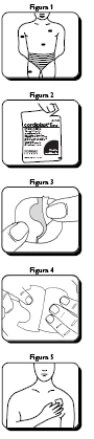
The Cordiplast patches must not be cut.
Use in elderly patients: no dose adjustment is required in elderly patients.
Use in children: Cordiplast is not recommended for use in children due to lack of data.
If you use more Cordiplast than you should
Symptoms of overdose are unlikely due to the type of formulation of the Cordiplast transdermal patch. If symptoms do occur, they can be rapidly eliminated by removing the patch.
Symptoms include: decreased blood pressure (less than or equal to 90 mm Hg), pallor, sweating, weak pulse, increased heart rate (tachycardia), dizziness upon standing, headache (cephalalgia), collapse, syncope with postural dizziness, feeling of weakness (asthenia), nausea, vomiting, and diarrhea.
Cases of methemoglobinemia (accumulation in the blood of methemoglobin, a form of hemoglobin that cannot carry oxygen) have been reported following accidental overdoses, which may cause cyanosis (purple discoloration of the skin and mucous membranes), rapid breathing, anxiety, loss of consciousness, and infarction, possibly requiring immediate resuscitation. Although unlikely with the transdermal delivery method, high doses may lead to increased intracranial pressure, resulting in cerebral symptoms.
General procedure:
Discontinue administration of the medicinal product by removing the patch.
General procedure for nitrate-related hypotension events:
Place the patient in a horizontal position with legs elevated, or, if necessary, apply a compression bandage to the patient's legs.
Administer oxygen.
Plasma volume expanders (intravenous fluids).
Specific treatment for shock (admit patient to an intensive care unit).
Special procedures:
Increase blood pressure if it is very low.
Additional administration of a vasoconstrictor, e.g., norepinephrine hydrochloride.
Treatment of methemoglobinemia:
Reduction therapy of choice with vitamin C, methylene blue, or toluidine blue.
Administration of oxygen (if necessary).
Initiate artificial respiration.
Hemodialysis (if necessary).
Treatment of methemoglobinemia with methylene blue is contraindicated in patients with glucose-6-phosphate deficiency or methemoglobin reductase deficiency. In cases where treatment is contraindicated or ineffective, blood transfusion or transfusion of a red blood cell concentrate is recommended.
Resuscitation measures:
In case of respiratory and circulatory arrest, initiate resuscitation measures immediately.
In case of overdose or accidental ingestion, contact your doctor or pharmacist immediately or call the Toxicology Information Service at 91 562 04 20, indicating the medicinal product and the amount ingested.
If you forget to use Cordiplast
Do not use a double dose to make up for missed doses. Contact your doctor.
If you stop using Cordiplast
If you have any further questions about the use of this product, ask your doctor or pharmacist.
4. Possible adverse effects
Like all medicines, Cordiplast may cause adverse effects, although not everyone experiences them.
Contact your doctor immediately if you experience any of the following adverse effects:
- allergic reactions with swelling of the face, lips, tongue or throat, difficulty breathing or swallowing, urticaria and itching.
- fainting, loss of consciousness.
The adverse effects observed during treatment with Cordiplast are listed below:
Very common (may affect more than 1 in 10 patients): headache.
Common (may affect up to 1 in 10 patients): dizziness (including dizziness upon standing), feeling of dizziness, tachycardia, low blood pressure upon standing (orthostatic hypotension), feeling of weakness (asthenia).
Uncommon (may affect up to 1 in 100 patients): worsening of angina pectoris (crushing pain in the chest, neck or arm), circulatory collapse (sometimes accompanied by abnormally slow heart rate and fainting), malaise, vomiting, itching, skin irritation (itching or burning at the site of patch application, redness, irritation), contact dermatitis (which resolves spontaneously within a few hours after removing the patch or with the use of topical corticosteroids).
Very rare (may affect up to 1 in 10,000 patients): stomach burning.
Frequency not known (cannot be estimated from available data): palpitations, flushing, hypotension, exfoliative dermatitis (a serious condition with generalized redness of the skin, accompanied by skin peeling, and may include itching and hair loss), generalized skin rash, increased heart rate.
As with some other medicines used to treat heart diseases, Cordiplast commonly causes headaches that depend on the administered dose, due to dilation of blood vessels in the brain. These headaches disappear after a few days, even if treatment with Cordiplast continues. If headaches persist during intermittent treatment, they should be managed with mild analgesics. If headaches nevertheless persist, your doctor may need to reduce your dose or discontinue the Cordiplast patch.
Any mild skin redness will normally disappear within a few hours after removing the patch.
You should regularly change the application site to prevent local irritation.
Your doctor may prescribe additional concomitant treatment to prevent a slight increase in heart rate.
Severe decreases in blood pressure have been reported with medicines of the same class as Cordiplast and may include nausea, vomiting, restlessness, pallor, and excessive sweating.
During treatment with these patches, you may also experience increased chest pain due to lack of oxygen in the heart muscle and surrounding areas.
Reporting of adverse effects
If you experience any type of adverse effect, consult your doctor, pharmacist, or nurse, even if these adverse effects are not listed in this leaflet. You can also report them directly via the Spanish Pharmacovigilance System for Human Medicines: https://www.notificaRAM.es. By reporting adverse effects, you can help provide more information on the safety of this medicine.
5. Storage of Cordiplast
Store below 25°C.
Keep in the original packaging.
Keep this medicine out of the sight and reach of children.
Do not use this medicine after the expiry date stated on the container after EXP. The expiry date is the last day of the month indicated.
Medicines should not be disposed of via wastewater or household waste. Dispose of unused medicines and their containers at the SIGRE collection point at your pharmacy. Ask your pharmacist how to dispose of medicines and containers you no longer need. This will help protect the environment.
6. Contents of the pack and other information
Composition of Cordiplast 10 mg/24 h transdermal patches
- The active substance is nitroglycerin. One patch contains 37.4 mg of nitroglycerin, in a 18 cm² patch that releases 10 mg every 24 hours.
- The other components are: acrylate/vinyl acetate copolymer and silicone-coated polyethylene terephthalate film (protective layer).
Appearance of the product and pack contents
Packs containing 30 transdermal adhesive patches, individually packaged in heat-sealed sachets.
Marketing Authorization Holder and Manufacturer
Marketing Authorization Holder
Merus Labs Luxco II S.à.r.l.
208, Val des Bons Malades
L-2121 Luxembourg
Luxembourg
Manufacturer
Aesica Pharmaceuticals GmbH
Alfred-Nobel-Str. 10
40789 Monheim (Germany)
For further information on this medicinal product, please contact the local representative of the Marketing Authorization Holder:
Norgine de España, S.L.U.
Paseo de la Castellana, 91, 2nd Floor
28046 Madrid
Spain
Date of the most recent review of this leaflet: September 2025
Detailed information on this medicinal product is available on the website of the Spanish Agency of Medicines and Health Products (AEMPS): http://www.aemps.gob.es