Combiprasal 0.5 mg/2.5 mg solution for inhalation by nebulizer
Spain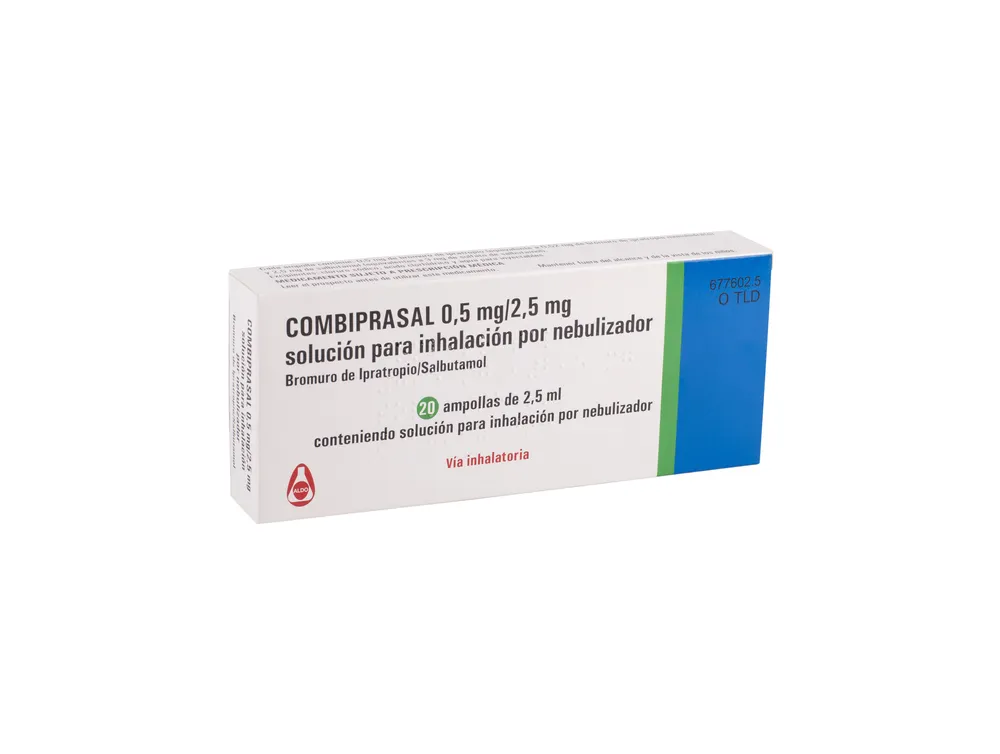
Table of Contents
Package leaflet: Information for the user
Introduction
Package leaflet: information for the user
COMBIPRASAL 0.5 mg/2.5 mg
inhalation solution for nebulizer
Read all of this leaflet carefully before you start using this medicine, because it contains important information for you.
- Keep this leaflet as you may need to read it again. If you have any questions, ask your doctor or pharmacist.
- This medicine has been prescribed for you only, and you should not give it to other people, even if they have the same symptoms as you, because it could harm them.
- If you experience any adverse effects, consult your doctor or pharmacist, even if they are adverse effects not listed in this leaflet. See section 4.
Contents of the leaflet
- What COMBIPRASAL is and what it is used for
- What you need to know before you start using COMBIPRASAL
- How to use COMBIPRASAL
- Possible adverse effects
- How to store COMBIPRASAL
- Contents of the pack and other information
1. What COMBIPRASAL is and what it is used for
This medicine comes in single-dose ampoules containing a clear, colourless solution for inhalation by nebulizer. Combiprasal contains 0.5 mg of ipratropium bromide (as monohydrate) and 2.5 mg of salbutamol (as sulfate).
COMBIPRASAL belongs to a group of medicines called bronchodilators, which help open the airways in the lungs so you can breathe more easily.
It is indicated for the treatment of reversible bronchospasm associated with chronic obstructive pulmonary disease (COPD) in patients who require more than one bronchodilator.
2. BEFORE USING COMBIPRASAL
Do not use COMBIPRASAL
- If you are allergic (hypersensitive) to ipratropium bromide, salbutamol sulfate, atropine, or any of the other components of Combiprasal.
- If you have a heart condition called obstructive hypertrophic cardiomyopathy (this occurs when the heart does not function properly due to thickening of the heart muscles).
- If you have a fast and irregular heartbeat (known as tachyarrhythmia).
Warnings and precautions
Lactic acidosis has been observed with high therapeutic doses of salbutamol, primarily in patients being treated for acute bronchospasm (see sections 3 and 4). Increased lactate levels may lead to shortness of breath and hyperventilation.
Contact your doctor immediately if you feel the medicine is not working as it usually does and you need to use the nebulizer more often than your doctor has recommended.
Take special care with COMBIPRASAL
Inform your doctor before starting treatment with this medicine:
- If you have a history of heart disease, irregular heartbeat, or angina pectoris.
- If you are pregnant, planning to become pregnant, or breastfeeding.
- Immediate allergic reactions such as urticaria, angioedema, skin rash, cough, wheezing, breathing difficulty (bronchospasm), and swelling of the mouth and throat (oropharyngeal edema) may occur.
- If you experience sudden breathing difficulty that worsens rapidly, you must consult your doctor immediately.
- If you have diabetes.
- If you have an overactive thyroid gland.
- If you have a disorder called phaeochromocytoma, a tumor that produces chemicals causing fatigue, high blood pressure, and a faster heartbeat.
- If you have cystic fibrosis, as you may be more prone to gastrointestinal motility disorders.
- If you are predisposed to increased eye pressure (narrow-angle glaucoma). You must avoid contact of the solution with your eyes. This may cause eye pain or discomfort, transient blurred vision, visual halos or colored images, and eye redness. If any of these symptoms occur, discontinue treatment immediately and consult a doctor without delay.
- If you have benign prostatic hyperplasia (enlarged prostate).
- If you have a condition that makes urination difficult.
Use of other medicines
Inform your doctor or pharmacist if you are taking or have recently taken any other medicines, including those obtained without a prescription.
Some medicines may interact with Combiprasal. It is important that you inform your doctor if you are taking any of the following medicines:
- Xanthine derivatives, such as theophylline.
- Medicines containing beta-blockers such as propranolol or timolol, as they may reduce the effectiveness of this medicine.
- Diuretics such as furosemide or indapamide.
- Digoxin, used in the treatment of heart failure.
- Other medicines that help ease breathing, such as terbutaline.
- Medicines containing anticholinergics (used to treat asthma, irritable bowel syndrome, Parkinson's disease, and incontinence).
- Certain medicines used to treat depression (known as monoamine oxidase inhibitors and tricyclic antidepressants).
- Anesthetic medicines, such as halothane.
Pregnancy and breastfeeding
Consult your doctor or pharmacist before taking any medicine.
The use of Combiprasal is not recommended during pregnancy or breastfeeding. If necessary, your doctor will assess whether its use is advisable.
Driving and using machines
No studies have been conducted on the effects on the ability to drive and use machines. However, do not drive or operate machinery until you know how you react to the medicine.
Use in athletes
Athletes are advised that this medicine contains salbutamol, which may result in a positive analytical finding in doping control tests.
3. How to use COMBIPRASAL
Follow exactly the administration instructions for Combiprasal as given by your doctor. Consult your doctor or pharmacist if you have any doubts.
Combiprasal should be used on an as-needed basis and not on a regular basis.
If your asthma is active (for example, you have symptoms or frequent attacks such as difficulty breathing that interferes with speaking, eating, or sleeping, coughing, wheezing, chest tightness, or limited physical capacity), you must inform your doctor immediately. Your doctor may start you on medication or increase your treatment dose, such as an inhaled corticosteroid, to control your asthma.
Inform your doctor as soon as possible if your medication does not seem to be working as well as usual (for example, if you require higher doses to relieve breathing problems or if your inhaler does not provide relief for at least 3 hours), as your asthma may be worsening and you may require a different medication.
If you use Combiprasal more than twice a week to treat your asthma symptoms, excluding preventive use before exercise, this indicates poorly controlled asthma and may increase the risk of severe asthma attacks (asthma worsening) that can lead to serious complications, may be life-threatening, or even fatal. You should contact your doctor as soon as possible to review your asthma treatment.
If you are taking a daily medication for lung inflammation, e.g., an "inhaled corticosteroid," it is important that you continue using it regularly, even if you feel better.
Your doctor may instruct you to use your nebulizer regularly every day or only when you experience breathing difficulties.
Adults including elderly and children over 12 years of age: The recommended dose is 1 single-dose container, 3 or 4 times daily. In severe cases, your doctor may increase the dose to 1 single-dose container, 4 times daily.
There is no experience with the use of this medicine in children under 12 years of age.
If you do not achieve significant improvement or if your condition worsens, you must consult your doctor.
Instructions for correct administration of the preparation:
Your medication is intended for inhalation via a nebulizer or ventilator and must not be injected or swallowed.

-
Prepare your nebulizer according to the instructions provided by the manufacturer and your doctor. Ensure that the nebulizing device is clean.
-
Remove one strip of plastic containing ampoules from the box, open it, and take out one ampoule (Fig. 1). Leave the remaining ampoules in the strip and return the strip to the box.
-
Take the ampoule and open it by twisting the top part (Fig. 2).
-
Unless otherwise directed by your doctor, add the entire liquid content from the plastic ampoule into the nebulizer solution container.
-
Use the nebulizer according to your doctor's instructions. Discard the empty plastic ampoule.
-
After using the nebulizer, clean it according to the manufacturer's instructions.
If you feel that the effect of Combiprasal is too strong or too weak, inform your doctor or pharmacist.
If you use more COMBIPRASAL than you should:
If you use more than you should, you may experience disturbances in heart rhythm, palpitations, tremor, increased or decreased blood pressure, pulse irregularities, angina pectoris, flushing, dry mouth, and visual accommodation disorders.
In case of overdose or accidental ingestion, contact your doctor or pharmacist immediately or call the Toxicology Information Service at telephone number 91 562 04 20, indicating the medication and amount taken. Contact your doctor or the nearest hospital emergency service. Bring this leaflet or an ampoule of this medicine with you so that the treating doctor knows what you have taken.
If you forget to use COMBIPRASAL
If you forget to use Combiprasal, take the next dose as scheduled or earlier if you begin to experience breathing difficulties.
Do not take a double dose to make up for missed doses.
4. Possible adverse effects
Like all medicines, Combiprasal may cause adverse effects, although not everyone experiences them.
The following adverse effects have been reported:
Frequent (affects 1 in every 10 people)
- Nervousness
- Headache (cephalalgia)
- Cough
- Dry mouth
Uncommon (affects less than 1 in every 100 people)
- Dizziness
- Tremor
- Dysphonia
- Cardiac rhythm disturbances (tachycardia, palpitations, arrhythmia)
- Throat irritation
- Nausea
- Urinary retention
Rare (affects less than 1 in every 1,000 people)
- Allergic reactions (hypersensitivity)
- Decreased blood potassium levels (hypokalaemia)
- Psychiatric disturbances
- Increased intraocular pressure
- Narrow-angle glaucoma
- Eye pain
- Pupil dilation (mydriasis)
- Airway obstruction (paradoxical bronchospasm)
- Vomiting
- Gastrointestinal motility disorders
- Skin reactions and increased sweating
- Muscle pain and weakness
- Muscle cramps
- Increase or decrease in blood pressure
The following adverse effects may also occur, but their frequency is unknown:
- Some people may occasionally experience chest pain (due to heart problems such as angina pectoris). Inform your doctor if you develop these symptoms while being treated with COMBIPRASAL, but do not stop taking this medicine unless instructed by your doctor.
- A condition known as lactic acidosis, which may cause stomach pain, hyperventilation, breathing difficulties, despite possible improvement in wheezing, cold hands and feet, irregular heartbeat, or thirst.
Reporting of adverse effects:
If you experience any adverse effect, consult your doctor or pharmacist, even if it is a possible adverse effect not listed in this leaflet. You may also report them directly via the Spanish Pharmacovigilance System for Human Medicines: http;//www.notificaram.es. By reporting adverse effects, you can help provide more information on the safety of this medicine.
5. Storage of COMBIPRASAL
Keep out of the reach and sight of children.
Do not store above 25°C. Do not freeze.
Keep in the outer packaging to protect from light.
Ampoules should be opened immediately before use, and any remaining unused solution must be discarded.
Expiry:
Do not use Combiprasal after the expiry date stated on the packaging after Exp.: The expiry date refers to the last day of the month indicated.
Medicines must not be disposed of via wastewater or household waste. Return unused medicines and their packaging to the SIGRE collection point at your pharmacy. If you are unsure, ask your pharmacist how to properly dispose of unused medicines and their packaging. This will help protect the environment.
6. ADDITIONAL INFORMATION
Composition of Combiprasal:
- The active substances are ipratropium bromide and salbutamol.
- The other components (excipients) are: sodium chloride, hydrochloric acid, and water for injections.
Each 2.5 ml ampoule of Combiprasal contains 0.5 mg of ipratropium bromide (equivalent to 0.52 mg of ipratropium bromide monohydrate) and 2.5 mg of salbutamol (equivalent to 3 mg of salbutamol sulfate).
Appearance of the product and contents of the container:
Combiprasal is supplied as strips of 10 ampoules containing a clear, colourless solution inside an aluminium sachet.
Each carton contains 20 ampoules.
Marketing Authorization Holder:
Laboratorio ALDO-UNIÓN, S.L.
Baronessa de Maldà, 73
08950 Esplugues de Llobregat
Barcelona (Spain)
Manufacturer:
Laboratoire Unither
Espace Industriel Nord
151 rue André Durouchez-CS 28028
80084 AMIENS Cedex 2
France
This leaflet was approved in December 2025.
Detailed and up-to-date information on this medicinal product is available on the website of the Spanish Agency for Medicines and Health Products (AEMPS) http://www.aemps.gob.es/