Colpotrofin 10 mg/g vaginal cream
Spain
Table of Contents
- Package leaflet: Information for the user
- Introduction
- 1. What Colpotrofin 10 mg/g vaginal cream is and what it is used for
- 2. What you need to know before using Colpotrofin 10 mg/g vaginal cream
- 3. How to use Colpotrofin 10 mg/g vaginal cream
- 4. Possible adverse effects
- 5. Storage of Colpotrofin 10 mg/g vaginal cream
- 6. Contents of the pack and other information
Package leaflet: Information for the user
Introduction
Package leaflet: information for the user
COLPOTROPHIN 10 mg/g vaginal cream
Promestriene
Read all of this leaflet carefully before you start using this medicine, because it contains important information for you.
- Keep this leaflet, as you may need to read it again.
- If you have any questions, ask your doctor or pharmacist.
- This medicine has been prescribed for you only, and you should not give it to other people, even if they have the same symptoms as you, because it may harm them.
- If you experience any adverse effects, consult your doctor or pharmacist, even if they are effects not listed in this leaflet. See section 4.
Contents of the leaflet:
- What Colpotrophin 10 mg/g vaginal cream is and what it is used for
- What you need to know before using Colpotrophin 10 mg/g vaginal cream
- How to use Colpotrophin 10 mg/g vaginal cream
- Possible side effects
- How to store Colpotrophin 10 mg/g vaginal cream
- Contents of the pack and other information
1. What Colpotrofin 10 mg/g vaginal cream is and what it is used for
Colpotrofin belongs to the group of medicines known as estrogens (female sex hormones).
Colpotrofin is used to treat atrophic disorders of the female genital area (vulva, vestibule, and vaginal ring) that occur in situations involving reduced estrogen levels, such as menopause, castration, contraceptive use, etc., and which manifest as dryness, itching, or irritation of the genital skin and mucosa.
2. What you need to know before using Colpotrofin 10 mg/g vaginal cream
Do not use Colpotrofin
- if you are allergic to the active substance or to any of the other ingredients of this medicine (listed in section 6).
- if you are breastfeeding.
- if you have a history, known presence, or suspicion of breast cancer.
- if you have a history or suspicion of estrogen-dependent malignant tumors (e.g., endometrial cancer).
- if you have undiagnosed genital bleeding.
- if you have untreated endometrial hyperplasia.
- if you have or have had venous thromboembolism (deep vein thrombosis, pulmonary embolism).
- if you have known thrombophilic disorders (e.g., protein C, protein S, or antithrombin deficiency; see “Warnings and precautions”).
- if you have recent or active arterial thromboembolic disease (e.g., angina pectoris or myocardial infarction).
- if you have acute liver disease or a history of liver disease when liver function values have not returned to normal.
- if you have porphyria (a rare, usually hereditary disorder characterized by excessive excretion of porphyrins in feces and urine).
Warnings and precautions
Consult your doctor or pharmacist before starting to use Colpotrofin. Before initiating or resuming treatment, a complete personal and family medical history should be taken, along with individually tailored periodic examinations, including mammograms. Any changes in the breasts should be reported to your doctor.
Take special care with Colpotrofin:
- if you have or have had vaginal narrowing (vaginal stenosis) or vaginal prolapse.
- if you have or have had a condition characterized by growth of uterine lining tissue outside the uterus (endometriosis) or a benign uterine tumor (uterine fibroid).
For the treatment of postmenopausal symptoms, local estrogen therapy should only be initiated for symptoms adversely affecting quality of life. In all cases, a careful assessment of risks and benefits should be performed at least annually, and therapy should only continue if benefits outweigh risks.
Data on risks associated with hormone replacement therapy (HRT) in the treatment of premature menopause are limited. However, due to the low absolute risk in younger women, the benefit-risk balance may be more favorable in younger women compared to older women.
Conditions requiring monitoring
If any of the following conditions affect you, have previously affected you, and/or worsened during pregnancy or prior to hormonal treatment, inform your doctor immediately, as close monitoring will be required. These conditions may recur or worsen during treatment with promestriene, particularly:
- Leiomyoma (uterine fibroids) or endometriosis
- Risk factors for thromboembolic disorders
- Risk factors for estrogen-dependent tumors, e.g., first-degree hereditary breast cancer
- High blood pressure
- Liver disorders (e.g., hepatic adenoma)
- Diabetes mellitus with or without vascular involvement
- Gallstones (cholelithiasis)
- Migraine or severe headache
- Systemic lupus erythematosus (an autoimmune disease affecting connective tissue)
- History of endometrial hyperplasia
- Epilepsy
- Asthma
- Otosclerosis (a disease affecting the eardrum membrane and hearing)
Reasons for immediate discontinuation of treatment
Treatment must be discontinued if a contraindication is discovered or in the following situations:
- Yellowing of the skin or mucous membranes (jaundice) or deterioration of liver function
- Significant increase in blood pressure
- New onset of migraine-type headache
- Pregnancy
Endometrial hyperplasia and carcinoma
The long-term endometrial safety (beyond one year) or repeated use of locally administered vaginal estrogens is uncertain. Therefore, if treatment is repeated, it should be reviewed at least annually.
If you have undergone hysterectomy (removal of the uterus) due to endometriosis and residual endometriosis is known, inform your doctor, as caution is recommended when using this type of medication.
If bleeding or spotting occurs at any time during treatment, inform your doctor, as the cause should be investigated; your doctor may perform an endometrial biopsy.
HRT and cancer
The following risks apply to systemic hormone replacement therapy (HRT) medications that circulate in the bloodstream. However, Colpotrofin is used for local vaginal treatment and systemic absorption is very low. It is less likely that the conditions mentioned below will worsen or reappear during treatment with Colpotrofin, but you should consult your doctor if you are concerned.
Breast cancer
Available data indicate that using Colpotrofin does not increase the risk of breast cancer in women who have not previously had breast cancer. It is not known whether Colpotrofin can be used safely in women who have previously had breast cancer.
Ovarian cancer
Ovarian cancer is much rarer than breast cancer.
Epidemiological data suggest a slight increase in risk in women taking systemic estrogen-only hormone replacement therapy (HRT), which becomes apparent within the first 5 years of use and decreases over time after stopping treatment.
Venous thromboembolism (VTE)
Systemic hormone replacement therapy (HRT) is associated with a 1.3- to 3-fold increased risk of developing venous thromboembolism (VTE), i.e., deep vein thrombosis or pulmonary embolism. The occurrence of such an event is more likely during the first year of HRT than thereafter (see section 4).
Generally, patients with known thromboembolic conditions have a higher risk of VTE, and HRT may increase this risk. Therefore, HRT is contraindicated in these patients (see section 2 “Do not use Colpotrofin”).
If prolonged immobilization is expected after elective surgery, it is recommended to temporarily discontinue HRT 4 to 6 weeks beforehand. Treatment should not be resumed until full mobility is restored.
Women without personal history of VTE but with a close family member who had thrombosis at a young age should be carefully evaluated.
HRT is contraindicated if a thrombophilic defect has caused thrombosis in family members or if the defect is severe (e.g., antithrombin, protein S, or protein C deficiencies, or a combination of defects).
Women already on chronic anticoagulant therapy require careful assessment of the benefit-risk balance before using HRT.
If VTE occurs after starting treatment, the medication must be discontinued. Contact your doctor immediately if you experience any potential thromboembolic symptoms (e.g., painful swelling of one leg, sudden chest pain, dyspnea).
Coronary artery disease (CAD)
Data from studies did not show an increased risk of CAD in hysterectomized women using systemic estrogen-only therapy.
Ischemic stroke
Systemic estrogen-only therapy is associated with a 1.5-fold increased risk of ischemic stroke.
This relative risk is independent of age or duration of use, but since the baseline risk increases strongly with age, the overall risk of stroke in women using HRT increases with age (see section 4).
Other conditions
Estrogens may cause fluid retention; therefore, patients with cardiac or renal dysfunction should be carefully monitored.
If you have pre-existing hypertriglyceridemia, your doctor will monitor you closely during estrogen replacement or HRT, as rare cases of marked increases in plasma triglycerides leading to pancreatitis have been reported with estrogen therapy in this condition.
There is some evidence of an increased risk of probable dementia in women who start continuous combined HRT or estrogen-only HRT after age 65.
Use of Colpotrofin with other medicines
Inform your doctor or pharmacist if you are taking, have recently taken, or might need to take any other medicines.
Due to the intravaginal administration of promestriene and its minimal systemic absorption, clinically significant drug interactions with promestriene are unlikely. However, interactions with other locally applied vaginal treatments should be considered.
The use of this medicine together with spermicides (substances that impair sperm motility or kill sperm) is not recommended. Local vaginal treatment may inactivate the contraceptive effect of spermicides.
Pregnancy and breastfeeding
If you are pregnant or breastfeeding, think you may be pregnant, or plan to become pregnant, consult your doctor or pharmacist before using this medicine.
Pregnancy
There is insufficient information on the use of promestriene in pregnant women. Promestriene is not indicated during pregnancy. If you become pregnant while using promestriene, you must stop treatment immediately.
Results from most current epidemiological studies on accidental fetal exposure to estrogens indicate no teratogenic or fetotoxic effects.
Breastfeeding
The use of this medicine is not recommended during breastfeeding, as the drug may pass into breast milk.
Driving and use of machines
Not applicable.
Colpotrofin contains methylparahydroxybenzoate sodium salt (E-219) and propylparahydroxybenzoate sodium salt (E-217)
This medicine may cause allergic reactions (possibly delayed) because it contains methylparahydroxybenzoate sodium salt (E-219) and propylparahydroxybenzoate sodium salt (E-217).
3. How to use Colpotrofin 10 mg/g vaginal cream
Follow exactly the instructions for use of this medicine as given by your doctor or pharmacist. If in doubt, consult your doctor or pharmacist again.
Your doctor will prescribe the lowest dose necessary to treat your symptoms for the shortest possible time. Please consult your doctor if you think the dose is too high or too low.
This medicine is administered vaginally.
The recommended dose is:
- One or two applications per day of the amount of cream needed to cover the area to be treated, followed by gentle massage.
- In cases where intravaginal application of the cream is considered appropriate, it should be applied 1–2 times daily, preferably with one dose administered at night before going to bed, equivalent to a daily dose of 10–20 mg of promestriene.
Your doctor may adjust the dose depending on the improvement observed.
Treatment should last on average for 3 weeks.
If the underlying cause of the disorder persists (menopause, castration, contraceptive treatments with oestrogen-progestogen), or if the iatrogenic effect (due to medical intervention) is long-lasting (e.g. irradiation), maintenance treatment may be necessary.
Method of intravaginal application:
-
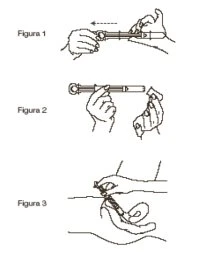
For intravaginal application of the cream, use the special applicator provided in the package. Fill the applicator directly from the tube by attaching it to the tube opening until the cream reaches the mark on the applicator, which corresponds to 1 gram of cream (Figure 1).
-
Once filled, insert the applicator into the vagina to the desired depth and administer the dose by pressing the plunger (Figure 2).
-
Application is easier when lying on your back with knees bent and slightly apart (Figure 3).
After use, the applicator should be washed with lukewarm water to ensure its proper preservation and for subsequent use.
If you need to undergo surgery
If you are scheduled for surgery, inform your surgeon that you are using Colpotrofin. You may need to stop using Colpotrofin for 4 to 6 weeks before the operation to reduce the risk of blood clotting (see section 2). Ask your doctor when you can start using Colpotrofin again.
If you use more Colpotrofin than you should
Due to the route of administration, poisoning is unlikely.
However, excessive use may lead to worsening of local side effects such as irritation, pruritus, and burning sensation in the vulvar area.
In case of overdose or accidental ingestion, contact your doctor, pharmacist, or call the Toxicology Information Service immediately at telephone number 91 562 04 20, stating the name of the medicine and the amount taken.
If you forget to use Colpotrofin
Do not use a double dose to make up for forgotten doses.
If you forget to use this medicine at the scheduled time, apply the cream as soon as you remember, and then continue with your usual treatment regimen.
If you have any further questions about the use of this product, ask your doctor or pharmacist.
4. Possible adverse effects
Like all medicines, this medicine can cause adverse effects, although not everyone will experience them.
Very rare (may affect up to 1 in 10,000 people): allergic reactions (e.g., rash, eczema, severe allergic reaction).
Very rare (may affect up to 1 in 10,000 people): itching in the vagina/vulva.
Frequency not known (frequency cannot be estimated from the available data): vaginal bleeding.
Frequency not known (frequency cannot be estimated from the available data): burning sensation in the vagina/vulva, discomfort in the vagina/vulva, pain in the vagina/vulva, vaginal discharge.
Class effects associated with systemic hormone replacement therapy (HRT)
The following risks have been associated with systemic hormone replacement therapy (HRT) and apply to a lesser extent to estrogenic products for vaginal application, in which systemic exposure to estrogens remains within the normal postmenopausal range.
The following diseases are observed more frequently in women using HRT medicines that circulate in the bloodstream compared to women not using HRT. These risks are less relevant to treatments administered vaginally, such as Colpotrofin.
Ovarian cancer
The use of systemic hormone replacement therapy (HRT) has been associated with a slight increase in the risk of diagnosed ovarian cancer (see section 2).
Risk of venous thromboembolism
Systemic hormone replacement therapy (HRT) has been associated with a 1.3- to 3-fold increased risk of developing venous thromboembolism (VTE), i.e., deep vein thrombosis or pulmonary embolism. The incidence of such an event is more likely during the first year of hormone therapy use (see section 2).
Risk of stroke
The use of systemic hormone replacement therapy (HRT) is associated with an increased risk of stroke of up to 1.5 times. The risk of haemorrhagic stroke does not increase during hormone replacement therapy (HRT).
This relative risk is not dependent on age or duration of use, but since the baseline risk strongly increases with age, the overall risk of stroke in women using hormone replacement therapy (HRT) will increase with age (see section 2).
Other adverse reactions have been reported in association with systemic estrogen/progestogen treatment: Risk estimates were based on systemic estrogen exposure, and it is not known how these may be extrapolated to local treatment:
- Gallbladder disease
- Skin and subcutaneous tissue disorders: yellowish-brown skin patches, particularly on the face (chloasma), red lesions on the extremities and inside the mouth (erythema multiforme), inflammatory nodules under the skin (erythema nodosum), red or purple discoloration of the skin and/or mucous membranes (vascular purpura).
- Probable dementia in women over 65 years of age (see section 2).
Reporting of adverse effects
If you experience any type of adverse effect, consult your doctor or pharmacist, even if it is a possible adverse effect not listed in this leaflet. You may also report them directly via the Spanish Pharmacovigilance System for Human Medicinal Products: https://www.notificaram.es. By reporting adverse effects, you can help provide more information on the safety of this medicine.
5. Storage of Colpotrofin 10 mg/g vaginal cream
This medicine does not require special storage conditions.
Keep this medicine out of the sight and reach of children.
Do not use this medicine after the expiry date stated on the carton after EXP. The expiry date is the last day of the month indicated.
Medicines should not be disposed of via wastewater or household waste. Dispose of empty containers and unused medicines at a SIGRE collection point at your pharmacy. If you are unsure, ask your pharmacist how to dispose of containers and medicines you no longer need. This will help protect the environment.
6. Contents of the pack and other information
Composition of Colpotrophin
- The active substance is promestriene. Each gram of cream contains 10 mg of promestriene.
- The other components (excipients) are glyceryl monostearate, decyl oleate, medium-chain triglycerides, glycerol (E-422), eumulgin, methylparaben sodium salt (E-219), propylparaben sodium salt (E-217), and purified water.
Appearance of the product and contents of the pack
Colpotrophin is a white, greasy-looking cream.
It is supplied in an aluminum tube with a polypropylene screw cap and an applicator, containing 15 g or 30 g of cream.
Marketing Authorization Holder and Manufacturer
Marketing Authorization Holder
Theramex Ireland Limited
3rd Floor, Kilmore House,
Park Lane, Spencer Dock,
Dublin 1
D01 YE64
Ireland
Manufacturer
Laboratoires CHEMINEAU
93 route de Monnaie
37210 Vouvray
France
Local Representative
Theramex Healthcare Spain, S.L.
Calle Martínez Villergas 52, Edificio C, planta 2ª izquierda
28027 Madrid
Spain
Date of the most recent revision of this leaflet: March 2022
Detailed and up-to-date information on this medicinal product is available on the website of the Spanish Agency for Medicines and Health Products (AEMPS) http://www.aemps.gob.es/