Colixin 1MIU. powder for injection solution
Spain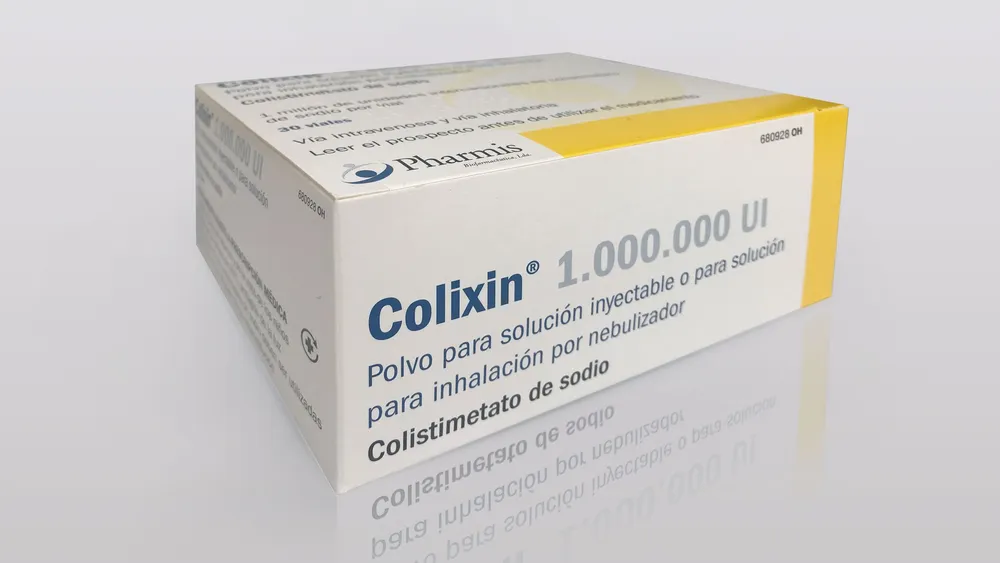
Table of Contents
- Package leaflet: Information for the user
- Introduction
- 1. What Colixin is and what it is used for
- 2. Before using Colixin
- 3. How to use Colixin
- 4. Possible adverse effects
- *Nervous system disorders*
- *Respiratory disorders*
- *Kidney and urinary disorders*
- *General disorders and administration site reactions*
- 5. Storage of Colixin
- 6. Contents of the container and other information
- Nebulization
Package leaflet: Information for the user
Introduction
Package leaflet: information for the user
Colixin 1 MUI Powder for injectable solution
Sodium colomycin
The active substance is sodium colistimethate. Each vial contains 1 million International Units (IU), equivalent to approximately 80 mg of sodium colistimethate. It does not contain any other components.
Read the entire leaflet carefully before you start using this medicine.
- Keep this leaflet, as you may need to read it again.
- If you have any questions, ask your doctor or pharmacist.
- This medicine has been prescribed for you and should not be given to other people, even if they have the same symptoms as you, as it may harm them.
If you experience any serious adverse reactions or any adverse reaction not mentioned in this leaflet, inform your doctor or pharmacist. See section 4.
Contents of the leaflet:
- What COLIXIN is and what it is used for
- Before you use COLIXIN
- How to use COLIXIN
- Possible adverse effects
- How to store COLIXIN
- Further information
1. What Colixin is and what it is used for
This medicine is an antibiotic belonging to the polymyxin group.
Antibiotics are used to treat bacterial infections and are not effective against viral infections such as flu or the common cold.
It is important that you follow your doctor's instructions regarding dose, dosing interval, and duration of treatment.
Do not store or reuse this medicine. If you have any antibiotic left over after completing treatment, return it to the pharmacy for proper disposal. Do not dispose of medicines via wastewater or household waste.
Colixin is administered by injection to treat certain types of severe infections caused by specific bacteria. Colixin is used when other antibiotics are not suitable.
Colixin is administered by inhalation to treat chronic respiratory infections in patients with cystic fibrosis. Colixin is used when these infections are caused by a specific bacterium called Pseudomonas aeruginosa.
2. Before using Colixin
Do not use Colixin:
- If you are allergic (hypersensitive) to sodium colistimethate, colistin, or other polymyxins.
Warnings and precautions
Consult your doctor, pharmacist, or nurse before starting to use Colixin
-
If you have or have had kidney problems
-
If you suffer from myasthenia gravis
-
If you suffer from porphyria
-
If you suffer from asthma
- If you require treatment with other antibiotics that may also damage the kidneys or cause neurological disturbances such as dizziness or visual disturbances.
- If you have cystic fibrosis, you may receive this medicine by inhalation. In this case, coughing and bronchospasm (difficulty breathing) may occur, which is why the first administration by this route must always be performed under medical supervision.
-
If you experience muscle spasms, fatigue, or increased urine production at any time, inform your doctor immediately, as these episodes may be related to a condition known as pseudo-Bartter syndrome.
Special caution should be taken when using Colixin in premature infants and newborns, as their kidneys are not yet fully developed.
Use of Colixin with other medicines
- Medicines that may affect how your kidneys function. Taking such medicines at the same time as Colixin may increase the risk of kidney damage.
- Medicines that may affect the nervous system. Taking such medicines at the same time as Colixin may increase the risk of adverse effects on your nervous system.
- Medicines known as muscle relaxants, often used during general anesthesia. Colixin may enhance the effects of these medicines. If you are to be given a general anesthetic, inform your anesthetist that you are taking Colixin.
If you have myasthenia gravis and are also taking other antibiotics called macrolides (such as azithromycin, clarithromycin, or erythromycin), or antibiotics known as fluoroquinolones (such as ofloxacin, norfloxacin, and ciprofloxacin), taking Colixin further increases the risk of muscle weakness and breathing difficulties.
Receiving Colixin by infusion at the same time as receiving Colixin by inhalation may increase your risk of experiencing adverse effects.
Pregnancy and breastfeeding
Colixin should only be administered to pregnant patients if the expected benefit outweighs any potential risk.
If administered to a breastfeeding woman, the patient should discontinue breastfeeding while receiving Colixin.
Consult your doctor or pharmacist before using any medicine.
Driving and use of machines
Colixin may cause dizziness, confusion, or visual disturbances; therefore, you should not drive or operate any tools or machinery in such cases.
Colixin contains sodium
This medicine contains 5.27 mg of sodium (main component of table/cooking salt) per vial. This corresponds to 0.26% of the maximum daily recommended sodium intake for an adult.
3. How to use Colixin
Follow exactly the administration instructions for Colixin as indicated by your doctor.
Consult your doctor if you have any doubts. Remember to take your medication. Your doctor will tell you how long the treatment with Colixin should last. Do not stop the treatment early, as there is a risk that the infection may recur.
Colixin can be administered systemically via intravenous route (infusion or single injection) or by inhalation, using a nebulizer.
- Intravenous route
Your doctor has prescribed Colixin as an intravenous infusion over 30 to 60 minutes.
The usual dose in adults is 9 million units, divided into two or three doses. If you are in poor condition, you will receive at the beginning of treatment a single higher dose of 9 million units.
In some cases, your doctor may decide to give you a higher daily dose of up to 12 million units.
The usual daily dose in children weighing up to 40 kg is 75,000 to 150,000 units per kilogram of body weight, divided into three doses.
In cases of cystic fibrosis, higher doses have occasionally been administered.
Children and adults with kidney problems, including those on dialysis, usually receive lower doses.
Your doctor will monitor your kidney function regularly while you are receiving Colixin.
- Inhalation route
The usual dose in adults, adolescents, and children aged 2 years or older is 1–2 million units two or three times a day (maximum 6 million units per day).
The usual dose in children under 2 years of age is 0.5–1 million units, twice daily (maximum 2 million units per day).
Your doctor may decide to adjust the dose depending on your circumstances. If you are also taking other inhaled medications, your doctor will advise you on the order in which they should be taken.
If the patient is also receiving other treatments for cystic fibrosis, such as physiotherapy or other inhaled treatments (e.g. bronchodilators), it should be remembered that sodium colistimethate must be administered after these.
In any case, if kidney function is impaired, dose adjustment will be necessary, i.e. reducing the dose and/or prolonging the dosing interval.
If you use more Colixin than you should
If you have used more Colixin than you should, you may experience breathing difficulties, muscle weakness, and kidney function problems.
In case of overdose or accidental ingestion, consult your doctor or pharmacist immediately or call the Toxicology Information Service at telephone number 91 5620420, indicating the medication and the amount ingested.
If you forget to use Colixin
Do not administer a double dose to make up for missed doses.
If you are receiving this medication by intravenous route and no more than 3 hours have passed since the time you should have received your dose, you may request administration of the missed dose. If more than 3 hours have passed since the missed dose, wait until the next scheduled dose.
If administration is by inhalation route, take the missed dose as soon as you remember, and then continue with your next dose as usual.
If you have any further questions about the use of this product, ask your doctor.
4. Possible adverse effects
Like all medicines, Colixin may produce adverse effects, although not everyone will experience them.
In the case of sodium colistimethate, these effects mainly involve the nervous system and kidney function. The most frequent adverse effects after nebulization are cough and difficulty breathing.
Nervous system disorders
Tingling or numbness around the lips and face, dizziness, difficulty speaking, visual disturbances, confusion, mental disturbances, or flushing (redness of the face).
Respiratory disorders
Nebulization of Colixin through a nebulizer may cause coughing and may lead to chest tightness, wheezing, or a sensation of suffocation in some individuals.
Kidney and urinary disorders
Colixin may affect the kidney, especially if the dose is high or if you are taking other medication that may affect the kidney.
General disorders and administration site reactions
Colixin may cause allergic reactions such as skin rashes. If this occurs, inform your doctor immediately, as it may be necessary to discontinue treatment.
After intravenous injection, you may feel mild pain at the injection site.
After intravenous administration, you may experience the following symptoms, which may be related to a condition known as pseudo-Bartter syndrome (see section 2):
- muscle spasms
- increased urine production
- fatigue
Colixin, administered via nebulizer, could cause pain in the mouth or throat, which may be due to an allergic reaction to the medicine or a superimposed fungal infection.
Reporting of adverse reactions:
If you experience any type of adverse reaction, consult your doctor, pharmacist, or nurse, even if it is a possible adverse reaction not listed in this leaflet. You may also report them directly through the Spanish Pharmacovigilance System for Human Medicines: https://www.notificaram.es. By reporting adverse reactions, you can help provide more information on the safety of this medicine.
5. Storage of Colixin
Keep out of the reach and sight of children.
Store below 25°C. Protect from light.
Do not use Colixin after the expiry date stated on the container. The expiry date is the last day of the month indicated.
Do not use Colixin if you notice any visible signs of deterioration.
Medicines should not be disposed of via wastewater drains or household waste. Ask your pharmacist how to dispose of unused medicines and their packaging. This will help protect the environment.
6. Contents of the container and other information
Instructions for use and handling.
Systemic administration
For bolus injection:
Reconstitute the vial contents with no more than 10 ml of water for injections or 0.9% sodium chloride.
For infusion:
The reconstituted vial contents may be diluted, usually with 50 ml of 0.9% sodium chloride.
For intrathecal and intraventricular administration:
The administered volume must not exceed 1 ml (reconstituted solution concentration 125,000 IU/ml).
A visual inspection for the presence of particles in the solution must be performed prior to administration, and the solution must be discarded if particles are present.
The solution is clear and intended for single use; any unused solution must be discarded.
Compatible infusion solutions are: 0.9% sodium chloride, 5% dextrose, 5% fructose, Ringer's solution, and 10% dextrose in sodium chloride.
Hydrolysis of colistimethate increases significantly when reconstituted and diluted below its critical micellar concentration of approximately 80,000 IU per ml.
Solutions below this concentration must be used immediately.
For bolus injection or nebulization solutions, chemical and physical in-use stability of the reconstituted solution in the original vial at a concentration ≥ 80,000 IU/ml has been demonstrated for 24 hours at 2 to 8°C.
From a microbiological standpoint, unless the method of opening/reconstitution/dilution excludes the risk of microbial contamination, the product should be used immediately.
If not used immediately, the duration and conditions of in-use storage are the user's responsibility.
For infusion solutions that have been diluted beyond the original vial volume and/or with a concentration < 80,000 IU/ml, immediate use is required.
For intrathecal and intraventricular routes of administration, the reconstituted product must be used immediately.
Nebulization
Reconstitute the vial contents either with water for injections to produce a hypotonic solution, or with a 50:50 mixture of water for injections and 0.9% sodium chloride to produce an isotonic solution, or with 0.9% sodium chloride to produce a hypertonic solution.
The reconstitution volume should be in accordance with the nebulizer device administration instructions and is normally no more than 4 mL.
The solution may be slightly cloudy and may foam when shaken. Nebulization using jet or ultrasonic nebulizers is generally preferred, as they generate respirable droplets with a particle diameter between 0.5–5.0 microns when used with an appropriate compressor. The manufacturer's instructions for maintenance and care of the nebulizer and compressor must be followed.
Some of the nebulized medication may be released into the environment. To minimize environmental release of the waste aerosol, a filter may be used. Colixin should be administered in a well-ventilated room.
Any unused solution remaining in the nebulizer after treatment must be discarded.
Composition of Colixin
- The active substance is sodium colistimethate.
- It contains no other ingredients.
Appearance of the product and contents of the container
Colixin is supplied in vials containing powder for injection/inhalation by nebulizer.
It is available in packs containing 10 or 30 vials.
Expiry date
Do not use Colixin after the expiry date stated on the container.
Marketing Authorization Holder and Manufacturer
Pharmis Biofarmacêutica, Lda.
Rua Professor Branquinho da Fonseca, nº 269
2775-078 Parede
Portugal
Tel.: 00351 21 4823850
Fax: 00351 21 4823859
e-mail: [email protected]
Further information on this medicinal product is available from the local representative of the Marketing Authorization Holder in Spain:
Pharmis Biofarmacéutica, S.L.
C/ General Yagüe, nº 52, 1st floor, D, 28020 - Madrid
Tel.: 91 640 22 88
Fax: 91 640 08 45
Manufacturer
Alfasigma S.p.A.
Via Enrico Fermi 1,
65020 Alanno (PE)
Italy
This summary of product characteristics was approved in March 2023
Detailed and up-to-date information on this medicinal product is available on the website of the Spanish Agency of Medicines and Health Products (AEMPS) http://www.aemps.gob.es/.