Colirofta Anestesico 5 mg/ml + 0.5 mg/ml solution for eye drops
Spain
Table of Contents
- Package leaflet: Information for the user
- Introduction
- 1. What COLIROFTA ANESTHÉTIC is and what it is used for
- 2. What you need to know before using COLIROFTA ANESTHETIC
- 3. How to use COLIROFTA ANESTHETIC
- 4. Possible adverse effects
- 5. Storage of COLIROFTA ANESTHETIC
- 6. Contents of the container and other information
Package leaflet: Information for the user
Introduction
Package leaflet: information for the user
COLIROFTA ANESTHETIC 5 mg/ml + 0.5 mg/ml eye drops, solution
Tetracaine hydrochloride/Naphazoline hydrochloride
Read the entire leaflet carefully before you start using this medicine, because it contains important information for you.
- Keep this leaflet, as you may need to read it again.
- If you have any questions, ask your doctor or pharmacist.
- This medicine has been prescribed for you only, and you should not give it to others, even if they have the same symptoms as you, because it could harm them.
- If you experience any adverse effects, consult your doctor or pharmacist, even if they are adverse effects not listed in this leaflet. See section 4.
Contents of the leaflet
-
What COLIROFTA ANESTHETIC is and what it is used for
-
What you need to know before using COLIROFTA ANESTHETIC
-
How to use COLIROFTA ANESTHETIC
-
Possible side effects
-
Storage of COLIROFTA ANESTHETIC
-
Contents of the pack and other information
1. What COLIROFTA ANESTHÉTIC is and what it is used for
It is an eye drop formulation containing two active ingredients: tetracaine, a local anesthetic (which temporarily eliminates sensitivity at the site of administration), and naphazoline, a decongestant agent (which causes vasoconstriction or narrowing of the visible blood vessels in the eye), thereby prolonging the anesthetic effect.
Colirofta Anestésico is indicated for the treatment of painful eye conditions, removal of foreign bodies, ocular examination, tonometry (measurement of pressure inside the eyes), gonioscopy (assessment of the angle where the iris joins the cornea, determining whether it is wide or narrow), and fundus examination with contact lens.
2. What you need to know before using COLIROFTA ANESTHETIC
Do not use Colirofta Anesthetic
- If you are allergic to naphazoline, tetracaine, or other local anesthetics of the same type, or to any of the other components of this medicine (listed in section 6).
- If you have narrow-angle glaucoma.
Warnings and precautions
Talk to your doctor or pharmacist before using Colirofta Anesthetic.
Use this medicine only in the eye(s).
You should exercise caution if you are in any of the following situations:
- If you are being treated with monoamine oxidase inhibitors (MAOIs) (usually antidepressants) or during the two weeks following the end of such treatment.
- If you are receiving certain anesthetics (e.g., halothane), which make the heart more sensitive to drugs of the naphazoline type.
- If you have bronchial asthma.
- If you have any heart or circulatory disease.
- If you have cerebral arteriosclerosis.
- If you have high blood pressure (hypertension).
- If you have hyperthyroidism (overactive thyroid gland).
- If you have diabetes.
Repeated use of this medicine (due to tetracaine) may cause corneal damage.
Prolonged use of tetracaine may lead to reduced duration of anesthesia and delayed healing, among other adverse visual effects.
- Due to the anesthetic effect, your eyes will lose sensitivity, so you must be careful to avoid accidental eye injuries.
- This medicine should only be used under the direct supervision of a healthcare professional.
- Do not use for longer than 3 to 5 days.
- Do not wear contact lenses while using this medicine.
Use in elderly patients
See section 3.
Caution should be exercised in patients over 65 years of age, particularly those with serious heart or circulatory diseases (such as arrhythmias or hypertension), as naphazoline may worsen these conditions.
Children
Do not use this medicine in children; efficacy and safety have not been established in pediatric patients.
Other medicines and COLIROFTA ANESTHETIC
Inform your doctor or pharmacist if you are taking, have recently taken, or might need to take any other medicines.
In particular, consult your doctor if you are taking:
- Monoamine oxidase inhibitors (MAOIs) (you may experience a severe hypertensive crisis).
- Ophthalmic sulfonamides in eye drops or ointment.
- St. John's wort.
Pregnancy, breastfeeding, and fertility
If you are pregnant or breastfeeding, think you may be pregnant, or are planning to become pregnant, consult your doctor or pharmacist before using this medicine.
You should not use Colirofta Anesthetic during pregnancy.
Your doctor must decide whether breastfeeding should be discontinued or treatment stopped, after weighing the benefits against the potential risks.
Driving and using machines
You may notice blurred vision or other visual disturbances for a short time after instilling the eye drops. Do not drive or operate machinery until these effects have disappeared.
COLIROFTA ANESTHETIC contains phosphates
This medicine contains 5.8 mg of phosphates per ml.
If you have severe corneal damage (the transparent layer at the front of the eye), treatment with phosphates may, in very rare cases, cause blurred vision due to calcium accumulation.
3. How to use COLIROFTA ANESTHETIC
Follow exactly the instructions for using this medicine as given by your doctor. If in doubt, consult your doctor or pharmacist again.
Recommended dose:
Adults
Generally, instill 1 or 2 drops into the affected eye as needed.
Use in elderly patients
It is recommended to start treatment with the lowest recommended dose, as these patients may have a variable response to one of the components of the medicine, tetracaine.
Use in case of hepatic and/or renal impairment
The safety and efficacy of this medicine have not been established in patients with hepatic and/or renal impairment.
Use in children
The safety and efficacy of this medicine have not been established in children.
Instructions for use:
Ophthalmic use (in the eyes).
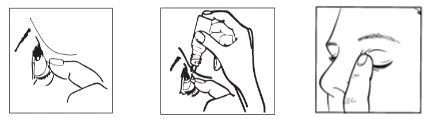
1 2 3
- Wash your hands.
- Take the bottle (dropper container).
- After opening the bottle for the first time, remove the loose plastic ring from the seal if present.
- Hold the bottle upside down between your fingers.
- Tilt your head backward. Gently pull down the eyelid to create a small pocket between the eyelid and the eye, into which the drop should fall (Figure 1).
- Bring the tip of the bottle close to the eye. Using a mirror may be helpful.
- Do not touch the eye, eyelid, nearby areas, or any other surfaces with the dropper tip. The eye drops could become contaminated.
- Gently squeeze the base of the bottle so that one drop falls at a time (Figure 2).
- After using these eye drops, press gently with your finger on the inner corner of the eye near the nose. This helps prevent the medicine from draining into the rest of the body (Figure 3).
- If applying drops to both eyes, repeat all the previous steps for the other eye.
- Close the bottle tightly immediately after using the medicine.
If a drop misses the eye, try again.
If you are using other ophthalmic medicines, wait at least 5 minutes between administering this eye drop and any other eye medicines. Ophthalmic ointments should be administered last.
If you use more COLIROFTA ANESTHETIC than you should
Taking a significantly larger amount of Colirofta Anesthetic than the recommended dose—for example, if Colirofta Anesthetic is accidentally swallowed—may cause serious adverse effects affecting the heart and blood circulation. Symptoms may include: slowed heart rate (bradycardia), severe headache, nausea, vomiting, breathing difficulties, increased heart rate (tachycardia), and chest pain.
An overdose in the eyes can be removed by rinsing the eyes with lukewarm water. Do not apply additional drops until the next scheduled dose.
In case of serious overdose or accidental ingestion, contact your doctor or pharmacist immediately, or call the Toxicology Information Service at 91 562 04 20, indicating the medicine and the amount used.
Serious reactions may occur, such as a drop in body temperature, drowsiness, or other symptoms of central nervous system depression (especially in children), and serious cardiovascular reactions.
After ingestion, especially in children, symptoms such as nausea, vomiting, lethargy, palpitations, and breathing difficulties may occur.
If you forget to use COLIROFTA ANESTHETIC
Do not use a double dose to make up for missed doses.
Apply a single dose as soon as you remember. However, if it is almost time for the next dose, skip the missed dose and continue with your regular dosing schedule.
If you have any further questions about the use of this medicine, ask your doctor or pharmacist.
4. Possible adverse effects
Like all medicines, this medicine can cause adverse effects, although not everyone will experience them.
The following adverse effects have been reported, although their frequency is not known exactly:
Due to the anesthetic, excessive use of this medicine may cause corneal lesions or eye damage.
Allergic reactions may occur in rare cases.
Because of the presence of naphazoline in the medicine, you may experience an increase in pupil size and elevated pressure in the eye. General side effects may occur such as headache, increased blood pressure, increased heart rate and irregular heartbeat, tachycardia, nausea, fainting, and stroke.
Other adverse effects in children
Excessive use of naphazoline in infants and young children may cause central nervous system depression and a significant reduction in body temperature.
In rare cases, itching after application has been observed.
Persistent eye redness and irritation, conjunctivitis, and eye pain have also been reported.
In predisposed patients, especially with higher amounts and more frequent use than recommended, tremors, weakness, and sweating may occur.
Reporting of adverse effects
If you experience any type of adverse effect, consult your doctor or pharmacist, even if it is a possible adverse effect not listed in this leaflet. You may also report them directly via the Spanish Pharmacovigilance System for Human Medicinal Products: https://www.notificaRAM.es. By reporting adverse effects, you can help provide more information on the safety of this medicine.
5. Storage of COLIROFTA ANESTHETIC
Keep this medicine out of the sight and reach of children.
Do not use this medicine after the expiry date stated on the container and carton, after EXP. The expiry date refers to the last day of the month indicated.
Before first opening, store in a refrigerator (between 2°C and 8°C). After first opening, do not store above 25°C.
To prevent infection, discard the bottle 4 weeks after first opening.
Please record the date of first opening in the box provided for this purpose on the carton.
Medicines should not be disposed of via wastewater or household waste. Dispose of unused medicines and their containers at the SIGRE collection point at your pharmacy. If you are unsure, please ask your pharmacist how to dispose of unused medicines and containers. This helps protect the environment.
6. Contents of the container and other information
Composition of COLIROFTA ANESTHÉSICO
- The active substances are tetracaine hydrochloride and naphazoline hydrochloride. Each ml of eye drop solution contains 5 mg of tetracaine hydrochloride (0.5%) and 0.5 mg of naphazoline hydrochloride (0.05%).
- The other components are chlorobutanol, monosodium phosphate monohydrate, sodium hydrogen phosphate dodecahydrate, sodium chloride, and purified water.
Appearance of the product and contents of the container
Colirofta Anestésico is an eye drop solution; a clear, colourless liquid.
It is supplied in a box containing one dropper bottle (plastic bottle) of 10 ml.
Marketing Authorisation Holder and Manufacturer
Marketing Authorisation Holder
Alcon Healthcare, S.A.
World Trade Center Almeda Park
Plaça de la Pau s/n, Edificio 6, planta 3
08940 – Cornellà de Llobregat (Barcelona)
Spain
Manufacturer
Alcon Laboratories Belgium
Lichterveld 3
2870 Puurs-Sint-Amands
Belgium
Date of the most recent revision of this package leaflet: June 2025
Detailed information on this medicine is available on the website of the Spanish Agency of Medicines and Health Products (AEMPS) http://www.aemps.gob.es/