Colircusi pilocarpine 20 mg/ml eye drops solution
Spain
Table of Contents
- Package leaflet: Information for the user
- Introduction
- 1. What COLIRCUSÍ PILOCARPINA is and what it is used for
- 2. What you need to know before using COLIRCUSÍ PILOCARPINA
- 3. How to use COLIRCUSÍ PILOCARPINE
- 4. Possible adverse effects
- 5. Storage of COLIRCUSÍ PILOCARPINE
- 6. Contents of the pack and other information
Package leaflet: Information for the user
Introduction
Package leaflet: information for the user
COLIRCUSÍ PILOCARPINE 20 mg/ml eye drops solution
pilocarpine hydrochloride
Read the entire leaflet carefully before you start using this medicine, as it contains important information for you.
- Keep this leaflet, as you may need to read it again.
- If you have any questions, ask your doctor or pharmacist.
- This medicine has been prescribed for you only, and you should not give it to other people, even if they have the same symptoms as you, because it could harm them.
- If you experience any adverse effects, consult your doctor or pharmacist, even if they are adverse effects not listed in this leaflet. See section 4.
Contents of the leaflet
- What COLIRCUSÍ PILOCARPINE is and what it is used for
- What you need to know before using COLIRCUSÍ PILOCARPINE
- How to use COLIRCUSÍ PILOCARPINE
- Possible side effects
- How to store COLIRCUSÍ PILOCARPINE
- Contents of the pack and other information
1. What COLIRCUSÍ PILOCARPINA is and what it is used for
Colircusí Pilocarpina is an eye drop solution containing an active substance (pilocarpine hydrochloride) that belongs to a group of medicines known as miotics, used to constrict the pupil and reduce intraocular pressure.
It is used as a miotic: to counteract pupil dilation occurring after eye surgery or examination.
In cases of accidents or surgical procedures where prolapse (protrusion) of the iris must be avoided.
For differential diagnosis of iris diseases, as it causes pupil constriction.
It is also used as an ocular hypotensive agent: to reduce intraocular pressure prior to surgery and to prevent intraocular pressure rise during laser surgery.
For the treatment of acute (closed-angle) or chronic (open-angle) glaucoma.
2. What you need to know before using COLIRCUSÍ PILOCARPINA
Do not use Colircusí Pilocarpina
- If you are allergic to pilocarpine or to any of the other ingredients of this medicine (listed in section 6).
- If you have inflammation of the iris or anterior uvea (one of the superficial layers of the eye).
- If you have pupillary block glaucoma (resistance to the flow of eye fluid through the pupil).
Warnings and precautions
Consult your doctor or pharmacist before starting to use Colircusí Pilocarpina.
- Use this medicine only in your eye(s).
- If you have had retinal detachment or are predisposed to it, or have other retinal diseases.
- If you are young and are myopic (nearsighted).
(You will likely be given an eye fundus examination before starting treatment with this medicine.)
-
If you have any damage to the cornea or other parts of the eye.
-
Consult your doctor if you have any of the following conditions, as they could worsen:
-
Problems with aqueous humor outflow (fluid inside the eye)
-
Heart problems
-
Hypertension or hypotension
-
Asthma or other lung diseases
-
Difficulty or inability to urinate
-
Stomach ulcers (peptic ulcers)
-
Hyperthyroidism
-
Gastrointestinal spasm (painful digestive-type contractions)
-
Parkinson's disease
-
Recent myocardial infarction
-
If you drive at night or perform hazardous tasks under low lighting, as this medicine may cause blurred vision and light sensitivity.
-
If you have dark-colored eyes, you may require a higher concentration of this medicine or more frequent administration to achieve the desired effect. Consult your doctor, as there may be a risk of overdose.
-
If you use this medicine for a prolonged period, eye irritation or allergic reactions may occur; in such cases, you must discontinue treatment.
Children
Do not use in children, as safety and efficacy have not been established in this population.
Other medicines and Colircusí Pilocarpina
Inform your doctor or pharmacist if you are taking, have recently taken, or might need to take any other medicines.
In particular, inform your doctor if you are using:
- Ophthalmic NSAIDs (non-steroidal anti-inflammatory drugs), such as ibuprofen, as they may reduce the effect of this eye drop.
- Beta-adrenergic antagonist drugs (commonly used to treat hypertension and heart conditions), as they may increase the risk of heart problems.
Pregnancy, breastfeeding and fertility
If you are pregnant or breastfeeding, think you may be pregnant, or are planning to become pregnant, consult your doctor or pharmacist before using this medicine.
Do not use this medicine during pregnancy or breastfeeding unless your doctor considers it necessary.
Driving and using machines
The effect of this medicine on the ability to drive and operate machinery is significant.
After application, this medicine may cause blurred vision and difficulty adapting to darkness. If these effects occur, do not drive or operate machinery until they have resolved.
Particular caution is required when driving at night or performing hazardous tasks under low lighting conditions.
COLIRCUSÍ PILOCARPINA contains benzalkonium chloride
This medicine contains 0.1 mg of benzalkonium chloride per ml.
Benzalkonium chloride can be absorbed by soft contact lenses, altering their color. Remove contact lenses before using this medicine and wait 15 minutes before reinserting them.
Benzalkonium chloride may cause ocular irritation, especially if you have dry eye or other corneal diseases (the transparent layer at the front of the eye). Consult your doctor if you experience a foreign body sensation, stinging, or eye pain after using this medicine.
3. How to use COLIRCUSÍ PILOCARPINE
Follow exactly the administration instructions for this medicine as indicated by your doctor. If in doubt, consult your doctor or pharmacist again.
The following measure is useful to limit the amount of medicine that passes into the bloodstream after eye drop application:
Keep your eyes closed while gently pressing with a finger on the tear duct for at least 2 minutes.
Recommended dose:
Adults, including elderly patients
- Induction of miosis: 1 or 2 drops, spaced 5 minutes apart, in the affected eye(s).
- Prevention of ocular hypertension during laser surgery: 1 or 2 drops, spaced 5 minutes apart, in the affected eye(s), administered between 15 and 60 minutes before surgery.
- Acute glaucoma: 1 drop in the affected eye(s), up to 3 times within a 30-minute period (a prior treatment may be required).
- Ocular hypertension and elevated intraocular pressure due to open-angle glaucoma: 1 drop in the affected eye(s), up to 4 times daily.
Your doctor may adjust the number of daily applications and will indicate the duration of treatment with this eye drop. Do not stop treatment earlier unless your doctor instructs you to do so.
Instructions for use
1 2 3
- Wash your hands.
- Take the bottle (dropper container).
- After opening the bottle for the first time, remove the loose plastic ring from the seal if present.
- Hold the bottle upside down between your fingers.
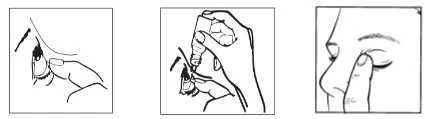
- Tilt your head backward. Gently separate the eyelid from the eye with one finger until a pouch forms between the eyelid and your eye, where the drop should fall (figure 1).
- Bring the tip of the bottle close to the eye. Using a mirror may be helpful.
- Do not touch the eye, eyelid, nearby areas, or any other surfaces with the dropper tip. The drops could become contaminated.
- Gently squeeze the base of the bottle with your index finger to release one drop at a time (figure 2).
- After using this eye drop, close your eye and gently press with your finger on the inner corner of the eye near the nose for about 2 minutes. This helps prevent the eye drop from passing into the rest of the body (figure 3).
- If applying drops to both eyes, repeat all the previous steps for the other eye.
- Close the bottle tightly immediately after using the medicine.
If a drop falls outside the eye, try again.
Use in case of hepatic and/or renal impairment
The safety and efficacy have not been established in patients with severe hepatic or renal impairment.
If you are using other ophthalmic medicines, wait at least 5 minutes between the administration of this medicine and other ophthalmic medicines. Ophthalmic ointments should be administered last.
If you use more Colircusí Pilocarpine than you should, remove it by rinsing your eyes with lukewarm water. Do not apply further drops until instructed to do so.
Symptoms of overdose or accidental ingestion may include: headache, salivation, sweating, fainting, slow heart rate, hypotension, abdominal cramps, vomiting, asthma, and diarrhea.
Treatment of overdose is supportive. In case of severe systemic toxicity, treatment with anticholinergics may be necessary.
In case of overdose or accidental ingestion, contact your doctor or pharmacist immediately or call the Toxicology Information Service. Telephone 91 562 04 20, indicating the medicine and the amount used.
If you forget to use Colircusí Pilocarpine
Do not apply a double dose to make up for missed doses.
Apply a single dose as soon as you remember and continue with your next scheduled dose. However, if it is almost time for your next dose, do not apply the missed dose and continue with your next dose according to your regular schedule.
If you have any further questions about the use of this medicine, ask your doctor or pharmacist.
4. Possible adverse effects
Like all medicines, this medicine may cause adverse effects, although not everyone experiences them.
The following adverse effects have been observed with this medicine:
Very common (may affect more than 1 in 10 people):
- Eye effects: blurred vision.
- General effects: headache.
Common (may affect up to 1 in 10 people):
- Eye effects: floaters in the fluid inside the eye (appearance of spots in vision), reduced vision (especially in elderly patients or those with opacities), eye pain, abnormal light perception, eye irritation, and eye redness.
- General effects: dizziness and nausea.
Uncommon (may affect up to 1 in 100 people):
- Eye effects: retinal tear, bleeding inside the eye, fluid detachment inside the eye, eyelid swelling, decrease in pupil size, glare, and abnormal sensation in the eye.
Frequency not known (cannot be estimated from available data):
- Eye effects: increased eye pressure and corneal swelling.
- General effects: vomiting.
Other adverse effects that may occur with this type of drug
Prolonged administration of miotics may lead to an increased risk of cataracts, iris cyst, or retinal detachment in patients with pre-existing retinal pathology.
A paradoxical increase in eye pressure may occur in patients with impaired outflow.
Reporting of adverse effects
If you experience any type of adverse effect, consult your doctor or pharmacist, even if it is a possible adverse effect not listed in this leaflet. You may also report them directly via the Spanish Pharmacovigilance System for Human Medicinal Products: https://www.notificaRAM.es. By reporting adverse effects, you can help provide more information on the safety of this medicine.
5. Storage of COLIRCUSÍ PILOCARPINE
Keep this medicine out of the sight and reach of children.
Do not use this medicine after the expiry date stated on the bottle and the carton, following "EXP". The expiry date refers to the last day of the month indicated.
Do not store above 25°C.
To prevent infections, discard the bottle 4 weeks after first opening.
Record the date of first opening of the bottle in the space provided for this purpose on the carton.
Medicines must not be disposed of via wastewater or household waste. Dispose of packaging and unused medicines at the SIGRE collection point at your pharmacy. If in doubt, ask your pharmacist how to properly dispose of unused medicines and packaging. This helps protect the environment.
6. Contents of the pack and other information
Composition of COLIRCUSÍ PILOCARPINE
- The active substance is pilocarpine hydrochloride. One ml of solution contains 20 mg of pilocarpine hydrochloride (2%).
- The other components are benzalkonium chloride, povidone, sodium chloride, boric acid (borax), and purified water.
Nature of the product and contents of the container
Colircusí Pilocarpine is an eye drop solution (a clear, colourless or slightly yellowish liquid).
It is presented in a dropper container (plastic bottle with a cap) inside a box.
Each container contains 10 ml of eye drops.
MARKETING AUTHORISATION HOLDER:
Mizar Farmacéutica, S.L.
Gran Via de les Corts Catalanes, 764
08013 – Barcelona, Spain
MANUFACTURER RESPONSIBLE FOR BATCH RELEASE
Siegfried El Masnou, S.A.
C/ Camil Fabra, 58
08320 El Masnou - Barcelona, Spain
or
Novartis Farmacéutica, S.A.
Gran Via de les Corts Catalanes, 764
08013 Barcelona, Spain
or
Novartis Pharma GmbH
Roonstrasse 25
90429 Nuremberg, Germany
For further information about this medicinal product, please contact the local representative of the marketing authorisation holder:
Novartis Farmacéutica, S.A.
Gran Via de les Corts Catalanes, 764
08013 – Barcelona, Spain
Date of the most recent review of this leaflet: February 2022.
Detailed information on this medicinal product is available on the website of the Spanish Agency of Medicines and Health Products (AEMPS) http://www.aemps.gob.es