Cluvot 250 IU, powder and solvent for solution for injection or infusion
Spain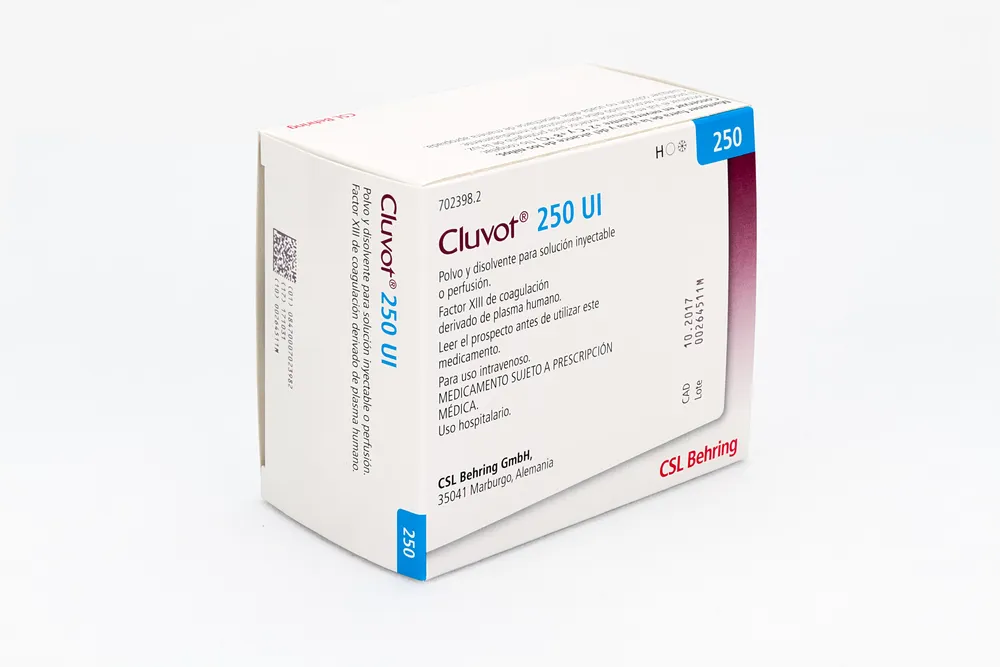
Table of Contents
Package leaflet: Information for the user
Introduction
Package leaflet: information for the user
Cluvot 250 IU
Powder and solvent for solution for injection or infusion.
Coagulation factor XIII concentrate (human plasma-derived)
Read the entire leaflet carefully before you start using this medicine, as it contains important information for you.
|
Package leaflet contents
- What Cluvot is and what it is used for
- What you need to know before using Cluvot
- How to use Cluvot
- Possible side effects
- Storage of Cluvot
- Contents of the pack and other information
1. What Cluvot is and what it is used for
What Cluvot is
Cluvot is presented as a white powder and a solvent. The solution obtained must be administered by intravenous injection.
Cluvot is a product composed of coagulation factor XIII (FXIII) derived from human plasma (the liquid portion of blood), and has important functions in hemostasis (stopping of bleeding).
What Cluvot is used for
Cluvot is used in adult and pediatric patients
- for the preventive treatment of hereditary factor XIII deficiency, and
- for the perioperative treatment of surgical bleeding associated with congenital FXIII deficiency.
2. What you need to know before using Cluvot
The following sections contain information your doctor should consider before administering Cluvot to you.
Do not use Cluvot:
- if you are allergic to the active substance or to any of the other components of this medicine (listed in section 6).
Inform your doctor if you are allergic to any medication or food.
Warnings and precautions
Talk to your doctor, pharmacist, or nurse before starting to use Cluvot.
- If you have previously experienced allergic reactions to coagulation FXIII, prophylactic antihistamines and corticosteroids should be administered if advised by your doctor.
- In the event of allergic-type or anaphylactic reactions (a severe allergic reaction causing severe breathing difficulties or dizziness), administration of Cluvot must be stopped immediately (e.g., stop the infusion). In case of shock, current medical guidelines for its treatment will be followed.
- Caution should be exercised if you have recently experienced thrombosis (blood clot), due to the fibrin-stabilizing effect of FXIII.
- The development of inhibitors (neutralizing antibodies) is a known complication of treatment and means that the treatment is no longer effective. If your bleeding episodes cannot be controlled with Cluvot, inform your doctor immediately. You should be carefully monitored for the development of inhibitors.
Your doctor will carefully weigh the benefits of treatment with Cluvot against the risks of these complications.
Viral safety
When medicines are manufactured from human blood or plasma, certain measures are taken to prevent transmission of infections to patients. These measures include:
- careful selection of blood and plasma donors to ensure potential carriers of infections are excluded;
- testing of each donation and plasma pool for signs of viruses/infections;
- inclusion of steps during blood or plasma processing to inactivate or remove viruses.
Despite these measures, when medicines prepared from human blood or plasma are administered, the possibility of transmitting infections cannot be completely ruled out. This also applies to any unknown or emerging viruses or other types of infections.
The measures taken are considered effective against enveloped viruses such as human immunodeficiency virus (HIV), hepatitis B virus, and hepatitis C virus, as well as against the non-enveloped hepatitis A virus and parvovirus B19.
It is strongly recommended that each time you are given Cluvot, your doctor records the name and batch number of the medicine (found on the cardboard box).
Your doctor may advise you to consider vaccination against hepatitis A and B if you regularly or repeatedly receive plasma-derived products.
Use of Cluvot with other medicines
- Inform your doctor or pharmacist if you are taking, have recently taken, or might need to take any other medicines.
- To date, no interactions are known between human plasma-derived coagulation FXIII concentrate and other medicines.
- Cluvot must not be mixed with other medicines, diluents, or solvents except those specified in section 6, and should be administered through a separate infusion line.
Pregnancy, breastfeeding, and fertility
-
If you are pregnant or breastfeeding, think you may be pregnant, or are planning to become pregnant, consult your doctor or pharmacist before receiving this medicine.
-
Limited clinical data on the use of Cluvot during pregnancy have not shown negative effects on pregnancy outcomes or perinatal or postnatal development. Therefore, Cluvot may be considered during pregnancy if needed.
-
There are no data on the excretion of Cluvot in human milk. However, due to its large molecular size, excretion in milk is unlikely, and because of its protein nature, absorption of intact molecules by the breastfed infant is also unlikely. Therefore, Cluvot may be used during breastfeeding.
-
Fertility data are not available.
Driving and using machines
No studies on the effects on the ability to drive and use machines have been conducted.
Cluvot contains sodium
Please note that Cluvot contains sodium. This is important if you are on a sodium-restricted diet. Cluvot contains 124.4 to 195.4 mg (5.41 to 8.50 mmol) of sodium per dose (40 IU/body weight: for an average of 70 kg), when the recommended dose is administered (2,800 IU = 44.8 ml).
3. How to use Cluvot
- Your doctor will normally administer Cluvot to you.
- Cluvot is intended solely for intravenous injection.
Dosage
Your doctor will calculate the correct dose and decide how often you will receive Cluvot, depending on how the treatment is working.
For more information, see section “This information is intended exclusively for healthcare professionals”.
Overdose
Cases of overdose have not been reported and are not expected, as the medicine is administered by healthcare professionals.
4. Possible adverse effects
Like all medicines, this medicine can cause adverse effects, although not everyone experiences them.
The following adverse effects have been observed rarely (affects more than 1 in 10,000 and less than 1 in 1,000 users):
- Allergic reactions, such as generalized urticaria (swollen, itchy areas on the skin), skin rash, decreased blood pressure (which may cause fainting or dizziness), and difficulty breathing.
- Increase in body temperature.
The following adverse effects have been observed very rarely (affects less than 1 in 10,000 users):
- Development of FXIII inhibitors.
If allergic reactions occur, administration of Cluvot must be immediately discontinued and appropriate treatment initiated. For treatment of shock, follow current medical standards.
Adverse effects in children and adolescents
Adverse effects in children are expected to be the same as those in adults.
Reporting of adverse effects
If you experience any type of adverse effect, consult your doctor, pharmacist, or nurse, even if it is an effect not listed in this leaflet. You may also report them directly via the Spanish Pharmacovigilance System for Human Medicines: https://www.notificaram.es. By reporting adverse effects, you can help provide more information on the safety of this medicine.
5. Storage of Cluvot
-
Store in a refrigerator (between +2°C and +8°C).
-
Do not freeze.
-
Keep the vial in the outer packaging to protect it from light.
-
Cluvot does not contain preservatives. The product should be used immediately after reconstitution. If not used immediately, the reconstituted solution must not be stored for more than 4 hours at room temperature. Do not refrigerate or freeze the reconstituted solution.
-
Keep this medicine out of the sight and reach of children.
-
Do not use this medicine after the expiry date stated on the label and on the carton. The expiry date refers to the last day of the month indicated.
-
Medicines should not be disposed of via wastewater or household waste. Ask your pharmacist how to dispose of medicines and packaging you no longer need. This will help protect the environment.
6. Contents of the pack and other information
Composition of Cluvot
Active substance:
Concentrate of human coagulation factor XIII derived from human plasma containing 250 IU per vial.
Other components:
Human albumin, monohydrated glucose, sodium chloride, sodium hydroxide (in small amounts for pH adjustment)
Solvent: Water for injections
Nature of the product and contents of the container
Cluvot is presented as a white powder and is supplied with a solvent (water for injections).
The reconstituted solution should be colourless, clear or slightly opalescent. When held to light, it should not appear cloudy or contain residues (deposits/particles).
Presentation
A 250 IU pack containing:
-
1 vial of powder
-
1 vial of 4 ml water for injections
-
1 transfer device with filter 20/20 (Mix2Vial)
-
Administration set (inner box):
-
1 disposable 5 ml syringe
-
1 venous access device
-
2 alcohol-impregnated wipes
-
1 non-sterile dressing
Marketing Authorization Holder and Manufacturer
CSL Behring GmbH
Emil-von-Behring-Strasse 76
35041 Marburg (Germany)
For further information regarding this medicinal product, please contact the local representative of the Marketing Authorization Holder:
CSL Behring, S.A.
c/ Tarragona 157, 18th floor
08014 Barcelona (Spain)
This medicinal product is authorized in the Member States of the European Economic Area under the following name: Cluvot
Date of the most recent review of this summary: October 2018.
Detailed and up-to-date information on this medicinal product is available on the website of the Spanish Agency of Medicines and Health Products (AEMPS) http://www.aemps.gob.es
_____________________________________________________________________________________
This information is intended for healthcare professionals only:
Dosage and method of administration
Dosage
1 ml corresponds approximately to 62.5 IU, and 100 IU correspond to 1.6 ml, respectively.
Important:
The amount to be administered and the frequency of administration must always be guided by the clinical efficacy in each individual case.
Dosing regimen
The dosing regimen should be individualized according to body weight, laboratory values, and the patient's clinical condition.
Typical prophylactic dosing regimen
Initial dose
- 40 international units (IU) per kg of body weight
- The infusion rate should not exceed 4 ml per minute.
Subsequent dosing
- Dosing should be guided by the most recent minimum FXIII activity level, with administration every 28 days (4 weeks) to maintain a minimum FXIII activity level between approximately 5% and 20%.
- Recommended dose adjustments of ± 5 IU per kg should be based on the minimum FXIII activity levels as shown in Table 1 and the patient's clinical condition.
- Dose adjustments should be made based on a specific and sensitive assay to determine FXIII levels. Table 1 below describes an example of dose adjustment using the standard Berichrom® activity assay.
Table 1: Dose adjustment using the standard Berichrom® activity assay
Minimum factor XIII activity level (%) | Dosage adjustment |
A minimum level of < 5% | Increase by 5 units per kg |
Minimum level between 5% and 20% | No change |
Two minimum levels of > 20% | Decrease by 5 units per kg |
A minimum level of > 25% | Decrease by 5 units per kg |
The potency expressed in units is determined by the Berichrom® activity assay, referenced to the current international standard for blood coagulation factor XIII in plasma.
Therefore, one unit in this document is equivalent to one international unit.
Preoperative prophylaxis
After the patient's last routine prophylactic dose, if surgery is scheduled:
- Between 21 and 28 days later: administer the patient the full prophylactic dose immediately before surgery, and the next prophylactic dose should be administered 28 days later.
- Between 8 and 21 days later: an additional dose (full or partial) may be administered before surgery. The dose should be guided by factor XIII activity levels and the patient's clinical status, and should be adjusted according to the half-life of Cluvot.
- Within 7 days after the last dose: an additional dose may not be necessary.
Dose adjustments may differ from these recommendations and should be individualized based on factor XIII activity levels and the patient's clinical condition. All patients should be closely monitored during and after surgery.
Therefore, monitoring of factor XIII activity increase using an FXIII assay is recommended. In the case of major surgery or severe bleeding, the goal is to achieve nearly normal values (healthy individuals: 70% – 140%).
Paediatric population
The dosage and method of administration in children and adolescents are based on body weight and therefore generally follow the same guidelines as for adults. The dose and frequency of administration for each individual must always be guided by clinical efficacy and factor XIII activity levels.
Elderly population
The dosage and method of administration in elderly individuals (> 65 years) have not yet been documented in clinical studies.
Method of administration
General instructions
- The solution should be clear or slightly opalescent. After drawing and filtering the reconstituted product (see below), it should be inspected visually for the presence of foreign particles and discoloration before administration.
- Do not use solutions that are visibly cloudy or that still contain flakes or particles.
- Reconstitution and withdrawal must be performed under aseptic conditions.
Reconstitution
Allow the solvent to reach room temperature. Ensure that the caps have been removed from the product and solvent vials, and that the stoppers are treated with an antiseptic solution and allowed to dry before opening the Mix2Vial device.
|
|
|
|
|
|
|
|
|
Discard the solvent vial with the attached blue Mix2Vial adapter. |
|
|
|
|
 1
1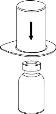 2
2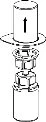 3
3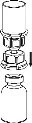 4
4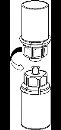 5
5 6
6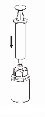 7
7Transfer and administration
|
by slowly pulling back the plunger. |
|
|
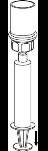 8
8 9
9Care must be taken to ensure that blood does not enter the syringe filled with the product, as there is a risk that the blood may coagulate in the syringe and, consequently, fibrin clots could be administered to the patient.
The reconstituted solution must be administered intravenously through a separate injection/infusion line (provided with the product) by slow injection at a rate not exceeding 4 ml per minute.
Any unused medicinal product and all materials that have come into contact with it must be disposed of in accordance with local regulations.