Clovate 500 microgram/g shampoo
Spain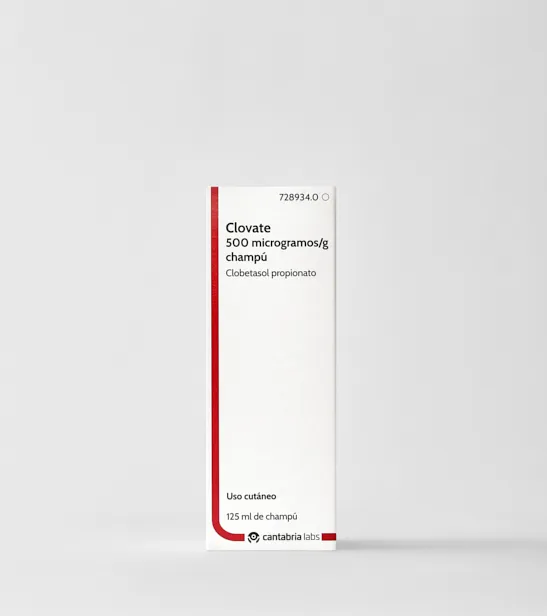
Table of Contents
Package leaflet: Information for the user
Introduction
Package leaflet: information for the patient
Clovate 500 micrograms/g shampoo
Clobetasol propionate
Read the entire leaflet carefully before you start using this medicine, because it contains important information for you.
- Keep this leaflet as you may need to read it again.
- If you have any questions, consult your doctor or pharmacist.
- This medicine has been prescribed for you only, and you should not give it to other people even if they have the same symptoms as you, because it may harm them.
- If you experience any adverse effects, consult your doctor or pharmacist, even if these adverse effects are not listed in this leaflet. See section 4.
Leaflet contents
- What Clovate is and what it is used for
- What you need to know before using Clovate
- How to use Clovate
- Possible adverse effects
- How to store Clovate
- Contents of the pack and other information
1. What Clovate is and what it is used for
Clovate shampoo contains the active substance clobetasol propionate; it belongs to a group of medicines called corticosteroids (or steroids). Topical corticosteroids are further classified into groups depending on their potency; clobetasol propionate is a very potent corticosteroid. "Topical" means that it should be applied only to the surface of the skin. Topical steroids reduce redness, itching, and inflammation associated with skin disorders.
Scalp psoriasis is caused by an excessively rapid production of skin cells on your scalp. This medicine is used to treat moderate scalp psoriasis in adults.
2. What you need to know before using Clovate
Do not use Clovate shampoo
- If you are allergic (hypersensitive) to clobetasol propionate or to any of the other ingredients of this medicine (listed in section 6). Please check carefully by reading the list of ingredients in this leaflet. If you are allergic to any component in that list, you must inform your doctor before starting treatment.
- If you have skin infections, bacterial, viral, fungal, or parasitic, such as herpes, chickenpox, shingles (herpes zoster), impetigo (a type of facial rash), ringworm, athlete’s foot, thrush, cutaneous tuberculosis, or a skin disease caused by syphilis.
- If you have ulcerated wounds (weeping sores) on your scalp.
- In children under 2 years of age.
- Do not apply the medicine to the eyes or eyelids (risk of glaucoma, which is high pressure in the eye, and risk of cataract, which is a loss of transparency of the eye's lens).
Warnings and precautions
Talk to your doctor or pharmacist before starting to use Clovate shampoo if:
- You experience new-onset bone pain or worsening of previous bone symptoms during treatment with Clovate shampoo, especially if you have been using Clovate shampoo for a prolonged or repeated period.
- You are using another oral or topical medicine containing corticosteroids or medicines to control your immune system (for example, for autoimmune disease or after a transplant). Combining Clovate shampoo with these medicines may lead to serious infections.
Take special care with Clovate shampoo
- This medicine should only be used on the scalp. Do not use it as a daily shampoo or on other parts of the body, and do not use it as a shower gel, body soap, or bath foam.
- When treating your scalp with this medicine, do not cover the treated area—for example, do not use a shower cap, as this may increase absorption of the active ingredient through the skin and affect other parts of the body.
- When using this medicine, avoid contact with the face, eyelids, armpits (underarms), eroded skin surfaces (cracked skin), and genital areas. Rinse immediately with water if the product spreads to an area outside the scalp.
- If this medicine gets into your eye(s), rinse the affected eye thoroughly with water. If irritation persists, consult your doctor.
- If you do not notice improvement in your scalp psoriasis, see your doctor.
- Contact your doctor if you experience blurred vision or other visual disturbances.
Children and adolescents
- If this medicine has been prescribed for a child or adolescent under 18 years of age, you should consult your doctor weekly before continuing its use.
Other medicines and Clovate shampoo
Tell your doctor or pharmacist if you are taking or using, or have recently taken or used, any other medicines, including those obtained without a prescription.
Pregnancy, breastfeeding, and fertility
Consult your doctor or pharmacist before using or taking any medicine.
Do not use this medicine if you are pregnant or breastfeeding, unless clearly instructed by your doctor.
If you are pregnant or breastfeeding, think you may be pregnant, or are planning to become pregnant, consult your doctor or pharmacist before using this medicine.
Driving and using machines
This medicine has no or very little influence on the ability to drive or operate machinery.
3. How to use Clovate
Follow exactly the instructions for use of this medicine given by your doctor. If in doubt, consult your doctor or pharmacist.
The usual daily dose per application is the amount equivalent to approximately half a tablespoon (approximately 7.5 ml), sufficient to cover the entire scalp.
Unless otherwise directed by your doctor, wash your hands and apply this medicine directly to your dry scalp once daily, taking care to cover it thoroughly, and massage the affected areas. Avoid using large amounts; use only enough to cover your dry scalp. Wash your hands thoroughly after application. Leave the product on the scalp for 15 minutes, without covering, to allow it to work, then add water, rinse thoroughly, and dry your hair as usual. You may use your regular shampoo if you need additional shampoo to wash your hair. Do not apply more of the medicine onto your hair.
Your doctor will inform you how long you need to use this medicine to control your scalp psoriasis. Treatment normally should not last longer than 4 weeks. However, if your scalp psoriasis improves significantly before the end of treatment, please consult your doctor. Conversely, if no improvement is seen at the end of treatment, please inform your doctor. This treatment requires careful monitoring; you must allow your doctor to assess your progress at regular intervals. Do not use this medicine for longer than indicated by your doctor.
Nevertheless, your doctor may advise you to use it again in the future after a period without treatment.
Use in children and adolescents
If the medicine has been prescribed for a child or adolescent between 2 and 18 years of age, follow the instructions given by the doctor. You should consult the doctor weekly to continue treatment.
If you use more Clovate shampoo than you should
If you use more medicine than you should, contact your doctor. This medicine is for use on the scalp only. Do not swallow it. If accidentally ingested, small amounts are not harmful. If in doubt, contact your doctor immediately.
In case of overdose or accidental ingestion, contact your doctor or pharmacist immediately or call the Toxicology Information Service at telephone number: 91 562 04 20, indicating the medicine and the amount ingested, or go to the nearest hospital to learn about the risks and receive advice on the measures to be taken.
If you forget to use Clovate shampoo
If you forget to use this medicine, do not use a double dose to make up for the missed doses. Continue with the treatment as directed by your doctor. If you have missed several doses, inform your doctor.
If you stop using Clovate shampoo
If you stop treatment with this medicine, contact your doctor. It may happen that stopping treatment causes a worsening of your condition, especially if it has been used for a long period of time. Inform your doctor if you notice such worsening of your scalp psoriasis.
If you have any other questions about the use of this medicine, ask your doctor or pharmacist.
4. Possible adverse effects
Like all medicines, this medicine can cause adverse effects, although not everyone experiences them. It may cause the following adverse effects:
Frequent (may affect up to 1 in 10 people):
- Skin burning sensation
- Inflammation of one or more hair follicles
Uncommon (may affect up to 1 in 100 people):
- Endocrine disorders (such as adrenal suppression, Cushing's syndrome); these have been observed with potent topical steroids, especially when applied over large areas or for prolonged periods
- Stinging or burning in the eyes, eye irritation
- Sensation of eye tightness
- Glaucoma
- Hypersensitivity
- Headache
- Skin pain, skin discomfort, skin swelling, skin atrophy (thinning of the skin), skin irritation, skin tightness
- Itching
- Acne
- Telangiectasia (blood vessels beneath the skin surface may become more visible)
- Worsening of psoriasis
- Hair loss
- Dry skin
- Urticaria
- Allergic contact dermatitis
- Erythema
- Rash
Irritation, itching, urticaria, visible small blood vessels, or skin thinning around treated areas are generally mild to moderate in nature.
Rare:
- Opportunistic infections (caused by bacteria, viruses, when the immune system is weakened); immunosuppression (your immune system does not function properly)
Frequency not known (cannot be estimated from available data):
-
Worsening of diabetes mellitus
-
Blurred vision
-
Cataracts
-
Perioral dermatitis (a rash with red patches around the mouth), if applied to the face
-
Worsening of rosacea (facial erythema associated with skin redness and possible appearance of papulopustules)
-
Pustular eruptions (large pimples), and changes in hair growth or skin pigmentation, or loss of skin color; striae (stretch marks) and purpura (bruising) may appear. These may occasionally occur with repeated, long-term use of topical steroids
-
Generalized pustular psoriasis (appearance of pustules and plaques all over the body)
-
If you experience any signs of local intolerance such as burning sensation or redness in the treated areas, do not use this medicine until these symptoms have disappeared.
-
If your condition worsens during treatment (this is more likely if this medicine is used longer than recommended), or if you experience swelling of the eyelids, face, or lips, which may indicate an allergy to the product or a skin infection, stop using it immediately and inform your doctor as soon as possible.
-
Using more medicine than recommended or leaving it on the scalp for longer than 15 minutes may:
-
cause the skin to become thinner and therefore more easily damaged.
-
allow the active ingredient to pass through the skin; this may affect other parts of the body, especially in children (may cause growth retardation, frequency not known) and during pregnancy.
-
Application to the skin may cause skin thinning; therefore, it should never be used on the face or on other skin areas apart from the scalp.
-
To avoid interaction with hair dyes, such as changes in hair color, this medicine must be thoroughly rinsed off.
-
If you experience any unusual discomfort that you cannot explain, inform your doctor as soon as possible.
Reporting of adverse effects
If you experience any adverse effect, talk to your doctor or pharmacist, even if it is a possible adverse effect not listed in this leaflet. You can also report them directly via the Spanish Pharmacovigilance System for Human Medicinal Products: www.notificaRAM.es. By reporting adverse effects, you can help provide more information on the safety of this medicine.
5. Storage of Clovate
Keep this medicine out of the sight and reach of children.
Do not use this medicine after the expiry date stated on the container following EXP:. The expiry date refers to the last day of the month indicated.
Discard the bottle 4 weeks after first opening.
Do not store above 30°C. Keep in the original packaging to protect from light.
Medicines must not be disposed of via wastewater or household waste. Dispose of unused containers and medicines at the SIGRE collection point at your pharmacy. If you are unsure, ask your pharmacist how to dispose of unused containers and medicines. This will help protect the environment.
6. Contents of the container and other information
Composition of Clovate
- The active substance is clobetasol propionate.
Each gram of shampoo contains 500 micrograms of clobetasol propionate. 1 gram of shampoo is equivalent to 1 milliliter.
- The other components are: ethanol, coco alkyl dimethyl betaine, sodium laureth sulfate, poliquaternium-10, sodium citrate dihydrate, citric acid monohydrate, and purified water.
Appearance of the product and contents of the container
Viscous, translucent liquid shampoo, colorless to pale yellow, with an alcoholic odor.
It is packaged in high-density polyethylene (HDPE) bottles with polypropylene screw caps.
Pack size: 125 ml.
Marketing Authorization Holder and Manufacturer
Industrial Farmacéutica Cantabria, S.A.
Barrio Solía 30
La Concha de Villaescusa
39690 Cantabria (Spain)
This medicinal product is authorized in the Member States of the European Economic Area under the following names:
Italy: Clobecare
Portugal: Clobetasol Cantabria 500 micrograms/g Shampoo
Spain: Clovate 500 micrograms/g shampoo
Denmark: Clobetasolpropionat IFC
Date of the most recent review of this leaflet: March 2021
Detailed information on this medicinal product is available on the website of the Spanish Agency of Medicines and Health Products (AEMPS) http://www.aemps.gob.es