Clovate 0.5 mg/g cream
Spain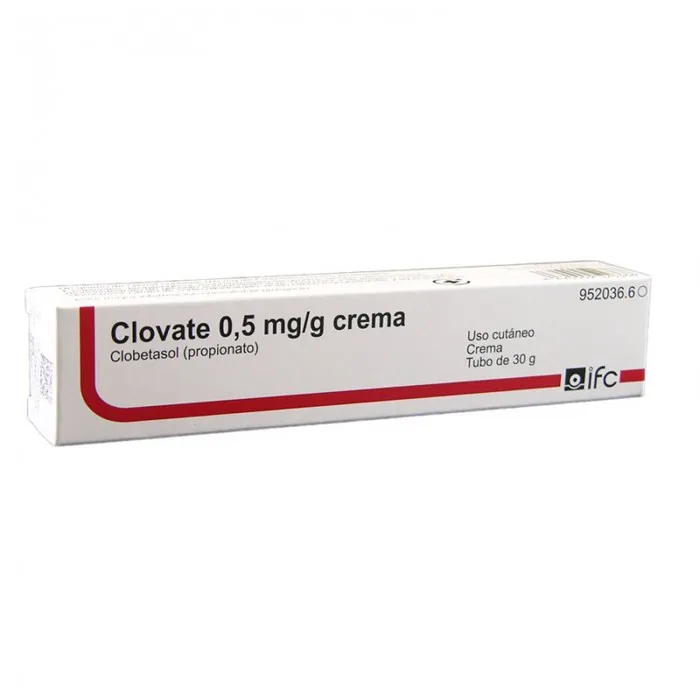
Table of Contents
Package leaflet: Information for the user
Introduction
Package leaflet: information for the user
Clovate 0.5 mg/g cream
Clobetasol (propionate)
Read the entire leaflet carefully before you start using this medicine, because it contains important information for you.
-
Keep this leaflet, as you may need to read it again.
-
If you have any questions, ask your doctor or pharmacist.
-
This medicine has been prescribed for you only, and you must not give it to other people, even if they have the same symptoms as you, because it could harm them.
-
If you experience any adverse effects, consult your doctor or pharmacist, even if they are adverse effects not listed in this leaflet. See section 4.
Leaflet contents
- What Clovate cream is and what it is used for
- What you need to know before using Clovate cream
- How to use Clovate cream
- Possible side effects
- How to store Clovate cream
- Contents of the pack and other information
1. What Clovate cream is and what it is used for
Clovate belongs to a group of medicines called topical steroids. "Topical" means that it is applied to the skin. Topical steroids reduce redness and itching associated with certain skin conditions.
Clovate cream reduces inflammatory effects in skin conditions such as:
- Difficult-to-treat eczemas
- Psoriasis, a skin inflammation causing redness, itching, and scaling of the skin
(excluding disseminated plaque psoriasis)
- Lichen planus (a disorder affecting the skin and mucous membranes, causing inflammation and itching)
- Discoid lupus erythematosus (a rash appearing on the cheeks and nose).
2. What you need to know before using Clovate cream
Do not use Clovate
- If you are allergic to clobetasol (propionate) or to any of the other components of this medicine (listed in section 6).
- If you have a primary fungal skin infection (for example: candidiasis, ringworm) or bacterial infection (for example, impetigo).
- If you have a primary viral infection (such as herpes simplex, chickenpox).
- If you have acne or a condition called rosacea (severe redness of the skin on and around the nose) or perioral dermatitis (red rash with bumps around the mouth).
- For skin lesions in children under 1 year of age, including dermatitis (skin inflammation) and diaper rash.
- If you have pruritus (itching) in the perianal or genital area.
Warnings and precautions
Talk to your doctor or pharmacist before starting to use Clovate cream if:
- You experience new-onset bone pain or worsening of previous bone symptoms during treatment with Clovate, especially if you have been using Clovate for a prolonged or repeated period.
- You are taking another oral or topical medicine containing corticosteroids or medicines to control your immune system (for example, for autoimmune disease or after a transplant). Combining Clovate with these medicines may lead to serious infections.
Clovate should not be used for long periods, especially in children. If used in children, strict weekly medical supervision is required. Note that the use of occlusive dressings (including diapers) may increase absorption of Clovate.
If you do not notice improvement after 4 weeks of treatment, consult your doctor.
Do not use the cream on the face unless specifically instructed by your doctor, as it may alter the thickness of your skin.
Avoid contact of Clovate with the eyes, as it may increase intraocular pressure. If contact occurs, rinse the affected area thoroughly with plenty of water.
Special caution is required if you are being treated for psoriasis, and strict medical supervision is recommended.
Clovate is not recommended for use on wounds or ulcers.
Contact your doctor if you experience blurred vision or other visual disturbances.
Children
Do not use in children under 1 year of age; it is contraindicated in this population.
Other medicines and Clovate cream
Inform your doctor or pharmacist if you are taking, have recently taken, or might need to take any other medicines.
No interactions between Clovate and other medicines are known.
Pregnancy, breastfeeding and fertility
If you are pregnant or breastfeeding, think you might be pregnant, or are planning to become pregnant, consult your doctor or pharmacist before using this medicine.
Pregnancy
Do not use Clovate during pregnancy unless your doctor considers it absolutely necessary.
Breastfeeding
Do not use Clovate during breastfeeding unless your doctor considers it absolutely necessary.
Driving and using machines
The effect of Clovate on the ability to drive or operate machinery is none or negligible.
Clovate 0.5 mg/g cream contains propylene glycol, chlorocresol, and cetostearyl alcohol
This medicine contains 475 mg of propylene glycol in each gram of cream.
Propylene glycol may cause skin irritation.
This medicine may cause local skin reactions (such as contact dermatitis) because it contains cetostearyl alcohol.
This medicine may cause allergic reactions because it contains chlorocresol.
3. How to use Clovate cream
Follow exactly the instructions for administering this medicine as given by your doctor. If in doubt, consult your doctor or pharmacist again.
For topical use only.
The recommended dose is:
Apply the cream moderately to the affected areas of skin once or twice daily. If you feel that the effect of Clovate is too strong or too weak, inform your doctor or pharmacist. If prolonged corticosteroid therapy is required, a less potent corticosteroid ointment should be used.
Wash your hands after applying Clovate, unless the hands themselves are being treated.
Unless otherwise directed by your doctor, you should not use larger amounts or apply the cream over large areas of the body for prolonged periods (such as daily for many weeks or months).
The skin should be cleaned before applying a new occlusive (closed) dressing or diaper over the affected area.
Clovate is for topical use only.
Use in children
Clovate is contraindicated in children under 1 year of age (see section 2 “What you need to know before starting to use Clovate cream”). Long-term treatment should be avoided, especially in children.
If you use more Clovate than you should
If you have used Clovate more than you should, in amounts exceeding the prescribed dose or for longer than instructed, consult your doctor or pharmacist immediately.
Using a larger amount is unlikely to be harmful unless the entire amount is applied at once.
In case of overdose or accidental ingestion, consult your doctor or pharmacist, or call the Toxicology Information Service at telephone number 91 562 04 20, stating the medicine and the quantity ingested.
If you forget to use Clovate cream
Do not use a double dose to make up for forgotten doses.
If you forget to use Clovate cream, apply the normal amount as soon as you remember, or wait until the next scheduled application if it is almost time for it.
If you stop treatment with Clovate cream
Do not stop treatment suddenly.
Discontinuation of prolonged treatment should be gradual, by increasing the interval between applications or by switching to a less potent or less concentrated corticosteroid.
If you have any further questions about the use of this medicine, ask your doctor or pharmacist.
4. Possible adverse effects
Like all medicines, this medicine can produce adverse effects, although not everyone experiences them.
Local allergic reactions such as redness of the skin, rash, itching, hives, local burning sensation of the skin, and allergic contact dermatitis at the site of application may occur. These may resemble the symptoms of the skin condition being treated. If symptoms persist, stop treatment immediately and consult your doctor.
If you experience swelling of the eyelids, face, or lips, stop treatment immediately and consult your doctor, as this could be an allergic reaction.
Clovate may be absorbed through the skin into the bloodstream. This is not a problem if you use the correct amount of medicine for the appropriate duration. However, if you use too much medicine or use it for a prolonged period, you may experience changes in the skin at the site of application, such as striae (stretch marks), thinning of the skin, appearance of blood vessels (especially when dressings are used or when applied to skin folds), changes in hair quantity or color, and pustular psoriasis (white blisters surrounded by red, irritated skin).
If large amounts of Clovate are used over long periods of time, signs of adrenal insufficiency may occur, including growth retardation in children, unexplained weight gain, and acne development. If you notice any of these symptoms, consult your doctor.
The frequencies of adverse effects are defined as follows: very common (may affect more than 1 in 10 people), common (may affect up to 1 in 10 people), uncommon (may affect up to 1 in 100 people), rare (may affect up to 1 in 1,000 people), very rare (may affect up to 1 in 10,000 people), frequency not known (cannot be estimated from available data).
Uncommon
Dilation of superficial blood vessels in the skin.
Local skin atrophy, striae.
Very rare
Allergy (hypersensitivity).
Hypercortisolism (increased cortisol) or Cushing's syndrome (round face, fat accumulation, and weakness), and decreased levels of adrenal gland hormones.
Skin redness, rash, itching, hives, local burning sensation of the skin, swelling of face, eyelids or lips, allergic contact dermatitis, pustular psoriasis (white blisters surrounded by red, irritated skin), worsening of initial symptoms, skin thinning, acne, pigmentation changes, increased hair growth (hypertrichosis).
Frequency not known
Blurred vision.
Reporting of adverse effects
If you experience any type of adverse effect, consult your doctor or pharmacist, even if it is a possible adverse effect not listed in this leaflet. You may also report them directly via the Spanish Pharmacovigilance System for Human Medicines: https://www.notificaram.es. By reporting adverse effects, you can help provide more information on the safety of this medicine.
5. Storage of Clovate cream
Keep this medicine out of the sight and reach of children.
Do not store above 30 °C.
Do not use this medicine after the expiry date stated on the packaging after EXP. The expiry date is the last day of the month indicated.
Medicines should not be disposed of via wastewater or household waste. Dispose of unused medicines and their containers at a SIGRE collection point.
6. Contents of the pack and other information
Composition of Clovate cream
- The active substance is clobetasol propionate. Each gram of cream contains 0.5 mg of clobetasol propionate, equivalent to 0.44 mg of clobetasol.
- The other components are: propylene glycol (E-1520), glycerol monoesterate, cetearyl alcohol, self-emulsifying glyceryl monostearate (Arlacel 165), white beeswax, chlorocresol, sodium citrate dihydrate, citric acid monohydrate and purified water.
Appearance of the medicinal product and contents of the pack
Clovate is a white cream supplied in a tube containing 30 grams.
Marketing Authorization Holder and Manufacturer
INDUSTRIAL FARMACÉUTICA CANTABRIA, S.A.
Barrio Solía 30
La Concha de Villaescusa
39690 Cantabria (Spain)
Date of the most recent revision of this leaflet: November 2021.
Detailed information on this medicinal product is available on the website of the Spanish Agency of Medicines and Medical Devices (AEMPS) http://www.aemps.gob.es