Clopixol Acuphase 50 mg/ml solution for injection
Spain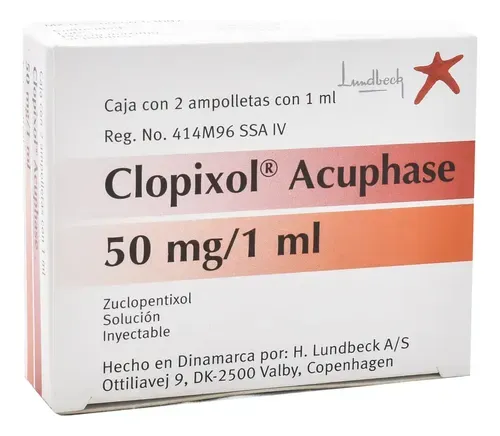
Table of Contents
- Package leaflet: Information for the user
- Introduction
- 1. What Clopixol Acufase is and what it is used for
- 2. What you need to know before starting to take Clopixol Acufase
- 3. How to take Clopixol Acufase
- 4. Possible adverse effects
- 5. Storage of Clopixol Acufase
- 6. Contents of the package and other information
Package leaflet: Information for the user
Introduction
Package leaflet: information for the user
Clopixol Acufase 50 mg/ml injection solution
zuclopentixol acetate
Read the entire leaflet carefully before you start taking this medicine, because it contains important information for you.
- Keep this leaflet, as you may need to read it again.
- If you have any questions, ask your doctor or pharmacist.
- This medicine has been prescribed for you only, and you should not give it to other people, even if they have the same symptoms as you, because it could harm them.
- If you experience any adverse reactions, consult your doctor or pharmacist, even if they are adverse reactions not listed in this leaflet. See section 4.
Leaflet contents:
- What Clopixol Acufase is and what it is used for.
- What you need to know before taking Clopixol Acufase.
- How to take Clopixol Acufase.
- Possible adverse effects.
- How to store Clopixol Acufase.
- Contents of the pack and other information.
1. What Clopixol Acufase is and what it is used for
Clopixol Acufase contains the active substance zuclopentixol. Clopixol Acufase belongs to a group of medicines called antipsychotics (also known as neuroleptics).
These medicines act on nerve pathways in specific areas of the brain and help correct certain chemical imbalances in the brain that cause the symptoms of your illness.
Clopixol Acufase is indicated for the treatment of chronic and subchronic schizophrenia, particularly in agitated and/or aggressive patients.
Initiation of treatment in the acute phase.
However, your doctor may prescribe Clopixol Acufase for another purpose. Speak with your doctor if you have any questions about why Clopixol Acufase has been prescribed for you.
2. What you need to know before starting to take Clopixol Acufase
Do not take Clopixol Acufase
- If you are allergic (hypersensitive) to zuclopentixol or to any of the other components of this medicine (listed in section 6).
- If you have reduced consciousness.
- If you have circulatory insufficiency.
Warnings and precautions
Talk to your doctor or pharmacist before starting to take Clopixol Acufase if you:
- Have a liver problem (liver disease).
- Have a serious respiratory disease.
- Have Parkinson's disease, thyroid disorders, myasthenia gravis, pheochromocytoma, or prostate hypertrophy.
- Have a history of seizures or fits.
- Have diabetes (your antidiabetic therapy may need adjustment).
- Have organic brain syndrome (this may be a condition resulting from alcohol or organic solvent poisoning).
- Have risk factors for stroke (cerebral infarction), e.g. if you are a smoker or have hypertension.
- Clopixol belongs to a group of medicines that may cause changes in the electrocardiogram (ECG); to prevent this, it should be used with caution in patients with hypokalemia or hypomagnesemia (low potassium or magnesium levels in the blood) or with a genetic predisposition to cardiac arrhythmias.
- Have a history of cardiovascular disorders.
- Are taking other antipsychotic medicines.
If you or a family member has a history of blood clots, inform your doctor, as medicines in this class have been associated with blood clot formation.
If you have persistent symptoms of infection, consult your doctor, as this may indicate a decrease in white blood cells (leukopenia).
With the use of various antipsychotics, a very rare but serious condition called neuroleptic malignant syndrome has been reported, characterized by symptoms such as high fever, unusual muscle stiffness, and altered mental status, especially if accompanied by sweating and rapid heart rate. If you experience these symptoms, they may indicate this condition and you should contact your doctor immediately (see section on possible side effects).
Movement disorders such as tremors and muscle spasms may occur, especially during the first days after starting treatment. Inform your doctor, as it may be necessary to reduce the dose. Inform your doctor if you continue to experience symptoms of an uncontrollable need to move, as these symptoms can be managed with appropriate medication. Inform your doctor if you experience uncontrolled movements of the face and jaw, as it may be necessary to discontinue treatment.
Difficulty swallowing may occur as a side effect of extrapyramidal symptoms (such as tremors, muscle spasms, or movement disorders), sedation (drowsiness), increased salivation, and/or neuroleptic malignant syndrome (a rare but dangerous reaction with fever, rigid muscles, changes in blood pressure, and coma).
Children and adolescents
Clopixol Acufase is not recommended for use in this patient group.
Taking Clopixol Acufase with other medicines
Inform your doctor or pharmacist if you are taking, have recently taken, or might need to take any other medicines.
Tell your doctor or pharmacist if you are taking any of the following medicines:
- Tricyclic antidepressants.
- Guanethidine and similar medicines (used to lower blood pressure).
- Barbiturates and similar medicines (their use with Clopixol may make you feel drowsy).
- Medicines used to treat epilepsy.
- Levodopa and similar medicines (used to treat Parkinson's disease).
- Metoclopramide (used in the treatment of gastrointestinal disorders).
- Piperazine (used to treat worm or pinworm infections).
- Medicines that affect fluid and electrolyte balance (causing low potassium or magnesium levels in your blood).
- Medicines known to increase the concentration of Clopixol Acufase in your blood.
The following medicines must not be taken at the same time as Clopixol Acufase:
- Medicines that alter heart rhythm (e.g. quinidine, amiodarone, sotalol, dofetilide, erythromycin, terfenadine, astemizole, gatifloxacin, moxifloxacin, cisapride, lithium).
- Other antipsychotic medicines (e.g. thioridazine).
Taking Clopixol Acufase with alcohol
Clopixol Acufase may enhance the sedative effects of alcohol, causing drowsiness. It is advisable not to drink alcohol during treatment with Clopixol Acufase.
Pregnancy, breastfeeding, and fertility
If you are pregnant or breastfeeding, think you may be pregnant, or are planning to become pregnant, consult your doctor before using this medicine.
Do not take Clopixol Acufase during pregnancy unless clearly necessary.
You should not use Clopixol Acufase during breastfeeding, as small amounts of the medicine may pass into breast milk.
The following symptoms may occur in newborns of mothers who have taken Clopixol during the third trimester (last three months of pregnancy): tremors, muscle stiffness and/or weakness, sleepiness, agitation, breathing difficulties, and feeding problems.
If your baby shows any of these symptoms, you should contact your doctor.
Animal studies have shown that Clopixol affects fertility. Please consult your doctor.
Driving and using machines
Clopixol may cause symptoms such as drowsiness, dizziness, or visual disturbances, and may reduce reaction time. These effects, as well as the underlying illness itself, may impair your ability to drive vehicles or operate machinery. Therefore, do not drive, operate machinery, or engage in other activities requiring special attention until your doctor has assessed your response to this medicine.
3. How to take Clopixol Acufase
Follow exactly the instructions given by your doctor for administering this medicine. Your doctor will decide the correct volume of medication and how frequently it should be administered.
A small volume of Clopixol Acufase is drawn into a syringe and then injected intramuscularly into your buttock.
The recommended dose is:
Adults
The usual dose is one injection of 1 to 3 ml (50 to 150 mg/day). This may be repeated after an interval of 2 to 3 days. Some patients may require an additional injection 1 or 2 days after the first injection.
If your dose exceeds 2 ml, it should be divided between two injection sites.
Elderly patients (over 65 years of age)
A dose reduction may be required. The maximum dose per injection should be 100 mg.
Patients at special risk
Patients with hepatic impairment usually receive the lower end of the dose range.
Use in children
Clopixol Acufase is not recommended for use in children.
If you feel that the effect of Clopixol Acufase is too strong or too weak, speak to your doctor or pharmacist.
Duration of treatment
This medicine should not be used for long-term treatment. The treatment duration should not exceed 2 weeks. During this time, no more than 4 injections or a total of 8 ml (400 mg) of medication should be administered.
If further treatment is required, your doctor will prescribe the appropriate medicine.
It is important that you complete the course of treatment exactly as directed by your doctor.
If you take more Clopixol Acufase than you should
This medicine will be administered by your doctor or nurse, so it is unlikely that you will receive more Clopixol Acufase than prescribed.
In the event of overdose or accidental ingestion, contact your doctor immediately or call the Toxicology Information Service at telephone number: 91 562 04 20, stating the name of the medicine and the amount administered.
Symptoms of overdose may include:
- Drowsiness
- Coma
- Unusual movements
- Seizures
- Shock
- High or low body temperature
- Changes in heartbeat have been observed, including irregular heartbeats or slow heart rate, when Clopixol Acufase has been administered in overdose together with drugs known to affect the heart.
If you have any further questions about the use of this medicine, ask your doctor or pharmacist.
4. Possible adverse effects
Like all medicines, this medicine can cause adverse effects, although not everyone will experience them.
If you experience any of the following symptoms, you must contact your doctor or go to hospital immediately.
Uncommon (may affect up to 1 in 100 people):
- Unusual movements of the mouth and tongue.
This may be an early sign of a condition called tardive dyskinesia.
Rare (may affect up to 1 in 1,000 people):
- Difficulty swallowing (see section 2).
Very rare (may affect up to 1 in 10,000 people):
-
High fever, unusual muscle rigidity, and disturbance of consciousness, especially if occurring with sweating and rapid heartbeat. These symptoms may be signs of a rare condition called neuroleptic malignant syndrome, which has been reported with the use of various antipsychotics.
-
Yellowing of the skin and whites of the eyes; this may indicate liver involvement and is a sign of a condition known as jaundice.
The following adverse effects are more pronounced at the beginning of treatment and most usually disappear during continued treatment.
Very common (may affect more than 1 in 10 people):
- Drowsiness (somnolence), difficulty sitting still or staying upright (akathisia), involuntary movements (hyperkinesia), slow or reduced movements (hypokinesia).
- Dry mouth.
- Movement disorders (extrapyramidal symptoms): due to effects on a part of the brain that regulates movement, which may cause tremors, muscle spasms, or movement disorders (see section 2).
Common (may affect up to 1 in 10 people):
- Fast heartbeat (tachycardia), sensation of rapid, forceful, or irregular heartbeats (palpitations).
- Tremor, repetitive movements or abnormal postures due to continuous muscle contractions (dystonia), increased muscle stiffness (hypertonia), dizziness, headache, tingling, burning, or numbness of the skin (paresthesia), attention disturbances, amnesia, abnormal gait.
- Difficulty focusing on nearby objects (accommodation disorder), visual abnormalities.
- Sensation of spinning or swaying when the body is still (vertigo).
- Nasal passage blockage (nasal congestion), difficulty breathing or painful breathing (dyspnea).
- Increased salivary secretion (hypersalivation), constipation, vomiting, digestive problems or discomfort centered in the upper abdomen (dyspepsia), diarrhea.
- Urinary disorder (urinary retention), increased urine volume (polyuria).
- Increased sweating (hyperhidrosis), itching (pruritus).
- Muscle pain (myalgia).
- Increased appetite, weight gain.
- Lack of sleep (insomnia), depression, anxiety, nervousness, abnormal dreams, agitation, decreased sexual behavior (decreased libido).
Uncommon (may affect up to 1 in 100 people):
- Hyperactive or hyperresponsive reflexes (hyperreflexia), jerky movements (dyskinesia), parkinsonism, fainting (syncope), inability to coordinate muscle activity (ataxia), speech disorder, decreased muscle tone (hypotonia), seizures, migraine.
- Circular eye movements (oculogyria), dilated pupils (mydriasis).
- Oversensitivity to certain sound frequencies or difficulty tolerating everyday sounds (hyperacusis), ringing in the ears (tinnitus).
- Abdominal pain, flatulence.
- Rash, skin reaction due to light sensitivity (photosensitivity reaction), pigmentation disorder, oily, shiny, yellowish skin due to increased sebum secretion (seborrhea), eczema or skin inflammation (dermatitis), bleeding under the skin seen as purple or red skin discolorations (purpura).
- Muscle stiffness, inability to open the mouth normally (trismus), neck twisting and unnatural head position (torticollis, neck twisting, neck stiffness).
- Decreased appetite, weight loss.
- Low blood pressure (hypotension), hot flushes.
- Thirst, abnormally low body temperature (hypothermia), fever (pyrexia).
- Redness or pain at the site of clopixol Acufase injection.
- Abnormal liver function tests.
- Sexual disorders (delayed ejaculation, problems with erection, women may have difficulty reaching orgasm, vaginal dryness (vulvovaginal dryness)).
- Marked indifference to one's surroundings (apathy), nightmares, increased sexual behavior (increased libido), confusion.
Rare (may affect up to 1 in 1,000 people):
- Low platelet count in blood (thrombocytopenia), low white blood cell count (neutropenia), reduced number of white blood cells in blood (leukopenia), bone marrow poisoning (agranulocytosis).
- Increased prolactin level in blood (hyperprolactinemia).
- High blood sugar (hyperglycemia), altered glucose tolerance, increased blood fat levels (hyperlipidemia).
- Excessive sensitivity (hypersensitivity), acute and severe systemic allergic reaction (anaphylactic reaction).
- Breast development in men (gynecomastia), excessive milk production (galactorrhea), absence of menstrual periods (amenorrhea), painful erection of the penis, persistent and not accompanied by sexual excitement or desire (priapism).
As with other medicines that act similarly to zuclopentixol acetate (the active substance in Clopixol Acufase), the following adverse effects have been reported in rare cases:
- QT prolongation (slow heartbeat and changes in the ECG).
- Irregular heartbeats (ventricular arrhythmias, ventricular fibrillation, ventricular tachycardia).
- Torsades de pointes (a specific type of irregular heartbeat).
In rare cases, irregular heartbeats (arrhythmias) may result in sudden death.
Blood clots in the veins, particularly in the legs (symptoms include swelling, pain, and redness in the legs), may travel through blood vessels to the lungs and cause chest pain and difficulty breathing. If you notice any of these symptoms, consult your doctor immediately.
In elderly patients with dementia, a small increase in the number of deaths has been reported among those taking antipsychotics compared to those who do not.
Reporting of adverse effects
If you experience any adverse effect, consult your doctor, pharmacist, or nurse, even if it is a possible adverse effect not listed in this leaflet. You can also report them directly via the Spanish Pharmacovigilance System for Human Medicines: https://www.notificaRAM.es. By reporting adverse effects, you can help provide more information on the safety of this medicine.
5. Storage of Clopixol Acufase
Normally, your doctor or nurse will store this medicine for you.
If you store it at home:
Keep this medicine out of the sight and reach of children.
Do not use this medicine after the expiry date stated on the packaging after EXP.
The expiry date refers to the last day of the month indicated.
Store the ampoules in the outer packaging to protect from light.
Medicines must not be disposed of via wastewater or household waste. Return unused medicines and their packaging to the SIGRE point at your pharmacy. If in doubt, ask your pharmacist how to dispose of medicines and packaging you no longer need. This will help protect the environment.
6. Contents of the package and other information
Composition of Clopixol Acufase
The active substance is zuclopentixol acetate.
Each millilitre (ml) of Clopixol Acufase contains 50 mg of zuclopentixol acetate.
The other component is medium-chain triglycerides.
Appearance of the product and contents of the pack
Clopixol Acufase 50 mg/ml injectable solution is supplied in glass ampoules containing 1 ml (50 mg) in a cardboard pack.
Clopixol Acufase is a clear, yellowish liquid.
Not all pack sizes may be marketed.
Marketing Authorisation Holder and Manufacturer
Marketing Authorisation Holder
Lundbeck España, S.A.
Av. Diagonal, 605, 7º-2ª
08028 Barcelona
Spain
Tel.: 93 494 96 20
Manufacturer
- Lundbeck A/S
Ottiliavej 9
2500 Valby
Denmark
Date of the most recent review of this leaflet: 01/2026
Detailed and up-to-date information on this medicinal product is available on the website of the Spanish Agency of Medicines and Health Products (AEMPS) http://www.aemps.gob.es/