Clindamycin Normon 300 mg/2 ml solution for injection EFG
Spain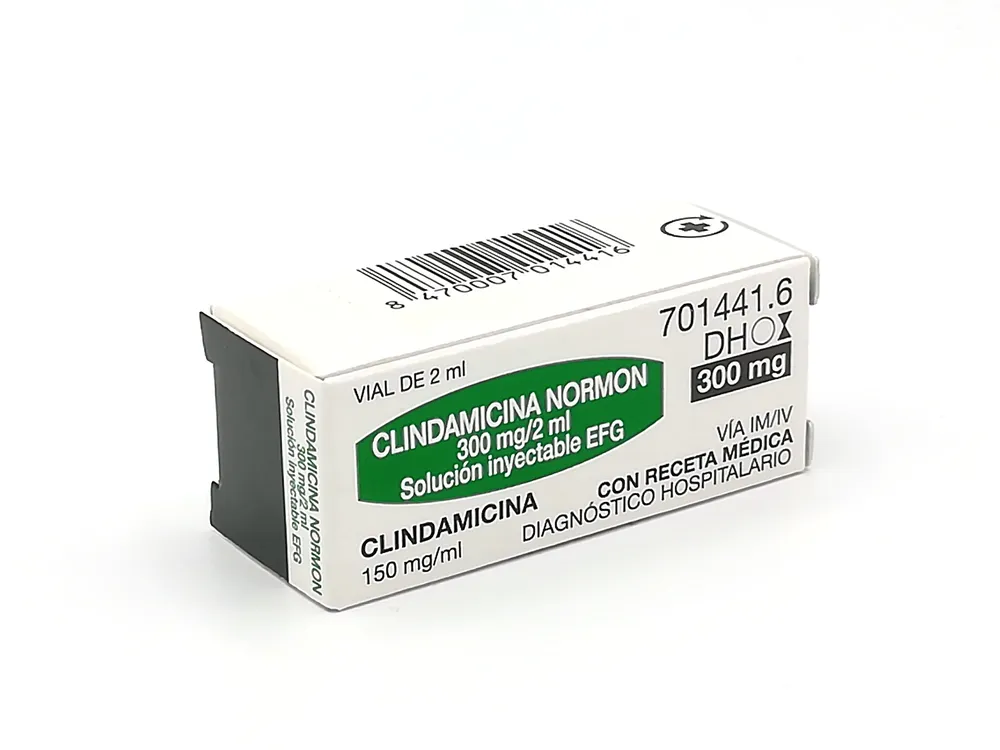
Table of Contents
- Package leaflet: Information for the user
- Introduction
- 1. What Clindamicina Normon is and what it is used for
- 2. What you need to know before starting Clindamycin Normon
- 3. How to take/use Clindamicina Normon
- 4. Possible adverse effects
- 5. Storage of Clindamicina Normon
- 6. Contents of the pack and other information
Package leaflet: Information for the user
Introduction
Package leaflet: information for the patient
Clindamicina Normon 300 mg/2 ml injectable solution EFG
Clindamycin
Read the entire leaflet carefully before you start taking this medicine, because it contains important information for you.
- Keep this leaflet, as you may need to read it again.
- If you have any questions, ask your doctor or pharmacist.
- This medicine has been prescribed for you only, and you should not give it to other people, even if they have the same symptoms as you, because it may harm them.
- If you experience any adverse reactions, consult your doctor or pharmacist, even if they are adverse reactions not listed in this leaflet. See section 4.
Contents of the leaflet
- What Clindamicina Normon is and what it is used for
- What you need to know before taking Clindamicina Normon
- How to take Clindamicina Normon
- Possible side effects
- How to store Clindamicina Normon
- Contents of the pack and other information
1. What Clindamicina Normon is and what it is used for
This medicine belongs to a group of antibiotics called lincosamides.

Antibiotics are used to treat bacterial infections and are not effective against viral infections such as influenza or the common cold.
It is important that you follow your doctor's instructions regarding dosage, administration, and duration of treatment.
Do not store or reuse this medicine. If you have any antibiotic left after completing your treatment, return it to the pharmacy for proper disposal. Do not dispose of medicines via the wastewater system or household waste.
Clindamicina is an antibiotic indicated for the treatment of serious localized infections in the lower respiratory tract, skin and soft tissues, abdomen, bones and joints, blood, and the genitourinary tract.
Additionally, clindamicina, in combination with other drugs, is effective in the treatment of the following infections:
- Toxoplasmic encephalitis (inflammation of the brain) in patients with HIV infection.
- Pneumocystis carinii pneumonia in patients with HIV infection.
2. What you need to know before starting Clindamycin Normon
Do not take Clindamycin Normon:
If you are allergic to clindamycin, lincomycin, or any of the other ingredients of this medicine (listed in section 6).
Warnings and precautions
Talk to your doctor or pharmacist before starting this medicine.
- If you have a history of gastrointestinal disease, especially conditions associated with diarrhea. This medicine may worsen diarrhea, potentially progressing to acute colitis that may require discontinuation of treatment. Contact your doctor if you develop diarrhea during or after treatment with clindamycin.
- If you have intestinal stasis (constipation).
- If you have severe renal and/or hepatic dysfunction.
- If you are receiving prolonged clindamycin therapy, you should undergo periodic check-ups.
Before starting treatment with clindamycin, inform your doctor if you have previously experienced allergic reactions to drugs.
Your doctor should continuously monitor your condition, as the use of clindamycin phosphate may lead to excessive growth of organisms not sensitive to the drug.
Acute kidney disorders may occur. Inform your doctor about any medication you are currently taking and if you have any kidney problems. If you experience reduced urine output, fluid retention causing swelling of the legs, ankles or feet, shortness of breath, or nausea, contact your doctor immediately.
Children and adolescents
Benzyl alcohol has been associated with a risk of serious adverse effects including respiratory problems ("gasping syndrome") in children.
Do not administer this medicine to your newborn (up to 4 weeks of age) unless specifically advised by your doctor.
This medicine should not be used for more than one week in children under 3 years of age unless directed by your doctor or pharmacist. For dosage and duration of treatment, see section 3. See excipients information below.
Other medicines and Clindamycin Normon
Taking Clindamycin Normon with other medicines. Inform your doctor or pharmacist if you are taking, have recently taken, or might need to take any other medicines.
Clindamycin Normon interacts with the following drugs:
- Certain muscle relaxants (pancuronium, tubocurarine, suxamethonium) and certain inhaled anesthetics (halothane, enflurane, isoflurane, diethyl ether).
- Other antibiotics such as erythromycin and aminoglycosides.
- Warfarin and similar medicines, which are used to make the blood less likely to clot and thus prevent thrombosis. There is an increased risk of bleeding when taking medicines with warfarin; therefore, your doctor may need to perform regular blood tests to monitor your blood clotting status.
Pregnancy and breastfeeding
If you are pregnant or breastfeeding, think you may be pregnant, or plan to become pregnant, consult your doctor or pharmacist before using this medicine.
Driving and using machines
There is no evidence of negative effects on the ability to drive or operate machinery.
Clindamycin Normon contains benzyl alcohol and sodium
This medicine contains 18 mg of benzyl alcohol per vial.
Benzyl alcohol may cause allergic reactions.
Consult your doctor or pharmacist if you are pregnant or breastfeeding. This is because large amounts of benzyl alcohol may accumulate in your body and cause adverse effects (metabolic acidosis).
Consult your doctor or pharmacist if you have liver or kidney disease. This is because large amounts of benzyl alcohol may accumulate in your body and cause adverse effects (metabolic acidosis).
Benzyl alcohol has been associated with a risk of serious adverse effects including respiratory problems ("gasping syndrome") in children. DO NOT administer this medicine to your newborn (up to 4 weeks of age) unless specifically recommended by your doctor. This medicine should not be used for more than one week in children under 3 years of age unless directed by your doctor or pharmacist.
This medicine contains approximately 17.2 mg of sodium (a main component of table/cooking salt) per vial. This corresponds to 0.86% of the maximum daily recommended sodium intake for an adult.
3. How to take/use Clindamicina Normon
Follow exactly the administration instructions for this medicine as indicated by your doctor or pharmacist. If in doubt, consult your doctor or pharmacist again.
This medicine is administered intravenously or intramuscularly.
Your doctor will decide the appropriate dosage and duration of treatment depending on the type of pathology.
Adults: Moderately severe infections: 1.2–1.8 g of clindamycin per day in 3 or 4 equal doses administered intravenously or intramuscularly. Severe infections: 2.4–2.7 g of clindamycin per day in 2, 3, or 4 equal doses administered intravenously or intramuscularly.
Very severe infections: Doses may be increased, although the maximum recommended dose is 2.7 g of clindamycin per day.
Use in children and adolescents
Children: The doctor may prescribe the use of this medicine in children if strictly necessary, despite the presence of benzyl alcohol as an excipient.
Newborns: 15–20 mg/kg body weight per day in 3 or 4 equal doses administered intravenously or intramuscularly. In low-weight premature infants, lower doses may be sufficient (15 mg/kg body weight per day).
Infants and older children: 20 to 40 mg/kg body weight per day in 3 or 4 equal doses administered intravenously or intramuscularly.
If you use more Clindamicina Normon than you should
In case of overdose or accidental ingestion, contact your doctor or pharmacist immediately or call the Toxicology Information Service at telephone number 91 562 04 20, indicating the medicine and the amount ingested.
If you forget to take Clindamicina Normon
Do not take a double dose to make up for missed doses.
If you have any further questions about the use of this product, ask your doctor or pharmacist.
4. Possible adverse effects
Like all medicines, this medicine may cause adverse effects, although not everyone experiences them.
The frequencies of adverse reactions are defined as follows: very common (may affect more than 1 in 10 people), common (may affect up to 1 in 10 people), uncommon (may affect up to 1 in 100 people), rare (may affect up to 1 in 1,000 people), very rare (may affect up to 1 in 10,000 people), and frequency not known (cannot be estimated from available data).
Very common: may affect more than 1 in 10 people.
- Gastrointestinal disorders: Diarrhea, which may be accompanied by blood and mucus in the stool
Frequency not known (cannot be estimated from available data)
- Blood disorders: Cases have been reported of both decreased and increased levels of certain blood cells, such as white blood cells, as well as decreased platelet counts.
- Allergic reactions: The most frequent is the appearance of skin lesions which may vary in appearance (for example, similar to measles), and which occasionally may become severe. Skin redness may also occur. Other possible adverse reactions include itching, facial swelling, and difficulty breathing.
- Gastrointestinal disorders: Nausea, vomiting, abdominal pain, flatulence (gas), and unpleasant metallic taste following high-dose intravenous administration.
- Hepatobiliary disorders: Jaundice (yellowing of the skin and mucous membranes) and changes in liver enzymes (e.g., transaminases).
- Skin and mucous membrane disorders: Cases of itching and vaginitis (inflammation of the vagina) have been reported, and rarely, cases of skin inflammation with peeling.
- Renal disorders: A few cases of increased blood urea, reduced urine output, and/or excess protein in the urine have been observed, indicating renal dysfunction.
Fluid retention causing swelling in the legs, ankles, or feet, difficulty breathing, or nausea.
- Cardiovascular disorders: Rarely, cases of cardiopulmonary collapse and hypotension (low blood pressure) have occurred following too rapid intravenous administration. If you experience any of these reactions or any other reaction not described in this leaflet, consult your doctor or pharmacist.
- Local reactions: Pain, induration (hardening of tissues), and sterile abscess after intramuscular injection, and thrombophlebitis (clot formation with inflammation of veins) after intravenous infusion.
Reporting of adverse effects
If you experience any type of adverse effect, consult your doctor or pharmacist, even if it is a possible adverse effect not listed in this leaflet. You may also report them directly via the Spanish Pharmacovigilance System for Human Medicines: https://wwwnotificaram.es. By reporting adverse effects, you can help provide more information on the safety of this medicine.
5. Storage of Clindamicina Normon
Before first opening: Store below 25°C.
It is recommended not to keep at low temperatures, as crystals may form; these dissolve upon warming with hands and gentle shaking.
After dilution: Diluted vials for intravenous administration remain stable for 24 hours at room temperature (25°C).
Keep this medicine out of the sight and reach of children.
Do not use this medicine after the expiry date stated on the packaging after EXP. The expiry date is the last day of the month indicated.
Medicines should not be disposed of via wastewater or household waste. Dispose of containers and unused medicines at a SIGRE collection point at your pharmacy. If in doubt, ask your pharmacist how to dispose of containers and medicines you no longer need. This will help protect the environment.
6. Contents of the pack and other information
Composition of Clindamicina Normon
- The active substance is clindamycin. Each vial contains 300 mg of clindamycin (as phosphate).
- Each ml of diluted solution contains 150 mg of clindamycin (as phosphate).
- The other components are benzyl alcohol, sodium hydroxide, and water for injectable preparations.
- Each vial contains 18 mg of benzyl alcohol and approximately 17.2 mg of sodium.
- Each ml of diluted solution contains 9 mg of benzyl alcohol and approximately 8.6 mg of sodium.
Appearance of the product and contents of the pack
Clindamicina Normon 300 mg/2 ml is presented as an injectable solution in packs containing 1 vial or 100 vials of 2 ml. The vial contains a clear, colorless or slightly yellow solution.
Marketing Authorization Holder and Manufacturer
LABORATORIOS NORMON, S.A.
Ronda de Valdecarrizo, 6 – 28760 Tres Cantos-Madrid (SPAIN)
Date of the most recent revision of this leaflet: July 2021
Detailed and up-to-date information on this medicine is available on the website of the Spanish Agency of Medicines and Health Products (Agencia Española de Medicamentos y Productos Sanitarios - AEMPS) http://www.aemps.es/
This information is intended for healthcare professionals only
-Intravenous administration
Prior to intravenous administration as an infusion, vials of clindamycin must be diluted in a compatible intravenous solution (5% glucose, 0.9% sodium chloride, or lactated Ringer's solution) to a clindamycin concentration not exceeding 12 mg/ml. Do not administer as a bolus injection.
Intermittent infusion
Intermittent intravenous infusion should be administered over at least 10 to 60 minutes. The concentration of clindamycin in the diluent must not exceed 12 mg/ml, and the infusion rate must not exceed 30 mg per minute. Usual infusion rates are as follows: 300 mg clindamycin in 50 ml diluent over 10 minutes; 600, 900, and 1,200 mg clindamycin in 100 ml over 20, 30, and 45 minutes, respectively. Administration of more than 1,200 mg in a single 1-hour infusion is not recommended.
Clindamycin must not be administered as a bolus injection.
Initial single rapid infusion followed by maintenance infusion
Alternatively, the first dose of clindamycin may be administered as a single rapid infusion (10 minutes or longer), followed by continuous intravenous infusion as follows: to maintain serum clindamycin levels above 4 µg/ml, administer a rapid infusion of 10 mg/min for 30 minutes, followed by a maintenance infusion of 0.75 mg/min; to maintain serum levels above 5 µg/ml, administer a rapid infusion of 15 mg/min for 30 minutes, followed by a maintenance infusion of 1 mg/min; to maintain serum levels above 6 µg/ml, administer a rapid infusion of 20 mg/min for 30 minutes, followed by a maintenance infusion of 1.25 mg/min.
-Intramuscular administration
Administration of more than 600 mg as a single injection via this route is not recommended.
Clindamycin phosphate is physically incompatible with ampicillin, sodium phenytoin, barbiturates, aminophylline, calcium gluconate, and magnesium sulfate.
The shelf life of the product after dilution of the vial is 24 hours at room temperature (25°C).