Clensia powder for oral solution
Spain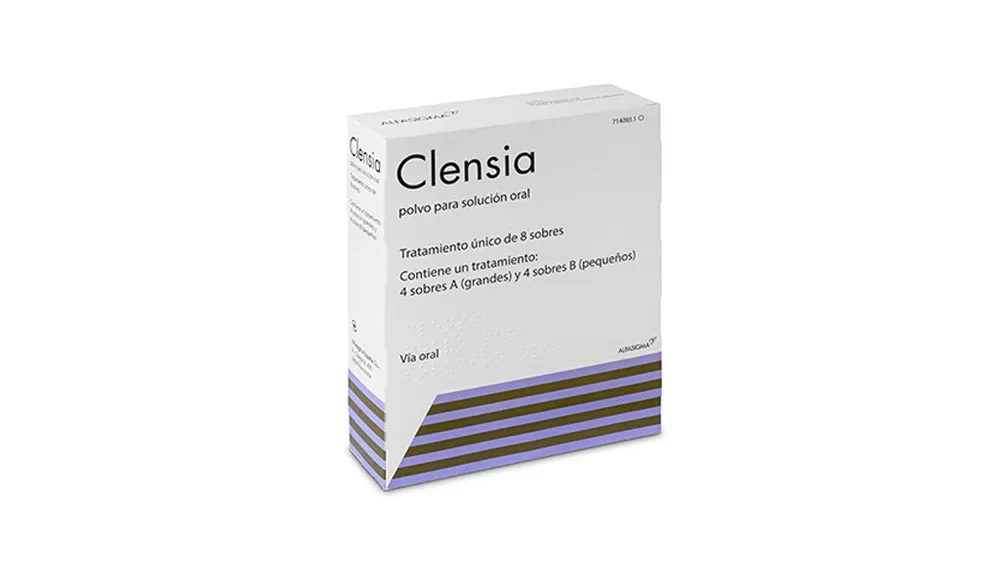
Table of Contents
Package leaflet: Information for the user
Introduction
Package leaflet: information for the user
Clensia powder for oral solution
For a list of active substances, see section 6.
Read the entire leaflet carefully before you start taking this medicine because it contains important information for you.
- Keep this leaflet as you may need to read it again.
- If you have any questions, ask your doctor or pharmacist.
- This medicine has been prescribed for you only, and you should not give it to other people, even if they have the same symptoms as you, because it could harm them.
- If you experience any adverse effects, consult your doctor or pharmacist, even if they are adverse effects not listed in this leaflet. See section 4.
Contents of the leaflet
- What Clensia is and what it is used for
- What you need to know before taking Clensia
- How to take Clensia
- Possible side effects
- How to store Clensia
- Contents of the pack and other information
1. What Clensia is and what it is used for
Clensia is an intestinal preparation with lime flavor, available as an oral powder contained in 8 sachets.
There are 4 sachets A (large) and 4 sachets B (small), to be reconstituted in water before use.
You or your child are taking this medicine to clean the bowel in preparation for its examination.
Clensia works by emptying the contents of the intestine, so you or your child will experience bowel movements.
This medicine is for use in adults, adolescents, and children aged 6 years and older.
2. What you need to know before taking Clensia
Do not take Clensia:
- if you or your child are allergic to macrogol or any of the other components of this medicine (listed in section 6)
- if you or your child have an obstruction in the gastrointestinal tract
- if you or your child have a perforation in the gastrointestinal tract
- if you or your child have altered gastric emptying
- if you or your child have intestinal paralysis (sometimes occurring after abdominal surgery)
- if you or your child have toxic colitis or toxic megacolon (a serious complication of acute colitis).
Clensia must not be administered to unconscious patients.
Warnings and precautions
Consult your doctor or pharmacist before starting to take Clensia.
If you or your child have fragile health or a serious medical condition, you should be aware of the possible adverse effects listed in section 4. If you are concerned, speak with your doctor or pharmacist.
You should consult your doctor before taking Clensia if you or your child have any of the following conditions:
- you or your child require thickened liquids to swallow safely
- tendency to regurgitate ingested drinks, food, or acid from the stomach
- kidney disease
- heart failure or heart conditions, including high blood pressure and irregular heartbeat
- dehydration (loss of body fluids that may lead to weight loss, thirst, dizziness, dry mouth, headache, dark and concentrated urine)
- acute flare-up of inflammatory bowel disease (Crohn’s disease or ulcerative colitis)
Clensia must not be administered to patients with impaired consciousness without medical supervision.
If you or your child experience sudden abdominal pain or rectal bleeding while taking Clensia for bowel preparation, contact your doctor or seek immediate medical attention.
Children
Do not administer this medicine to children from birth up to 2 years of age, as the safety and efficacy of Clensia have not been established in this age group. No data are available.
Do not administer this medicine to children between 2 and less than 6 years of age, as the efficacy of Clensia has not been established in this age group. No dosage recommendation can be made based on the available data.
Taking Clensia with other medicines
If you or your child are taking other medicines, take them at least one hour before or at least one hour after taking Clensia, as they may be flushed out of the digestive tract and not work properly. In particular, a transient increase in blood pressure has been observed related to inadequate absorption of antihypertensive medications.
Inform your doctor or pharmacist if you or your child are taking, have recently taken, or might need to take any other medicines.
If you or your child are taking medicines that affect kidney function (e.g., diuretics, non-steroidal anti-inflammatory drugs, ACE inhibitors, and Angiotensin Receptor Blockers), you or your child have an increased risk of electrolyte disturbances when using Clensia. Monitoring for adequate hydration is recommended, and laboratory tests of baseline and post-treatment levels (electrolytes, creatinine, and blood urea nitrogen) should be considered.
If you or your child require thickened liquids for safe swallowing, Clensia may neutralize the effect of the thickening agent.
Taking Clensia with food and drink
Do not take any solid food from the time you or your child start taking this medicine until after the medical examination.
Pregnancy and breastfeeding
Since absorption of Clensia into the body is negligible, Clensia may be used during pregnancy, if necessary.
There is no documented experience with the use of this medicine during breastfeeding. Since absorption of this medicine into the woman’s body during breastfeeding is negligible, it may be used during breastfeeding, if necessary.
If you are pregnant or breastfeeding, think you may be pregnant, or plan to become pregnant, consult your doctor or pharmacist before using this medicine.
Driving and use of machines
Clensia does not affect the ability to drive or operate machinery.
Clensia contains sodium and potassium
This medicine contains 3877.8 mg of sodium (main component of table/cooking salt) per liter. This corresponds to 194% of the maximum daily recommended sodium intake for an adult.
This medicine contains 11.2 mmol of potassium per liter, which should be taken into account when treating patients with renal impairment or those on potassium-restricted diets.
3. How to take Clensia
Use in adults
Follow exactly the administration instructions given by your doctor for this medicine. If in doubt, consult your doctor or pharmacist again.
This medicine is for oral use.
The package contains 4 sachets A (large) and 4 sachets B (small). The recommended dose is 4 sachets A and 4 sachets B dissolved in 2 liters of water.
Dissolve 2 sachets A and 2 sachets B in 1 liter of water each time.
Before taking Clensia, please read carefully the following instructions. You need to know:
- When to take Clensia
- How to prepare the Clensia solution
- How to drink Clensia
- What to expect
When to take Clensia
Your doctor or nurse should have informed you when to take this medicine. Your treatment with this medicine must be completed before the clinical examination takes place, and you may take it according to the following instructions:
- Full dose the day before the examination:
Dissolve 2 sachets A and 2 sachets B in 1 liter of water each time (in total, 4 sachets A and 4 sachets B dissolved in 2 liters of water) and drink it the evening before the examination.
- Split dose:
Dissolve 2 sachets A and 2 sachets B in 1 liter of water, drink it the evening before the examination, and dissolve another 2 sachets A and 2 sachets B in 1 liter of water and drink it on the morning of the examination day.
Important: Do not consume any solid food from the start of taking Clensia until after the examination.
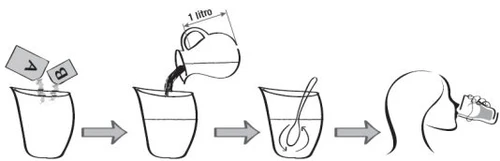
How to prepare Clensia
- Open 2 sachets A (large) and 2 sachets B (small).
- Add the contents of 2 sachets A and 2 sachets B into a suitable container.
- Add 1 liter of water to the container and stir until all the powder is dissolved.
- After preparation, the solution may be stored (kept covered) at below 25°C until the time of starting bowel preparation. The solution may also be stored in the refrigerator.
How to take Clensia
- Full dose
On the evening before the procedure, dissolve 2 sachets A and 2 sachets B in 1 liter of water and drink the Clensia solution over 1 to 1.5 hours. Try to drink 250 ml (two glasses) every 15–20 minutes.
After a break of 1–2 hours, dissolve again 2 sachets A and 2 sachets B in 1 liter of water and drink the solution.
During this treatment, it is recommended to drink an additional 1 liter of clear fluid (eight glasses) to prevent potential fluid loss due to diarrhea and maintain adequate hydration. Water, broth, fruit juices (without pulp), soft drinks, tea or coffee (without milk) are suitable. These drinks may be taken at any time desired.
- Split dose
On the evening before the diagnostic procedure, dissolve 2 sachets A and 2 sachets B in 1 liter of water and drink the solution over 1 to 1.5 hours. Additionally, drink at least 500 ml (four glasses) of additional clear fluid (water, fruit juices, soft drinks, tea/coffee without milk) during the evening.
On the morning of the diagnostic procedure day, prepare the solution following the same process (2 sachets A and 2 sachets B dissolved in 1 liter of water), followed by 500 ml (four glasses) of additional clear fluid (water, fruit juices, soft drinks, tea/coffee without milk).
Leave at least a two-hour gap without drinking before starting the colonoscopy.
What to expect
When you start drinking the Clensia solution, it is important that you stay close to a toilet.
At some point, you will begin to feel intestinal movements. This is very normal and indicates that the solution is working.
Bowel movements will stop shortly after you finish drinking the solution.
If you follow these instructions, your bowel will be cleaned, which will help ensure a proper examination.
Use in children and adolescents
Adolescents and children from 6 years of age
Give this medicine to your child exactly as instructed by your doctor. Consult your doctor if you are unsure.
This medicine is for oral use.
Clensia should be administered as a full-dose regimen the day before the diagnostic procedure, starting in mid-afternoon (4–6 p.m.).
Dissolve 2 sachets A and 2 sachets B in 1 liter of water to obtain the first liter of Clensia solution.
Dissolve 2 sachets A and 2 sachets B in another liter of water to prepare the second liter of Clensia solution, if necessary.
The dose depends on the child's age and body weight in kilograms.
Children aged 6 to less than 12 years
Weight ≤ 25 kg: give 750 ml of Clensia over 1–2 hours. Additionally, give 375 ml of clear fluid (water, fruit juice, soft drinks, tea (without milk)) for rehydration.
Weight > 25–35 kg: give 1000 ml of Clensia over 1–2 hours. Additionally, give 500 ml of clear fluid (water, fruit juice, soft drinks, tea (without milk)) for rehydration.
Weight > 35 kg: give 1250 ml of Clensia over 1–2 hours. Additionally, give 625 ml of clear fluid (water, fruit juice, soft drinks, tea (without milk)) for rehydration.
If your child has not passed watery and clear stools within 3 hours after completing the bowel preparation solution, give up to an additional 500 ml of Clensia.
Adolescents aged 12 to less than 18 years
Weight ≤ 45 kg: give 1500 ml over 2–3 hours. Additionally, give 750 ml of clear fluid (water, fruit juice, soft drinks, tea (without milk)) for rehydration.
Weight > 45 kg: give 1750 ml over 2–3 hours. Additionally, give 875 ml of clear fluid (water, fruit juice, soft drinks, tea (without milk)) for rehydration.
If the adolescent has not passed watery and clear stools within 3 hours after completing the bowel preparation solution, administer additional Clensia up to a maximum cumulative dose of 2000 ml.
Administration via nasogastric tube
The Clensia solution can be administered through nasogastric tubes of 8 Fr or larger diameter.
It is not necessary to flush the tube after administration.
If you take more Clensia than you should
If you or your child takes more Clensia than you should, you or your child may experience excessive diarrhea which may lead to dehydration. Drink generous amounts of fluids, especially fruit juices. If you are concerned, contact your doctor or pharmacist.
If you forget to take Clensia
If you or your child forgets to take Clensia, take the dose as soon as you or your child realize it has been missed.
If several hours have passed since the dose should have been taken, seek advice from your doctor or pharmacist. It is important that you or your child complete the administration at least two hours before the examination.
If you stop taking Clensia
If you have any further questions about the use of this medicine, ask your doctor or pharmacist.
4. Possible adverse effects
Like all medicines, this medicine can cause adverse effects, although not everyone will experience them.
It is common to have diarrhoea when taking Clensia.
If you experience any of the following symptoms, stop taking this medicine and contact your doctor immediately. You should not take any more Clensia until you have consulted your doctor:
- rash or itching
- swelling of the face, ankles, or any other part of the body
- irregular heartbeat
- extreme tiredness
- shortness of breath
Very common adverse effects (may affect more than 1 in 10 people):
Nausea, abdominal pain, abdominal distension.
Common adverse effects (may affect more than 1 in 100 people):
Headache, vomiting, anal irritation.
Uncommon adverse effects (may affect more than 1 in 1,000 people):
Temporary increase in blood pressure, stomach pain, taste disturbances, dry mouth, chills, decreased levels of potassium in the blood.
The following adverse effects have been reported with the use of other polyethylene glycol formulations, but their frequency is unknown because it cannot be estimated from the available data: allergic reactions (sometimes severe up to shock), dehydration, dizziness, irregular heartbeat, feeling unwell, feeling faint, sensation that the room is spinning (vertigo), redness, hives, changes in blood electrolyte levels such as decreased or increased sodium, calcium, and chloride, and decreased bicarbonate.
Blood sodium levels may also decrease, particularly in patients taking medicines that affect the kidneys, such as ACE inhibitors and diuretics used to treat heart conditions (see also "Taking Clensia with other medicines").
These reactions usually occur on the day of the procedure. If they persist, consult your doctor.
Additional adverse effects in children and adolescents
Very common adverse effects (may affect more than 1 in 10 people):
Nausea, abdominal pain, abdominal distension, vomiting, fatigue.
Common adverse effects (may affect more than 1 in 100 people):
Anal irritation, asthenia.
Uncommon adverse effects (may affect more than 1 in 1,000 people):
Headache, chills, diarrhoea, abnormal stools, belching.
Reporting of adverse effects
If you or your child experience any adverse effect, consult your doctor or pharmacist, even if it is a possible adverse effect not listed in this leaflet. You may also report them directly via the Spanish Pharmacovigilance System for Human Medicinal Products: www.notificaRAM.es.
By reporting adverse effects, you can help provide more information on the safety of this medicine.
5. Storage of Clensia
Keep this medicine out of sight and reach of children.
Do not use this medicine after the expiry date stated on the packaging after EXP. The expiry date refers to the last day of the month indicated.
Store Clensia sachets below 30°C.
After dissolving the contents of the sachets in water, the solution may be stored (kept covered) below 25°C. The solution may also be refrigerated (2°C–8°C).
Do not store the solution for longer than 24 hours.
Medicines must not be disposed of via wastewater or household waste. Dispose of unused medicines and their packaging at a SIGRE collection point at your pharmacy. Ask your pharmacist how to dispose of medicines and packaging you no longer need. This helps protect the environment.
6. Contents of the pack and other information
Composition of Clensia
The active substances are:
Sachet A
Macrogol (also known as polyethylene glycol) 4000 52.500 g
Anhydrous sodium sulfate 3.750 g
Simethicone 0.080 g
Sachet B
Sodium citrate 1.863 g
Anhydrous citric acid 0.813 g
Sodium chloride 0.730 g
Potassium chloride 0.370 g
Electrolyte concentration when 2 sachets A and 2 sachets B are dissolved in 1 litre of water is as follows:
Sodium 168.6 mmol/L
Sulfate 52.8 mmol/L
Chloride 34.9 mmol/L
Potassium 11.2 mmol/L
Citrate 21.1 mmol/L
The other excipients are potassium acesulfame (E950), lime flavour.
Nature of the product and contents of the pack
Clensia is available in a pack containing a single treatment of 8 sachets [4 sachets A (large) and 4 sachets B (small)] and in multiple packs containing 24, 48, 96, 192 packs with single treatments.
Only certain pack sizes may be marketed.
Marketing Authorization Holder:
Alfasigma España, S.L.
C/Aribau 195, 4º
08021 Barcelona
Spain
Manufacturer:
Sigmar Italia S.p.A.
Via Sombreno, 11
24011 Almé (BG)
Italy
This medicinal product is authorized in the Member States of the European Economic Area under the following names:
Germany: Clensia Pulver zur Herstellung einer Lösung zum Einnehmen
Czech Republic: Clensia Prášek pro perorální roztok
Slovakia: Clensia Prášok na perorálny roztok
Spain: Clensia Polvo para solución oral
France: Ximepeg Poudre pour solution buvable
Italy: Clensia Polvere per soluzione orale
Netherlands: Clensia Poeder voor drank
Poland: Clensia proszek do sporzadzania roztworu doustnego
Portugal: Clensia Pó para solução oral
Romania: Clensia Pulbere pentru solutie orala
Date of the most recent review of this leaflet: April 2026
Other sources of information
Detailed information on this medicinal product is available on the website of the Spanish Agency of Medicines and Health Products (AEMPS) http://www.aemps.gob.es/
This information is intended for healthcare professionals only:
Note for medical personnel:
Clensia should be administered with caution in fragile patients with poor health or in patients with severe clinical conditions such as:
- Swallowing disorders or with tendency to aspiration or regurgitation
- Altered consciousness
- Severe renal impairment (creatinine clearance < 30 ml/min)
- Cardiac failure (NYHA class III or IV)
- Dehydration
- Acute severe inflammatory disease
Any existing dehydration must be corrected prior to the use of Clensia.
Semi-conscious patients or patients prone to aspiration or regurgitation should be carefully monitored during administration, especially if administered via nasogastric tube.
Clensia must not be administered to unconscious patients.
In children unable to drink the required amount of solution, a nasogastric tube may be used, with an administration rate of 20–30 ml/minute.