Citric acid sodium chloride powder for oral solution in sachet
Spain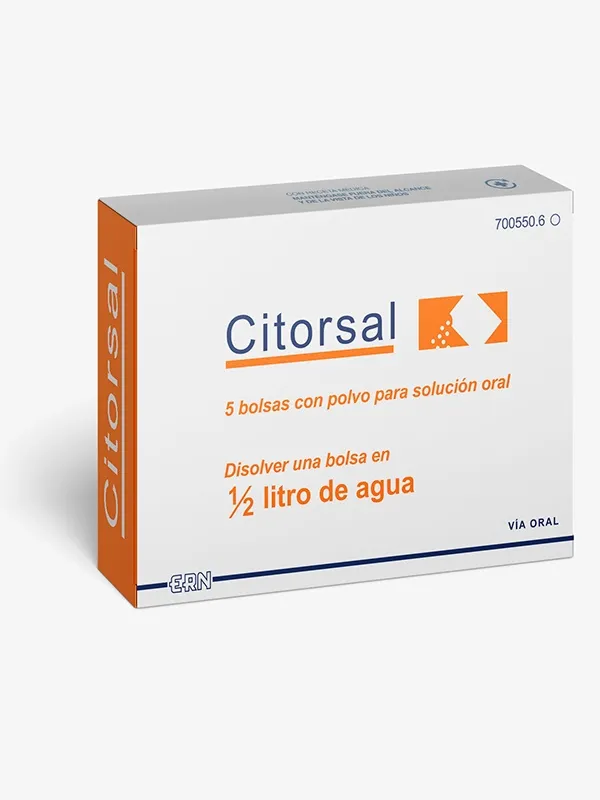
Table of Contents
Patient Information Leaflet
Introduction
Patient Information Leaflet
Citorsal
Effervescent Oral Solution Powder in Sachet
Anhydrous calcium lactate, anhydrous magnesium sulfate, anhydrous citric acid, anhydrous sodium citrate, anhydrous sodium chloride, anhydrous potassium chloride, anhydrous sodium phosphate and glucose monohydrate
Read the entire leaflet carefully before you start taking this medicine, as it contains important information for you.
- Keep this leaflet, as you may need to read it again.
- If you have any questions, ask your doctor or pharmacist.
- This medicine has been prescribed for you only, and you should not give it to other people, even if they have the same symptoms as you, since it could harm them.
- If you experience any adverse effects, consult your doctor or pharmacist, even if they are adverse effects not listed in this leaflet. See section 4.
Leaflet Contents
- What Citorsal is and what it is used for
- What you need to know before taking Citorsal
- How to take Citorsal
- Possible side effects
- How to store Citorsal
- Contents of the pack and other information
1. What Citorsal is and what it is used for
Citorsal belongs to the pharmacotherapeutic group of oral rehydration salts and is used for the prevention and treatment of mild to moderate dehydration caused by various conditions, such as acute gastrointestinal disorders in infants, acidosis, acetonemic vomiting, extrarenal uremia, vomiting during pregnancy, and in general, all cases involving substantial fluid loss due to persistent vomiting or diarrhea.
Citorsal is indicated for use in adults, infants, and children.
2. What you need to know before starting to take Citorsal
Do not take Citorsal:
- If you are allergic to the active substances or to any of the components of this medicine (listed in section 6).
- If you have glucose-galactose malabsorption.
- If you have diabetes.
- If you are unable to drink.
- If oral administration via gastric tube or intravenous administration is required.
- If you have severe, persistent diarrhea or other critical fluid losses requiring parenteral therapy.
- If you are experiencing severe and persistent vomiting.
- If you have intestinal obstruction, paralytic ileus, or intestinal perforation.
- If you have anuria (cessation of urine secretion) or oliguria (reduced urine production).
- If you have renal insufficiency.
- Premature infants or children under one month of age.
Warnings and precautions
Consult your doctor or pharmacist before starting to take Citorsal.
Take special care with Citorsal:
- When parenteral rehydration is indicated, such as in cases of severe dehydration and continuous or frequent vomiting, as Citorsal administration is not appropriate in these cases.
- You may resume normal eating once diarrhea has resolved.
Taking Citorsal with other medicines
Inform your doctor or pharmacist if you are taking, have recently taken, or might need to take any other medicines.
Due to its calcium content, absorption of tetracyclines may be interfered with.
Taking Citorsal with food and drinks
- Avoid foods or other liquids with high sugar content, such as fruit juices, or other liquids containing electrolytes; if additional fluid is needed, use water.
- Avoid salty foods.
- Cow's milk should only be discontinued if diarrhea worsens significantly after its consumption, replacing it with another protein-containing food.
Pregnancy and breastfeeding
If you are pregnant or breastfeeding, think you may be pregnant, or are planning to become pregnant, consult your doctor or pharmacist before using this medicine.
Driving and using machines
This medicine does not affect the ability to drive or operate machinery.
Citorsal contains glucose, sodium, potassium, and the colouring agent Orange Yellow S (E-110)
This medicine contains glucose. If your doctor has informed you that you have an intolerance to certain sugars, consult him before taking this medicine.
Patients with diabetes mellitus should be aware that this medicine contains 5 g of glucose per 100 ml of reconstituted solution.
This medicine contains 115 mg of sodium (main component of table/cooking salt) per 100 ml of prepared solution. This corresponds to 6% of the maximum daily recommended sodium intake for an adult.
Patients with renal insufficiency or those on potassium-restricted diets should be aware that this medicine contains 78 mg (2 mmol) of potassium per 100 ml of prepared solution.
This medicine may cause allergic reactions because it contains Orange Yellow S (E-110). It may trigger asthma, especially in patients allergic to acetylsalicylic acid.
3. How to take Citorsal
Follow exactly the instructions for administering this medicine as given by your doctor or pharmacist. If in doubt, please consult your doctor or pharmacist again.
Citorsal should be taken by dissolving the contents of one sachet in half a liter of water, or two sachets in one liter of water.
The solution must be prepared and administered at room temperature.
The water, if necessary, may have been previously boiled, but not after preparation.
Do not add any other ingredients, such as sugar.
Citorsal is administered orally.
The usual dose should be individually calculated based on the patient's weight and the severity of their condition. However, the recommended dose is generally as follows:
Infants from one month of age: It is recommended to administer between 1 – 1.5 times their usual volume of food.
Children from one year of age: 200 ml of solution for each diarrheal stool.
Adults: 200 to 400 ml of solution for each diarrheal stool.
Treatment should be continued while diarrhea persists. Once diarrhea has stopped, your doctor will assess whether rehydration has been achieved and whether there is no risk of becoming dehydrated again, which is usually achieved within 4 to 5 days.
Administration is normally performed “ad libitum,” allowing the patient to drink as much as desired. In patients with very frequent diarrhea, encourage them to drink. In very weak patients, assistance may be required.
In children, especially if weak or experiencing vomiting, it is advisable to administer the solution in amounts of 25 to 30 ml at intervals of 10 to 15 minutes.
If dehydration is mild, and in children under 2 years of age, on the first day of treatment, give one dose of plain water for every two doses of Citorsal oral rehydration solution, all of the same volume. On subsequent days, drink water frequently.
Always start with small amounts and gradually increase according to the patient's needs. In all cases, it is recommended to administer the solution frequently, in small quantities and slowly, to facilitate absorption. In infants and children, continued feeding—including breastfeeding—is important to maintain hydration and nutrition.
In adults, normal diet should be resumed as soon as appetite returns.
Elderly patients
The recommended dosage regimen is the same as for adults.
Patients with hepatic impairment
In this case, dose adjustment is not necessary.
Patients with renal impairment
Citorsal must not be administered to patients with impaired renal function, as these patients may develop very high levels of sodium (hypernatremia) and potassium (hyperkalemia) in the blood.
Instructions for correct administration of the preparation:
Empty the contents of one sachet into half a liter of water (500 ml), or two sachets into one liter of water. To facilitate dissolution, it is recommended to slowly add the powder to the water while vigorously stirring with a tablespoon until completely dissolved.
Under certain circumstances, which do not affect its therapeutic properties at all, Citorsal may harden in the sachet. Simply press the sachet with your hand to turn it back into a fine, equally soluble powder.
If you take more Citorsal than you should
In case of overdose or accidental ingestion, contact your doctor or pharmacist immediately, or call the Toxicology Information Service at telephone number: 91 562 04 20, indicating the medicine and the amount taken.
Excess Citorsal may cause overhydration. Discontinue treatment if you notice swollen eyelids.
In patients with impaired renal function, overdose may lead to hypernatremia and hyperkalemia.
If you forget to take Citorsal
Do not take a double dose to make up for missed doses.
4. Possible adverse effects
Like all medicines, this medicine may cause adverse effects, although not everyone will experience them. The most common are vomiting, which may occur if the medicine is administered too quickly. In such cases, administration of Citorsal should be interrupted for 10 minutes and then resumed with smaller amounts given more frequently.
Reporting of adverse effects
If you experience any type of adverse effect, consult your doctor or pharmacist, even if it is a possible adverse effect not listed in this leaflet. You may also report them directly via the Spanish Pharmacovigilance System for Human Medicines: https://www.notificaram.es. By reporting adverse effects, you can help provide more information on the safety of this medicine.
5. Storage of Citorsal
Keep this medicine out of the sight and reach of children.
Any unused solution must be discarded 24 hours after preparation and does not require any special storage precautions.
Do not use this medicine after the expiry date stated on the packaging after EXP. The expiry date refers to the last day of the month indicated.
Medicines should not be disposed of via wastewater or household waste. Return empty containers and unused medicines to the SIGRE collection point at your pharmacy. If you are unsure, please ask your pharmacist how to dispose of containers and medicines you no longer need. This will help protect the environment.
6.
Composition of Citorsal
- The active substances are anhydrous calcium lactate, anhydrous magnesium sulfate, anhydrous citric acid, anhydrous sodium citrate, anhydrous sodium chloride, anhydrous potassium chloride, anhydrous sodium phosphate, and glucose monohydrate.
- The other components are: neohesperidin, orange flavor, and orange-yellow dye S (E-110).
Each sachet must be dissolved in half a liter (500 ml) of water. Each 100 ml of the resulting solution contains as active substances: 0.0436 g of anhydrous calcium lactate, 0.024 g of anhydrous magnesium sulfate, 0.032 g of anhydrous citric acid, 0.258 g of anhydrous sodium citrate, 0.0585 g of anhydrous sodium chloride, 0.149 g of anhydrous potassium chloride, 0.071 g of anhydrous sodium phosphate, and 5 g of glucose (monohydrate).
Appearance of the product and contents of the container
Citorsal is presented as slightly orange-colored powder for oral solution with an orange odor, in sachets. It may be available in two pack sizes: cartons containing 2 or 5 aluminum-paper sachets.
Marketing Authorization Holder
LABORATORIOS ERN, S.A.
Perú, 228 - 08020 Barcelona, Spain
Manufacturer
LABORATORIOS ERN, S.A.
Gorgs Lladó, 188 – 08210 Barberà del Vallès, Barcelona, Spain
Date of latest review of this leaflet: June 2020
Detailed and up-to-date information on this medicinal product is available on the website of the Spanish Agency for Medicines and Health Products (AEMPS) http://www.aemps.gob.es/.