Ciproxina 2 mg/ml + 10 mg/ml otic suspension drops
SpainTable of Contents
- Package leaflet: Information for the user
- Introduction
- 1. What CIPROXINA is and what it is used for
- CIPROXINA contains two active substances, a steroid anti-inflammatory (hydrocortisone) and an antibiotic (ciprofloxacin); ciprofloxacin is a antibacterial agent belonging to the group known as fluoroquinolones, which works by eliminating bacteria that cause infections.
- 2. What you need to know before using CIPROXINA
- 3. How to use CIPROXINA
- 4. Possible adverse effects
- 5. Storage of CIPROXINA
- 6. Contents of the pack and other information
Package leaflet: Information for the user
Introduction
Package leaflet: information for the user
CIPROXINA 2 mg/ml + 10 mg/ml ear drops, suspension
ciprofloxacin / hydrocortisone
Read the entire leaflet carefully before you start using this medicine, because it contains important information for you.
- Keep this leaflet; you may need to read it again.
- If you have any questions, ask your doctor or pharmacist.
- This medicine has been prescribed for you only, and you should not give it to others, even if they have the same symptoms as you, because it could harm them.
- If you experience any adverse reactions, consult your doctor or pharmacist, even if they are adverse reactions not listed in this leaflet. See section 4.
Leaflet contents
- What CIPROXINA is and what it is used for
- What you need to know before using CIPROXINA
- How to use CIPROXINA
- Possible side effects
- How to store CIPROXINA
- Contents of the pack and other information
1. What CIPROXINA is and what it is used for
CIPROXINA is an antibiotic that contains the active substance ciprofloxacin. Ciprofloxacin belongs to a group of antibiotics called fluoroquinolones, which work by killing bacteria that cause infections.
CIPROXINA is used to treat infections caused by bacteria, such as:
- Infections of the respiratory tract (e.g., worsening of chronic bronchitis)
- Infections of the urinary tract (e.g., cystitis, pyelonephritis)
- Infections of the genital tract (e.g., gonorrhea, prostatitis)
- Infections of the gastrointestinal tract (e.g., infectious diarrhea caused by E. coli, Shigella, or Campylobacter)
- Skin and soft tissue infections
- Bone and joint infections
- Infections in patients with low white blood cell counts (neutropenia) and fever, suspected to be due to bacteria
- Prevention of infections caused by Bacillus anthracis (anthrax)
- Complicated infections of the abdomen
- Complicated infections of the urinary tract and kidneys (e.g., pyelonephritis)
CIPROXINA works only against bacterial infections and is not effective against viral infections such as the common cold or flu.
CIPROXINA contains two active substances, a steroid anti-inflammatory (hydrocortisone) and an antibiotic (ciprofloxacin); ciprofloxacin is a antibacterial agent belonging to the group known as fluoroquinolones, which works by eliminating bacteria that cause infections.
One of the active ingredients in this medicine is an antibiotic. Antibiotics are used to treat bacterial infections and are not effective against viral infections.
It is important that you follow the instructions regarding dosage, dosing interval, and duration of treatment as directed by your doctor.
Do not store or reuse this medication. If you have leftover antibiotic after completing treatment, return it to the pharmacy for proper disposal. Medicines must not be disposed of down the drain or in household waste.
This medicine is used to treat acute external otitis (infection of the ear canal) with non-perforated eardrum, in adults and children over 2 years of age.
2. What you need to know before using CIPROXINA
Before prescribing this medicine, your doctor will have examined your eardrums to ensure they are not perforated.
Do not use CIPROXINA
- if you are allergic (hypersensitive) to ciprofloxacin or to other medicines in the fluoroquinolone group.
- if you are allergic (hypersensitive) to hydrocortisone or to any of the other ingredients listed in section 6.
- if your eardrum is perforated or damaged.
- if you have viral or fungal ear infections, including infections caused by varicella virus or herpes simplex virus.
- if you have otitis media (an infection or inflammation of the middle ear). Symptoms include ear pain, high temperature (fever), and a feeling of blocked ears.
Warnings and precautions
- use CIPROXINA only in the ears. This medicine must not be injected or swallowed.
- if you experience any rash or notice early signs of skin rash or any other local allergic reaction, including hives, itching, or breathing problems, stop treatment immediately and consult your doctor.
- use of this medicine may make you more susceptible to other infections. Consult your doctor if symptoms and signs persist after one week of treatment.
- the dropper cap contains latex rubber, which may cause severe allergic reactions.
- contact your doctor if you experience blurred vision or other visual disturbances.
Children
CIPROXINA is not recommended for use in children under 2 years of age due to lack of data in these patients.
Use of CIPROXINA with other medicines
Inform your doctor or pharmacist if you are taking, have recently taken, or might need to take any other medicines.
It is recommended not to apply other ear medications at the same time.
Pregnancy and breastfeeding
If you are pregnant or breastfeeding, think you may be pregnant, or are planning to become pregnant, consult your doctor or pharmacist before using this medicine.
Driving and using machines
Treatment with CIPROXINA does not affect the ability to drive or operate machinery.
Ciproxina contains benzyl alcohol
This medicine contains 90 mg of benzyl alcohol in each 10 ml bottle, equivalent to 9 mg/ml. Benzyl alcohol may cause allergic reactions and moderate local irritation.
The dropper cap contains latex rubber
The dropper cap contains latex rubber. It may cause severe allergic reactions.
3. How to use CIPROXINA
This medicine is for ear use only. Do not inject or ingest this medicine.
Always follow exactly the instructions for using CIPROXINA as given by your doctor. If in doubt, consult your doctor or pharmacist again.
Apply 3 drops into the ear canal of the affected ear twice daily, in the morning and at night.
The usual duration of treatment is 7 days. If symptoms persist after this time, consult your doctor.
To ensure effectiveness of this medicine, use it regularly at the prescribed dose and for the period of time indicated by your doctor.
Disappearance of symptoms does not mean you are completely cured. Any feeling of fatigue is not due to the treatment, but to the infection. Reducing the dose or stopping treatment prematurely will not affect this sensation and may only delay your recovery.
For correct application of the drops, follow these steps:
- Wash your hands thoroughly.
- Unscrew the cap of the bottle and place the dropper into the bottle.
- Warm the bottle immediately before use by holding it in the palm of your hand for a few minutes to avoid discomfort when the cold suspension comes into contact with your ear.
- Shake the bottle before use.
- Tilt your head to the side opposite the affected ear, so that the affected ear faces upward, and apply the drops into the affected ear.
- While keeping your head tilted, gently pull the earlobe forward and backward (Figure 1). This movement helps the drops to enter the ear canal.
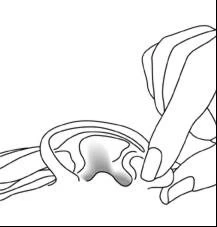 Figure 1
- Keep your head tilted to that side for about 5 minutes to help the drops enter the external ear canal. However, when you raise your head, some drops may leak out. You may wipe them away gently with a non-sterile absorbent paper.
- Repeat, if necessary, in the other ear.
It is very important to follow these instructions to achieve optimal effectiveness of the medicine in the ear. When applying the drops, do not keep your head upright or move it too quickly, as some drops may be lost by running down the face and fail to enter the ear canal.
Avoid letting the dropper come into contact with the ears or fingers to minimize the risk of contamination of the drops.
After completing the treatment, discard any remaining solution in the bottle and do not keep it for future use.
If you use more CIPROXINA than you should, do not apply additional drops until the next scheduled dose.
In case of overdose or accidental ingestion, contact your doctor, pharmacist, or call the Toxicology Information Service immediately at telephone 91 562 04 20, indicating the name of the medicine and the amount ingested.
If you forget to use CIPROXINA, apply a single dose as soon as you remember, and then continue with your next scheduled dose. However, if it is almost time for your next dose, do not apply the missed dose and continue with your regular dosing schedule. Do not apply a double dose to make up for a missed dose.
If you have any further questions about the use of this medicine, ask your doctor or pharmacist.
4. Possible adverse effects
Like all medicines, CIPROXINA may produce adverse effects, although not everyone experiences them.
The following adverse effects have been observed with CIPROXINA:
Frequent
(may affect up to 1 in 10 people)
Ear effects: itching in the ear.
Uncommon
(may affect up to 1 in 100 people)
Ear effects: ear pain, ear congestion, ear discomfort, redness of the ear canal.
Other effects: dizziness, headache, nausea, skin peeling, fungal skin infection, urticaria, skin rash, itching, abnormal or decreased sensation in the skin, and presence of medication residue inside or around the ear.
Additional adverse effects have been reported for which the frequency is unknown (cannot be estimated from available data), including:
Ear effects: reduced hearing, tinnitus (ringing in the ears).
Eye effects: blurred vision.
Other effects: allergy.
Reporting of adverse effects
If you experience any type of adverse effect, consult your doctor or pharmacist, even if it is a possible adverse effect not listed in this leaflet. You may also report them directly via the Spanish Pharmacovigilance System for Human Medicinal Products: https://www.notificaram.es. By reporting adverse effects, you can help provide more information on the safety of this medicine.
5. Storage of CIPROXINA
Keep this medicine out of sight and reach of children.
Do not use this medicine after the expiry date stated on the bottle and carton after EXP. The expiry date refers to the last day of the month indicated.
Do not store above 25°C.
Do not refrigerate or freeze.
Keep the container in the outer carton to protect it from light.
Keep the container tightly closed to protect it from moisture.
After opening the bottle and inserting the dropper, the drops should be used within the following 14 days.
At the end of treatment, any remaining contents of the bottle must be discarded. Do not keep it for future use.
Medicines must not be disposed of via wastewater or household waste. Return empty containers and unused medicines to the SIGRE collection point at your pharmacy. If in doubt, ask your pharmacist how to dispose of containers and medicines no longer required. This will help protect the environment.
6. Contents of the pack and other information
Composition of CIPROXINA
- The active substances are ciprofloxacin 2 mg/ml and hydrocortisone 10 mg/ml.
- The other components are polysorbate 20, sodium acetate, glacial acetic acid, benzyl alcohol, lecithin, sodium chloride, polyvinyl alcohol, and purified water.
Appearance of the medicine and contents of the pack
CIPROXINA is a white to off-white liquid (a suspension). It is supplied in a carton containing a 10 ml glass bottle with a polypropylene screw cap, and separately, a dropper (a polypropylene pipette, a polypropylene cap, and a latex rubber bung).
Marketing Authorisation Holder
Novartis Farmacéutica, S.A.
Gran Via de les Corts Catalanes, 764
08013 - Barcelona, Spain
Manufacturer
Novartis Farmacéutica S.A.
Gran Via de les Corts Catalanes, 764
08013 Barcelona, Spain
Date of the most recent revision of this leaflet: September 2020
Detailed and up-to-date information on this medicine is available on the website of the Spanish Agency for Medicines and Health Products (AEMPS): http://www.aemps.gob.es