Cinfatos Antitussive 15 mg oral solution in sachets
Spain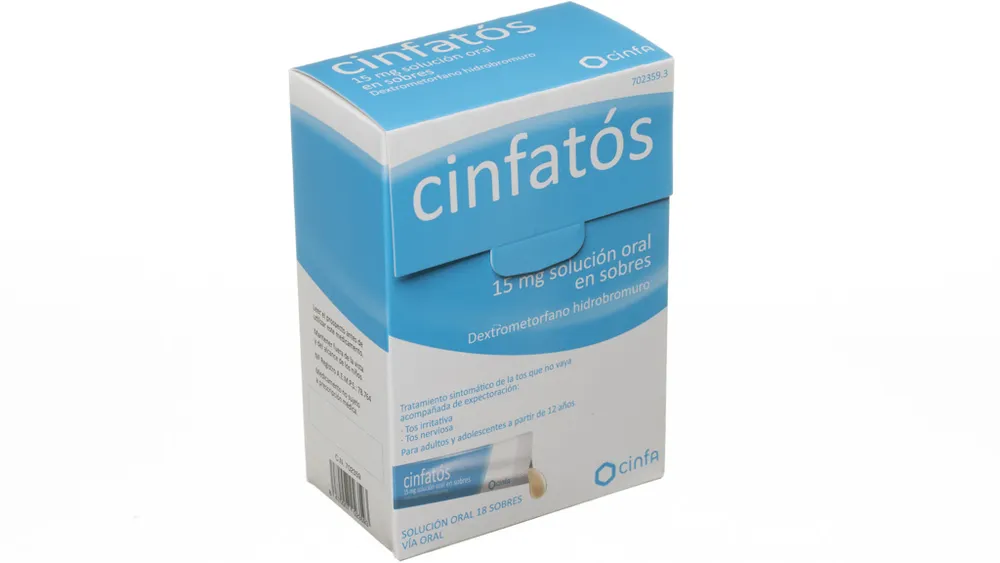
Table of Contents
- Package leaflet: Information for the user
- Introduction
- 1. What is cinfatós antitussive and what is it used for
- 2. What you need to know before taking cinfatós antitussive.
- 3. How to take cinfatós antitussive
- 4. Possible adverse effects
- 5. Storage of Cinfatós antitussive
- 6. Contents of the pack and other information
Package leaflet: Information for the user
Introduction
Package leaflet: information for the user
cinfatós antitussive 15 mg oral solution in sachets
Dextromethorphan hydrobromide
Read the entire leaflet carefully before you start taking this medicine, because it contains important information for you.
Follow exactly the instructions for use provided in this leaflet or as directed by your doctor or pharmacist.
- Keep this leaflet, as you may need to read it again.
- If you need advice or more information, consult your pharmacist.
- If you experience any adverse effects, consult your doctor or pharmacist, even if they are adverse effects not listed in this leaflet. See section 4.
- You should consult a doctor if your condition worsens or if you develop a high fever, skin rash, persistent headache, or if you do not improve after 7 days of treatment.
Contents of the leaflet
- What cinfatós antitussive is and what it is used for
- What you need to know before taking cinfatós antitussive
- How to take cinfatós antitussive
- Possible adverse effects
- How to store cinfatós antitussive
- Contents of the pack and other information
1. What is cinfatós antitussive and what is it used for
Dextromethorphan, the active ingredient in this medicine, is an antitussive that suppresses the cough reflex.
It is indicated for the symptomatic treatment of dry cough (non-productive cough, irritative cough, nervous cough) in adults and adolescents aged 12 years and older.
You should consult a doctor if symptoms worsen or do not improve after 7 days of treatment.
2. What you need to know before taking cinfatós antitussive.
This medicine may cause dependence. Therefore, treatment should be short-term.
Do not take cinfatós antitussive
- If you are allergic to dextromethorphan or to any of the other ingredients of this medicine (listed in section 6).
- If you have a severe lung disease.
- If you have asthmatic cough.
- If you have a cough accompanied by abundant secretions.
- If you are currently taking or have taken within the previous 2 weeks any monoamine oxidase inhibitor (MAOI) medicines used to treat depression or Parkinson's disease or other conditions, as well as other serotonin reuptake inhibitor medicines used to treat depression such as fluoxetine and paroxetine, or also bupropion, which is a medicine used to stop smoking, or linezolid, which is an antibacterial medicine. (See section: Other medicines and cinfatós antitussive).
- Children under 12 years of age must not take this medicine.
Warnings and precautions
Talk to your doctor or pharmacist before taking cinfatós antitussive.
This medicine may cause dependence. Therefore, treatment should be short-term.
Patients should especially consult their doctor before using this medicine if they:
- Have persistent or chronic cough, such as that caused by smoking. Particularly in children, chronic cough may be an early sign of asthma.
- Have liver or kidney disease.
- Have atopic dermatitis (an inflammatory skin disease characterized by erythema, itching, exudation, crusting, and scaling, which begins in childhood in individuals with a hereditary predisposition to allergy).
- Are sedated, weakened, or bedridden.
- Have CYP2D6 polymorphism (a genetic alteration affecting the activity of this liver enzyme).
- Are taking other medicines such as antidepressants or antipsychotics, as cinfatós antitussive may interact with these medicines and you may experience changes in your mental state (e.g., agitation, hallucinations, coma) and other effects such as body temperature above 38°C, increased heart rate, high blood pressure, exaggerated reflexes, muscle rigidity, lack of coordination and/or gastrointestinal symptoms (e.g., nausea, vomiting, and diarrhea).
Cases of abuse of medicines containing dextromethorphan have been reported in adolescents; therefore, this possibility should be considered, as it may lead to serious adverse effects (see section: If you take more cinfatós antitussive than you should). This medicine may also be addictive, so its use at high doses or for prolonged periods may lead to tolerance and mental and physical dependence. In patients with a tendency to abuse or dependence, this medicine should only be administered under strict medical supervision and for short periods of time.
Children
Children under 12 years of age must not take this medicine due to the amount of dextromethorphan contained in each sachet.
Other formulations more suitable for this age group are available.
Other medicines and cinfatós antitussive
Tell your doctor or pharmacist if you are taking, have recently taken, or might need to take any other medicines.
Do not take this medicine during treatment with, or within 2 weeks after stopping, the following medicines, as it may cause excitation, high blood pressure, and fever above 40°C (hyperpyrexia):
- Monoamine oxidase inhibitor (MAOI) antidepressants (moclobemide, tranylcypromine, clorgyline, iproniazid, and isocarboxazid).
- Serotonin reuptake inhibitor antidepressants (fluoxetine, sibutramine, sertraline, or paroxetine).
- Bupropion (used to stop smoking).
- Linezolid (used as an antibacterial agent).
- Procarbazine (used to treat cancer).
- Selegiline (used to treat Parkinson's disease).
Before starting this medicine, consult your doctor if you are taking any of the following medicines, as it may be necessary to adjust the dose or interrupt treatment:
- Amiodarone and quinidine (used to treat heart arrhythmias).
- Anti-inflammatory medicines (celecoxib, parecoxib, or valdecoxib).
- Central nervous system depressants (some of which are used to treat: mental disorders, allergies, Parkinson's disease, etc.).
- Expectorants and mucolytics (used to eliminate phlegm and mucus).
- CYP2D6 inhibitors such as haloperidol (used to treat mental disorders).
Taking cinfatós antitussive with food, drinks, and alcohol
Do not consume alcoholic beverages during treatment, as they may cause adverse effects.
Do not take together with grapefruit or orange juice during treatment, as they may increase the adverse effects of this medicine.
Pregnancy and breastfeeding
If you are pregnant or breastfeeding, think you may be pregnant, or plan to become pregnant, consult your doctor or pharmacist before using this medicine.
Pregnant or breastfeeding women should not take this medicine without consulting their doctor.
Driving and using machines
Rarely, drowsiness and mild dizziness may occur during treatment. If you experience these symptoms, you should not drive or operate dangerous machinery.
cinfatós antitussive contains sorbitol (E-420).
This medicine contains 3000 mg of sorbitol per sachet.
Sorbitol is a source of fructose. If your doctor has told you (or your child) that you have an intolerance to certain sugars, or if you (or your child) have been diagnosed with hereditary fructose intolerance (HFI), a rare genetic condition in which the patient cannot break down fructose, consult your doctor before taking this medicine.
Sorbitol may cause gastrointestinal discomfort and a mild laxative effect.
cinfatós antitussive contains ethanol.
This medicine contains 0.015% ethanol (alcohol), a small amount corresponding to 1.12 mg per sachet (7.5 ml).
cinfatós antitussive contains sodium benzoate (E-211).
This medicine contains 26.25 mg of sodium benzoate per sachet.
cinfatós antitussive contains sodium.
This medicine contains less than 23 mg of sodium (1 mmol) per sachet; hence, it is essentially "sodium-free".
3. How to take cinfatós antitussive
Follow exactly the instructions for use provided in this leaflet or those given by your doctor or pharmacist. If in doubt, consult your doctor or pharmacist.
The recommended dose is:
Adults and adolescents aged 12 years and over: Take 1 sachet (15 mg of dextromethorphan) every 4 hours. Do not exceed 6 doses in 24 hours.
Alternatively, 2 sachets (30 mg) may be taken every 6 to 8 hours, depending on the severity of the cough. Do not exceed 4 doses in 24 hours.
The maximum amount to be taken in 24 hours is 8 sachets (120 mg), divided into several doses. Always use the lowest effective dose.
Use in children
Children under 12 years of age must not take this medicine due to the amount of dextromethorphan contained in each sachet.
Method of administration
cinfatós antitussive is taken orally.
Open the sachet and pour the contents directly into the mouth. It is recommended to drink a glass of water after each dose and plenty of fluids throughout the day.
It may be taken with or without food.
Do not take with grapefruit juice or bitter orange juice, or with alcoholic beverages (see section: Taking cinfatós antitussive with food, drinks and alcohol).
If your cough worsens or persists beyond 7 days of treatment, or if it is accompanied by high fever, skin rash, or persistent headache, consult your doctor.
If you take more cinfatós antitussive than you should
If you take more cinfatós antitussive than indicated, you may experience the following symptoms: nausea and vomiting, involuntary muscle contractions, agitation, confusion, drowsiness, disturbances of consciousness, rapid and involuntary eye movements, cardiac disorders (increased heart rate), coordination problems, psychosis with visual hallucinations, and hyperexcitability.
Other symptoms in cases of massive overdose may include: coma, severe breathing problems, and seizures.
Contact your doctor or hospital immediately if you experience any of the symptoms listed.
Cases of abuse have been reported with medications containing dextromethorphan in adolescents, which may lead to serious adverse effects such as tachycardia (increased heart rate), lethargy, hypertension or hypotension (high or low blood pressure), mydriasis (dilation of the pupil of the eye), agitation, dizziness, gastrointestinal discomfort, hallucinations, slurred speech, nystagmus (involuntary and uncontrolled eye movements), fever, tachypnea (rapid and shallow breathing), brain damage, ataxia (uncoordinated movements), seizures, respiratory depression, loss of consciousness, arrhythmias (irregular heartbeat), and death.
In case of poisoning, appropriate treatments for the symptoms will be administered, which may include intravenous naloxone injection and gastric lavage.
In case of overdose or accidental ingestion, contact your doctor or pharmacist immediately or call the Toxicology Information Service at telephone number 91 562 04 20, indicating the medication and the amount ingested.
If you forget to take cinfatós antitussive
Do not take a double dose to make up for missed doses. If you have forgotten a dose, take it as soon as possible and then continue with your usual dosing schedule, as indicated in section 3. How to take cinfatós antitussive.
If you have any further questions about the use of this medicine, ask your doctor or pharmacist.
4. Possible adverse effects
Like all medicines, this medicine may cause adverse effects, although not everyone experiences them.
During the period of dextromethorphan use, the following adverse effects have been observed, whose frequency could not be established accurately:
- Nervous system disorders: somnolence, dizziness, fatigue, involuntary muscle contractions, and more rarely mental confusion and headache.
- Gastrointestinal disorders: nausea, vomiting, gastrointestinal discomfort such as stomach pain, constipation.
- Ear and labyrinth disorders: vertigo.
- Immune system disorders: hypersensitivity and anaphylactic reaction including symptoms such as: skin rash, urticaria, edema, pruritus, and cardio-respiratory difficulty.
- Psychiatric disorders: visual hallucinations and confusion. These effects are much more pronounced in cases of overdose (See section If you take more cinfatós antitussive than you should).
- Skin and subcutaneous tissue disorders: skin rash, urticaria, pruritus, erythema, allergic dermatitis.
Reporting of adverse effects
If you experience any type of adverse effect, consult your doctor or pharmacist, even if it involves possible adverse effects not listed in this leaflet. You can also report them directly through the Spanish Pharmacovigilance System for Human Medicinal Products: https://www.notificaram.es. By reporting adverse effects, you can help provide more information on the safety of this medicine.
5. Storage of Cinfatós antitussive
Keep this medicine out of the sight and reach of children.
Do not use this medicine after the expiry date stated on the packaging, after EXP. The expiry date is the last day of the month indicated.
This medicine does not require any special storage conditions.
Medicines must not be disposed of via wastewater or household waste. Dispose of unused medicines and their containers at the SIGRE Point at your pharmacy. If you are in doubt, ask your pharmacist how to dispose of medicines and containers you no longer need. This will help protect the environment.
6. Contents of the pack and other information
Composition of cinfatós antitussive
- Each sachet contains 15 mg of dextromethorphan hydrobromide as the active substance.
- The other components (excipients) are: non-crystallizable sorbitol liquid 70% (E-420), sodium benzoate (E-211), sodium saccharin (E-954), citric acid monohydrate, orange flavoring, ethanol 96%, and purified water.
Appearance of the product and contents of the pack
cinfatós antitussive is a transparent oral solution with an orange odor.
Each box of cinfatós antitussive contains 18 single-dose sachets.
Marketing Authorization Holder and Manufacturer
Laboratorios Cinfa, S.A.
Carretera Olaz-Chipi, 10. Polígono Industrial Areta
31620 Huarte (Navarra) - Spain
Date of the most recent revision of this leaflet: December 2020
Detailed and up-to-date information on this medicinal product is available on the website of the Spanish Agency for Medicines and Health Products (AEMPS) http://www.aemps.gob.es/
You can access detailed and up-to-date information about this medicine by scanning with your mobile phone (smartphone) the QR code included in the package leaflet and outer packaging. You can also access this information at the following internet address: https://cima.aemps.es/cima/dochtml/p/78764/P_78764.html
QR code to: https://cima.aemps.es/cima/dochtml/p/78764/P_78764.html