Cinfadol Spray 39.2 mg/ml solution for cutaneous spray
Spain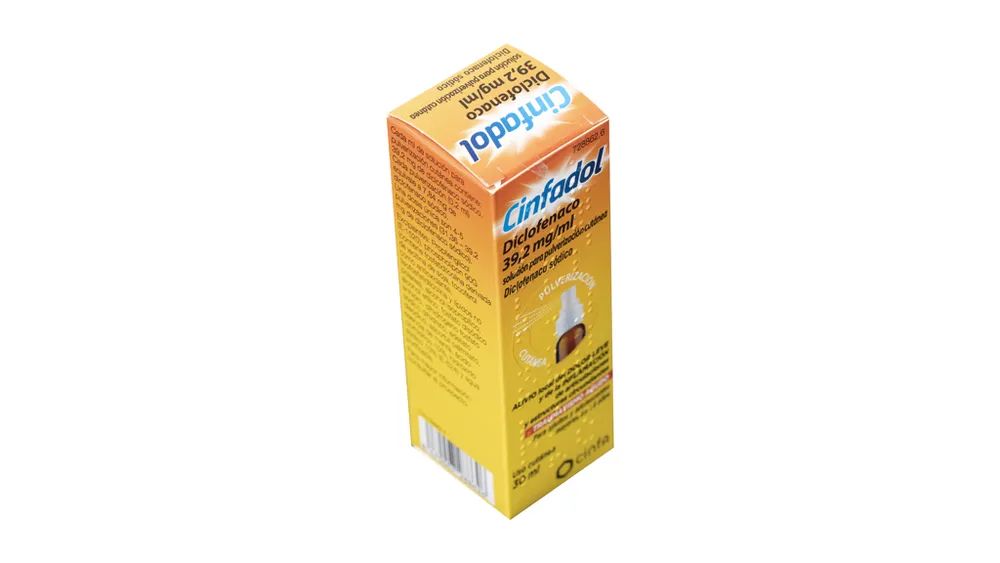
Table of Contents
Package leaflet: Information for the user
Introduction
Package leaflet: information for the patient
Cinfadol SPRAY 39.2 mg/ml solution for cutaneous spray
Diclofenac sodium
Read the entire leaflet carefully before you start using this medicine, because it contains important information for you:
Follow exactly the instructions for using this medicine as described in this leaflet or as directed by your doctor or pharmacist.
- Keep this leaflet, as you may need to read it again.
- If you need advice or more information, consult your pharmacist.
- If you experience any adverse reactions, consult your doctor or pharmacist, even if they are adverse reactions not listed in this leaflet. See section 4.
- You should consult a doctor if your condition worsens or if you do not improve after 3 days.
Leaflet contents:
- What Cinfadol SPRAY is and what it is used for.
- What you need to know before using Cinfadol SPRAY.
- How to use Cinfadol SPRAY.
- Possible side effects.
- How to store Cinfadol SPRAY.
- Contents of the pack and other information.
1. What Cinfadol SPRAY is and what it is used for
Diclofenac sodium, the active ingredient in this medicine, belongs to the group of non-steroidal anti-inflammatory drugs (NSAIDs) and acts as a local analgesic and anti-inflammatory agent.
This medicine is used in adults and adolescents over 14 years of age for the local symptomatic relief of mild to moderate pain and inflammation in small and medium joints and surrounding structures following an acute injury.
You should consult a doctor if your condition worsens or does not improve after 3 days.
2. What you need to know before using Cinfadol SPRAY
Do not use Cinfadol SPRAY:
- If you are allergic (hypersensitive) to sodium diclofenac, peanut, soy, or any of the other components of this medicine (listed in section 6).
- If you have ever had an allergic reaction with breathing difficulties, skin rash, and rhinorrhea (runny nose) to any other medicine used to treat pain, fever, or inflammation, such as ibuprofen or acetylsalicylic acid (also used to prevent blood clotting). If you are unsure, consult your doctor or pharmacist.
- If the patient is a child or adolescent under 14 years of age.
- On wounds, inflamed or infected skin, eczematous lesions, burns, or mucous membranes.
- During the third trimester of pregnancy – see the section on pregnancy and breastfeeding.
- On the chest area in women who are breastfeeding.
Warnings and precautions
Talk to your doctor or pharmacist before starting to use this medicine.
- If you have or have had gastric ulcers, liver or kidney problems, a tendency to bleeding, or any inflammatory bowel disease.
- If you have suffered from bronchial asthma or allergies.
- Do not apply on areas of skin with cuts or open wounds, on mucous membranes, or on eczema or areas of skin with a rash.
- Stop using the medicine if a skin rash occurs after application.
- Avoid using it on large areas of skin unless advised by a doctor. Use it only on the affected area.
- Avoid contact with the eyes. If this occurs, rinse the eyes with clean water and consult your doctor or pharmacist if you experience any discomfort afterwards.
- Do not cover the treated area with occlusive dressings (waterproof or non-breathable) or adhesive plasters.
- Do not use more of the medicine than indicated, or for longer than recommended, unless advised by your doctor.
- Do not apply simultaneously in the same area where other medicines have been applied.
- Do not swallow this medicine or use it in the mouth. This medicine is for external use only. Consult your doctor or pharmacist in case of accidental ingestion.
- Treated areas must not be exposed to sunlight (even when cloudy) or ultraviolet radiation lamps (UVA rays).
The possibility of systemic adverse effects related to the use of this medicine cannot be ruled out if used over large skin areas for prolonged periods.
Adverse effects can be minimized by using the lowest effective dose for the shortest possible duration.
Children and adolescents
Do not use this medicine in children and adolescents under 14 years of age.
Other medicines and Cinfadol SPRAY
Inform your doctor or pharmacist if you are taking, have recently taken, or might need to take any other medicines, including those obtained without a prescription.
Inform your doctor before using this medicine:
- If you are taking tablets, capsules, or using suppositories for pain, including any medicine containing sodium diclofenac, acetylsalicylic acid (aspirin), or any other anti-inflammatory medicine, for example ibuprofen.
Using another NSAID (e.g., acetylsalicylic acid or ibuprofen) together with this medicine may increase the risk of adverse effects.
Pregnancy and breastfeeding
If you are pregnant or breastfeeding, think you may be pregnant, or plan to become pregnant, consult your doctor or pharmacist before using this medicine.
Pregnancy
Do not use this medicine during the last three months of pregnancy. You should not use this medicine during the first six months of pregnancy unless strictly necessary and recommended by your doctor. If treatment is needed during this period, you should take the lowest possible dose for the shortest possible time.
Oral formulations (e.g., tablets) of diclofenac may cause adverse effects on the fetus. It is unknown whether the same risk applies to diclofenac when used on the skin.
Breastfeeding
Consult your doctor or pharmacist before using any medicine.
Do not use this medicine during breastfeeding unless specifically instructed by your doctor.
Under no circumstances should it be applied directly to the chest area or to other large skin areas or for prolonged periods.
Driving and using machines
The topical use of this medicine has no effect on the ability to drive or operate machinery.
Cinfadol SPRAY contains propylene glycol (E-1520), soybean lecithin, and peppermint essence:
- May cause skin irritation as it contains propylene glycol (E-1520).
- Contains soybean lecithin. Do not use this medicine if you are allergic to peanut or soy.
Contains peppermint essence which may cause allergic reactions.
3. How to use Cinfadol SPRAY
Follow exactly the administration instructions provided in this leaflet or those given by your doctor or pharmacist. If in doubt, consult your doctor or pharmacist again.
The recommended dose is:
Adults and adolescents over 14 years of age: Apply 4-5 sprays 3 times a day at regular intervals, either onto the hand or directly onto the painful or inflamed area, always with gentle massage to facilitate skin penetration. The amount of this medicine will vary depending on the size of the affected area. A maximum dose of 5 sprays per application or 15 sprays per day on the affected area must never be exceeded.
Treatment may be discontinued when symptoms (pain and swelling) have subsided.
Treatment should not continue for longer than 7 days without medical review.
Consult your doctor if your condition worsens or if there is no improvement after 3 days of treatment.
Use in children and adolescents:
Do not use in children or adolescents under 14 years of age.
Method of use:
This medicine is a solution for topical use on the skin (cutaneous use). It must not be administered by any other route under any circumstances.
Follow the instructions carefully:
- Remove the transparent protective cap from the pump.
- Before first use, press the pump four times to prime it, discarding the contents. Failure to properly prime the pump may result in an under-dose upon first use.
- Apply the recommended dose using the dispenser in an upright position, either onto the hand or directly onto the painful or inflamed area.
- Spread the solution over the painful and inflamed area of skin using gentle massage. Afterwards, wash your hands unless they are the area being treated.
If you use more Cinfadol SPRAY than you should
If you apply more medicine than indicated, remove the excess with a dressing.
If you accidentally ingest this medicine or use it over a large skin area for a prolonged period, adverse reactions similar to those caused by oral diclofenac (e.g. tablets) may occur.
In case of overdose or accidental ingestion, go immediately to a medical center or call the Toxicology Information Service (91 562 04 20), indicating the medicine and the amount ingested.
If you forget to use Cinfadol SPRAY
If you forget to apply this medicine at the scheduled time, apply the solution as soon as possible and continue treatment as before. Do not use a double dose to make up for a missed dose.
If you have any further questions about the use of this medicine, ask your doctor or pharmacist.
4. Possible adverse effects
Like all medicines, this medicine can cause adverse effects, although not everyone experiences them.
Stop treatment with this medicine if a skin rash appears. After topical application (skin application) of preparations containing diclofenac, reactions at the application site have frequently been observed, such as rash, itching, redness, burning sensation, or skin peeling.
Some rare and very rare adverse effects can be serious:
If you experience any of the following signs of allergy, stop using this medicine and consult your doctor or pharmacist immediately.
- Rare (may affect up to 1 in 1,000 people): Skin rash accompanied by blisters; urticaria (red, raised rashes, often with itching and burning sensation).
- Very rare (may affect up to 1 in 10,000 people): Difficulty breathing or feeling of pressure in the chest (asthma); swelling of the face, lips, tongue, or throat.
Other adverse effects may occur, but these are usually mild and transient. If you notice any of them, consult your doctor or pharmacist as soon as possible.
- Frequent (may affect up to 1 in 10 people): Rash, itching, redness, or stinging of the skin after using the medicine.
- Very rare (may affect up to 1 in 10,000 people): The skin may become more sensitive to sunlight (photosensitivity). Signs include itchy sunburn, swelling, and blisters. Pustular rash.
- Frequency not known (cannot be estimated from available data): Burning sensation at the application site, dry skin.
If topical diclofenac is applied over a very large area of skin and for a prolonged period of time, systemic adverse effects may occur, such as stomach pain and gastric disturbances, heartburn, liver or kidney problems, and hypersensitivity reactions.
Reporting of adverse effects
If you experience any type of adverse effect, consult your doctor or pharmacist, even if it is a possible adverse effect not listed in this leaflet. You may also report them directly through the Spanish Pharmacovigilance System for Human Medicines: www.notificaRAM.es. By reporting adverse effects, you can help provide more information on the safety of this medicine.
5. Storage of Cinfadol SPRAY
Keep this medicine out of the sight and reach of children.
Store in the original packaging to protect it from light.
Do not use this medicine after the expiry date stated on the container, following “EXP”. The expiry date refers to the last day of the month indicated.
After first opening, discard the bottle with any remaining solution after 6 months.
Medicines must not be disposed of via wastewater or household waste. Dispose of containers and unused medicines at the SIGRE collection point at your pharmacy. If you are unsure, please ask your pharmacist how to dispose of containers and medicines you no longer need. This will help protect the environment.
6. Storage of the container and additional information
Composition of Cinfadol SPRAY:
- The active substance is sodium diclofenac. Each ml of cutaneous spray solution (equivalent to 5 sprays) contains 39.2 mg of sodium diclofenac. Each spray (0.2 ml of solution) delivers 7.84 mg of sodium diclofenac.
- The other components (excipients) are: Isopropyl alcohol, Phospholipon 90G (contains phosphatidylcholine derived from soybean lecithin, tocopherol as antioxidant, lysophosphatidylcholine and non-polar lipids), ethanol, anhydrous disodium phosphate, sodium dihydrogen phosphate dihydrate, edetate disodium, propylene glycol (E-1520), ascorbyl palmitate, peppermint essence, hydrochloric acid 10%, sodium hydroxide 10% (E-524), and purified water.
Appearance of Cinfadol SPRAY and contents of the pack:
Slightly yellowish transparent solution with a mint odour, which becomes gel-like in consistency after application.
Amber glass bottle containing 30 ml of solution (25 g), equipped with a pump and polyethylene immersion tube.
Only certain pack sizes may be marketed.
Marketing Authorization Holder
Laboratorios Cinfa, S.A.
Carretera Olaz-Chipi, 10. Polígono Industrial Areta
31620 Huarte (Navarra) – Spain
Manufacturer
FARMALIDER, S.A.
Aragoneses, 2
28108 Madrid
Spain
or
MEDINFAR MANUFACTURING S.A.
Parque Industrial Armando Martins Tavares,
Rua Outeiro Da Armada No 5,
Condeixa-a-Nova, 3150-194, Portugal
Date of the most recent revision of this leaflet: September 2024
"Detailed information on this medicine is available on the website of the Spanish Agency for Medicines and Health Products (AEMPS) (http://www.aemps.gob.es/)."