Cinacalcet Normon 60 mg film-coated tablets EFG
Spain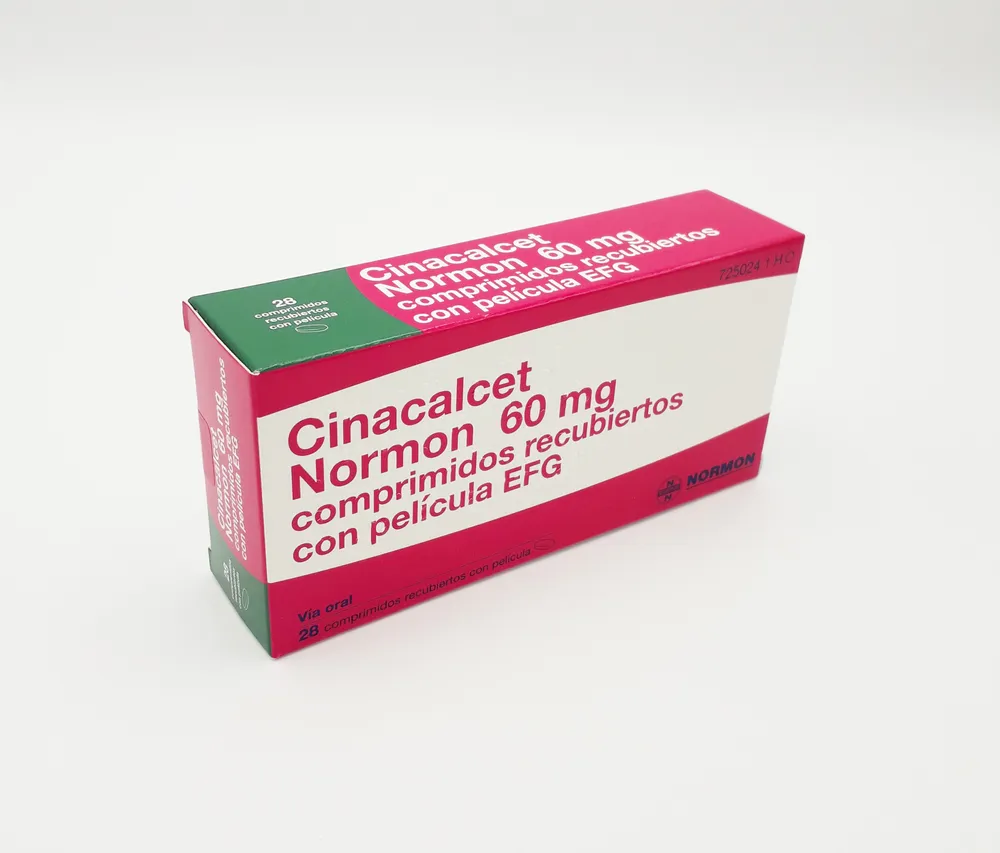
Table of Contents
Patient Information Leaflet
Introduction
Patient Information Leaflet
Cinacalcet Normon 60 mg film-coated tablets EFG
Cinacalcet
Read all of this leaflet carefully before you start taking this medicine, as it contains important information for you.
- Keep this leaflet, as you may need to read it again.
If you have any questions, ask your doctor, pharmacist, or nurse.
- This medicine has been prescribed for you only, and you must not give it to other people, even if they have the same symptoms as you, because it may harm them.
- If you experience any adverse effects, consult your doctor, pharmacist, or nurse, even if they are adverse effects not listed in this leaflet. See section 4.
Leaflet Contents
- What Cinacalcet Normon is and what it is used for
- What you need to know before taking Cinacalcet Normon
- How to take Cinacalcet Normon
- Possible side effects
- How to store Cinacalcet Normon
- Contents of the pack and other information
1. What Cinacalcet Normon is and what it is used for
Cinacalcet Normon works by controlling the levels of parathyroid hormone (PTH), calcium, and phosphorus in your body, and is used to treat disorders of organs called parathyroid glands. The parathyroid glands are four small glands located in the neck, near the thyroid, which produce parathyroid hormone (PTH).
Cinacalcet Normon is used in adults:
- to treat secondary hyperparathyroidism in adults with severe kidney disease who require dialysis to remove waste products from their blood.
- to reduce high levels of calcium in the blood (hypercalcemia) in adult patients with parathyroid cancer.
- to reduce high levels of calcium in the blood (hypercalcemia) in adult patients with primary hyperparathyroidism when removal of the parathyroid glands is not possible.
Cinacalcet Normon is used in children between 3 years and less than 18 years of age:
- to treat secondary hyperparathyroidism in patients with severe kidney disease who require dialysis to remove waste products from their blood, and whose condition is not controlled with other treatments.
In both primary and secondary hyperparathyroidism, the parathyroid glands produce too much PTH. The term "primary" means that the hyperparathyroidism is not caused by any other disease, and "secondary" means that the hyperparathyroidism is caused by another disease, such as kidney disease. Both primary and secondary hyperparathyroidism can lead to loss of calcium from the bones, which may result in bone pain and fractures, problems in blood vessels and heart vessels, kidney stones, mental disorders, and coma.
2. What you need to know before taking Cinacalcet Normon
Do not take Cinacalcet Normon if you are allergic to cinacalcet or to any of the other ingredients of this medicine (listed in section 6).
Do not take Cinacalcet Normon if you have low levels of calcium in your blood. Your doctor will monitor your blood calcium levels.
Warnings and precautions
Talk to your doctor, pharmacist, or nurse before starting treatment with cinacalcet.
Before starting cinacalcet, inform your doctor if you have or have ever had:
- seizures (fits or convulsions). The risk of seizures is higher in people who have previously experienced them;
- liver problems;
- heart failure.
Cinacalcet lowers calcium levels. Life-threatening events and fatal outcomes associated with low calcium levels (hypocalcemia) have been reported in adults and children treated with cinacalcet.
Inform your doctor if you experience any of the following symptoms, which may indicate low calcium levels: muscle spasms, twitching or cramps, or numbness and tingling in the fingers, toes, or around the mouth, or seizures, confusion, or loss of consciousness while on cinacalcet treatment.
Low calcium levels may affect your heart rhythm. Inform your doctor if you experience unusually strong or rapid heartbeats, have problems with your heart rhythm, or are taking medications that may cause heart rhythm disturbances while taking cinacalcet.
For additional information, see section 4.
During treatment with cinacalcet, inform your doctor:
- if you start or stop smoking, as this may alter the effect of cinacalcet.
Children and adolescents
Children under 18 years of age with parathyroid cancer or primary hyperparathyroidism must not take cinacalcet.
If you are being treated for secondary hyperparathyroidism, your doctor should monitor your calcium levels before starting and during treatment with cinacalcet. You must inform your doctor if you experience any of the symptoms related to low calcium levels described above.
It is important that you take your dose of cinacalcet exactly as prescribed by your doctor.
Other medicines and Cinacalcet Normon
Inform your doctor or pharmacist if you are taking, have recently taken, or might need to take any other medicines, particularly etelcalcetide or any other medicine that lowers calcium levels in your blood.
You must not receive cinacalcet together with etelcalcetide.
Inform your doctor if you are taking any of the following medicines.
The following medicines may alter the effect of cinacalcet:
- medicines used to treat skin conditions and fungal infections (ketoconazole, itraconazole, and voriconazole);
- medicines used to treat bacterial infections (telithromycin, rifampicin, and ciprofloxacin);
- a medicine used to treat infections caused by the human immunodeficiency virus (HIV) and AIDS (ritonavir);
- a medicine used to treat depression (fluvoxamine).
Cinacalcet may alter the effect of the following medicines:
- medicines used to treat depression (amitriptyline, desipramine, nortriptyline, and clomipramine);
- a medicine used to relieve cough (dextromethorphan);
- medicines used to treat heart rhythm disorders (flecainide and propafenone);
- a medicine used to treat high blood pressure (metoprolol).
Taking Cinacalcet Normon with food and drink
Cinacalcet should be taken with food or shortly after eating.
Pregnancy, breastfeeding, and fertility
If you are pregnant or breastfeeding, think you may be pregnant, or are planning to become pregnant, consult your doctor or pharmacist before using this medicine.
Cinacalcet has not been studied in pregnant women. During pregnancy, your doctor may decide to change your treatment, as cinacalcet may be harmful to the unborn baby.
It is not known whether cinacalcet passes into breast milk. Your doctor will advise you whether you should discontinue breastfeeding or stop treatment with cinacalcet.
Driving and use of machines
Dizziness and seizures have been reported in patients taking cinacalcet. If you experience these effects, do not drive or operate machinery.
3. How to take Cinacalcet Normon
Follow exactly the instructions for using this medicine given by your doctor or pharmacist. If in doubt, consult your doctor or pharmacist again. Your doctor will tell you how much cinacalcet you should take.
Cinacalcet should be taken orally, with food or shortly after eating. The tablets should be swallowed whole and must not be chewed, crushed, or split.
Your doctor will perform regular blood tests during treatment to monitor your progress and, if necessary, adjust the dose you are receiving.
If the treatment is for secondary hyperparathyroidism
The usual starting dose of cinacalcet in adults is 30 mg (one tablet) once daily.
The usual starting dose of cinacalcet in children aged 3 years to less than 18 years should not exceed 0.20 mg/kg body weight per day.
If the treatment is for parathyroid cancer or primary hyperparathyroidism
The usual starting dose of cinacalcet in adults is 30 mg (one tablet) twice daily.
If you take more Cinacalcet Normon than you should
If you have taken more cinacalcet than you should, you must contact your doctor immediately. Possible signs of overdose include numbness or tingling around the mouth, muscle pain or cramps, and seizures.
If you forget to take Cinacalcet Normon
Do not take a double dose to make up for missed doses.
If you forget to take a dose of cinacalcet, take the next dose at your usual time.
If you have any further questions about the use of this medicine, ask your doctor, pharmacist, or nurse.
4. Possible adverse effects
Like all medicines, this medicine can cause adverse effects, although not everyone experiences them.
Tell your doctor immediately:
- If you notice numbness or tingling around the mouth, muscle pain or cramps, and seizures. These may be symptoms of low calcium levels (hypocalcemia).
- If you notice swelling of the face, lips, mouth, tongue, or throat, which may cause difficulty swallowing or breathing (angioedema).
Very common: may affect more than 1 in 10 people
- Nausea and vomiting. These adverse effects are usually mild and transient.
Common: may affect up to 1 in 10 people
- Dizziness,
- Sensation of numbness or tingling (paresthesia),
- Loss (anorexia) or decreased appetite,
- Muscle pain (myalgia),
- Weakness (asthenia),
- Skin rash,
- Decreased testosterone levels,
- High potassium levels in the blood (hyperkalemia),
- Allergic reactions (hypersensitivity),
- Headache,
- Seizures (fits or attacks),
- Low blood pressure (hypotension),
- Upper respiratory tract infection,
- Difficulty breathing (dyspnea),
- Cough,
- Stomach discomfort (dyspepsia),
- Diarrhea,
- Abdominal pain, upper abdominal pain,
- Constipation,
- Muscle spasms,
- Back pain,
- Low calcium levels in the blood (hypocalcemia).
Not known: frequency cannot be estimated from available data
- Hives (urticaria),
- Swelling of the face, lips, mouth, tongue, or throat, which may cause difficulty swallowing or breathing (angioedema),
- Unusually fast or strong heartbeat, which may be associated with low calcium levels in your blood (prolonged QT and ventricular arrhythmia secondary to hypocalcemia).
In a small number of patients with heart failure, their condition and/or low blood pressure (hypotension) worsened after taking cinacalcet.
Reporting of adverse effects
If you experience any adverse effect, consult your doctor, pharmacist, or nurse, even if it is a possible adverse effect not listed in this leaflet. You can also report them directly via the Spanish Pharmacovigilance System for Human Medicines: https://www.notificaram.es. By reporting adverse effects, you can help provide more information on the safety of this medicine.
5. Storage of Cinacalcet Normon
Keep this medicine out of the sight and reach of children.
Do not use this medicine after the expiry date stated on the carton and blister after EXP. The expiry date refers to the last day of the month indicated.
This medicine does not require any special storage conditions.
Medicines should not be disposed of via wastewater or household waste. Ask your pharmacist how to dispose of medicines and packaging that you no longer need. This will help protect the environment.
6. Contents of the container and other information
Composition of Cinacalcet Normon
- The active substance is cinacalcet. Each film-coated tablet contains 60 mg of cinacalcet (as hydrochloride).
- The other components are:
Tablet core
Microcrystalline cellulose |
Povidone |
Colloidal anhydrous silica |
Crospovidone |
Magnesium stearate |
Tablet coating |
Hypromellose |
Titanium dioxide (E-171) |
Triacetin |
Talc |
Indigo carmine lake (E-132) |
Yellow iron oxide (E-172) |
Appearance of the product and contents of the container
Film-coated tablet, light green in colour, elongated and biconvex, 13.1 mm long and 6 mm wide, marked with “C60” on one side and plain on the other.
Cinacalcet Normon is supplied in blisters containing 60 mg film-coated tablets. Each box contains 28 tablets.
Marketing Authorization Holder and Manufacturer:
LABORATORIOS NORMON, S.A.
Ronda de Valdecarrizo, 6
28760 Tres Cantos, Madrid
Spain
Date of the most recent review of this leaflet: February 2019