Cholestagel 625 mg film-coated tablets
Spain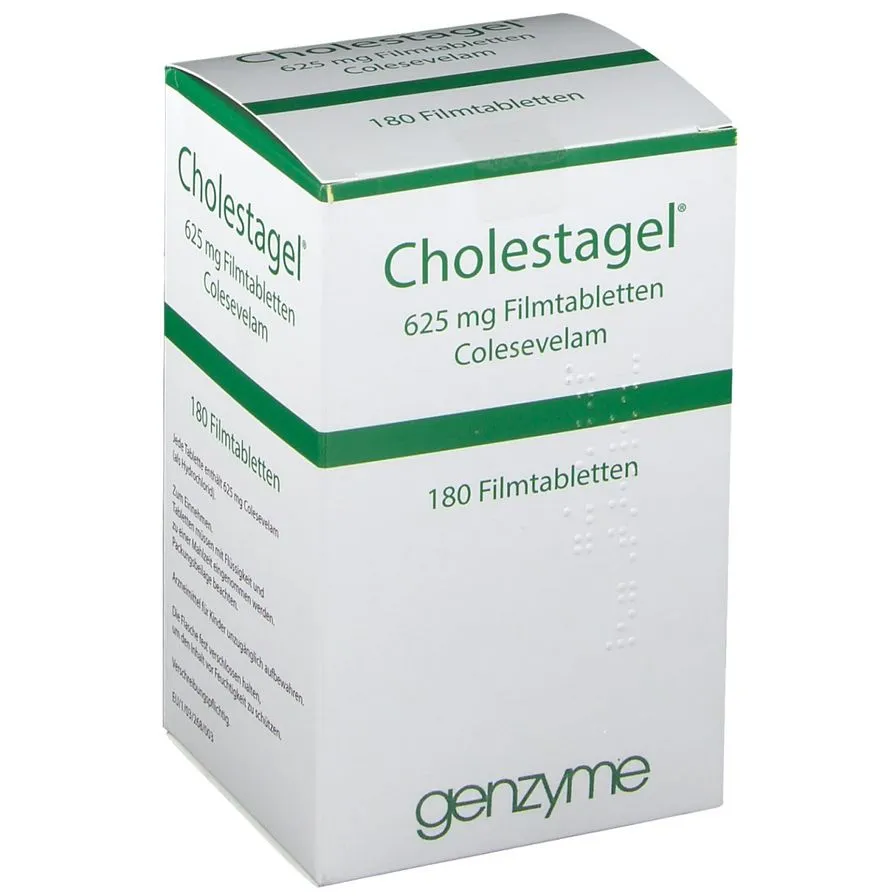
Table of Contents
Package leaflet: Information for the user
Introduction
Package leaflet: information for the user
Cholestagel 625mg film-coated tablets
Colesevelam
Read the entire leaflet carefully before you start taking this medicine, because it contains important information for you.
- Keep this leaflet as you may need to read it again.
- If you have any questions, ask your doctor or pharmacist.
- This medicine has been prescribed for you only, and you should not give it to others, even if they have the same symptoms as you, because it could harm them.
- If you experience any adverse effects, consult your doctor or pharmacist, even if they are effects not listed in this leaflet. See section 4.
Contents of the leaflet
- What Cholestagel is and what it is used for
- What you need to know before taking Cholestagel
- How to take Cholestagel
- Possible side effects
- How to store Cholestagel
- Contents of the pack and other information
1. What Cholestagel is and what it is used for
Cholestagel contains the active substance colesevelam (as hydrochloride). Taking Cholestagel helps you reduce the level of cholesterol in your blood. Your doctor should prescribe Cholestagel if a low-fat and low-cholesterol diet has not been sufficiently effective.
Cholestagel works in the intestinal system by binding to bile acids produced by the liver and removing these bile acids from the body through the faeces, thereby preventing the body from recycling bile acids from the intestines in the normal way. Because this recycling process is interrupted, the liver must produce additional bile acids, using cholesterol from the blood, which reduces the concentration of cholesterol in the blood.
Cholestagel is prescribed to treat a condition known as primary hypercholesterolaemia (when blood cholesterol is high) in adults.
- Cholestagel may be prescribed alone, together with a low-fat and low-cholesterol diet, when treatment with a statin (a class of cholesterol-lowering medicine that acts on the liver) is not appropriate or not well tolerated.
- Cholestagel may be used in combination with a statin and a low-fat and low-cholesterol diet when patients treated with a statin alone are not adequately controlled.
- Cholestagel may also be used with ezetimibe (a cholesterol-lowering medicine that works by reducing cholesterol absorption from the intestine), with or without a statin.
2. What you need to know before taking Cholestagel
Do not take Cholestagel:
- if you are allergic to colesevelam or to any of the other ingredients of this medicine (listed in section 6)
- if you have intestinal blockage or blockage of the bile ducts (the ducts that carry bile).
If you are prescribed Cholestagel together with another medicine, you must also read the leaflet of that medicine before starting treatment.
Warnings and precautions Talk to your doctor or pharmacist before taking Cholestagel
- if your triglyceride levels (fats in the blood) are above 3.4 mmol/l
- if you have difficulty swallowing or have a serious stomach or intestinal disorder
- if you suffer from constipation, as Cholestagel may cause or worsen this condition. This is especially important in patients with coronary heart disease and angina pectoris.
If you think any of the above points apply to you, you must inform your doctor or pharmacist before taking Cholestagel.
Before starting treatment with Cholestagel, your doctor should ensure that certain conditions are not contributing to your high cholesterol levels. These may include poorly controlled diabetes, untreated hypothyroidism (low thyroid hormone levels for which no treatment is currently provided), protein in the urine (nephrotic syndrome), altered blood protein levels (dysproteinemias), or obstruction of bile flow to the gallbladder (obstructive liver disease).
Children and adolescents
The safety and efficacy in children (under 18 years of age) have not been studied. Therefore, the use of Cholestagel is not recommended in this population.
Other medicines and Cholestagel
Tell your doctor or pharmacist if you are taking, have recently taken, or might take any other medicines.
If your doctor suspects that Cholestagel might affect the absorption of other medicines, you may be advised to take Cholestagel at least 4 hours before or 4 hours after taking the other medicine. If you need to take other medicines more than once a day, remember that Cholestagel tablets can be taken once daily.
Cholestagel may affect how the following medicines work:
- Anticoagulant treatment (medicines such as warfarin, used to thin the blood). If you are taking anticoagulant treatment, consult your doctor to carefully monitor anticoagulant levels, as Cholestagel may affect vitamin K absorption and thereby interfere with warfarin's activity.
- Thyroid replacement therapy (medicines such as thyroxine or levothyroxine, used to treat low thyroid hormone levels)
- Oral contraceptives (medicines to prevent pregnancy)
It is important that you take Cholestagel at least 4 hours after taking the oral contraceptive to ensure contraceptive efficacy is not affected.
- Verapamil or olmesartan (a medicine used to treat high blood pressure). It is important that you take olmesartan at least 4 hours before Cholestagel.
- Antidiabetic medicines (medicines used to treat diabetes, such as extended-release (ER) metformin tablets, glimepiride, glipizide, pioglitazone, repaglinide, or glyburide). If you are taking medicines for diabetes, you should consult your doctor so that you can be properly monitored. It is important that you take glimepiride and glipizide at least 4 hours before Cholestagel.
- Antiepileptic medicines (medicines such as phenytoin used to treat epilepsy).
- Cyclosporine (a medicine used to suppress the immune system).
- Ursodeoxycholic acid (a medicine used to dissolve gallstones or treat certain chronic liver diseases).
If you are to take Cholestagel and one of these other medicines, your doctor may want to carry out tests to ensure that Cholestagel does not interfere with these medicines.
Additionally, if you have a condition that causes deficiency in vitamins A, D, E, or K, your doctor may want to periodically test your vitamin levels while you are taking Cholestagel. If necessary, your doctor will advise you to take vitamin supplements.
Pregnancy and breastfeeding
If you are pregnant or breastfeeding, think you may be pregnant, or are planning to become pregnant, consult your doctor or pharmacist before using this medicine.
If you are prescribed Cholestagel together with a statin, it is important to inform your doctor if you are pregnant or planning to become pregnant, as statins must not be used during pregnancy; refer to the leaflet of the specific statin.
If you are breastfeeding, inform your doctor, as your treatment may need to be interrupted.
Driving and using machines
Taking Cholestagel tablets does not affect your ability to drive or operate machinery.
3. How to take Cholestagel
Before starting treatment with Cholestagel, you should be advised to follow a cholesterol-lowering diet, which you must continue during treatment.
Always take Cholestagel exactly as your doctor or pharmacist has instructed you. If in doubt, consult your doctor or pharmacist again. As described in section 2, if you are taking another medicine together with Cholestagel, your doctor may advise you to take Cholestagel at least 4 hours before or 4 hours after taking other medicines.
If you are taking a medicine called Neoral® or ciclosporina, make sure you take it with Cholestagel in a consistent manner throughout the day—either always together or separated by a fixed time interval.
You must take Cholestagel tablets with food and liquid. The tablets should be swallowed whole. Do not split, crush, or chew the tablets.
Combination therapy
The recommended dose of Cholestagel when used together with a statin or ezetimibe, or both, is 4 to 6 tablets daily taken orally. Your doctor may instruct you to take your Cholestagel dose once or twice a day; in either case, it must be taken with a meal. The administration of the statin and ezetimibe doses should follow the instructions provided for those specific medicines. These medicines may be taken together or at different times, as prescribed by your doctor.
Monotherapy
The recommended dose of Cholestagel is 3 tablets taken twice daily with meals, or 6 tablets taken once daily with a meal. Your doctor may increase your dose to up to 7 tablets daily.
If you take more Cholestagel than you should
Contact your doctor. Constipation and bloating may occur.
If you forget to take Cholestagel
You may take your missed dose with a subsequent meal, but never take more tablets in one day than your doctor has prescribed for a single day.
If you stop taking Cholestagel
Your cholesterol levels may rise again to those present before starting treatment.
If you have any further questions about the use of this medicine, ask your doctor or pharmacist.
4. Possible adverse effects
Like all medicines, Cholestagel may cause adverse effects, although not everybody gets them.
The following adverse effects have been observed in patients taking Cholestagel:
Very common (may affect more than 1 in 10 people): flatulence, constipation.
Common (may affect up to 1 in 10 people): vomiting, diarrhoea, indigestion, abdominal pain, abnormal stools, nausea, bloating, headache, elevated blood triglyceride levels (fats).
Uncommon (may affect up to 1 in 100 people): muscle pain, increased plasma levels of liver enzymes, difficulty swallowing.
Very rare (may affect up to 1 in 10,000 people): inflammation of the pancreas.
Not known (frequency cannot be estimated from the available data): intestinal obstruction (which may be increased in patients with previous history of intestinal obstruction or intestinal resection).
Reporting of adverse reactions
If you experience any type of adverse effect, consult your doctor or pharmacist, even if it is a possible adverse effect not listed in this leaflet. You can report adverse reactions through the national reporting system included in Appendix V. By reporting adverse reactions, you can help provide more information on the safety of this medicine.
5. Storage of Cholestagel
Keep this medicine out of the sight and reach of children.
Do not use this medicine after the expiry date stated on the carton or on the label of the bottle after "EXP".
Keep the bottle tightly closed to protect it from moisture.
Once opened, use within 45 days.
Medicines should not be disposed of via wastewater or household waste. Ask your pharmacist how to properly dispose of unused medicines and their packaging. This will help protect the environment.
6. Contents of the pack and other information
Composition of Cholestagel
-
The active substance is colesevelam (as hydrochloride). Each tablet contains 625 mg of colesevelam.
-
The other components (excipients) are:
Tablet core:
Microcrystalline cellulose (E460)
Anhydrous colloidal silica
Magnesium stearate
Purified water
Film coating:
Hypromellose (E464)
Diacetylated monoglycerides
Printing ink:
Black iron oxide (E172)
Hypromellose (E464)
Propylene glycol
Appearance of the product and contents of the pack
Cholestagel tablets are whitish, capsule-shaped, film-coated tablets, printed with «C625» on one side. They are packed in plastic bottles closed with child-resistant caps.
Pack sizes: 180 (1 x 180) tablets.
Marketing Authorisation Holder and Manufacturer
Marketing Authorisation Holder
CHEPLAPHARM Arzneimittel GmbH
Ziegelhof 24
17489 Greifswald
Germany
Manufacturer
CHEPLAPHARM Arzneimittel GmbH
Ziegelhof 23-24
17489 Greifswald
Germany
Date of the most recent revision of this package leaflet
Other sources of information
Detailed information on this medicine is available on the European Medicines Agency website: http://www.ema.europa.eu.