Chenodeoxycholic acid Leadiant 250 mg hard capsules
Spain
Table of Contents
- Package leaflet: Information for the user
- Introduction
- 1. What Ácido quenodesoxicólico Leadiant is and what it is used for
- 2. What you need to know before starting to take Chenodeoxycholic Acid Leadiant
- 3. How to take Chenodeoxycholic Acid Leadiant
- 4. Possible adverse effects
- 5. Conservation of Chenodeoxycholic Acid Leadiant
- 6. Package contents and other information
Package leaflet: Information for the user
Introduction
Package leaflet: Information for the user
Chenodeoxycholic Acid Leadiant 250 mg hard capsules
Chenodeoxycholic acid
This medicinal product is subject to additional monitoring, which will allow quicker identification of new safety information. You can help by reporting any suspected adverse reactions. Section 4 at the end includes information on how to report these adverse reactions.
Read this entire leaflet carefully before you start taking this medicine, because it contains important information for you.
-
Keep this leaflet, as you may need to read it again.
-
If you have any questions, consult your doctor or pharmacist.
-
This medicine has been prescribed for you only, and you should not give it to others, even if they have the same symptoms as you, because it could harm them.
-
If you experience any adverse reactions, consult your doctor or pharmacist, even if they are adverse reactions not listed in this leaflet. See section 4.
Leaflet contents
- What Chenodeoxycholic Acid Leadiant is and what it is used for
- What you need to know before taking Chenodeoxycholic Acid Leadiant
- How to take Chenodeoxycholic Acid Leadiant
- Possible adverse effects
- How to store Chenodeoxycholic Acid Leadiant
- Contents of the pack and other information
1. What Ácido quenodesoxicólico Leadiant is and what it is used for
Ácido quenodesoxicólico Leadiant capsules contain a substance called chenodeoxycholic acid. This substance is normally produced in the liver from cholesterol. It is a component of bile, a fluid that helps digest fats and fat-soluble vitamins from food. Patients with a rare disease called cerebrotendinous xanthomatosis (CTX) are unable to produce chenodeoxycholic acid, leading to an accumulation of fatty acid deposits in various parts of the body. This buildup can cause damage in the affected areas.
Ácido quenodesoxicólico Leadiant capsules treat CTX by replacing the missing chenodeoxycholic acid, thereby preventing the accumulation of fatty acid deposits.
Ácido quenodesoxicólico Leadiant capsules can be used from the first month of life, and patients with CTX require lifelong treatment.
2. What you need to know before starting to take Chenodeoxycholic Acid Leadiant
Do not take Chenodeoxycholic Acid Leadiant
- if you are allergic to chenodeoxycholic acid or to any of the other ingredients of this medicine (listed in section 6).
Warnings and precautions
Chenodeoxycholic Acid Leadiant should be used under medical supervision. During treatment, your doctor will perform blood and urine tests to monitor your response to this medicine and adjust the dose if necessary. Your doctor will inform you if there is any reason why you should stop treatment with Chenodeoxycholic Acid Leadiant.
Infants (under 1 month of age)
The safety and efficacy of Chenodeoxycholic Acid Leadiant have not been studied in infants under one month of age.
Taking Chenodeoxycholic Acid Leadiant with other medicines
Inform your doctor or pharmacist if you are taking, have recently taken, or might need to take any other medicines.
The following medicines may affect the levels of Chenodeoxycholic Acid Leadiant:
- cyclosporine and sirolimus (medicines used to suppress the immune system)
- phenobarbital (a medicine for epilepsy)
If your doctor considers it necessary for you to take cyclosporine, sirolimus, or phenobarbital, your blood and urine test results will be closely monitored, and the dose of Chenodeoxycholic Acid Leadiant may be adjusted if needed.
Oral contraceptives may interfere with the effectiveness of Chenodeoxycholic Acid Leadiant, making it less effective. Taking oral contraceptives during treatment with Chenodeoxycholic Acid Leadiant is not recommended. Consult your doctor about other suitable contraceptive methods.
The following medicines may reduce the effect of Chenodeoxycholic Acid Leadiant:
-
cholestyramine, colestipol (known as bile acid sequestrants)
-
medicines used to treat heartburn (antacids) containing aluminium hydroxide and/or smectite (aluminium oxide)
If you need to take cholestyramine, take Chenodeoxycholic Acid Leadiant one hour before cholestyramine or 4 to 6 hours after.
Other medicines mentioned above should be taken 2 hours before or 2 hours after taking Chenodeoxycholic Acid Leadiant.
Consult your doctor if you are taking any of these medicines.
Pregnancy
Chenodeoxycholic Acid Leadiant is not recommended during pregnancy. It may pose a risk to the fetus. If you think you may be pregnant or are planning to become pregnant, consult your doctor before using this medicine.
Breast-feeding
It is unknown whether Chenodeoxycholic Acid Leadiant is excreted in human breast milk. Inform your doctor if you are breast-feeding or plan to breast-feed. Your doctor will help you decide whether to discontinue breast-feeding or stop taking Chenodeoxycholic Acid Leadiant, after considering the benefits of breast-feeding for the child and the benefits of treatment for the mother.
Contraception in women
Women of childbearing potential must use an effective method of contraception while being treated with Chenodeoxycholic Acid Leadiant. Oral contraceptives are not recommended (see Other medicines and Chenodeoxycholic Acid Leadiant). Consult your doctor about other suitable contraceptive methods.
Driving and using machines
Chenodeoxycholic Acid Leadiant is not expected to affect your ability to drive or operate machinery.
3. How to take Chenodeoxycholic Acid Leadiant
Follow exactly the instructions given by your doctor for administering this medicine.
If in doubt, consult your doctor again. The usual initial dose is one 250 mg capsule three times a day.
The maximum dose is one 250 mg capsule three times a day. The maximum dose is one 250 mg capsule four times a day. Capsules should be taken whole with water, approximately at the same time each day. Capsules may be taken with or without food. Your doctor may decide to increase your dose depending on how your body responds to treatment. Your doctor will inform you how many capsules you need to take and when you should take them.
Use in children and adolescents (from one month to 18 years of age)
In infants and children, the dose should be calculated based on body weight. The initial dose will be 5 mg per kg per day. The maximum dose for children is 15 mg per kg per day. Your doctor will determine the number and frequency of doses required to achieve the total daily dose for the child. The doctor may decide to adjust the dose depending on how the child's body responds to treatment.
For infants, children, and adults who cannot swallow capsules and/or require a dose less than 250 mg, the capsules may be opened and mixed with an 8.4% sodium bicarbonate solution. The active substance dissolves in the sodium bicarbonate solution, but not all components of the capsule are soluble, so the mixture may appear heterogeneous. This mixture will be prepared at the pharmacy. Your doctor or pharmacist will provide instructions on the amount and frequency with which the mixture should be administered to the child.
If you take more Chenodeoxycholic Acid Leadiant than you should
Chenodeoxycholic Acid Leadiant has a very low likelihood of causing serious adverse effects. If you, or the child, have taken more than prescribed, contact your doctor.
If you forget to take Chenodeoxycholic Acid Leadiant
Take the next dose at the usual time. Do not take a double dose to make up for forgotten doses.
If you stop taking Chenodeoxycholic Acid Leadiant
This medicine is intended for long-term use. Do not stop taking Chenodeoxycholic Acid Leadiant without first consulting your doctor. If you stop taking this medicine, your symptoms may worsen.
If you have any further questions about the use of this medicine, ask your doctor or pharmacist.
4. Possible adverse effects
Like all medicines, this medicine may cause adverse effects, although not everyone experiences them.
Adverse reactions of unknown frequency (cannot be estimated from the available data)
- constipation;
- changes in liver function tests (elevated transaminases);
- yellowing of the skin and whites of the eyes (jaundice)
Reporting of adverse effects
If you experience any adverse effects, consult your doctor or pharmacist, even if they are adverse effects not listed in this leaflet. You may also report them directly through the national reporting system included in Appendix V. By reporting adverse effects, you can help provide more information on the safety of this medicine.
5. Conservation of Chenodeoxycholic Acid Leadiant
Keep this medicine out of the sight and reach of children.
Do not use this medicine after the expiry date stated on the carton and on the blisters after "EXP". The expiry date refers to the last day of the month indicated.
Medicines must not be disposed of via wastewater drains or household waste. Ask your pharmacist how to properly dispose of unused medicines and their packaging. This will help protect the environment.
6. Package contents and other information
Composition of Chenodeoxycholic Acid Leadiant
- The active substance is chenodeoxycholic acid. Each capsule contains 250 mg of chenodeoxycholic acid.
- The other components are:
Each capsule contains: maize starch, magnesium stearate, anhydrous colloidal silica, water.
Capsule shell: gelatin, titanium dioxide (E 171), quinoline yellow (E 104), erythrosine (E 127).
Description of the product and package contents
Chenodeoxycholic Acid Leadiant is presented as hard capsules. The capsules consist of a yellow body and an orange cap, containing a white compressed powder.
Chenodeoxycholic Acid Leadiant is available in blisters containing 100 hard capsules.
Marketing Authorization Holder
Leadiant GmbH
Liebherrstr. 22
80538 Munich
Germany
Email: [email protected]
Manufacturer
Pharmaloop S.L.
C/Bolivia, no 15, Polígono Industrial Azque
Alcalá de Henares
Madrid 28806
Spain
Date of the most recent review of this leaflet: July 2025
Other sources of information
Detailed information on this medicinal product is available on the European Medicines Agency website: http://www.ema.europa.eu. Links to other websites on rare diseases and orphan medicinal products are also available.
Information for healthcare professionals
Patients unable to swallow capsules
For children, adolescents, and adults who cannot swallow capsules, or who require doses lower than 250 mg, the capsules may be opened and their contents mixed with 25 ml of sodium bicarbonate (8.4% solution, 1 mmol/ml) to produce a suspension containing 10 mg/ml of chenodeoxycholic acid.
For infants: capsules may be opened and their contents mixed with 50 ml of sodium bicarbonate (8.4% solution, 1 mmol/ml) to produce a suspension containing 5 mg/ml of chenodeoxycholic acid.
Stir the mixture until all powder is suspended. Ensure that all powder adhering to the container walls is included in the mixture, and stir thoroughly (for approximately 5 minutes) until the mixture is homogeneous and no visible powder residues remain. The suspension is ready when no visible powder residues are present.
The resulting suspension contains 22.9 mg of sodium per ml, which should be taken into account in patients on sodium-restricted diets.
The suspension forms easily and is ready when no visible powder residues remain. It is recommended that the suspension be prepared in the pharmacy, and that parents be provided with instructions on how to administer it.
The suspension should be stored in a glass container. Do not refrigerate or freeze. The suspension remains stable for up to 7 days.
Oral dosing syringes with appropriate volume and graduation for administering the suspension may be provided by the pharmacy. It is preferable that oral syringes are clearly marked with the correct volumes.
A pharmacy label must be affixed to the container, including the patient's name, dosing instructions, expiry date, name of the medicinal product, and any other information required by local pharmacy regulations.
The physician must provide information on the dose to be administered to the child based on body weight. The pediatric dose range is 5–15 mg/kg per day.
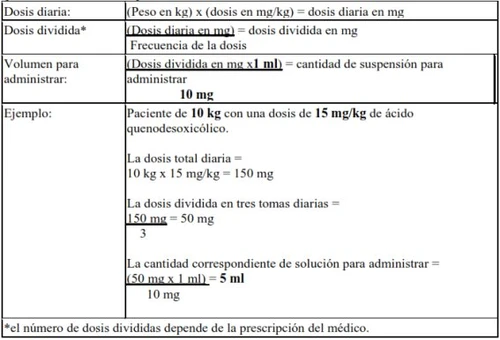
Dose calculation (children aged 1 to 12 years, adolescents aged 12 to 18 years, and adults):10 mg/mlchenodeoxycholic acid in suspension
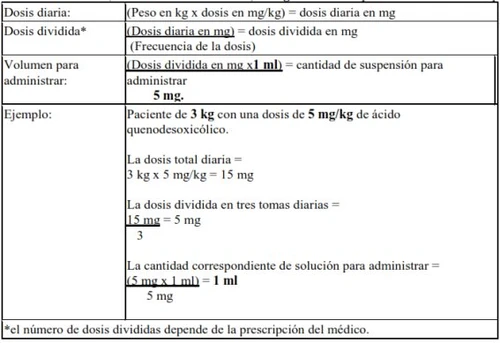
Dose calculation (infants aged 1 month to 1 year):5 mg/mlchenodeoxycholic acid in suspension