Ceziboe 0.25 mg solution for injection in pre-filled syringe
SpainTable of Contents
- Package leaflet: Information for the user
- Introduction
- 1. What Ceziboe is and what it is used for
- **What Ceziboe is**
- 2. What you need to know before using Ceziboe
- **DO NOT use Ceziboe**
- 3. How to use Ceziboe
- **How much to use**
- 4. Possible adverse effects
- 5. Storage of Ceziboe
- 6. Contents of the pack and other information
- **3. Place everything you need on a clean surface:**
Package leaflet: Information for the user
Introduction
Package leaflet: information for the user
Ceziboe 0.25 mg solution for injection in pre-filled syringe
cetrorelix (as acetate)
Read all of this leaflet carefully before you start using this medicine because it contains important information for you.
- Keep this leaflet. You may need to read it again.
- If you have any questions, ask your doctor or pharmacist.
- This medicine has been prescribed for you only. Do not pass it on to other people, even if they have the same symptoms as you, because it may harm them.
- If you experience any adverse effects, talk to your doctor or pharmacist, even if the adverse effects are not listed in this leaflet. See section 4.
Contents of this leaflet
- What Ceziboe is and what it is used for
- What you need to know before using Ceziboe
- How to use Ceziboe
- Possible side effects
- How to store Ceziboe
- Contents of the pack and other information
1. What Ceziboe is and what it is used for
Ceziboe is a medicine that contains the active substance Acidum ascorbicum (also known as vitamin C). It is used to prevent or treat vitamin C deficiency in adults, adolescents, and children. Vitamin C is important for maintaining healthy skin, blood vessels, bones, and cartilage, and for supporting the body's natural defense system (immune system).
Ceziboe may also be used to increase vitamin C intake during periods of increased need, such as during illness, recovery from surgery, or times of physical stress.
What Ceziboe is
Ceziboe contains a substance called "cetrorelix acetate". This substance prevents your body from releasing an egg from the ovary (ovulation) during your menstrual cycle. Ceziboe belongs to a group of medicines known as "gonadotropin-releasing hormone antagonists".
What Ceziboe is used for
Ceziboe is one of the medicines used during "assisted reproductive techniques" to help you become pregnant. It works by immediately preventing the release of eggs. This is because if the eggs are released too early (premature ovulation), your doctor may not be able to collect them.
How Ceziboe works
Ceziboe blocks a natural hormone in your body called LHRH ("luteinizing hormone-releasing hormone").
- LHRH controls another hormone called LH ("luteinizing hormone").
- LH stimulates ovulation during the menstrual cycle.
This means that Ceziboe stops the chain of events that leads to the release of an egg from the ovary. When your eggs are ready to be collected, you will be given another medicine to trigger their release (induction of ovulation).
2. What you need to know before using Ceziboe
DO NOT use Ceziboe
- if you are allergic to cetrorelix (as acetate) or to any of the other components of this medicine (listed in section 6).
- if you are allergic to medicines similar to Ceziboe (any other peptide hormone).
- if you are pregnant or breastfeeding.
- if you have severe kidney disease.
Do not use Ceziboe if any of the above conditions apply to you. If in doubt, consult your doctor before starting to use this medicine.
Warnings and precautions
Allergies
Consult your doctor before starting to use Ceziboe if you currently have an allergy or have had allergies in the past.
Ovarian hyperstimulation syndrome (OHSS)
Ceziboe is used together with other medicines that stimulate your ovaries to develop more eggs ready for release. During or after receiving these medicines, you may develop OHSS. This condition occurs when your follicles develop excessively and become large cysts.
For information on possible signs to watch for and what to do if they occur, see section 4, “Possible side effects”.
Use of Ceziboe for more than one cycle
Experience with the use of Ceziboe for more than one cycle is limited. Your doctor will carefully evaluate the benefits and risks for you if you needed to use Ceziboe for more than one cycle.
Liver disease
Inform your doctor before starting to use Ceziboe if you have any liver disease. Ceziboe has not been studied in patients with liver disease.
Kidney disease
Inform your doctor before starting to use Ceziboe if you have any kidney disease. Ceziboe has not been studied in patients with kidney disease.
Children and adolescents
Ceziboe is not intended for use in children and adolescents.
Other medicines and Ceziboe
Inform your doctor if you are taking, have recently taken, or might need to take any other medicines.
Pregnancy and breastfeeding
Do not use Ceziboe if you are pregnant, think you may be pregnant, or are breastfeeding.
Driving and using machines
Ceziboe is not expected to affect your ability to drive or use machines.
3. How to use Ceziboe
Follow exactly the administration instructions for this medicine as given by your doctor. If in doubt, consult your doctor again.
Use of this medicine
This medicine is intended exclusively for injection just under the skin of your abdomen (subcutaneous route). To reduce skin irritation, select a different area of your abdomen each day.
- Your doctor should supervise the first injection. Your doctor or nurse will teach you how to prepare and inject the medicine.
- You may then self-administer subsequent injections, provided your doctor has informed you about the symptoms that may indicate an allergic reaction and the potentially serious or life-threatening consequences that would require immediate treatment (see section 4, "Possible side effects").
- Carefully read and follow the instructions provided at the end of this leaflet, entitled "How to inject Ceziboe".
- You will start using another medicine on day 1 of your treatment cycle. You will then begin using Ceziboe a few days later. (See the next section, "How much to use".)
How much to use
Inject the contents of one syringe (0.25 mg of Ceziboe) once daily. It is best to use the medicine at the same time each day, leaving 24 hours between each dose.
You may choose to administer the injection each morning or each evening.
- If you administer the injection every morning: Begin your injections on the fifth or sixth day of the treatment cycle. Depending on your ovarian response, your doctor may decide to start treatment on a different day. Your doctor will inform you of the exact date and time. You will continue using this medicine until the morning of oocyte retrieval, including that morning (ovulation induction).
OR
- If you administer the injection every evening: Begin your injections on the fifth day of the treatment cycle. Depending on your ovarian response, your doctor may decide to start treatment on a different day. Your doctor will inform you of the exact date and time. You will continue using this medicine until the evening before oocyte retrieval, including that evening (ovulation induction).
If you use more Ceziboe than you should
No adverse effects are expected if more medicine than intended is accidentally injected. The effect of the medicine will simply last longer. Generally, no specific measures are required.
In case of overdose or accidental ingestion, contact your doctor or call the Toxicology Information Service at telephone number 91 562 04 20, indicating the medicine and the amount ingested.
If you forget to use Ceziboe
- If you miss a dose, inject it as soon as you remember and consult your doctor.
- Do not inject a double dose to make up for a missed dose.
If you have any further questions about the use of this medicine, ask your doctor or pharmacist.
4. Possible adverse effects
Like all medicines, this medicine can cause adverse effects, although not everyone will experience them.
Allergic reactions
- Redness and feeling of warmth in the skin, itching (often in the groin or armpits), red, swollen and itchy areas (urticaria), runny nose, fast or irregular pulse, swelling of the tongue and throat, sneezing, whistling sound when breathing (wheezing), severe breathing difficulties or dizziness. You may be experiencing a serious, potentially life-threatening allergic reaction to the medicine. This is uncommon (may affect up to 1 in 100 women).
If you notice any of the adverse effects described above, stop using Ceziboe and consult your doctor immediately.
Ovarian hyperstimulation syndrome (OHSS)
This may occur due to other medicines you are using to stimulate your ovaries.
- Pain in the lower abdomen, together with nausea or vomiting, may be symptoms of OHSS. This may indicate that the ovaries have over-responded to treatment and large ovarian cysts have developed. This effect is common (may affect up to 1 in 10 women).
- OHSS may become severe, with clearly enlarged ovaries, reduced urine production, weight gain, difficulty breathing, or fluid accumulation in the abdomen or chest. This effect is uncommon (may affect up to 1 in 100 women).
If you notice any of the adverse effects described above, consult your doctor immediately.
Other adverse effects
Common (may affect up to 1 in 10 women):
- Mild and short-lived skin reactions at the injection site such as redness, itching or swelling may occur.
Uncommon (may affect up to 1 in 100 women):
- Feeling nauseous.
- Headache.
Reporting of adverse effects
 If you experience any adverse effect, consult your doctor or pharmacist, even if it is a possible adverse effect not listed in this leaflet. You may also report them directly via the Spanish Pharmacovigilance System for Human Medicinal Products: www.notificaRAM.es. By reporting adverse effects, you can help provide more information on the safety of this medicine.
5. Storage of Ceziboe
Keep this medicine out of the sight and reach of children.
Do not use this medicine after the expiry date stated on the syringe after EXP. The expiry date refers to the last day of the month indicated.
Store in a refrigerator (between 2°C and 8°C).
The unopened product can be stored in its original packaging at room temperature (not above 25°C) for up to three months.
Do not use this medicine if you notice that the solution in the syringe is not clear and colourless or contains particles.
Medicines should not be disposed of via wastewater or household waste. Ask your pharmacist how to dispose of medicines and packaging that you no longer need. This will help protect the environment.
6. Contents of the pack and other information
Composition of Ceziboe
- The active substance is cetrorelix (as acetate). Each pre-filled syringe (1 ml) contains 0.25 mg of cetrorelix (as acetate).
- The other components are mannitol (E421), s-lactic acid, and water for injectable preparations.
Appearance of the product and contents of the pack
Ceziboe is a clear, colourless solution in a type I transparent glass pre-filled syringe (1 ml), attached to a 27G, 12 mm needle, sealed with a bromobutyl rubber plunger stopper. The pre-filled syringe has a white plunger and an automatic safety system.
It is available in packs of 1 pre-filled syringe and in multiple packs which include 7 cardboard boxes, each containing one pre-filled syringe.
For each syringe, the pack also contains:
- one pre-filled syringe with a safety device containing the solution
- one alcohol swab for cleaning.
Only certain pack sizes may be marketed.
Marketing Authorisation Holder
Sun Pharmaceutical Industries Europe B.V.
Polarisavenue 87
2132 JH Hoofddorp
The Netherlands
Manufacturer
Sun Pharmaceutical Industries Europe B.V.
Polarisavenue 87
2132 JH Hoofddorp
The Netherlands
S.C. Terapia S.A.
124 Fabricii Street
400632, Cluj-Napoca
Cluj County
Romania
For further information about this medicinal product, please contact the local representative of the Marketing Authorisation Holder:
Sun Pharma Laboratorios, S.L
Rambla de Catalunya, 53-55
08007 Barcelona
Spain
Tel.: +34 93 342 78 90
This medicinal product is authorised in the European Economic Area member states under the following names:
Belgium Ceziboe
Czech Republic Ceziboe
Germany Ceziboe
Greece Ceziboe
France Ceziboe
Hungary Ceziboe
Ireland Ceziboe
Italy Ceziboe
The Netherlands Ceziboe
Spain Ceziboe
United Kingdom Ceziboe
Date of the most recent revision of this leaflet: November 2020
Detailed information on this medicinal product is available on the website of the Spanish Agency of Medicines and Health Products: http://www.aemps.gob.es
HOW TO INJECT CEZIBOE
The different parts of the Ceziboe pre-filled syringe are
- Rigid needle cap
- Plunger
- Finger grip
- Safety shield
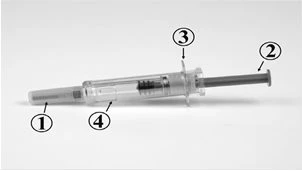
Syringe before use:
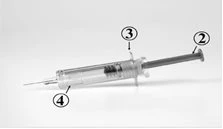
Syringe after use:
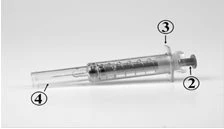
This section explains how to inject your medicine.
- Before starting to use this medicine, read these instructions completely first.
- This medicine is for your use only; do not allow anyone else to use it.
- Use each needle and syringe only once.
Before you begin
-
This medicine should be at room temperature before injection. Remove it from the refrigerator approximately 30 minutes before use.
-
Wash your hands.
It is important that your hands and the items you use are as clean as possible.
3. Place everything you need on a clean surface:
- A pre-filled syringe.
- An alcohol swab.
Preparing the injection site and administering the medication
- Clean the injection site
- Sit or lie down in a comfortable position. Choose an injection site on your abdomen. The best area is around the navel (Figure A).
To reduce skin irritation, select a different part of your abdomen each day. Clean the injection site thoroughly with an alcohol swab.
- Remove the needle cap by pulling it straight off the syringe (Figure B). Discard the needle cap. To prevent infection, do not touch the needle or allow it to come into contact with any surface before the injection. A small air bubble in the syringe is normal. To ensure no medication is lost, do not attempt to remove air bubbles from the syringe before administering the injection.
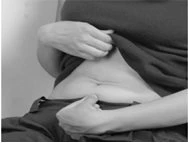
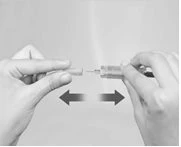
Figure A Figure B
- Gently pinch the cleaned skin to form a skin fold. Hold this fold firmly between your thumb and index finger of one hand throughout the injection (Figure C).
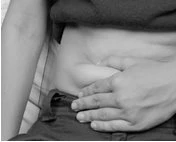
Figure C
- Hold the syringe in one hand, as you would a pencil.
Gently pinch the skin around the injection site and hold it firmly with your other hand.
Slowly insert the needle completely into your skin at an angle of approximately 45 to 90 degrees, then release the skin.
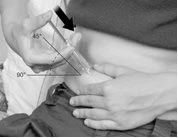
Figure D
- Gently pull back on the syringe plunger. If blood appears, proceed as instructed in step 5. If no blood appears, push the plunger slowly to inject the medication. Inject all the medication in the syringe by gently pressing the plunger until it stops (Figure E). Warning: Do not press firmly, as this will activate the needle safety guard—see step 6.
Once the syringe is empty, slowly remove the needle at the same angle, keeping your finger on the plunger. Use the alcohol swab to gently press on the injection site.
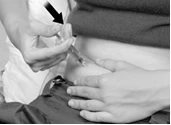
Figure E
- If blood appears:
Slowly withdraw the needle at the same angle. Use the alcohol swab to apply gentle pressure to the puncture site. Empty the medication into a sink and proceed as instructed in step 6 below. Wash your hands and restart using a new pre-filled syringe (Figure F).
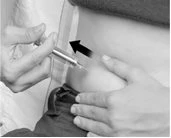
Figure F
- Point the needle away from yourself and others, and activate the safety guard by firmly pressing the plunger. The protective sheath will automatically cover the needle, and you will hear an audible "click" confirming activation of the safety mechanism (Figure G).
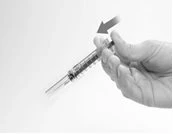
Figure G
Follow your nurse’s or doctor’s instructions on how to dispose of used syringes and needles. National regulations may govern the proper disposal of used syringes, needles, and disposal containers.
NOTE:
- The Safety System can only be activated once the syringe is fully emptied.
- The Safety System must only be activated after the needle has been removed from the patient’s skin.
- Do not recap the needle after injection.
- The Safety System must not be sterilized.
- Activation of the Safety System may cause a minor splash of liquid. For optimal safety, activate the system while pointing it downward, away from yourself and others.