Cervarix injectable suspension in pre-filled syringe
Spain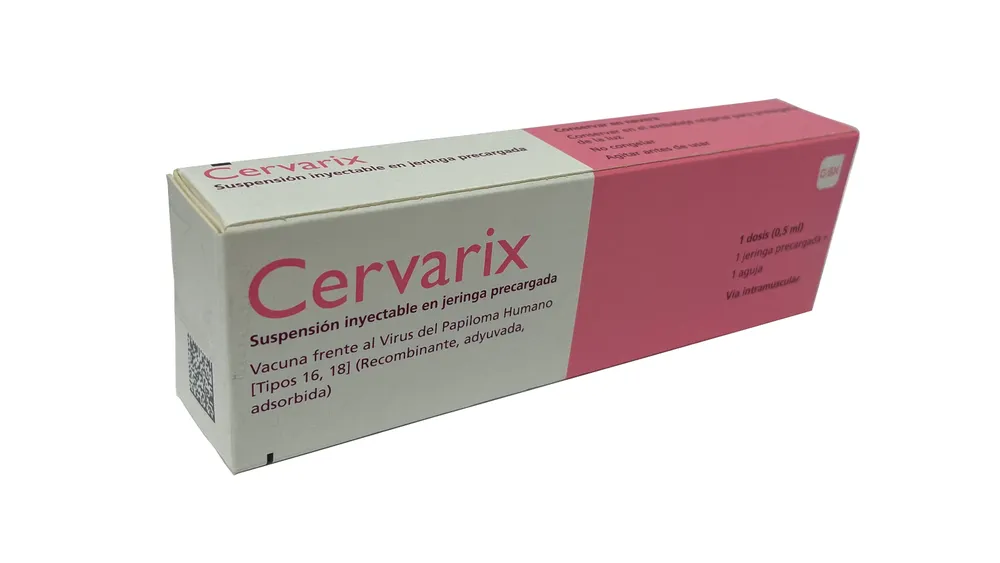
Table of Contents
Package leaflet: Information for the user
Introduction
Package leaflet: information for the user
Cervarix, injectable suspension in a pre-filled syringe
Human Papillomavirus Vaccine [Types 16, 18]
(Recombinant, adjuvanted, adsorbed)
Read all of this leaflet carefully before you start receiving this vaccine, because it contains important information for you.
-
Keep this leaflet, as you may need to read it again.
-
If you have any questions, consult your doctor or pharmacist.
-
This medicine has been prescribed for you only, and you should not give it to others.
-
If you experience any adverse reactions, consult your doctor or pharmacist, even if they are adverse reactions not listed in this leaflet. See section 4.
Contents of this leaflet:
- What Cervarix is and what it is used for
- What you need to know before receiving Cervarix
- How Cervarix is administered
- Possible side effects
- How to store Cervarix
- Contents of the pack and other information
1. What Cervarix is and what it is used for
Cervarix is a vaccine indicated to protect individuals from the age of 9 years against diseases caused by infection with Human Papillomavirus (HPV).
These diseases include:
- cervical cancer (i.e., cancer of the cervix or uterus) and anal cancer,
- precancerous lesions of the cervix, vulva, vagina, and anus (changes in genital or anal cells that carry a risk of becoming cancerous).
The Human Papillomavirus (HPV) types contained in the vaccine (types 16 and 18) are responsible for approximately 70% of cervical cancers, 90% of anal cancers, 70% of HPV-related precancerous lesions of the vulva and vagina, and 78% of HPV-related precancerous anal lesions. Other HPV types may also cause anogenital cancers. Cervarix does not protect against all HPV types.
When a person is vaccinated with Cervarix, the immune system (the body's natural defense system) produces antibodies against HPV types 16 and 18.
Cervarix is non-infectious and therefore cannot cause HPV-related diseases.
Cervarix is not used to treat existing HPV-related diseases present at the time of vaccination.
Cervarix should be used in accordance with official recommendations.
2. What you need to know before receiving Cervarix
Cervarix must not be given
- if you are allergic to any of the active substances or to any of the other ingredients of this vaccine (listed in section 6). Signs of an allergic reaction may include itchy skin rash, difficulty breathing, and swelling of the face or tongue.
Warnings and precautions
Talk to your doctor or pharmacist before receiving Cervarix:
- if you have a blood clotting disorder or bruise easily
- if you have a condition that reduces your resistance to infection, such as HIV infection
- if you have a serious infection with high fever. You may need to delay vaccination until you recover. A minor infection, such as a cold, should not be a problem for vaccination, but you should inform your doctor before being vaccinated.
Fainting may occur before or after any injection (especially in adolescents), so you should inform your doctor or nurse if you or your child have previously fainted after receiving an injection.
Like all vaccines, Cervarix may not fully protect all individuals who are vaccinated.
Cervarix does not protect against diseases caused by infection with HPV types 16 or 18 if individuals are already infected with HPV types 16 or 18 at the time of vaccination.
Although vaccination may protect you against cervical cancer, it is not a substitute for routine gynecological examination of the cervix. You should continue to follow your doctor's advice regarding cervical cytology tests / Papanicolaou test (a test to detect changes in cervical cells caused by HPV infection) and the use of preventive and protective measures.
Since Cervarix does not protect against all types of Human Papillomavirus, you should continue to take appropriate precautions to avoid transmission of HPV and sexually transmitted diseases.
Cervarix does not protect against diseases not caused by Human Papillomavirus.
Other medicines and Cervarix
Cervarix may be administered concomitantly with a booster combination vaccine containing diphtheria (d), tetanus (T), and [acellular] pertussis (pa), with or without inactivated poliomyelitis (IPV) (vaccines dTpa, dTpa-IPV), with a combined hepatitis A and hepatitis B vaccine (Twinrix), with a hepatitis B vaccine (Engerix B), or with a conjugate vaccine against meningococcal serogroups A, C, W-135, and Y using tetanus toxoid as carrier (MenACWY-TT), at a different injection site (another part of your body, for example, the other arm) during the same visit.
Cervarix may not have an optimal effect if you are taking medicines that suppress the immune system.
In clinical studies, the use of oral contraceptives (e.g., the pill) did not reduce the protection provided by Cervarix.
Inform your doctor if you are taking, have recently taken, or might need to take any other medicines, or if you have recently received any other vaccines.
Pregnancy, breastfeeding, and fertility
If you are pregnant, become pregnant during the vaccination course, or are planning to become pregnant, it is recommended that you postpone or interrupt vaccination until after pregnancy.
If you are pregnant or breastfeeding, think you may be pregnant, or plan to become pregnant, consult your doctor before receiving this vaccine.
Driving and using machines
It is unlikely that Cervarix will affect your ability to drive or operate machinery. However, do not drive or operate machinery if you do not feel well.
Cervarix contains sodium
This vaccine contains less than 1 mmol of sodium (23 mg) per dose; this is essentially “sodium-free”.
3. How to administer Cervarix
How the vaccine is given
Your doctor or nurse will administer Cervarix as an injection into the muscle of the upper arm.
How much is given
Cervarix is indicated for individuals from 9 years of age.
The total number of injections you will receive depends on your age at the time of the first injection.
If you are between 9 and 14 years old
You will receive 2 injections:
First injection: on the scheduled date.
Second injection: between 5 and 13 months after the first injection.
If you are 15 years of age or older
You will receive 3 injections:
First injection: on the scheduled date.
Second injection: 1 month after the first injection.
Third injection: 6 months after the first injection.
If necessary, the vaccination schedule may be more flexible. Consult your doctor for further information.
After the first dose of Cervarix has been administered, it is recommended to use Cervarix (and not another HPV vaccine) to complete the vaccination schedule.
The use of Cervarix is not recommended in individuals under 9 years of age.
The vaccine must never be injected into a vein.
If you missed a dose
It is important to follow the instructions provided by your doctor or nurse regarding follow-up visits. If you miss your scheduled appointment, consult your doctor for advice.
If you do not complete the full vaccination course (two or three injections, depending on your age at the time of vaccination), you may not achieve the optimal immune response and protection from vaccination.
4. Possible adverse effects
Like all medicines, this vaccine may cause adverse effects, although not everyone will experience them.
The adverse effects observed during clinical trials with Cervarix were:
-
Very common (adverse effects occurring in more than 1 in every 10 doses of vaccine): pain or discomfort at the injection site, redness or swelling at the injection site, headache, muscle pain, muscle tenderness or weakness (not caused by physical exercise), fatigue.
-
Common (adverse effects occurring in less than 1 in every 10 but in more than 1 in every 100 doses of vaccine): gastrointestinal symptoms including nausea, vomiting, diarrhoea and abdominal pain, itching, skin redness and skin rash, urticarial rash (urticaria), joint pain, fever (?38°C).
-
Uncommon (adverse effects occurring in less than 1 in every 100 but more than 1 in every 1,000 doses of vaccine): upper respiratory tract infection (infection of nose, throat or trachea), dizziness, other injection site reactions such as induration, tingling or numbness in the area.
Adverse effects observed during the post-marketing use of Cervarix include:
-
Allergic reactions. These may be recognized by:
-
Itchy skin rash affecting hands and feet,
-
Swelling of the eyes and face,
-
Difficulty breathing or swallowing,
-
Sudden drop in blood pressure and loss of consciousness.
These reactions usually occur before leaving the doctor's office. However, if your child experiences any of these symptoms, you must contact a doctor urgently.
- Swelling of the lymph nodes in the neck, armpits or groin,
- Fainting, sometimes accompanied by tremors or stiffness.
Reporting of adverse effects
If you experience any type of adverse effect, consult your doctor or pharmacist, even if it is a possible adverse effect not listed in this leaflet. You can also report them directly through the Spanish Pharmacovigilance System for Human Medicinal Products: https://www.notificaram.es. By reporting adverse effects, you can help provide more information on the safety of this medicine.
5. Storage of Cervarix
Keep this vaccine out of the sight and reach of children.
Do not use this vaccine after the expiry date stated on the packaging. The expiry date refers to the last day of the month indicated.
Store in a refrigerator (between 2°C and 8°C).
Do not freeze.
Keep in the original packaging to protect from light.
Medicines must not be disposed of via wastewater or household waste. Ask your pharmacist how to dispose of any packaging and medicines you no longer need. This will help protect the environment.
6. Package contents and other information
Composition of Cervarix
- Active substances:
Human Papillomavirus1 type 162,3,4 L1 protein 20 micrograms
Human Papillomavirus1 type 182,3,4 L1 protein 20 micrograms
1Human Papillomavirus = HPV
2Adjuvanted with AS04 containing:
3-O-desacyl-4’-monophosphoryl lipid A (MPL) 50 micrograms
3Adsorbed on aluminium hydroxide, hydrated (Al(OH)3) 0.5 milligrams of Al3+ in total
4L1 protein in the form of non-infectious virus-like particles (VLPs) produced by recombinant DNA technology using a baculovirus expression system employing Hi-5 Rix4446 cells derived from the insect Trichoplusia ni.
- Other components: sodium chloride (NaCl), disodium hydrogen phosphate dihydrate (NaH2PO4·2H2O), and water for injections.
Appearance of the product and contents of the container
Injectable suspension in a pre-filled syringe.
Cervarix is a white, turbid suspension.
Cervarix is available in 1-dose pre-filled syringes, with or without separate needles; pack sizes of 1 and 10.
Only certain pack sizes may be marketed.
Marketing Authorization Holder and Manufacturer
GlaxoSmithKline Biologicals s.a.
Rue de l'Institut 89
B-1330 Rixensart, Belgium
For further information about this medicinal product, please contact the local representative of the Marketing Authorization Holder:
|
Belgium/Belgium/Belgium GlaxoSmithKline Pharmaceuticals SA/NV Tel/Tel: + 32 10 85 52 00 |
Lithuania GlaxoSmithKline Biologicals SA Tel: +370 80000334 |
|
Bulgaria GlaxoSmithKline Biologicals SA Tel: + 359 80018205 |
Luxembourg/Luxembourg GlaxoSmithKline Pharmaceuticals SA/NV Tél/Tel: + 32 10 85 52 00 |
|
Czech Republic GlaxoSmithKline s.r.o. Tel: + 420 2 22 00 11 11 |
Hungary GlaxoSmithKline Biologicals SA Tel.: + 36 80088309 |
|
Denmark GlaxoSmithKline Pharma A/S Tlf: + 45 36 35 91 00 |
Malta GlaxoSmithKline Biologicals SA Tel: + 356 80065004 |
|
Germany GlaxoSmithKline GmbH & Co. KG Tel: + 49 (0)89 360448701 |
Netherlands GlaxoSmithKline BV Tel: + 31 (0)30 69 38 100 |
|
Estonia GlaxoSmithKline Biologicals SA Tel: +372 8002640 |
Norway GlaxoSmithKline AS Tlf: + 47 22 70 20 00 |
|
Greece GlaxoSmithKline Μονοπρόσωπη A.E.B.E Tηλ: + 30 210 68 82 100 |
Austria GlaxoSmithKline Pharma GmbH Tel: + 43 (0)1 97075 0 |
|
Spain GlaxoSmithKline, S.A. Tel: + 34 900 202 700 |
Poland GSK Services Sp. z o.o. Tel.: + 48 (22) 576 9000 |
|
France Laboratoire GlaxoSmithKline Tél: + 33 (0) 1 39 17 84 44 Croatia GlaxoSmithKline Biologicals SA Tel.: + 385 800787089 |
Portugal GlaxoSmithKline - Produtos Farmacêuticos, Lda. Tel: + 351 21 412 95 00 Romania GlaxoSmithKline Biologicals SA Tel: +40 800672524 |
|
Ireland GlaxoSmithKline (Ireland) Ltd Tel: + 353 (0)1 495 5000 |
Slovenia GlaxoSmithKline Biologicals SA Tel: + 386 80688869 |
|
Iceland Vistor hf. Sími: +354 535 7000 |
Slovakia GlaxoSmithKline Biologicals SA Tel: + 421 800500589 |
|
Italy GlaxoSmithKline S.p.A. Tel: + 39 (0)45 7741 111 |
Finland GlaxoSmithKline Oy Puh/Tel: + 358 10 30 30 30 |
|
Cyprus GlaxoSmithKline Biologicals SA Τηλ: + 357 80070017 |
Sweden GlaxoSmithKline AB Tel: + 46 (0)8 638 93 00 |
|
Latvia GlaxoSmithKline Biologicals SA Tel: + 371 80205045 |
United Kingdom (Northern Ireland) GlaxoSmithKline Biologicals SA Tel: +44 (0)800 221 441 |
Date of the most recent review of this leaflet: 04/2023
Other sources of information
Detailed information on this medicinal product is available on the website of the European Medicines Agency: http://www.ema.europa.eu, and on the website of the Spanish Agency of Medicines and Medical Devices (AEMPS) (http://www.aemps.gob.es/).
This information is intended for healthcare professionals only:
Once removed from the refrigerator, Cervarix should be administered as soon as possible. However, it has been shown to be stable when stored outside the refrigerator for up to 3 days at temperatures between 8°C and 25°C, or up to 1 day at temperatures between 25°C and 37°C. If not used within this time, the vaccine should be discarded.
During storage of the syringe, a white deposit and a clear supernatant may be observed. This is not an indication of deterioration.
The contents of the syringe should be inspected visually both before and after shaking to check for the presence of any foreign particles and/or changes in physical appearance before administration.
If any such conditions are observed, the vaccine should be discarded.
The vaccine must be shaken well before use.
Instructions for the pre-filled syringe
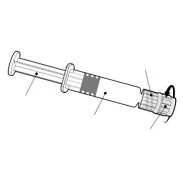
| Hold the syringe by the barrel, not by the plunger. Unscrew the syringe cap by turning it counterclockwise. |
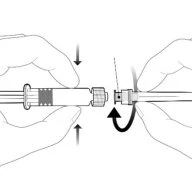
| To attach the needle, connect the base to the luer-lock adapter and turn it a quarter turn clockwise until you feel it lock into place. Do not remove the plunger from the syringe barrel. If this occurs, do not administer the vaccine. |




Waste disposal
Disposal of unused medication and all materials that have come into contact with it must be carried out in accordance with local regulations.