Cernevit powder for injection and for infusion solution
Spain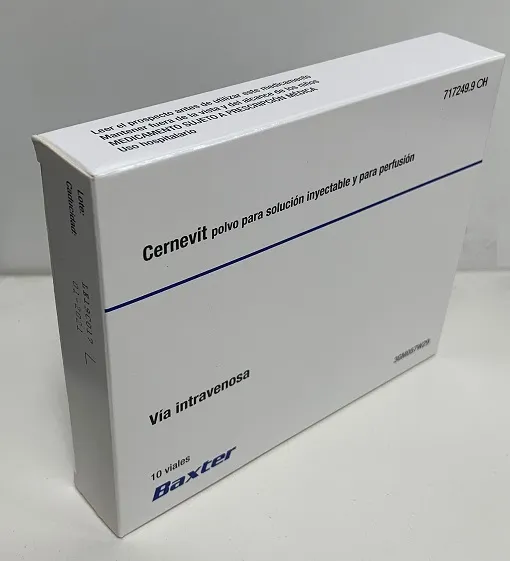
Table of Contents
Package leaflet: Information for the user
Introduction
PACKAGE LEAFLET: INFORMATION FOR THE USER
Cernevit powder for injectable solution and for infusion
Vitamins
Read all of this leaflet carefully before you start using this medicine, because it contains important information for you.
- Keep this leaflet. You may need to read it again.
- If you have any questions, ask your doctor, pharmacist or nurse.
- This medicine has been prescribed for you only and must not be given to other people, even if they have the same symptoms as you. It may harm them.
- If you experience any adverse effects, consult your doctor, pharmacist or nurse, even if they are adverse effects not listed in this leaflet. See section 4.
This medicine is called "Cernevit powder for injectable solution and for infusion", but will be referred to as "Cernevit" throughout the rest of this leaflet.
Contents of this leaflet:
- What Cernevit is and what it is used for
- What you need to know before Cernevit is administered to you
- How Cernevit will be administered to you
- Possible adverse effects
- How to store Cernevit
- Contents of the pack and other information
1. What Cernevit is and what it is used for
Cernevit is a powder for solution for injection or infusion.
It contains 12 vitamins:
Retinol (Vitamin A) | Pyridoxine (Vitamin B6) | Ascorbic acid (Vitamin C) |
Thiamine (Vitamin B1) | Biotin (Vitamin B8) | Cholecalciferol (Vitamin D) |
Riboflavin (Vitamin B2) | Folic acid (Vitamin B9) | Alpha-tocopherol (Vitamin E) |
Pantothenic acid (Vitamin B5) | Cyanocobalamin (Vitamin B12) | Nicotinamide (Vitamin PP) |
Cernevit is a multivitamin in the form of a powder for injectable solution and infusion, which provides a balanced combination of all essential water-soluble and fat-soluble vitamins required for the metabolism of adults and children over 11 years of age, except for vitamin K when reconstituted.
Cernevit is used to provide vitamins corresponding to the daily requirements of adults and children over 11 years of age in situations requiring vitamin supplementation by the parenteral route, i.e., when oral administration is contraindicated, not feasible, or insufficient.
2. What you need to know before being given Cernevit
DO NOT be given Cernevit:
- if you are allergic to the active substances or to any of the other components of this medicine, particularly thiamine (Vitamin B1) or to soybean and peanut proteins (listed in section 6).
- if you are under 11 years of age.
- if you have hypervitaminosis of any of the vitamins contained in Cernevit.
- if you have excess calcium in the blood (severe hypercalcemia), in the urine (hypercalciuria), or any treatment, disease, and/or disorder that leads to severe hypercalcemia and/or hypercalciuria (e.g., neoplasms, bone metastases, excess parathyroid hormone, granulomatosis [inflammatory tissue], etc.).
- if you are taking vitamin A or vitamin A derivatives (retinoids).
Warnings and precautions
Talk to your doctor or nurse before receiving Cernevit
- if you have liver disease.
- if you have kidney disease.
- if you have epilepsy.
- if you have Parkinson's disease.
- if you are taking vitamins A, D, and E.
Hypersensitivity reactions
Allergic reactions ranging from mild to severe have been reported to vitamins B1, B2, B12, folic acid, and to soybean lecithin contained in Cernevit.
Cross-allergic reactions between soybean and peanut proteins have been observed.
If you experience any symptoms of an allergic reaction, such as sweating, fever, chills, headache, skin rash, hives, skin redness, or difficulty breathing, inform your doctor or nurse immediately. The infusion will be stopped immediately, and necessary emergency measures will be taken.
Children
Cernevit must not be administered to children under 11 years of age.
Other medicines and Cernevit
Tell your doctor or nurse if you are taking, have recently taken, or might need to take any other medicines.
You must not take medicines containing vitamin A or vitamin A derivatives (retinoids) during treatment with Cernevit, due to the risk of hypervitaminosis A (excess vitamin A in the blood) (see section 3 "How to use Cernevit").
You should exercise special caution if you are taking any of the following types of medicines:
- Levodopa (used to treat Parkinson's disease).
- Phenobarbital, Phenytoin, Fosphenytoin, Primidone, Carbamazepine and/or Valproate (used to treat epilepsy).
- Acetylsalicylic acid at high doses (for pain and inflammation).
- Efavirenz, zidovudine (HIV treatment).
- Chloramphenicol, Trimethoprim, tetracyclines (for bacterial infections).
- Deferoxamine (for iron intoxication or overload).
- Ethionamide, Cycloserine, Isoniazid (for tuberculosis).
- Sulfasalazine (treatment for Crohn's disease).
- Pyrimethamine (antimalarial and other infection treatment).
- Fluoropyrimidines, Raltitrexed, Bexarotene (cancer treatments).
- Methotrexate, penicillamine (for rheumatoid arthritis).
- Triamterene, Hydralazine (for heart conditions).
- Phenelzine (for depression).
- Theophylline (for respiratory diseases and asthma).
- Warfarin (anticoagulant).
Your doctor may monitor blood levels of these medicines and may need to adjust their dosage when starting or stopping Cernevit.
Interference with laboratory tests
Ascorbic acid may interfere with blood and urine glucose tests. Consult your doctor if you need to undergo testing.
Cernevit contains 69 micrograms of biotin per vial. If you are to undergo laboratory tests, you must inform your doctor or laboratory staff that you are currently receiving or have recently received Cernevit, as biotin may affect test results. Depending on the test, results may show false elevations or false reductions due to biotin. Your doctor may instruct you to stop receiving Cernevit before laboratory testing. You should also be aware that other products you may be taking, such as multivitamin preparations or supplements for hair, skin, and nails, may also contain biotin and affect laboratory test results. Inform your doctor or laboratory staff if you are taking such products.
Use of Cernevit with food and drink
You should ask your doctor what you may eat or drink.
Fertility, pregnancy, and breastfeeding
If you are pregnant or breastfeeding, think you may be pregnant, or plan to become pregnant, consult your doctor before using this medicine.
Pregnancy
You may receive Cernevit during pregnancy if required, provided that the recommended indications and dosages are followed to avoid vitamin overdose.
Breastfeeding
The use of Cernevit is not recommended if you are breastfeeding. If you breastfeed your baby while receiving Cernevit, there is a risk that your baby may receive an overdose of vitamin A.
Fertility
There is insufficient data on the use of Cernevit regarding fertility in male or female patients.
Driving and using machines
There is no information available on the effects of Cernevit on driving or operating machinery.
Warnings about excipients
This medicine contains 24 mg of sodium (a main component of cooking/table salt) per vial. This corresponds to 1.2% of the maximum daily recommended sodium intake for an adult.
3. How Cernevit will be administered to you
Cernevit will be administered by a doctor or a nurse, usually through an intravenous infusion into your vein.
The recommended dose is one vial per day.
If you receive more Cernevit than you should
If you receive an excessive amount of Cernevit (overdose), or if it is administered too rapidly or too frequently, an increase in vitamins A and D may occur.
-
Signs of acute vitamin A overdose include:
-
Gastrointestinal disorders (nausea, vomiting),
-
disorders of the nervous system (headache, optic nerve swelling, seizures) due to increased pressure in the head,
-
psychiatric disorders (irritability),
-
skin disorders (skin peeling).
-
Signs of chronic vitamin A overdose include:
-
Headache due to increased pressure in the head,
-
bone disorders (painful or mild swelling at the ends of the limbs).
If you notice any of these overdose symptoms, inform your doctor so that the Cernevit infusion can be stopped.
In case of overdose or accidental ingestion, contact the Toxicology Information Service. Telephone 915.620.420, indicating the medication and the amount used.
Interrupting the Cernevit infusion
Your doctor will decide when the infusion should be stopped.
If you have any further questions about the use of this product, ask your doctor, pharmacist, or nurse.
4. Possible adverse effects
Like all medicines, this medicine can cause adverse effects, although not everyone experiences them.
Frequent (may affect more than 1 in 10 people):
- Pain at the injection site.
Uncommon (may affect less than 1 in 100 people):
- Feeling unwell (nausea, vomiting).
Frequency not known (the number of affected people is unknown):
- Allergic reactions, with breathing difficulties, chest pain, throat tightness, urticaria, rash, skin redness, abdominal discomfort, as well as cardiac arrest.
- Increased levels of vitamin A and vitamin A transport protein in the blood.
- Taste disturbance (metallic taste).
- Increased heart rate.
- Increased respiratory rate.
- Diarrhea.
- Increased levels of liver enzymes and bile acids.
- Pruritus (itching).
- Fever, generalized pain, reactions at the injection site, such as burning sensation and rash.
If you experience any symptoms of an allergic reaction, such as difficulty breathing, chest pain, throat tightness, urticaria, rash, skin redness, or abdominal discomfort, inform a doctor immediately so that the infusion can be stopped and appropriate measures taken.
Reporting of adverse effects:
If you experience any adverse effects, consult your doctor or pharmacist, even if they are possible adverse effects not listed in this leaflet. You may also report them directly via the Spanish Pharmacovigilance System for Human Medicinal Products, https://www.notificaRAM.es. By reporting adverse effects, you can help provide more information on the safety of this medicine.
5. Storage of Cernevit
Keep this medicine out of the sight and reach of children.
Store below 25°C and in the outer packaging to protect from light.
Do not use this medicine after the expiry date which is stated on the vial and the carton after exp. The expiry date is the last day of the month indicated.
6. Contents of the pack and other information
Composition of Cernevit
- The active substances are:
One vial contains:
Retinol (Vitamin A) as retinol palmitate 3500 IU
Colecalciferol (Vitamin D3) 220 IU
Alfa-tocoferol (Vitamin E) 11.20 IU
equivalent to DL-alfa-tocoferol 10.20 mg
Ácido ascórbico (Vitamin C) 125 mg
Tiamina (Vitamin B1) 3.51 mg
as Cocarboxylase tetrahydrate 5.80 mg
Riboflavina (Vitamin B2) 4.14 mg
as riboflavin phosphate sodium dihydrate 5.67 mg
Piridoxina (Vitamin B6) 4.53 mg
as pyridoxine hydrochloride 5.50 mg
Cyanocobalamin (Vitamin B12) 6 micrograms
Folic acid (Vitamin B9) 414 micrograms
Pantothenic acid (Vitamin B5) 17.25 mg
as D-panthenol 16.15 mg
Biotin (Vitamin B8) 69 micrograms
Nicotinamide (Vitamin PP) 46 mg
The other components are: glycine, glycocholic acid, soybean lecithin, sodium hydroxide and hydrochloric acid.
Appearance of Cernevit and contents of the pack
Cernevit is a yellow-orange powder for injectable solution and for infusion, presented in an amber glass vial.
Each box contains 10 vials.
Marketing Authorization Holder and Manufacturer
Marketing Authorization Holder:
Baxter S.L.
Polígono Industrial Sector 14, Pouet de Camilo, 2.
46394 Ribarroja del Turia (Valencia)
Spain
Manufacturer:
Baxter S.A.
Boulevard René Branquart, 80 7860 Lessines
Belgium
Date of the most recent revision of this leaflet: December 2017
Detailed and up-to-date information on this medicine is available on the website of the Spanish Agency of Medicines and Health Products (AEMPS) http://www.aemps.gob.es/
This information is intended for healthcare professionals only:
Posology and method of administration
For adults and children over 11 years of age only:
1 vial/day.
Exclusively for intravenous use:
Method of administration: Follow the instructions below
After reconstitution: Administer by slow intravenous injection (over at least 10 minutes, see section on warnings) or by infusion using 0.9% saline or 5% glucose solution.
Administration may continue via parenteral nutrition. Cernevit may be included in nutrient mixtures containing carbohydrates, lipids, amino acids and electrolytes, provided compatibility and stability have been previously confirmed in each case, to meet nutritional requirements and prevent the development of deficiencies or complications.
Total vitamin intake from all sources, including nutrition, other vitamin supplements or medications containing vitamins as inactive ingredients, should be taken into account.
The patient's clinical condition and vitamin levels should be monitored to ensure adequate levels are maintained.
Note that certain vitamins, especially A, B2, and B6, are sensitive to ultraviolet light (e.g., direct or indirect sunlight). In addition, losses of vitamins A, B1, C, and E may increase with higher oxygen levels in the solution. These factors should be considered if adequate vitamin levels are not achieved.
Special precautions for disposal and other handling
Hypersensitivity reactions
Allergic reactions ranging from mild to severe have been reported to vitamins B1, B2, B12, folic acid, and to the soybean lecithin contained in Cernevit.
Cross-allergic reactions between soy and peanut proteins have been observed.
If any symptoms of an allergic reaction occur, such as sweating, fever, chills, headache, skin rash, urticaria, skin redness or difficulty breathing, inform your doctor or nurse immediately. The infusion must be stopped immediately and necessary emergency measures implemented.
This medicinal product must not be mixed with other medicinal products unless compatibility and stability of the mixture have been demonstrated. In such cases, contact Baxter for further information.
- Reconstitution must be performed under aseptic conditions, as when used as part of a mixture in parenteral nutrition.
- Mix gently to dissolve the powder for injectable solution and for infusion.
- Before transferring from the vial, Cernevit must be completely dissolved.
- Do not use the medicine unless the reconstituted solution is clear and the original seal is intact.
- After adding Cernevit to a parenteral nutrition solution or emulsion, check for any abnormal color change and/or formation of precipitates, insoluble complexes or crystals.
- When Cernevit is used as an additive in parenteral nutrition, mix the final solution thoroughly.
- Any unused portion of reconstituted Cernevit must be discarded and must not be stored for later mixing.
- Parenteral medicinal products should be inspected visually for particulate matter and discoloration prior to administration, whenever the solution and container permit.
- Use of an in-line filter is recommended during administration of all parenteral nutrition solutions.
Compatibility of solutions administered simultaneously through the same administration set should be reviewed.
Reconstitution
Using a syringe, inject 5 ml of water for injection, 5% glucose solution or 0.9% sodium chloride solution into the vial.
Mix gently to dissolve the powder.
The resulting solution is yellow-orange in color.
From a microbiological standpoint, the product should be used immediately. If not used immediately, storage conditions and times prior to use are the responsibility of the user and normally should not exceed 24 hours at 2 °C to 8 °C, unless reconstitution has been carried out under controlled and validated aseptic conditions.