Cerezyme 400 units powder for concentrate for solution for infusion
Spain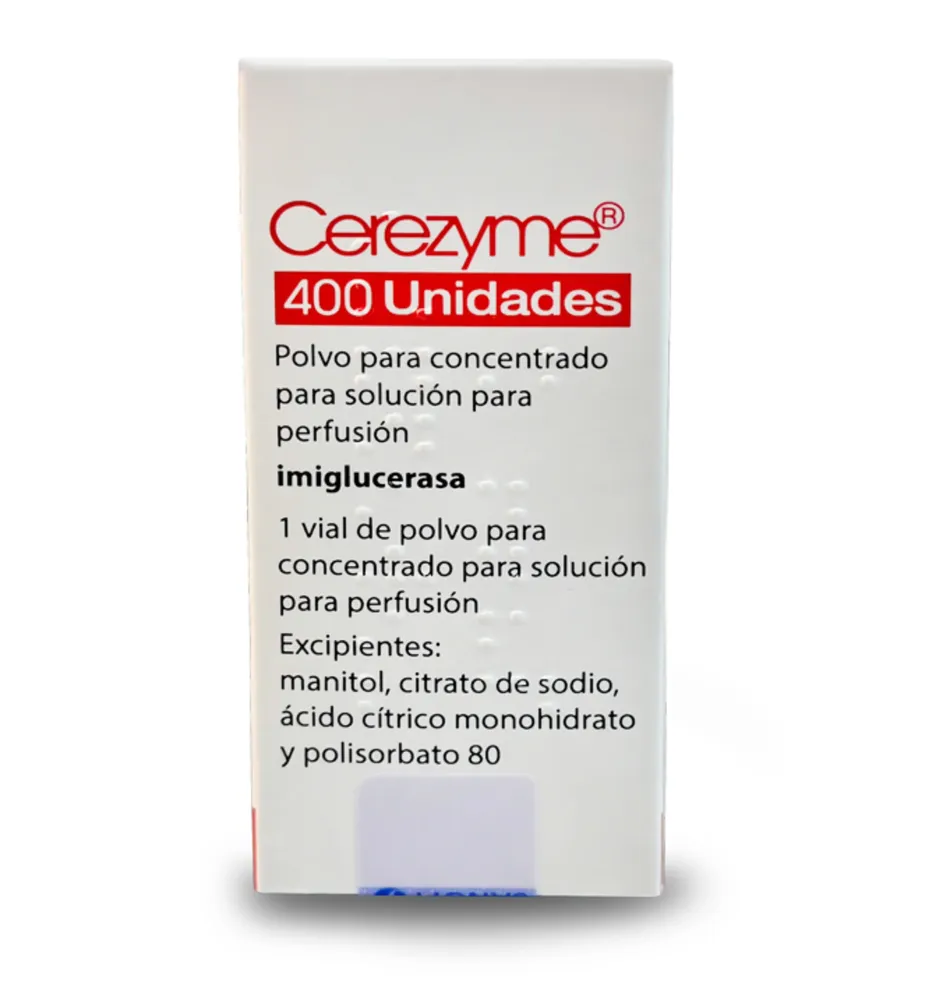
Table of Contents
Package leaflet: Information for the user
Introduction
Package leaflet: information for the user
Cerezyme 400 Units powder for concentrate for solution for infusion
Imiglucerase
Read the entire leaflet carefully before you start using this medicine, as it contains important information for you.
- Keep this leaflet, as you may need to read it again.
- If you have any questions, consult your doctor or pharmacist.
- This medicine has been prescribed for you only, and you should not give it to others, even if they have the same symptoms, as it may harm them.
- If you experience any adverse effects, consult your doctor or pharmacist, even if they are adverse effects not listed in this leaflet. See section 4.
Contents of the leaflet
- What Cerezyme is and what it is used for
- What you need to know before you are given Cerezyme
- How Cerezyme is administered
- Possible adverse effects
- How to store Cerezyme
- Contents of the pack and other information
1. What Cerezyme is and what it is used for
Cerezyme contains the active substance imiglucerase and is used to treat patients with a confirmed diagnosis of type I or type III Gaucher disease who have signs of the disease such as: anaemia (low red blood cell count), tendency to bleed easily (due to low platelet count, a type of blood cell), enlargement of the spleen or liver, or bone disease.
People with Gaucher disease have low levels of an enzyme known as β-glucosidase acid. This enzyme helps the body regulate levels of glucosylceramide, a natural substance in the body made up of sugar and fat. In Gaucher disease, levels of glucosylceramide can become too high.
Cerezyme contains an artificial enzyme called imiglucerase, which can replace the naturally occurring β-glucosidase acid enzyme that is deficient or insufficiently active in patients with Gaucher disease.
The information in this leaflet applies to all patient groups, including children, adolescents, adults, and elderly people.
2. What you need to know before Cerezyme is administered to you
Do not use Cerezyme
- if you are allergic to imiglucerase or to any of the other ingredients of this medicine (listed in section 6).
Warnings and precautions
Talk to your doctor or pharmacist before starting treatment with Cerezyme:
- if you are treated with Cerezyme, you may experience infusion-associated reactions (IARs) or an allergic reaction while receiving the medicine or shortly afterwards. IARs or allergic reactions are adverse effects that occur during the infusion or up to the end of the day of the infusion (see section 4). If you experience such a reaction, you must inform your doctor immediately. You may need to receive additional medications to prevent these reactions from occurring. Your doctor may check whether you have an allergic reaction to imiglucerase.
- some patients with Gaucher disease have pulmonary hypertension (high blood pressure in the lungs). The cause may be unknown or due to heart, lung, or liver problems. This may occur regardless of whether the patient is being treated with Cerezyme. However, if you experience difficulty breathing, you should inform your doctor.
Other medicines and Cerezyme
Inform your doctor or pharmacist if you are taking, have recently taken, or might need to take any other medicines.
Cerezyme must not be administered mixed with other medicines in the same infusion (bottle).
Pregnancy and breastfeeding
If you are pregnant or breastfeeding, think you may be pregnant, or are planning to become pregnant, consult your doctor or pharmacist before using this medicine.
Cerezyme is recommended to be used with caution during pregnancy and breastfeeding.
Cerezyme contains sodium
This medicine contains 41 mg of sodium (main component of table/cooking salt) per vial. This is equivalent to 2% of the maximum daily recommended sodium intake for an adult. It is administered using a 0.9% sodium chloride intravenous solution. This should be taken into account in patients on low-sodium diets.
3. How Cerezyme is administered
Instructions for proper use
Cerezyme is administered through an intravenous infusion (via a drip into a vein).
It is supplied as a powder to be mixed with sterile water before administration.
Cerezyme must only be administered under the supervision of a physician experienced in the treatment of Gaucher disease. Your doctor may suggest home treatment if you meet certain criteria. Contact your doctor if you wish to receive treatment at home.
The dose you receive will be specific to you. Your doctor will adjust the dose based on the severity of your symptoms, among other factors. The recommended dose is 60 units/kg body weight administered once every two weeks.
Your doctor will closely monitor your response to treatment and may adjust your dose (increase or decrease) until the optimal dose for controlling your symptoms is found.
Once this dose has been established, your doctor will periodically check your response to ensure you are receiving the appropriate dose, usually every 6–12 months.
There is no information available on the effect of Cerezyme on brain symptoms in patients with chronic neuronopathic Gaucher disease. Therefore, no specific dosing regimen can be recommended.
ICGG Gaucher Registry
Your doctor may ask you to have your patient data recorded in the "ICGG Gaucher Registry" (ICGG: International Collaborative Gaucher Group). The purpose of this registry is to expand knowledge about Gaucher disease and to evaluate the effectiveness of enzyme replacement therapies such as Cerezyme. This should lead to improved safety and efficacy in the use of Cerezyme. Your patient data will be recorded anonymously: no one will be able to identify you from the data.
If you use more Cerezyme than you should
Cases of Cerezyme overdose have not been reported.
If you forget to use Cerezyme
If you miss an infusion appointment for any reason, contact your doctor.
If you have any further questions about the use of this product, consult your doctor or pharmacist.
4. Possible adverse effects
Like all medicines, this medicine can cause adverse effects, although not everyone will experience them.
Frequent (may affect up to 1 in 10 people):
- difficulty breathing
- cough
- urticaria/localised swelling of the skin or of the lining of the mouth or throat
- pruritus (itching)
- skin rash
Uncommon (may affect up to 1 in 100 people):
- dizziness
- headache
- sensation of tingling, itching, stinging or numbness of the skin
- increased heart rate
- cyanosis (blue colouration) of the skin
- rubor (flushing)
- decrease in blood pressure
- vomiting
- nausea
- abdominal colic pain
- diarrhoea
- arthralgia (joint pain)
- discomfort at the infusion site
- stinging at the infusion site
- swelling at the infusion site
- sterile abscess at the injection site
- chest discomfort
- fever
- chills
- fatigue
- back pain
Rare (may affect up to 1 in 1,000 people):
- anaphylactoid reactions
Frequency not known (frequency cannot be estimated from the available data):
- Temporarily high blood pressure
Some adverse effects have been observed mainly while patients were receiving the medication or immediately after administration. These include pruritus, rubor, urticaria/localised swelling of the skin, of the mucosa of the mouth or of the throat, chest discomfort, chills, fatigue, increased heart rate, cyanosis of the skin, difficulty breathing, sensation of tingling, itching, stinging or numbness of the skin, decrease in blood pressure and back pain. If you experience any of these symptoms, inform your doctor immediately. You may need additional medicines to prevent an allergic reaction (e.g., antihistamines and/or corticosteroids).
Reporting of adverse effects
If you experience any type of adverse effect, consult your doctor or pharmacist, even if it is a possible adverse effect not listed in this leaflet. You may also report them directly through the national reporting system detailed in Appendix V. By reporting adverse effects, you can help provide further information on the safety of this medicine.
5. Storage of Cerezyme
Keep this medicine out of the sight and reach of children.
Do not use this medicine after the expiry date stated on the container, following EXP. The expiry date refers to the last day of the month indicated.
Unopened vials: Store in a refrigerator (between 2°C and 8°C).
Diluted solution:
Cerezyme should be used immediately after reconstitution with sterile water. The reconstituted solution in the vial must not be stored and should be immediately diluted into an intravenous infusion bag; the diluted solution may be stored for up to 24 hours if kept refrigerated (2–8 °C) and protected from light.
Medicines must not be disposed of via wastewater or household waste. Ask your pharmacist how to dispose of medicines and containers you no longer need. This helps protect the environment.
6. Contents of the pack and other information
Composition of Cerezyme
- The active substance is imiglucerase. Imiglucerase is a modified form of the human enzyme β-glucosidase acid produced by recombinant DNA technology. Each vial contains 400 units of imiglucerase. After reconstitution, the solution contains 40 units of imiglucerase per milliliter.
- The other components are: mannitol, sodium citrate, citric acid monohydrate, and polysorbate 80.
What Cerezyme looks like and contents of the pack
Cerezyme 400 Units is available as a powder for concentrate for solution for infusion (in a vial – pack sizes of 1, 5 or 25 vials). Only certain pack sizes may be marketed.
Cerezyme is supplied as a white or almost white powder. After reconstitution, a clear, transparent liquid free from foreign particles is obtained. The reconstituted solution must be further diluted before use.
Marketing Authorization Holder and Manufacturer
Marketing Authorization Holder
Sanofi B.V., Paasheuvelweg 25, 1105 BP Amsterdam, The Netherlands
Manufacturer
Genzyme Ireland Limited, IDA Industrial Park, Old Kilmeaden Road, Waterford, Ireland
For further information about this medicinal product, please contact the local representative of the Marketing Authorization Holder:
Belgium/Belgium/Belgium/Luxembourg/Luxembourg Sanofi Belgium Tel/Tel: + 32 2 710 54 00 | Hungary SANOFI-AVENTIS Zrt. Tel: +36 1 505 0050 |
| Malta Sanofi S.r.l. Tel: +39 02 39394275 |
Czech Republic sanofi-aventis, s.r.o. Tel: +420 233 086 111 | Netherlands Genzyme Europe B.V. Tel: +31 20 245 4000 |
Denmark Sanofi A/S Tlf: +45 45 16 70 00 | Norway sanofi-aventis Norge AS Tlf: + 47 67 10 71 00 |
Germany Sanofi-Aventis Deutschland GmbH Tel: 0800 04 36 996 Tel. from abroad: +49 69 305 70 13 | Austria sanofi-aventis GmbH Tel: + 43 1 80 185 - 0 |
Estonia Swixx Biopharma OÜ Tel: +372 640 10 30 | Poland sanofi-aventis Sp. z o.o. Tel.: +48 22 280 00 00 |
Greece sanofi-aventis AEBE Tel: +30 210 900 1600 | Portugal Sanofi – Produtos Farmacêuticos, Lda. Tel: +351 21 35 89 400 |
Spain sanofi-aventis, S.A. Tel: +34 93 485 94 00 | Romania Sanofi Romania SRL Tel: +40 (0) 21 317 31 36 |
France sanofi-aventis France Tél: 0 800 222 555 Call from abroad: +33 1 57 63 23 23 | Slovenia Swixx Biopharma d.o.o. Tel: +386 1 235 51 00 |
Croatia Swixx Biopharma d.o.o. Tel: +385 1 2078 500 | Slovak Republic Swixx Biopharma s.r.o. Tel: +421 2 208 33 600 |
Ireland sanofi-aventis Ireland Ltd. T/A SANOFI Tel: +353 (0) 1 403 56 00 Iceland Vistor hf. Tel: +354 535 7000 | Finland Sanofi Oy Puh/Tel: + 358 201 200 300 |
Italy Sanofi S.r.l. Tel: 800 536 389 | Sweden Sanofi AB Tel: +46 (0)8 634 50 00 |
Cyprus C.A. Papaellinas Ltd. Tel: +357 22 741741 | United Kingdom (Northern Ireland) sanofi-aventis Ireland Ltd. T/A SANOFI Tel: +44 (0) 800 035 2525 |
Latvia Swixx Biopharma SIA Tel: +371 6 616 47 50 | |
Lithuania Swixx Biopharma UAB Tel: +370 5 236 91 40 |
Date of the most recent review of this package leaflet:
Detailed information on this medicine is available on the European Medicines Agency website: http://www.ema.europa.eu/. It also provides links to other websites on rare diseases and their treatments.
This information is intended for healthcare professionals only:
Instructions for use: reconstitution, dilution, and administration
Each Cerezyme vial is for single use only. After reconstitution, each vial contains 400 units of imiglucerase in 10.0 ml (40 units per ml).
Determine the number of vials to reconstitute based on the patient's individual dosage, and remove the vials from the refrigerator.
Use aseptic technique.
Reconstitution
Reconstitute each vial with 10.2 ml of water for injections, avoiding forceful impact of the injection water on the powder and formation of foam in the solution, by gently mixing. The reconstituted volume is 10.6 ml. The pH of the reconstituted solution is approximately 6.2.
After reconstitution, a clear, transparent liquid without foreign particles should be observed. The reconstituted solution must be further diluted. Before any additional dilution, visually inspect the solution in each vial for foreign particles and discoloration. Do not use vials showing presence of foreign particles or discoloration.
After reconstitution, dilute the vials promptly and do not store for later use.
Dilution
The reconstituted solution contains 40 units of imiglucerase per ml. The reconstituted volume allows the exact withdrawal of 10.0 ml (equivalent to 400 units) from each vial. Withdraw 10.0 ml of the reconstituted solution from each vial, pool the withdrawn volumes, and then dilute with 0.9% sodium chloride intravenous solution to a total volume of 100 to 200 ml. Gently mix the infusion solution.
Administration
It is recommended to administer the diluted solution through an in-line 0.2 µm filter with low protein binding to remove any protein particles. This will not result in a reduction of imiglucerase activity. The diluted solution should be administered within 3 hours. The product diluted in 0.9% sodium chloride intravenous solution may maintain its chemical stability for up to 24 hours if stored between 2°C and 8°C protected from light; however, microbiological safety will depend on whether reconstitution and dilution were performed aseptically.
Cerezyme does not contain preservatives. Disposal of unused medicine and all materials that have come into contact with it must be carried out in accordance with local regulations.