Celestone Chronodose solution for injection
Spain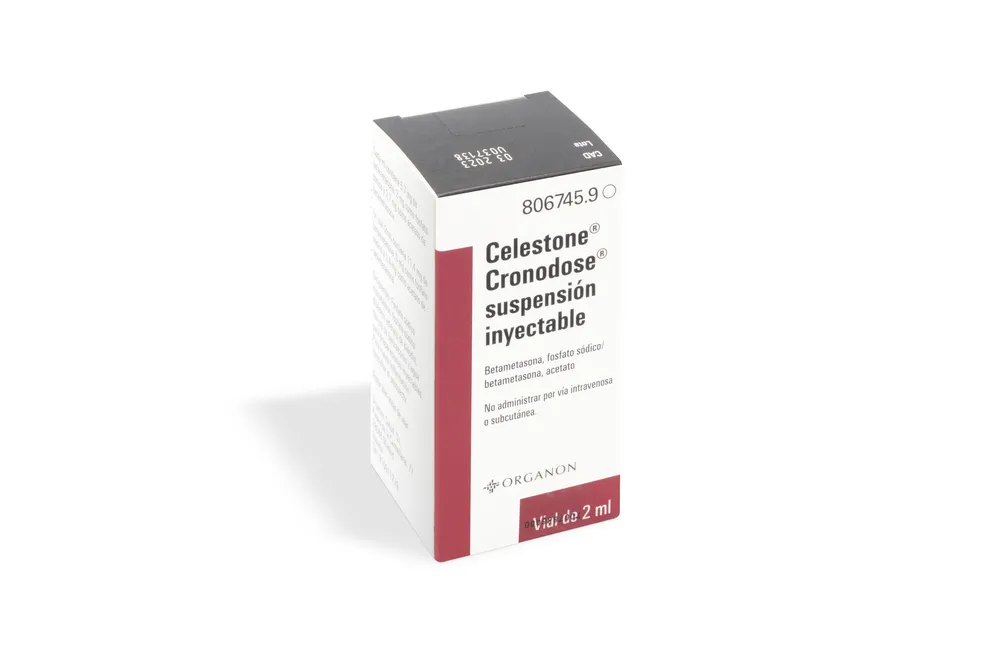
Table of Contents
- Package leaflet: Information for the user
- Introduction
- 1. What Celestone Cronodose is and what it is used for
- 2. What you need to know before using Celestone Cronodose
- 3. How to use Celestone Chronodose
- 4. Possible adverse effects
- 5. Storage of Celestone Cronodose
- 6. Contents of the pack and other information
Package leaflet: Information for the user
Introduction
Package leaflet: information for the user
Celestone Cronodose injectable suspension
Betamethasone sodium phosphate / betamethasone acetate
Read all of this leaflet carefully before you start using this medicine because it contains important information for you.
-
Keep this leaflet. You may need to read it again.
- If you have any further questions, ask your doctor, pharmacist or nurse.
-
This medicine has been prescribed for you only; do not pass it on to others, even if they have the same symptoms as you. It may harm them.
- If you experience any adverse effects, talk to your doctor, pharmacist or nurse, even if they are effects not listed in this leaflet. See section 4.
Contents of the leaflet
- What Celestone Cronodose is and what it is used for
- What you need to know before using Celestone Cronodose
- How to use Celestone Cronodose
- Possible side effects
5 Storage of Celestone Cronodose
- Contents of the pack and other information
1. What Celestone Cronodose is and what it is used for
Celestone Cronodose contains betamethasone. It is a corticosteroid (glucocorticoid) with anti-inflammatory properties. It is indicated for conditions that respond to treatment with injectable corticosteroids when a prolonged effect is required (if necessary, as an adjunct to primary treatment), and is particularly useful in patients who cannot be treated with oral or local corticosteroids.
Celestone Cronodose is used for the treatment of:
By intramuscular route:
- Allergic, dermatological, rheumatic conditions, and other conditions that respond to corticosteroids.
By local infiltration:
- Bursitis and inflammatory disorders associated with tendons (such as tenosynovitis); and inflammatory disorders of muscle (such as fibrosis and myositis).
By intra-articular route:
- Rheumatoid arthritis and osteoarthritis.
By intradermal/intralesional route:
- Various skin conditions, and certain inflammatory and cystic disorders of the foot.
It must not be administered by intravenous or subcutaneous route.
2. What you need to know before using Celestone Cronodose
Do not use Celestone Cronodose:
- if you are allergic to betamethasone or to any of the other ingredients of this medicine (listed in section 6).
- if you have an infection (unless you are being treated for that infection).
Warnings and precautions
Talk to your doctor, pharmacist, or nurse before starting to use this medicine.
You must inform all your doctors if you are taking or have recently taken glucocorticoids.
Your doctor will use the lowest possible dose of this medicine to control your condition and will, whenever possible, gradually reduce the dose.
Avoid abrupt discontinuation of treatment, as a corticosteroid withdrawal syndrome may occur, which can persist for months after stopping this medicine. Therefore, in stressful situations during this period, treatment should be reinstated along with the necessary supplementation of salts and/or a mineralocorticosteroid.
If the medicine is administered locally (intra-articular route), systemic unwanted effects may occur.
Intramuscular administration of the medicine should be performed with special caution in patients with idiopathic thrombocytopenic purpura.
Repeated intra-articular injections may lead to cartilage destruction and joint instability. Therefore, excessive use of a previously treated joint should be avoided.
Corticosteroids may mask signs of infection as well as increase the risk of developing infections and/or make their diagnosis more difficult. Latent infections may reactivate during treatment with this medicine.
This medicine must not be injected into a previously infected joint. If septic arthritis occurs (i.e., a significant increase in pain along with local swelling, restricted joint mobility, fever, and general malaise) and sepsis is confirmed, appropriate antimicrobial treatment must be initiated.
Inform your doctor, as precautions may be needed, such as closer monitoring of your condition or additional therapeutic measures, if:
- you have a history of tuberculosis or amebiasis, as the disease could be reactivated; or if you currently have active tuberculosis or amebiasis.
- you have had contact with or been exposed to chickenpox or measles.
- you have infections caused by fungi or parasites.
- you are due to be vaccinated.
- you are allergic to any medicine.
- you have diabetes.
- you have osteoporosis (loss of calcium from bones), especially in postmenopausal women.
- you have a psychiatric illness or a history of psychiatric illness (in yourself or close family members).
- you have pheochromocytoma (a tumor of the adrenal gland).
- you have cataracts, glaucoma (increased intraocular pressure), eye infections, or herpes simplex of the eye.
- you have hypothyroidism or hepatic cirrhosis.
- you have ulcerative colitis, inflammatory diseases of the digestive system, peptic ulcers, esophagitis, renal failure, heart failure, arterial hypertension, or myasthenia gravis (severe muscle weakness).
Contact your doctor if you experience blurred vision or other visual disturbances.
Especially with medium- to high-dose corticosteroid treatment, adequate potassium intake and dietary salt restriction should be considered. Blood pressure and blood potassium levels should also be monitored.
This medicine must not be administered by the epidural route. The safety and efficacy of epidural administration of corticosteroids have not been established.
This medicine may produce a positive result in doping control tests.
Administration of corticosteroids may alter the results of certain laboratory tests. Additionally, skin reactions in allergy tests may be masked.
Children and adolescents
In infants, children, and adolescents, the doctor must carefully evaluate the benefits of treatment, particularly with prolonged corticosteroid therapy, as it may affect growth and development. Therefore, during prolonged treatment with this medicine, your doctor will closely monitor the growth and development of children and adolescents.
Use of Celestone Cronodose with other medicines
Tell your doctor or pharmacist if you are taking, have recently taken, or might need to take any other medicines, including those obtained without a prescription.
Dosage adjustments and monitoring for adverse reactions may be necessary. This is especially important if you are taking the following medicines:
- Amphotericin B, as it may increase the risk of low potassium levels (hypokalemia).
- Antibiotics, as they may significantly reduce corticosteroid elimination.
- Oral anticoagulants, as their desired effect may be altered.
- Antidiabetic medicines, as dosage adjustment may be necessary.
- Antituberculosis medicines, as their blood levels may be reduced.
- Medicines used to treat heart conditions, such as cardiac glycosides, as the risk of arrhythmias may increase due to low potassium levels (hypokalemia).
- Estrogens (including oral contraceptives), as they may alter the action of this medicine.
- Hepatic enzyme-inducing medicines (e.g., barbiturates, phenytoin, carbamazepine, rifampicin), as the dose of this medicine may need to be increased.
- Antifungal medicines (ketoconazole), as they may increase the potential adverse effects of this medicine.
- Some medicines may increase the effects of Celestone Cronodose, so your doctor will perform careful monitoring if you are taking these medicines (including some used for HIV: ritonavir, cobicistat).
- Non-steroidal anti-inflammatory drugs (NSAIDs), as they may increase the risk of gastrointestinal adverse effects.
- Aminoglutethimide (a medicine used to treat certain tumors), as it may reduce the effect of this medicine due to adrenal suppression.
- Anticholinesterases, as they may cause severe weakness in patients with myasthenia gravis, which may require their discontinuation at least 24 hours before starting treatment with this medicine.
- Somatropin (human growth hormone), as it may inhibit its response.
Interference with laboratory tests
If you are scheduled for any laboratory tests (including blood and urine tests, skin tests using allergens, etc.), inform your doctor that you are taking this medicine, as it may alter test results.
Use of Celestone Cronodose with alcohol
Using this medicine with alcohol may increase the occurrence or severity of gastrointestinal ulcers.
Pregnancy, breastfeeding, and fertility
If you are pregnant, breastfeeding, think you may be pregnant, or plan to become pregnant, consult your doctor or pharmacist before using this medicine.
Pregnancy
Betamethasone crosses the placenta. During pregnancy, treatment should only be administered after careful assessment of the risk-benefit balance for both mother and fetus, even when used prophylactically beyond the 32nd week of gestation.
With long-term corticosteroid treatment during pregnancy, the newborn should be closely monitored for signs of adrenal insufficiency.
Corticosteroids are not indicated for the management of hyaline membrane disease after birth and should not be administered to pregnant women with preeclampsia, eclampsia, or evidence of placental damage.
Newborns of mothers who received Celestone Cronodose close to the end of pregnancy may have low blood sugar levels after birth.
Breastfeeding
Corticosteroids, including this medicine, pass into breast milk and may impair growth, interfere with the infant’s own corticosteroid production, or cause other adverse effects. Therefore, caution is recommended when administering this medicine during breastfeeding.
Fertility
In some patients, steroids may increase or decrease sperm motility and sperm count.
Driving and using machines
The effect of this medicine on the ability to drive and use machines is negligible or minor. However, some adverse effects of this medicine (such as muscle weakness or loss of muscle mass, psychiatric disorders (e.g., euphoria or depression), decreased visual acuity, increased intraocular pressure, or dizziness) may affect these activities. Therefore, avoid performing such tasks until you know how you tolerate the medicine.
Use in athletes
This medicine contains betamethasone, which may produce a positive result in doping control tests.
Celestone Cronodose contains sodium and benzalkonium chloride
This medicine contains less than 23 mg of sodium (1 mmol) per ml; hence, it is essentially “sodium-free”.
This medicine contains 0.4 mg of benzalkonium chloride in each 2 ml vial, equivalent to 0.2 mg/ml.
3. How to use Celestone Chronodose
Follow exactly the administration instructions for this medicine given by your doctor or pharmacist. If in doubt, consult your doctor or pharmacist again.
The initial dose varies depending on the specific disease being treated.
During treatment, your doctor may adjust the dose of this medicine. In certain stress situations, a temporary increase in the dose of this medicine may be necessary. When dose reduction is possible, it should be gradual.
The recommended dose is:
Intramuscular administration:
In most cases, treatment with Celestone Chronodose is initiated with a 1 ml intramuscular injection, repeated once a week, or more frequently depending on the patient's needs.
In severe conditions, it may be necessary to initially administer 2 ml.
Intra-articular administration:
Doses range from 0.25 ml to 2 ml, according to the size of the joint being treated. The usual dose is as follows: very large joints (hip), 1 to 2 ml; large joints (knee, ankle, and shoulder), 1 ml; medium-sized joints (elbow and wrist), 0.5 to 1 ml; small joints (hand and foot), 0.25 to 0.5 ml.
Pain relief and reduction in stiffness are observed 2 to 4 hours after intra-articular injection.
Local infiltration administration:
For bursitis, inflammatory disorders associated with tendons, and inflammatory disorders around the joint, the usual dose is 1 ml, repeated at intervals of one to two weeks. In bursitis, pain relief and complete recovery are observed within a few hours after injection.
For joint capsule cysts, the usual dose is 0.5 ml into the cystic cavity.
In acute gouty arthritis, the usual dose is 0.25 to 1 ml, repeated at intervals of 3 days to 1 week.
Intradermal/intralesional administration:
For foot diseases, the usual dose is 0.25 to 0.50 ml, repeated at intervals of 3 days to 1 week.
For dermatological conditions, administer by intradermal injection (not subcutaneous) of 0.2 ml/cm² as required, but not exceeding 1 ml per week.
Hypothyroidism and hepatic cirrhosis
In patients with hypothyroidism or hepatic cirrhosis, dose adjustment may be necessary.
Elderly patients
In elderly patients, close monitoring of treatment by the doctor may be necessary.
Use in children
Generally, the recommended initial dose in children is 0.02 to 0.3 mg/kg per day, divided into three or four doses (0.6 to 9 mg/m² body surface area/day). The initial dose may vary depending on the type of disease.
If you use more Celestone Chronodose than you should
In case of overdose or accidental ingestion, contact your doctor, pharmacist, or call the Toxicology Information Service at telephone number 91.562.04.20, indicating the medicine and the amount used.
Treatment of acute overdose is supportive and symptomatic. For managing chronic overdose with a serious illness requiring continuous steroid treatment, the corticosteroid dose may be temporarily reduced or administered on alternate days.
If you interrupt treatment with Celestone Chronodose
Do not stop treatment earlier than instructed by your doctor or abruptly, as this could worsen your condition.
Dose reduction should be carried out gradually. Likewise, discontinuation of treatment should be done gradually whenever possible.
If you have any further questions about the use of this medicine, ask your doctor, pharmacist, or nurse.
4. Possible adverse effects
Like all medicines, this medicine can cause adverse effects, although not everyone will experience them.
The following adverse effects have been reported with the use of corticosteroids:
Immune system disorders: Anaphylactic reactions, hypersensitivity reactions.
Endocrine disorders: Menstrual irregularities, development of Cushingoid state (moon face, trunk obesity), secondary adrenal cortical and pituitary unresponsiveness (particularly during periods of stress such as trauma, surgery, or illness), manifestations of latent diabetes mellitus, and increased insulin or oral hypoglycemic agent requirements in diabetics.
Metabolism and nutrition disorders: Sodium retention, potassium loss, hypokalemic alkalosis, fluid retention.
Psychiatric disorders: Euphoria, mood changes, depression, personality changes, insomnia.
Nervous system disorders: Seizures, increased intracranial pressure with papilledema (pseudotumor cerebri), usually after treatment, headache.
Eye disorders: Posterior subcapsular cataract, glaucoma (increased intraocular pressure), exophthalmos (abnormal protrusion of one or both eyes), blurred vision with unknown frequency (frequency cannot be estimated from available data).
Ear and labyrinth disorders: Vertigo.
Cardiac disorders: Cardiac failure.
Vascular disorders: Hypertension.
Gastrointestinal disorders: Gastrointestinal ulcer with possible perforation and hemorrhage, pancreatitis (inflammation of the pancreas), abdominal distension, ulcerative esophagitis (inflammation of the tissue lining the inner wall of the esophagus), hiccups.
Skin and subcutaneous tissue disorders: Allergic dermatitis, edema, thin and fragile skin, petechiae and ecchymoses (red spots on the skin), erythema (redness of the skin), increased sweating, urticaria, angioedema.
Musculoskeletal and connective tissue disorders: Muscle weakness, steroid myopathy (muscle pain), loss of muscle mass, osteoporosis (loss of calcium in bones), vertebral compression fractures, aseptic necrosis of the humeral and femoral heads, pathological fractures of long bones, tendon rupture, growth retardation in childhood.
General disorders and administration site conditions: Impaired wound healing.
Investigations: Decreased carbohydrate tolerance, negative nitrogen balance due to protein catabolism, increased intraocular pressure, suppression of reactions to skin tests.
Reporting of adverse effects:
If you experience any type of adverse effect, consult your doctor, pharmacist, or nurse, even if it is a possible adverse effect not listed in this leaflet. You may also report them directly through the Spanish Pharmacovigilance System for Human Medicines: https://www.notificaram.es. By reporting adverse effects, you can help provide more information on the safety of this medicine.
5. Storage of Celestone Cronodose
Do not store above 25°C.
Keep this medicine out of the sight and reach of children.
Do not use this medicine after the expiry date stated on the packaging after EXP. The expiry date refers to the last day of the month indicated.
Do not use this medicine if you notice any possible clumping or precipitation (which might be due to exposure to freezing).
Medicines must not be disposed of via wastewater or household waste. Dispose of empty containers and unused medicines at the SIGRE Point in your pharmacy. If in doubt, ask your pharmacist how to dispose of containers and medicines you no longer need. This will help protect the environment.
6. Contents of the pack and other information
Composition of Celestone Cronodose
- The active substances are betamethasone sodium phosphate and betamethasone acetate.
Each vial (2 ml) contains 11.4 mg of betamethasone, comprising 6 mg of betamethasone (as sodium phosphate) and 5.4 mg of betamethasone (as 6 mg of betamethasone acetate).
- The other components (excipients) are: monobasic sodium phosphate, dibasic sodium phosphate, disodium edetate, benzalkonium chloride, and water for injections.
Appearance of the product and contents of the pack
Celestone Cronodose is a sterile, injectable, aqueous suspension that is transparent and colorless, with white particles in suspension, free from visible aggregates or foreign particles.
It is supplied in a glass vial with a rubber stopper and an aluminum and polypropylene seal. Each carton contains 1 vial.
Marketing Authorization Holder and Manufacturer
Marketing Authorization Holder
Organon Salud, S.L.
Paseo de la Castellana, 77
28046 Madrid
Spain
Tel.: 915911279
Manufacturer
Organon Heist bv
Industriepark 30
2220 Heist-op-den-Berg
Belgium
Date of the most recent revision of this package leaflet: 12/2021.
Detailed information on this medicinal product is available on the website of the Spanish Agency of Medicines and Health Products (AEMPS) http://www.aemps.gob.es/
This information is intended for healthcare professionals only:
INSTRUCTIONS FOR CORRECT ADMINISTRATION
For intramuscular, intraarticular, intrasinovial, intralesional, or intradermal administration. This medicine must not be administered intravenously or subcutaneously.
This medicine must not be injected into an unstable joint.
This medicine must be administered under aseptic conditions.
To restore the homogeneity of the suspension, shake the vial before opening.
This medicine must not be used if possible aggregation or precipitation is observed (which may be due to exposure to freezing).
Once the required amount of suspension has been drawn into the syringe, it must be injected immediately to prevent sedimentation.
- Intramuscular administration:
Corticosteroids should be administered by deep intramuscular injection into the gluteal muscle to avoid local tissue atrophy.
- Intraarticular administration:
Injections should be performed into affected tendon sheaths and not into the tendons themselves. In inflammatory periarticular conditions, the injection should be administered into the painful area.
Intraarticular injection must be performed under aseptic conditions using 22 to 24 gauge needles.
The technique is as follows: the needle, attached to an empty syringe, is inserted into the synovial cavity and aspiration is performed. If synovial fluid is obtained, the puncture is correct. The first syringe is then replaced with another one containing the required amount of suspension, and the injection is carried out.
Intraarticular injection of this medicine is not associated with significant pain, nor has secondary exacerbation—sometimes observed several hours after intraarticular administration of other corticosteroids—been reported.
- Intralesional and intradermal administration:
Intralesional treatment is performed by intradermal injection (not subcutaneously). A tuberculin syringe and a 25 gauge needle 1.5 cm in length should be used.
The medicine should be administered so as to form a uniform intradermal deposit.
Foot diseases: In most cases, the medicine can be administered using a tuberculin syringe with a 25 gauge needle 2 cm in length.
Use with local anesthetics
Local administration of this medicine is well tolerated. However, if the use of local anesthetics is considered necessary, the suspension may be mixed in the same syringe with an equal volume of 1% or 2% procaine hydrochloride or lidocaine prior to injection. First, transfer the required amount of suspension from the vial into the syringe, then add the anesthetic, and briefly shake the syringe. Do not introduce the anesthetic into the Celestone Cronodose vial. Do not use anesthetic formulations containing parabens.