Ceftriaxone Normon 500 mg powder and solvent for solution for injection and for infusion EFG
Spain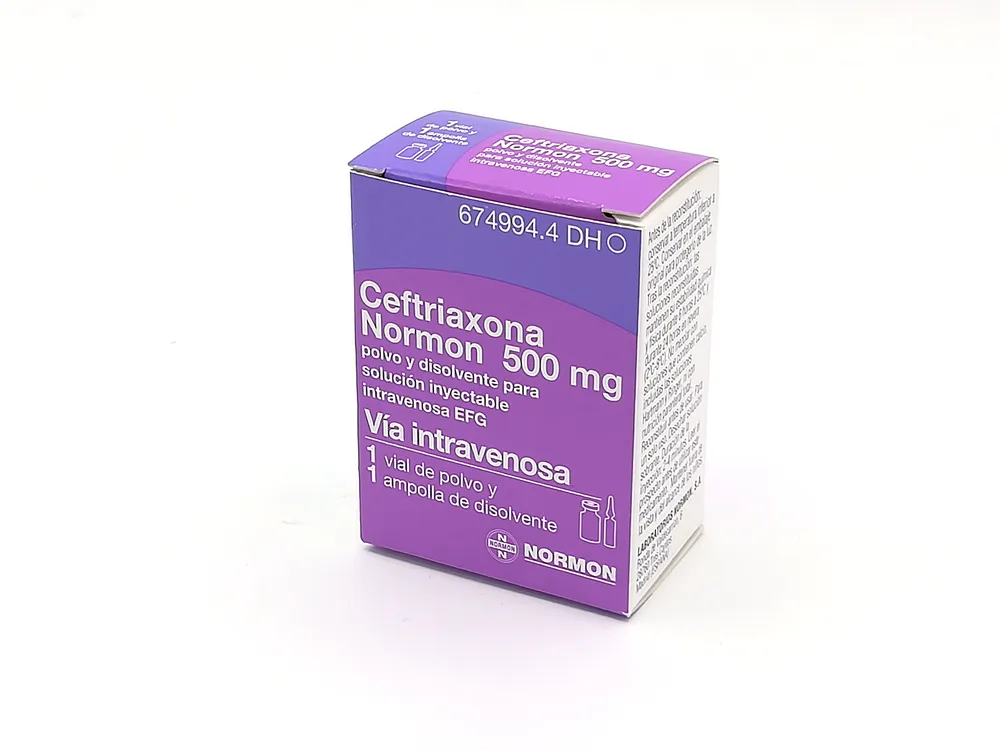
Table of Contents
- Package leaflet: Information for the user
- Introduction
- 1. What Ceftriaxone Normon is and what it is used for
- 2. What you need to know before using Ceftriaxone Normon
- 3. How to use Ceftriaxone Normon
- 4. Possible adverse effects
- 5. Storage of Ceftriaxone Normon
- 6. Contents of the container and additional information
Package leaflet: Information for the user
Introduction
Package leaflet: Information for the user
Ceftriaxone Normon 500 mg powder and solvent for injectable solution and for infusion EFG
Read the entire leaflet carefully before you start using this medicine, because it contains important information for you.
- Keep this leaflet, as you may need to read it again.
- If you have any questions, consult your doctor or pharmacist.
- This medicine has been prescribed for you only and must not be given to other people, even if they have the same symptoms as you, because it could harm them.
- If you experience any adverse effects, consult your doctor or pharmacist, even if they are adverse effects not listed in this leaflet. See section 4.
Contents of the leaflet:
- What Ceftriaxone Normon is and what it is used for.
- What you need to know before using Ceftriaxone Normon.
- How to use Ceftriaxone Normon.
- Possible adverse effects.
- How to store Ceftriaxone Normon.
- Contents of the pack and other information.
1. What Ceftriaxone Normon is and what it is used for
Ceftriaxone Normon is an antibiotic for adults and children (including newborn babies). Ceftriaxone works by eliminating the bacteria that cause infections. It belongs to a group of medicines called cephalosporins.
|
Ceftriaxone is indicated in the treatment of infections of:
- the brain (meningitis)
- the lungs
- the middle ear
- the abdomen and abdominal wall (peritonitis)
- the urinary tract and kidneys
- the bones and joints
- the skin and soft tissues
- the blood
- the heart
Ceftriaxone can be used:
- for the treatment of specific sexually transmitted infections (gonorrhea and syphilis)
- for the treatment of patients with low levels of white blood cells (neutropenia) who have fever due to a bacterial infection
- for the treatment of chest infections in adults with chronic bronchitis
- to treat Lyme disease (transmitted by ticks) in adults and children, including newborns from 15 days of age
- to prevent infections during surgical procedures
2. What you need to know before using Ceftriaxone Normon
Do not use Ceftriaxone Normon
- If you are allergic to ceftriaxone or to any of the other components of this medicine (listed in section 6).
- If you have had a sudden or severe allergic reaction to any penicillin or other similar antibiotics (such as cephalosporins, carbapenems, or monobactams). Signs of an allergic reaction include sudden swelling of the throat or face causing difficulty breathing or swallowing, sudden swelling of hands, feet, and ankles, chest pain, or a rapid and intense skin rash.
- If you are allergic to lidocaine and need to use ceftriaxone via intramuscular injection.
Ceftriaxone Normon must not be used in newborns in the following cases:
- Premature infants.
- Newborns (up to 28 days) with jaundice (yellowing of the skin or whites of the eyes), or if an intravenous product containing calcium is to be administered.
Warnings and precautions
Talk to your doctor or pharmacist before starting Ceftriaxone Normon:
- If you have recently used or are planning to use products containing calcium.
- If you have recently had diarrhea after taking an antibiotic. If you have intestinal problems, particularly colitis (inflammation of the intestine).
- If you have liver or kidney problems (see section 4).
- If you have gallstones or kidney stones.
- If you suffer from other diseases, such as hemolytic anemia (reduction in red blood cells, which may cause yellowing of the skin, weakness, and difficulty breathing).
- If you are on a low-sodium diet.
- If you experience or have experienced a combination of any of the following symptoms: rash, skin redness, blistering of the lips, eyes, and mouth, skin peeling, high fever, flu-like symptoms, increased liver enzyme levels seen in blood tests, an increase in a type of white blood cells (eosinophilia), and swollen lymph nodes (signs of serious skin reactions; see also section 4 “Possible side effects”).
If you are to undergo blood or urine tests
When using this medicine for prolonged periods, periodic blood tests may be necessary. Ceftriaxone may alter the results of urine glucose tests and the blood test known as the Coombs test. If you are to undergo any test:
- Inform the person taking your sample that you are taking this medicine.
If you are diabetic or need to monitor your blood glucose levels, do not use certain glucose monitoring systems, as results may be inaccurate due to ceftriaxone use. If you use such systems, consult the instructions for use and inform your doctor or pharmacist. Alternative methods may be used if necessary.
Children
Talk to your doctor or pharmacist before administering ceftriaxone to your child if:
- He/she has received or is to receive a product containing calcium administered intravenously.
Other medicines and Ceftriaxone Normon
Inform your doctor or pharmacist if you are taking, have recently taken, or plan to take any other medicines, including those obtained without a prescription.
In particular, if you are taking any of the following medicines, inform your doctor or pharmacist, as they may interact with ceftriaxone:
- An antibiotic known as an aminoglycoside.
- An antibiotic called chloramphenicol (used to treat infections, particularly of the eye).
Pregnancy, breastfeeding, and fertility
If you are pregnant, think you may be pregnant, plan to become pregnant, or are breastfeeding, inform your doctor before using this medicine. Your doctor will assess the benefits of treatment with ceftriaxone against any potential risks to the fetus.
Driving and use of machines
Ceftriaxone may cause dizziness. If you feel dizzy or experience vertigo, do not drive or operate tools or machinery. If you experience these symptoms, inform your doctor.
Ceftriaxone Normon contains sodium
This medicine contains 41.6 mg of sodium (the main component of table/cooking salt) per vial. This corresponds to 2.08% of the maximum daily recommended sodium intake for an adult.
It contains 0.36 mmol (8.32 mg) of sodium per ml of reconstituted solution.
3. How to use Ceftriaxone Normon
Follow exactly the instructions for administering this medicine as given by your doctor or pharmacist. If in doubt, consult your doctor or pharmacist.
Ceftriaxone is usually administered by a doctor or nurse. It can be given as an intravenous infusion or as an injection directly into a vein. Ceftriaxone is prepared for administration by a doctor, pharmacist, or nurse.
Do not mix or simultaneously administer ceftriaxone with other injectable products containing calcium.
Usual dose
Your doctor will determine the correct dose of ceftriaxone. The dose will depend on the type and severity of the infection, whether you are already receiving other antibiotics, your weight and age, as well as the condition of your liver and kidneys. The number of days or weeks you will receive ceftriaxone will depend on the type of infection.
Adults, elderly patients, and children over 12 years of age and ≥ 50 kg:
- 1 to 2 g per day, depending on the type and severity of the infection. If your infection is severe, your doctor may prescribe a higher dose (up to 4 g per day). If your daily dose exceeds 2 g, it may be administered as a single daily dose or as two separate doses.
Newborns, infants, and children from 15 days to 12 years of age weighing less than 50 kg:
- 50 to 80 mg of ceftriaxone per kg of body weight once daily, depending on the type and severity of the infection. If the infection is severe, your doctor may prescribe a higher dose, up to 100 mg per kg of body weight, up to a maximum of 4 g once daily. If your daily dose exceeds 2 g, it may be administered as a single daily dose or as two separate doses.
- Children weighing 50 kg or more should receive the usual adult dose.
Newborns (up to 14 days):
- 20 to 50 mg of ceftriaxone per kg of body weight once daily, depending on the type and severity of the infection.
- The maximum daily dose must not exceed 50 mg per kg of the infant's body weight.
Patients with liver or kidney problems
If you have impaired kidney or liver function, you may receive a different dose than usual. Your doctor will decide how much ceftriaxone you need and will monitor you closely depending on the severity of your kidney or liver disease.
If you use more Ceftriaxone Normon than you should
If you accidentally receive a higher dose than prescribed, contact your doctor or go to the nearest hospital as soon as possible.
In case of overdose or accidental ingestion, contact your doctor or pharmacist immediately or call the Toxicology Information Service at 91 562 04 20, indicating the medicine and the amount used.
If you forget to use Ceftriaxone Normon
If you miss an injection, it should be administered as soon as possible. However, if it is almost time for the next injection, skip the missed dose. Do not administer a double dose (two injections at once) to make up for a missed dose.
If you stop treatment with Ceftriaxone Normon
Do not stop receiving ceftriaxone unless your doctor tells you to. If you have any further questions about the use of this medicine, consult your doctor, pharmacist, or nurse.
If you have any other questions about the use of this product, ask your doctor or pharmacist.
4. Possible adverse effects
Like all medicines, ceftriaxone can cause adverse effects, although not everyone experiences them.
The possible adverse effects associated with the use of this medicine are listed below:
Treatment with ceftriaxone may, in rare cases, lead to decreased consciousness, abnormal movements, agitation, and seizures, particularly in elderly patients with severe disorders of the kidney or nervous system.
Severe allergic reactions (frequency not known, cannot be estimated from the available data)
If you experience a severe allergic reaction, consult your doctor immediately.
Symptoms may include:
- Sudden swelling of the face, throat, lips, or mouth, which may cause difficulty breathing or swallowing.
- Sudden swelling of the hands, feet, and ankles.
- Chest pain occurring in the context of allergic reactions, which may be a symptom of an allergy-triggered heart attack (Kounis syndrome).
Severe skin reactions (frequency not known, cannot be estimated from the available data)
If you experience a severe allergic reaction, consult your doctor immediately.
Symptoms may include:
- A severe rash developing rapidly, with blisters or skin peeling, and sometimes blisters in the mouth (Stevens-Johnson syndrome [SJS] and toxic epidermal necrolysis [TEN]).
- A combination of any of the following symptoms: widespread rash, high body temperature, elevated liver enzyme levels, abnormalities in blood count (eosinophilia), enlarged lymph nodes, and involvement of other organs (drug reaction with eosinophilia and systemic symptoms, also known as DRESS syndrome or systemic drug-induced hypersensitivity syndrome with eosinophilia).
- Jarisch-Herxheimer reaction, causing fever, chills, headache, muscle pain, and skin rash, which usually resolve spontaneously. These effects occur shortly after starting ceftriaxone treatment for spirochetal infections, such as Lyme disease.
Other possible adverse effects:
Frequent (may affect up to 1 in 10 people)
- Abnormalities in white blood cells (such as decreased leukocytes and increased eosinophils) and platelets (decreased thrombocytes).
- Soft stools or diarrhea.
- Abnormal liver function test results in blood tests.
- Skin rash.
Uncommon (may affect up to 1 in 100 people)
- Fungal infection (e.g., candidiasis or genital fungal infections).
- Decreased number of white blood cells (granulocytopenia).
- Decreased number of red blood cells (anemia).
- Blood clotting disorders. Symptoms may include easy bruising, as well as joint pain and swelling.
- Headache.
- Dizziness.
- Nausea or vomiting.
- Itching (pruritus).
- Pain or burning sensation at the site of ceftriaxone administration. Blisters, bruising, intense redness or rash, burning sensation, pain, irritation, itching, skin hardening, or inflammation at the injection site.
- High temperature (fever).
- Abnormal kidney test results in blood tests (increased serum creatinine).
Rare (may affect up to 1 in 1,000 people)
- Inflammation of the large intestine (colon). Symptoms may include diarrhea, usually with blood and mucus, stomach pain, and fever.
- Difficulty breathing (bronchospasm).
- Rash (urticaria), which may affect large areas of the body, with itching and swelling.
- Blood or glucose in the urine.
- Edema (fluid accumulation).
- Chills.
- Infections at the injection site.
Frequency not known (frequency cannot be estimated from the available data)
- Secondary infection that may not respond to previously prescribed antibiotics.
- A form of anemia in which red blood cells are destroyed (hemolytic anemia).
- Marked decrease in certain white blood cells (agranulocytosis).
- Seizures.
- Dizziness (spinning sensation).
- Inflammation of the pancreas (pancreatitis). Symptoms may include severe stomach pain radiating to the back.
- Inflammation of the oral mucosa (stomatitis).
- Inflammation of the tongue (glossitis). Symptoms may include swelling, redness, and pain in the tongue.
- Gallbladder or liver disorders that may cause pain, nausea, vomiting, yellowing of the skin, itching, darkening of the urine, and clay-colored stools.
- Neurological disease that may cause severe jaundice in neonates (nuclear jaundice).
- Kidney disorders due to calcium-ceftriaxone deposits, which may cause pain during urination or reduced urine output.
- False positive Coombs test result (a test detecting certain blood disorders).
- False positive result for galactosemia (abnormal accumulation of the sugar galactose).
- Ceftriaxone may alter the results of certain types of blood glucose tests. Consult your doctor.
Reporting of adverse effects
If you experience any adverse effects, consult your doctor, pharmacist, or nurse, even if they are possible adverse effects not listed in this leaflet. You may also report them directly via the Spanish Pharmacovigilance System for Human Medicines: www.notificaRAM.es. By reporting adverse effects, you can help provide more information on the safety of this medicine.
5. Storage of Ceftriaxone Normon
Keep this medicine out of the sight and reach of children.
Store below 25°C. Keep in the original packaging to protect from light.
Before reconstitution: Do not use Ceftriaxone Normon after the expiry date stated on the packaging after "EXP". The expiry date refers to the last day of the month indicated.
After reconstitution: Reconstituted solutions remain chemically and physically stable for 6 hours at 25°C and for 24 hours when refrigerated (2°C–8°C).
From a microbiological standpoint, the product should be used immediately. If not used immediately, the storage conditions and time prior to use are the responsibility of the user and should not exceed 24 hours when stored between 2°C and 8°C, unless reconstitution has taken place under controlled and validated aseptic conditions.
Medicines must not be disposed of via wastewater or household waste. Dispose of unused medicines and their containers at the SIGRE point at your pharmacy. If you have any doubts, ask your pharmacist how to dispose of medicines and containers you no longer need. This will help protect the environment.
6. Contents of the container and additional information
Composition of Ceftriaxone Normon
The active substance is ceftriaxone (as ceftriaxone sodium).
Each vial contains 500 mg of ceftriaxone (as ceftriaxone sodium). Once reconstituted with the 5 ml of solvent contained in the ampoule, the concentration of the solution is 100 mg of ceftriaxone (as ceftriaxone sodium) per ml.
The powder vial contains no other components (excipients).
The solvent ampoule contains 5 ml of water for injections.
Presentation of the product and contents of the pack
It is presented in a glass vial, closed with a rubber stopper and sealed with a flip-off cap,
and one glass ampoule of solvent.
It is packaged in cardboard boxes containing 1 vial of powder and 1 ampoule of solvent.
Marketing Authorization Holder and Manufacturer
Laboratorios Normon S.A.
Ronda de Valdecarrizo, 6 – 28760
Tres Cantos – Madrid, Spain
Date of the most recent revision of this leaflet: January 2026
Detailed information on this medicinal product is available on the website of the Spanish Agency of Medicines and Health Products (AEMPS) http://www.aemps.gob.es
This information is intended exclusively for healthcare professionals
Please refer to the product's package leaflet or summary of product characteristics for complete prescribing information.
This medicine must be reconstituted before use. The reconstituted solution is for single use only. Any unused solution must be discarded.
The reconstituted solution is clear and yellow or slightly yellowish.
Incompatibilities
Solutions containing ceftriaxone must not be mixed or combined with other agents. In particular, diluents containing calcium (e.g., Ringer's solution, Hartmann's solution) must not be used to reconstitute ceftriaxone vials or to dilute reconstituted vials when administration is intended via intravenous (IV) route, as precipitates may form. Ceftriaxone must not be mixed or administered simultaneously with calcium-containing solutions.
According to available information in the medical literature, ceftriaxone is incompatible with amsacrine, vancomycin, fluconazole, and aminoglycosides.
Instructions for use
Intravenous route
Direct intravenous injection should be administered over 2–4 minutes. Doses exceeding 50 mg/kg must be administered by infusion.
For intravenous administration, the contents of the vial should be dissolved in 5 ml of solvent from the accompanying ampoule (5 ml of water for injections).
Once reconstituted with 5 ml of solvent, the concentration of the solution is 100 mg of ceftriaxone (as ceftriaxone sodium) per ml.
The solution must be inspected before injection for the presence of particles or turbidity. If foreign particles are observed, the solution must be discarded.
The dose and administration regimen used depend on the patient's age and weight, as well as the severity of the infection.
The solution must not be mixed with solutions containing other antibiotics or with any other solutions different from those specified above.