Ceftriaxone Normon 250 mg powder and solution for intramuscular injection EFG
Spain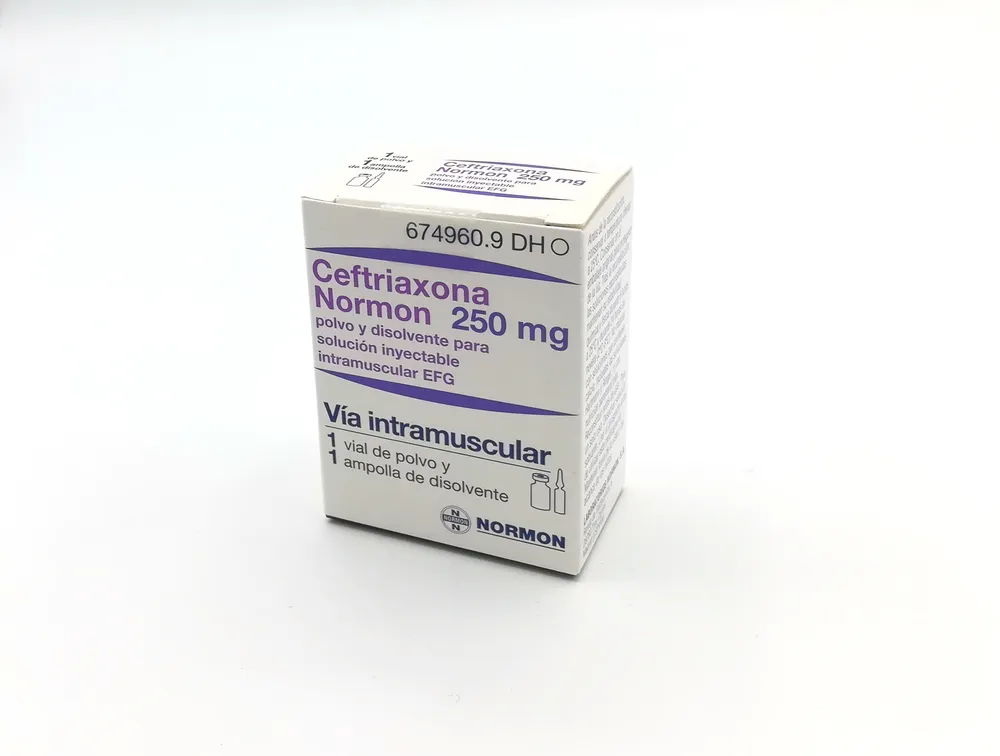
Table of Contents
- Package leaflet: Information for the user
- Introduction
- 1. What Ceftriaxone Normon is and what it is used for
- 2. What you need to know before using Ceftriaxone Normon
- 3. How to use Ceftriaxone Normon
- 4. Possible adverse effects
- 5. Storage of Ceftriaxone Normon
- 6. Contents of the pack and other information
Package leaflet: Information for the user
Introduction
Package leaflet: Information for the user
Ceftriaxone Normon 250 mg powder and solvent for injectable intramuscular solution EFG
Read the entire leaflet carefully before you start using this medicine, as it contains important information for you.
- Keep this leaflet, as you may need to read it again.
- If you have any questions, ask your doctor, pharmacist, or nurse.
- This medicine has been prescribed for you only and must not be given to other people, even if they have the same symptoms as you, as it may harm them.
- If you experience any adverse effects, consult your doctor, pharmacist, or nurse, even if the effects are not listed in this leaflet. See section 4.
Leaflet contents:
- What Ceftriaxone Normon is and what it is used for.
- What you need to know before using Ceftriaxone Normon.
- How to use Ceftriaxone Normon.
- Possible adverse effects.
- How to store Ceftriaxone Normon.
- Contents of the pack and other information.
1. What Ceftriaxone Normon is and what it is used for
Ceftriaxone Normon is an antibiotic for adults and children (including newborn babies). Ceftriaxone works by killing the bacteria that cause infections. It belongs to a group of medicines called cephalosporins.
Ceftriaxone Normon is administered by intramuscular injection as a solution containing lidocaine, which helps reduce the pain associated with the injection.
Ceftriaxone is used to treat infections of:
Ceftriaxone can also be used:
2. What you need to know before using Ceftriaxone NormonDo not use Ceftriaxone Normon
Ceftriaxone Normon must not be used in newborns in the following cases:
Warnings and precautions Talk to your doctor or pharmacist before starting Ceftriaxone Normon:
If you are to have blood or urine tests When using this medicine for prolonged periods, periodic blood tests may be necessary. Ceftriaxone may alter the results of urine glucose tests and the blood test known as the Coombs test. If you are to undergo any testing, inform the person taking your sample that you are taking this medicine. If you are diabetic or need to monitor your blood glucose levels, do not use certain blood glucose monitoring systems, as they may give inaccurate results while you are receiving ceftriaxone. If you use such systems, consult the user instructions and inform your doctor, pharmacist, or nurse. Alternative monitoring methods may be used if necessary. Children Talk to your doctor or pharmacist before administering ceftriaxone to your child if:
Other medicines and Ceftriaxone Normon Tell your doctor or pharmacist if you are taking, have recently taken, or might take any other medicines, including those obtained without a prescription. In particular, if you are taking any of the following medicines, inform your doctor or pharmacist, as they may interact with ceftriaxone:
A large number of medicines may interact with lidocaine and alter their effects. These include:
Pregnancy, breastfeeding, and fertility If you are pregnant, think you may be pregnant, plan to become pregnant, or are breastfeeding, inform your doctor before using this medicine. Your doctor will assess the benefits of treatment with ceftriaxone against any potential risks to the fetus. Driving and using machines Ceftriaxone may cause dizziness. If you feel dizzy or have vertigo, do not drive or operate tools or machinery. If you experience these symptoms, inform your doctor. Ceftriaxone Normon contains sodium This medicine contains less than 23 mg of sodium (1 mmol) per vial; this is essentially “sodium-free”. It contains 0.45 mmol (10.405 mg) of sodium per ml of reconstituted solution. 3. How to use Ceftriaxone NormonFollow exactly the instructions for administering this medicine as given by your doctor or pharmacist. If in doubt, consult your doctor or pharmacist. Ceftriaxone is usually administered by a doctor or nurse. It is given by intramuscular injection. Ceftriaxone is prepared for administration by a doctor, pharmacist, or nurse. It must not be mixed or simultaneously administered with other injectable products containing calcium. For intramuscular administration, the contents of the vial must be dissolved in 2 ml of solvent from the accompanying ampoule. Recommended dose Your doctor will decide the correct dose of ceftriaxone. The dose will depend on the type and severity of the infection, whether you are already receiving other antibiotics, your weight and age, as well as the condition of your liver and kidneys. The number of days or weeks you will receive ceftriaxone will depend on the type of infection you have. Adults, elderly patients, and children from 12 years of age with a body weight of 50 kilograms (kg) or more:
Newborns, infants, and children from 15 days to 12 years of age with a body weight below 50 kg:
Newborns (up to 14 days of age):
Patients with liver or kidney problems If you have impaired kidney or liver function, you may receive a different dose than usual. Your doctor will decide how much ceftriaxone you need and will carefully monitor you based on the severity of your kidney or liver disease. If you use more Ceftriaxone Normon than you should If you accidentally receive a higher dose than prescribed, contact your doctor immediately or go to the nearest hospital. If you forget to use Ceftriaxone Normon If you miss an injection, it should be given as soon as possible. However, if it is almost time for the next injection, skip the missed dose. Do not administer a double dose (two injections at the same time) to make up for a missed dose. If you stop using Ceftriaxone Normon Do not stop receiving ceftriaxone unless your doctor tells you to. If you have any further questions about the use of this medicine, consult your doctor, pharmacist, or nurse. If you have any other questions about the use of this product, ask your doctor or pharmacist. 4. Possible adverse effectsLike all medicines, ceftriaxone can cause adverse effects, although not everyone will experience them. The possible adverse effects associated with the use of this medicine are listed below: Treatment with ceftriaxone, particularly in elderly patients with severe kidney or nervous system disorders, may in rare cases cause decreased level of consciousness, abnormal movements, agitation, and seizures. Severe allergic reactions (frequency unknown, cannot be estimated from available data) If you experience a severe allergic reaction, contact your doctor immediately. Signs may include:
Severe skin reactions (frequency unknown, cannot be estimated from available data) If you experience a severe allergic reaction, contact your doctor immediately. Signs may include:
Frequent (may affect up to 1 in 10 people)
Uncommon (may affect up to 1 in 100 people)
Rare (may affect up to 1 in 1,000 people)
Frequency unknown (frequency cannot be estimated from available data)
Accidental intravascular injection of lidocaine during intramuscular administration of ceftriaxone may lead to additional adverse effects. These adverse effects may include: Frequency unknown (frequency cannot be estimated from available data)
Reporting of adverse effects If you experience any adverse effect, talk to your doctor, pharmacist, or nurse, even if it is a possible adverse effect not listed in this leaflet. You can also report them directly via the Spanish Pharmacovigilance System for Human Medicines: www.notificaRAM.es. By reporting adverse effects, you can help provide more information on the safety of this medicine. 5. Storage of Ceftriaxone NormonKeep this medicine out of the sight and reach of children. Store below 25°C. Keep in the original packaging to protect from light. Before reconstitution: Do not use Ceftriaxone Normon after the expiry date stated on the packaging after "EXP". The expiry date refers to the last day of the month indicated. After reconstitution: Reconstituted solutions remain chemically and physically stable for 6 hours at 25°C and for 24 hours when refrigerated (2°C-8°C). From a microbiological standpoint, the product should be used immediately. If not used immediately, the storage conditions and duration prior to use are the responsibility of the professional and should not exceed 24 hours when stored between 2 and 8°C, unless reconstitution has taken place under controlled, validated aseptic conditions. Medicines must not be disposed of via wastewater or household waste. Dispose of unused medicines and their containers at the SIGRE Point at your pharmacy. If in doubt, ask your pharmacist how to dispose of medicines and containers you no longer need. This will help protect the environment. 6. Contents of the pack and other informationComposition of Ceftriaxone Normon The active substance is ceftriaxone. Each vial of powder contains 250 mg of ceftriaxone (as ceftriaxone sodium). The solvent ampoule contains 20 mg of lidocaine hydrochloride monohydrate. Once reconstituted with the 2 ml of solvent containing lidocaine hydrochloride monohydrate provided in the ampoule, the concentration of the solution is 125 mg of ceftriaxone (as ceftriaxone sodium) per ml. The other components (excipients) are: Solvent ampoule: water for injections. Appearance of the product and contents of the pack It is supplied in a glass vial, closed with a rubber stopper and sealed with a flip-off cap, and 1 solvent ampoule. Pack size: 1 vial. Only certain pack sizes may be marketed. Marketing Authorization Holder and Manufacturer Responsible Laboratorios Normon S.A. Ronda de Valdecarrizo, 6 – 28760 Tres Cantos – Madrid (Spain) Date of the most recent revision of this summary: January 2026 Detailed information on this medicine is available on the website of the Spanish Agency for Medicines and Health Products (AEMPS) http://www.aemps.gob.es This information is intended for healthcare professionals only Please refer to the package leaflet or summary of product characteristics for complete prescribing information. This medicine must be reconstituted before use. The reconstituted solution is for single use only. Any unused solution must be discarded. The reconstituted solution is clear and yellow or slightly yellowish. Instructions for use For intramuscular use only. For intramuscular administration, dissolve the contents of the vial in 2 ml of solvent from the accompanying ampoule (a solution of 20 mg/2 ml lidocaine hydrochloride monohydrate). Once reconstituted with 2 ml of solvent, the concentration of the solution is 125 mg of ceftriaxone (as ceftriaxone sodium) per ml. The solution should be inspected visually for particulate matter or discoloration prior to injection. If foreign particles are observed, the solution must be discarded. Then, inject into a relatively large muscle. Do not administer more than 1 gram at a single injection site. For doses exceeding 2 g, intravenous administration should be used. The dose and administration schedule depend on the patient's age and weight, as well as the severity of the infection. The solution must not be mixed with solutions containing other antibiotics or with any other solvents different from those specified above. |