Cefotaxime Normon 1 g powder and solvent for solution for injection EFG
Spain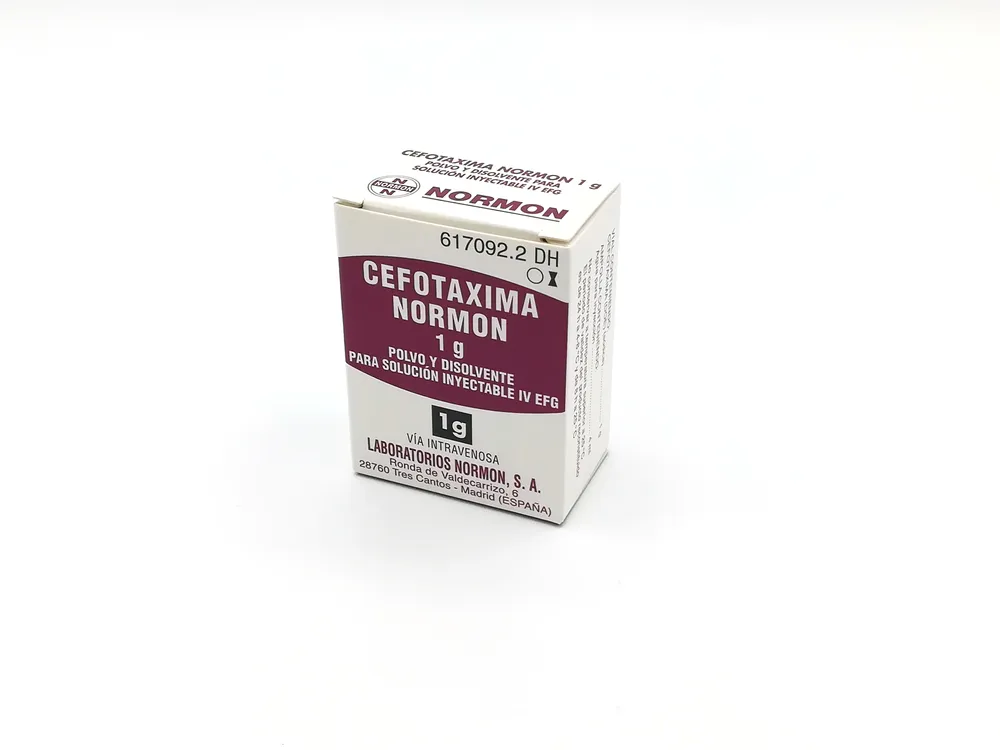
Table of Contents
- Package leaflet: Information for the user
- Introduction
- 1. What Cefotaxime Normon is and what it is used for
- 2. What you need to know before using Cefotaxime Normon
- 3. How to use Cefotaxime Normon
- 4. Possible adverse effects
- 5. Storage of Cefotaxime Normon
- 6. Contents of the pack and other information
Package leaflet: Information for the user
Introduction
Package leaflet: information for the patient
Cefotaxime Normon 1 g powder and solvent for injectable solution EFG
Read the entire leaflet carefully before you start using this medicine, because it contains important information for you.
- Keep this leaflet, as you may need to read it again.
- If you have any questions, ask your doctor or pharmacist.
- If you experience any adverse reactions, consult your doctor or pharmacist, even if they are adverse reactions not listed in this leaflet. See section 4.
Leaflet contents
- What Cefotaxime Normon is and what it is used for
- What you need to know before using Cefotaxime Normon
- How to use Cefotaxime Normon
- Possible side effects
- How to store Cefotaxime Normon
- Contents of the pack and other information
1. What Cefotaxime Normon is and what it is used for
This medicine belongs to a group of medicines called cephalosporins, used to fight bacteria.
Antibiotics are used to treat bacterial infections and are not effective against viral infections such as influenza or the common cold. It is important to follow your doctor's instructions regarding dosage, dosing interval, and duration of treatment. Do not keep or reuse this medicine. If you have leftover antibiotics after completing the treatment, return them to the pharmacy for proper disposal. Medicines must not be disposed of via the sink or in household waste. |
Cefotaxime is indicated for severe, acute and chronic bacterial infections caused by pathogens sensitive to cefotaxime:
- Respiratory tract infections.
- Otorhinolaryngological infections.
- Renal and urinary tract infections.
- Skin and soft tissue infections.
- Bone and joint infections.
- Gynecological infections, including gonorrhea.
- Abdominal infections (including peritonitis).
- Meningitis.
- Blood poisoning (sepsis).
- Inflammation of the heart (endocarditis).
- Lyme disease (especially in stages II and III) (infection caused mainly by tick bites).
In addition, for the prevention of infections following surgical procedures in patients at higher risk of infections.
2. What you need to know before using Cefotaxime Normon
Do not use Cefotaxime Normon
- If you are allergic to cefotaxime, to other cephalosporins, or to any of the other components of this medicine (listed in section 6).
- If you have previously experienced an acute or severe hypersensitivity reaction to penicillin or to other beta-lactam antibiotics. Penicillins and cephalosporins may cause cross-reactions.
- If you have ever had a severe skin rash, peeling skin, blisters, or mouth sores after taking cefotaxime or other cephalosporins.
Do not take Cefotaxime Normon or inform your doctor if any of the above apply to you.
The use of cefotaxime mixed with lidocaine for intramuscular injection is not indicated in children under 30 months of age. The product leaflet containing lidocaine should be consulted for preparation instructions.
Warnings and precautions
Talk to your doctor or pharmacist before using cefotaxime:
- If you are allergic to penicillin or to other beta-lactam antibiotics in any form (for contraindications due to known hypersensitivity reactions, see above in the section "Do not use Cefotaxime Normon").
- If you have an allergic reaction (e.g., hay fever, bronchial asthma, hives) or if you have a history of such conditions. In this case, you have a higher risk of more severe (and in rare cases, fatal) hypersensitivity reactions. If you experience chest tightness, dizziness, nausea, or weakness, these may be signs of a hypersensitivity reaction (see section 4).
- If a hypersensitivity reaction occurs, treatment must be discontinued.
- If you develop severe or persistent diarrhea during treatment or for several weeks after stopping treatment. Inform your doctor immediately, as diarrhea in its most severe form (called pseudomembranous colitis) can be life-threatening and requires treatment. Do not take any medication that reduces intestinal motility.
- If you know you have kidney impairment. Inform your doctor; the dose may need to be adjusted. Your kidney function should be monitored.
- If you are receiving concomitant or subsequent treatment with aminoglycosides (other antibiotics), probenecid (for gout), or other medicines that may cause kidney damage. Your kidney function should be monitored by a doctor, as these substances may increase kidney-related adverse effects and caution is required.
- If you experience movement disorders, seizures, confusion, or altered consciousness. These may be signs of what is called encephalopathy. The risk of these adverse effects increases with high doses, overdose, or in case of renal impairment. If such reactions occur, consult your doctor immediately.
- If your treatment lasts longer than 7 to 10 days. In this case, blood tests should be performed to monitor for possible blood changes (see also section 4).
- If you show signs of a new infection (e.g., fungal infection of mucous membranes with redness and a white coating). Antibiotic use may increase the presence of pathogens not sensitive to the drug. Watch for signs of new infections and inform your doctor if necessary.
Take special care with Cefotaxime Normon
- Severe skin reactions such as Stevens-Johnson syndrome, toxic epidermal necrolysis, drug reaction with eosinophilia and systemic symptoms (DRESS), and acute generalized exanthematous pustulosis (AGEP) have been reported with cefotaxime treatment. Stop taking cefotaxime and seek immediate medical attention if you notice any of the symptoms described in section 4 related to these serious skin reactions.
Other medicines and Cefotaxime Normon
Tell your doctor or pharmacist if you are taking, have recently taken, or might need to take any other medicines.
Other antibiotics
Concomitant use of certain antibiotics may reduce the effectiveness of cefotaxime. Inform your doctor if you are taking or have recently taken other antibiotics.
Diuretics and medicines potentially harmful to the kidneys
When cefotaxime is used together with medicines that may have a harmful effect on the kidneys, such as aminoglycosides (other antibiotics) or medicines that may cause significant dehydration (diuretics, such as furosemide), the kidney-related adverse effects of these medicines may increase. If administered together, kidney function should be monitored (see section 2, "Warnings and precautions").
Probenecid
Concomitant administration of probenecid leads to increased serum concentrations of cefotaxime and thus prolongs its effect, as probenecid reduces the renal elimination of cefotaxime. Inform your doctor if you are taking probenecid, especially if you have renal impairment, so that the dose may be adjusted if necessary.
Pregnancy, breastfeeding, and fertility
If you are pregnant or breastfeeding, think you may be pregnant, or plan to become pregnant, consult your doctor or pharmacist before using this medicine.
Pregnancy
There are insufficient data on the use of cefotaxime in pregnant women. Animal studies did not show signs of teratogenic properties of cefotaxime.
Nevertheless, cefotaxime should only be used during pregnancy, especially in the first trimester, after a strict assessment of the risks and benefits of treatment by a specialist.
Breastfeeding
Cefotaxime is excreted in breast milk only in small amounts. If you receive cefotaxime during breastfeeding, it may cause disturbances in intestinal flora resulting in diarrhea, fungal overgrowth, and may also lead to sensitization. The doctor will decide whether to interrupt breastfeeding or discontinue treatment with cefotaxime, taking into account the benefits of breastfeeding for the child and the benefits of treatment for the mother.
Driving and use of machines
Based on previous experience, cefotaxime at low and medium doses has no effect on concentration or reaction ability.
However, if you experience adverse effects such as dizziness or encephalopathy, which may be associated with seizures, confusion, altered consciousness, or movement disorders, you should not drive or operate machinery.
Cefotaxime Normon contains sodium
This medicine contains 50.6 mg (2.20 mmol) of sodium (main component of table/cooking salt) per dose. This corresponds to 2.53% of the maximum daily recommended sodium intake for an adult.
3. How to use Cefotaxime Normon
Follow exactly the administration instructions for this medicine as indicated by your doctor. If in doubt, consult your doctor or pharmacist again.
The dose, route of administration, and time intervals between injections depend on the required dose, pathogen sensitivity, severity of the infection, and the patient's condition.
Unless otherwise determined by the physician, the recommended dose is:
Adults and children over 12 years of age: the usual dosage regimen is 1 g of cefotaxime every 12 hours. In severe cases, the daily dose may be increased up to 12 g. Daily doses up to 6 g should be divided into at least two divided doses administered at 12-hour intervals. Higher daily doses should be divided into at least 3–4 divided doses with administration intervals of 6 or 8 hours.
The following table may be considered a dosage guideline:
| Single dose of cefotaxime | Dosing interval |
| ||||
Typical infections in which a susceptible pathogenic microorganism is detected or suspected | 1 g | 12 hours | 2 g | ||||
Infections in which different pathogenic microorganisms with medium to high sensitivity are detected or suspected | 2 g | 12 hours | 4 g | ||||
Bacterial diseases of undetermined origin that cannot be localized, as well as life-threatening situations | 2–3 g | 8 hours up to 6 hours up to 4 hours | 6 g up to 8 g up to 12 g |
For the treatment of gonorrhoea in adults, a single dose of 0.5 g of cefotaxime should be administered intramuscularly. In less sensitive pathogens, a higher dose may be required. Before starting treatment, check for the presence of syphilis.
For perioperative prophylaxis of infections, administration of 1–2 g of cefotaxime 30–60 minutes before surgery is recommended. Higher doses may be needed for less sensitive pathogenic microorganisms. Before starting treatment, check for the presence of syphilis.
For Lyme disease, the daily dose is 6 g of cefotaxime (for 14 to 21 days). In most cases, the daily dose is divided into 3 divided doses (2 g of cefotaxime 3 times daily), but in some cases it has been administered as 2 divided doses (3 g of cefotaxime twice daily). Dosing recommendations are not based on comparative clinical trials but on observations from individual patients.
Combination therapy
In severe, life-threatening infections, combination therapy with cefotaxime and aminoglycosides is indicated, even without an antibiogram. When combined with aminoglycosides, renal function must be monitored.
In infections caused by Pseudomonas aeruginosa, combination therapy with other antibiotics effective against Pseudomonas may also be indicated.
For infection prophylaxis in patients with weakened immune systems, combination therapy with other appropriate antibiotics may also be indicated.
Infants and children up to 12 years of age receive 50 to 100 mg of cefotaxime (up to 150 mg) per kilogram of body weight daily, depending on the severity of the infection. The daily dose should be divided into 2 or more equal divided doses administered at intervals of 12 (to 6) hours. In individual cases, especially in life-threatening situations, the daily dose may be increased to 200 mg of cefotaxime per kilogram of body weight.
In premature infants, it must be considered that renal function is not yet fully developed, and the dose should not exceed 50 mg of cefotaxime per kilogram of body weight per day.
In patients with severe renal impairment (creatinine clearance less than 10 ml/min), after the normal initial dose (the first dose at the beginning of treatment), the maintenance dose can be reduced to half the normal dose, maintaining the same dosing interval.
Patients undergoing haemodialysis receive 1 to 2 g of cefotaxime daily, depending on the severity of the infection. On the day of haemodialysis, cefotaxime should be administered after dialysis.
Patients undergoing peritoneal dialysis receive 1 to 2 g of cefotaxime daily, depending on the severity of the infection. Cefotaxime is not removed by peritoneal dialysis.
Cefotaxime Normon 1 g is administered intravenously (into a vein), but may also be administered intramuscularly.
Elderly patients
In elderly patients, renal function should be carefully monitored and, if necessary, the dose should be adjusted.
If you use more Cefotaxima Normon than you should
Beta-lactam antibiotics, including cefotaxime, may cause so-called encephalopathies, accompanied by central nervous system excitation, myoclonus, seizures, confusion, impaired consciousness, and movement disorders. This risk exists with higher doses, in cases of overdose, and in patients with impaired renal function or those suffering from epilepsy or meningitis.
If cefotaxime is injected too rapidly through a central venous catheter (CVC) (in less than 1 minute), it may cause a serious cardiac arrhythmia.
If you think you have received too much cefotaxime, speak immediately with your doctor or medical staff.
If you forget to use Cefotaxima Normon
Your doctor or nurse will have instructions on when to administer the medicine, so it is unlikely that the medicine will not be administered as directed. If you think a dose has been missed, speak with your doctor or nurse.
If you have any further questions about the use of this medicine, ask your doctor, pharmacist, or nurse.
4. Possible adverse effects
Like all medicines, this medicine may cause adverse effects, although not everyone experiences them.
Stop taking cefotaxime and inform your doctor immediately if you notice any of the following symptoms:
- Seizures (uncommon, may affect up to 1 in 100 people).
- Frequency not known (cannot be estimated from available data):
- Severe acute hypersensitivity reactions and life-threatening allergic reactions, as well as swelling (angioedema) and narrowing of the airways (bronchospasm). If you experience chest tightness, dizziness, or feel sick or weak, these could be signs of a hypersensitivity reaction.
- Severe persistent diarrhoea or blood in the stools due to a possible life-threatening intestinal inflammation.
- Decrease in red blood cells (haemolytic anaemia), change in urine colour (to reddish-brown).
- Acute kidney failure.
- Flat reddish patches, or circular or target-like rashes on the chest, often with central blisters, skin peeling, and ulcers in the mouth, throat, nose, genitals, and eyes. These serious skin rashes may be preceded by fever and flu-like symptoms (Stevens-Johnson syndrome, toxic epidermal necrolysis).
- Widespread skin rash, high body temperature, and enlarged lymph nodes (DRESS syndrome or drug hypersensitivity syndrome).
- Generalized red, scaly rash, with lumps under the skin and blisters, accompanied by fever. Symptoms usually appear at the beginning of treatment (acute generalized exanthematous pustulosis).
Inform your doctor or nurse if you experience any of the following adverse effects with a frequency not known (cannot be estimated from available data):
- Jaundice as a sign of possible hepatitis.
- Severe decrease in white blood cells (agranulocytosis), which may present as sudden signs of infection, as well as inflammation of the oral, nasal, pharyngeal, genital, and anal areas.
- Marked decrease in all blood cells and bone marrow failure. Sudden signs of infection and inflammation (see above), bleeding, bruising (due to decreased platelets), fatigue, paleness, or shortness of breath (due to decreased red blood cells) may also occur.
Inform your doctor or nurse if any of the following adverse effects worsen or last longer than a few days:
Very common (may affect more than 1 in 10 people)
- Pain at the injection site, also hardening after intramuscular administration.
Common (may affect up to 1 in 10 people)
- Joint problems (e.g., swelling).
Uncommon (may affect up to 1 in 100 people)
- Increase in eosinophils (eosinophilia).
- Decrease in platelet count (thrombocytopenia) and certain white blood cells (leukopenia, granulocytopenia).
- Jarisch-Herxheimer reaction (see explanation below).
- Diarrhoea.
- Loss of appetite.
- Increase in bilirubin (bile pigment in the blood) and liver enzymes in serum (SGOT, SGPT, γ-GT, alkaline phosphatase, LDH).
- Allergic reactions such as rash, itching, hives.
- Impaired kidney function, e.g., increased serum creatinine and urea concentrations.
- Fever.
- Inflammatory reactions at the injection site and vein inflammation (phlebitis/thrombophlebitis).
Frequency not known (cannot be estimated from available data)
- Secondary infections by bacteria or fungi (e.g., in the mouth or vagina).
- Decrease in certain white blood cells (neutropenia).
- Tachycardia, cardiac arrhythmia (after rapid administration via a central venous access).
- Central nervous system stimulation, altered consciousness, confusion, movement disorders, muscle spasms (encephalopathy symptoms, especially with high doses, overdose, or impaired renal function).
- Headache.
- Dizziness.
- Nausea, vomiting, abdominal pain.
- Kidney inflammation (interstitial nephritis).
- Intolerance reactions such as sensation of warmth or nausea during faster intravenous administration.
Jarisch-Herxheimer reaction
When starting treatment for spirochetal infections (e.g., Lyme disease), you may experience fever, chills, headache, and joint pain. After several weeks of treatment for Lyme disease, one or more of the following symptoms have been reported: rash, itching, fever, decreased white blood cells, increased liver enzymes, difficulty breathing, and joint pains. These symptoms partially correspond to symptoms of the underlying disease in treated patients.
Reporting of adverse effects
If you experience any adverse effect, consult your doctor, pharmacist, or nurse, even if it is a possible adverse effect not listed in this leaflet. You can also report them directly through the Spanish Pharmacovigilance System for Human Medicines: https://www.notificaram.es. By reporting adverse effects, you can help provide more information on the safety of this medicine.
5. Storage of Cefotaxime Normon
Keep this medicine out of the sight and reach of children.
Do not store above 25°C.
Do not use this medicine after the expiry date stated on the packaging after EXP. The expiry date refers to the last day of the month indicated.
Reconstituted vials maintain their chemical and physical stability for 24 hours at 8–25°C and when stored in the refrigerator (2°C–8°C).
From a microbiological standpoint, it is recommended to use the solutions immediately after preparation. If not administered immediately, the time and conditions of storage are the responsibility of the user and should normally not exceed 24 hours at 2°C–8°C, unless reconstitution has been carried out under controlled, validated aseptic conditions.
Medicines must not be disposed of via wastewater or household waste. Return empty containers and unused medicines to the SIGRE point at your pharmacy. If you have any doubts, ask your pharmacist how to dispose of medicines and containers you no longer need. This will help protect the environment.
6. Contents of the pack and other information
Composition of Cefotaxime Normon 1 g
The active substance is cefotaxime (as cefotaxime sodium).
Each vial contains 1 g of cefotaxime (as cefotaxime sodium).
Each solvent ampoule contains water for injections.
Presentation of the product and contents of the pack
Cefotaxime Normon 1 g is presented as a white or slightly yellow powder contained in a clear glass vial, with a rubber stopper sealed with an aluminium cap, and one glass ampoule containing 4 ml of solvent.
The vials are supplied in boxes containing 1 vial or in hospital packs of 100 vials.
Only some pack sizes may be marketed.
Marketing Authorization Holder and Manufacturer
Laboratorios Normon, S.A.
Ronda de Valdecarrizo, 6
28760 Tres Cantos (Madrid)
Spain
Date of the most recent revision of this leaflet: June 2024
Detailed information on this medicinal product is available on the website of the Spanish Agency of Medicines and Health Products (AEMPS) http://www.aemps.gob.es
This information is intended for healthcare professionals only.
Common information for the following presentations:
Cefotaxime Normon 250 mg powder and solvent for injectable solution EFG
Cefotaxime Normon 500 mg powder and solvent for injectable solution EFG
Cefotaxime Normon 1 g powder and solvent for injectable solution EFG
Cefotaxime Normon 2 g powder and solvent for injectable and perfusion solution EFG
Intravenous injection
Cefotaxime Normon 250 mg, 500 mg, 1 g, and 2 g are administered by slow intravenous injection over 3 to 5 minutes, after dilution in 2, 4, or 10 ml of solvent (water for injections).
Intravenous infusion
Reconstitute the 2 g vial with 10 ml of water for injections. Subsequently:
For rapid intravenous infusion, dilute in 40 ml of water for injections or an isotonic sodium chloride solution, and administer by intravenous infusion over approximately 20 minutes.
For slow intravenous infusion, dissolve in 100 ml of isotonic sodium chloride solution or glucose solution, and administer by intravenous infusion over a period of 50 to 60 minutes.
Intramuscular injection
Cefotaxime Normon 500 mg and 1 g:
For intramuscular injection, dissolve 500 mg of cefotaxime in 2 ml or 1 g of cefotaxime in 4 ml of water for injections. The injection should then be administered by deep intragluteal route. Pain during intramuscular injection may be avoided by dissolving 1 g of cefotaxime in 4 ml or 500 mg in 2 ml of 1% lidocaine (see section 2 Do not use Cefotaxime Normon). Intravascular injection must be avoided, as intravascular administration of lidocaine may cause restlessness, tachycardia, conduction abnormalities, vomiting, and confusion. The commercial presentation Cefotaxime Normon 1 g powder and solvent for intramuscular injectable solution EFG includes the lidocaine ampoule inside for intramuscular administration.
Unless compatibility with other infusion solutions has been demonstrated, cefotaxime solution should, in principle, be administered separately from other solutions.
Cefotaxime is not compatible with:
- Sodium bicarbonate solution
- Infusion solutions with a pH above 7
- Aminoglycosides
In general, cefotaxime must not be mixed or administered together with other antibiotics or medicinal products in the same syringe. Cefotaxime must not be mixed with aminoglycoside antibiotics in the infusion set or in the syringe.