Cefepime LDP- Laboratorios Torlan 1 g powder for injection and for infusion EFG
Spain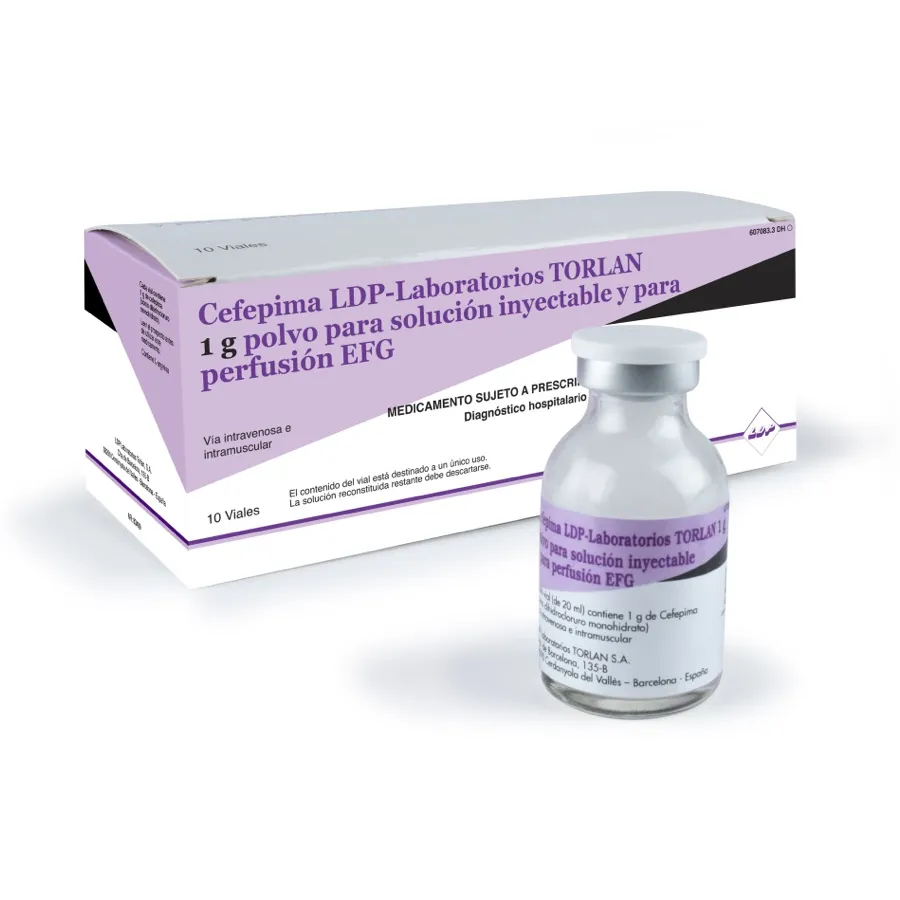
Table of Contents
- Package leaflet: Information for the user
- Introduction
- 1. What Cefepime is and what it is used for
- 2. What you need to know before using Cefepime LDP-Laboratorios TORLAN
- 3. How to use Cefepime LDP-Laboratorios TORLAN
- 4. Possible adverse effects
- 5. Storage of Cefepime LDP-Laboratorios TORLAN
- 6. Contents of the pack and other information
Package leaflet: Information for the user
Introduction
Package leaflet: information for the user
Cefepime LDP-Laboratorios TORLAN 1 g powder for solution for injection and for infusion EFG
Read the entire leaflet carefully before you start using this medicine, because it contains important information for you.
- Keep this leaflet as you may need to read it again.
- If you have any questions, ask your doctor or pharmacist.
- This medicine has been prescribed for you only, and you should not give it to other people, even if they have the same symptoms as you, because it could harm them.
- If you experience any adverse reactions, consult your doctor or pharmacist, even if they are adverse reactions not listed in this leaflet. See section 4.
Contents of the leaflet
- What Cefepime LDP-Laboratorios TORLAN is and what it is used for
- What you need to know before using Cefepime LDP-Laboratorios TORLAN
- How to use Cefepime LDP-Laboratorios TORLAN
- Possible side effects
- How to store Cefepime LDP-Laboratorios TORLAN
- Contents of the pack and other information
1. What Cefepime is and what it is used for
Cefepime LDP-Laboratorios TORLAN is indicated for the treatment of infections caused by bacteria susceptible to cefepime, namely:
-
lower respiratory tract infections, including nosocomial pneumonia and community-acquired pneumonia, acute bacterial exacerbation of chronic bronchitis, and bacterial infection secondary to acute bronchitis;
- uncomplicated and complicated urinary tract infections, including pyelonephritis;
-
skin and subcutaneous tissue infections;
-
intra-abdominal infections, including peritonitis and biliary tract infections;
-
gynecological infections;
-
bacterial meningitis in infants and children;
-
in combination with other antibacterial agents for the treatment of febrile neutropenic patients in whom a bacterial infection is suspected;
-
treatment of patients with bacteremia occurring in association with, or suspected to be associated with, any of the infections listed above.
-
Antibiotics are used to treat bacterial infections and are not effective against viral infections such as influenza or the common cold.
-
It is important that you follow your doctor's instructions regarding dosage, dosing interval, and duration of treatment.
-
Do not store or reuse this medicine. If you have leftover antibiotic after completing treatment, return it to the pharmacy for proper disposal. Do not dispose of medicines via the sink or in household waste.
Official guidelines on the appropriate use of antibacterial agents should be taken into consideration.
2. What you need to know before using Cefepime LDP-Laboratorios TORLAN
Do not use Cefepime LDP-Laboratorios TORLAN:
- if you are allergic to cefepime, to any other cephalosporin or other type of antibiotics, or to any of the other components of this medicine (listed in section 6).
- if you have a history of severe allergic reaction to any other type of beta-lactam antibiotics (penicillins, monobactams, and carbapenems).
Warnings and precautions
Talk to your doctor or pharmacist before starting to use Cefepime LDP-Laboratorios TORLAN.
Special care is needed when using Cefepime LDP-Laboratorios TORLAN:
- Severe and occasionally fatal allergic reactions have been reported. Inform your doctor if you have a history of asthma or allergic reactions (rash, itching, etc.). Severe allergic reactions may require epinephrine and other supportive therapy.
- Cefepime is not suitable for the treatment of certain types of infections. Your doctor has prescribed this antibiotic because it is the best option for your condition.
- if you have kidney problems (such as reduced kidney function), as elimination of this medicine may be affected.
- if you develop persistent diarrhea during or after using this medicine. Inform your doctor immediately so they can investigate whether the diarrhea is due to intestinal inflammation caused by the antibiotic; treatment with this medicine may need to be discontinued.
- If you suffer from allergies (such as hay fever, hives) or have previously experienced an allergic reaction to medications.
Cefepime must be discontinued at the first sign of any hypersensitivity reaction, and appropriate therapeutic measures should be initiated.
- Doses for elderly patients should be carefully selected and should take renal function into account, as there is a higher likelihood of kidney disease in this population.
Use of Cefepime with other medicines
Tell your doctor or pharmacist if you are taking, have recently taken, or might need to take any other medicines, including over-the-counter medicines.
Renal function should be carefully monitored when Cefepime LDP-Laboratorios TORLAN is combined with medicines that may affect the kidneys (such as aminoglycosides and potent diuretics).
Cephalosporins may enhance the effect of coumarin anticoagulants.
Interaction with diagnostic tests
Cefepime may cause false positive results in certain laboratory tests (Coombs test and urine glucose tests).
Pregnancy and breastfeeding
If you are pregnant or breastfeeding, think you may be pregnant, or are planning to become pregnant, consult your doctor or pharmacist before using this medicine.
Do not use this medicine during pregnancy unless absolutely necessary and specifically prescribed by your doctor. If you become pregnant while being treated with Cefepime LDP-Laboratorios TORLAN, consult your doctor.
Cefepime LDP-Laboratorios TORLAN may pass into breast milk; therefore, this medicine should be used during breastfeeding with great caution and only after consulting your doctor.
Driving and use of machines
No studies have been conducted to determine the effects on the ability to drive and use machines.
However, you may experience altered consciousness, dizziness, confusion, or hallucinations, which could affect your ability to drive or operate machinery.
3. How to use Cefepime LDP-Laboratorios TORLAN
Follow exactly the administration instructions for this medicine given by your doctor or pharmacist. If in doubt, consult your doctor or pharmacist.
Cefepime LDP-Laboratorios TORLAN can be administered by intravenous or intramuscular route.
After reconstitution, the solution is yellow to yellowish-brown in color.
The usual dose and route of administration vary depending on the severity of the infection, renal function, and the patient's general condition.
The intravenous (IV) route is preferred in patients with severe infections or in life-threatening situations, particularly if shock is possible.
Recommended dosage for adults and children (> 12 years) weighing > 40 kg with normal renal function:
Severity of infection | Dose and route of administration | Dosing interval |
Mild to moderate urinary tract infections (UTI) | 500 mg to 1 g IV or IM | every 12 h |
Other mild to moderate infections (non-UTI) | 1 g IV or IM | every 12 h |
Severe infections | 2 g IV | every 12 h |
Extremely severe or potentially life-threatening infections | 2 g IV | every 8 h |
The usual duration of therapy is 7 to 10 days. However, more severe infections may require longer treatment. For empirical treatment of febrile neutropenia, the usual duration of therapy is 7 days or until resolution of neutropenia.
In patients with a body weight ≤ 40 kg, the dosage recommended for children should be used.
Use in children
In children with normal renal function:
The usual recommended dose in children is:
- Pneumonia, urinary tract infection, skin and subcutaneous tissue infection:
- Children over 2 months of age and weighing ≤ 40 kg: 50 mg/kg every 12 hours for 10 days; in more severe infections, the dosing interval should be reduced to every 8 hours.
- Bacteremia occurring in association with infections, bacterial meningitis, and empirical treatment of febrile neutropenia:
- Children over 2 months of age and weighing ≤ 40 kg: 50 mg/kg every 8 hours for 7 to 10 days.
Experience in children under 2 months of age is limited. Administration of Cefepime LDP-Laboratorios TORLAN in children of this age group should be carefully monitored.
In children weighing > 40 kg, the adult dose should be used.
The maximum recommended adult dose (2 g every 8 hours) must not be exceeded. Experience with intramuscular use in children is limited.
Elderly patients, patients with renal impairment, patients on dialysis, and children with renal impairment:
The physician will determine the appropriate dose to be administered.
If you use more Cefepime LDP-Laboratorios TORLAN than you should:
Contact your doctor or other healthcare professionals immediately, as you may experience more severe side effects in certain situations.
If you have any further questions about the use of this medicine, ask your doctor or pharmacist.
4. Possible adverse effects
Like all medicines, this medicine may cause adverse effects, although not everyone experiences them.
Cefepime LDP-Laboratorios TORLAN may cause one or more of the following side effects:
Very common (may affect more than 1 in 10 people):
- Positive Coombs test results without hemolysis (a method to determine antibody levels)
Common (may affect up to 1 in 10 people):
- Prolonged blood coagulation time (increased prothrombin time or thromboplastin time);
- Anemia;
- Elevated levels of certain blood cells (eosinophilia);
- Phlebitis at the infusion site;
- Diarrhea;
- Rash;
- Reaction at the infusion site;
- Pain and inflammation at the injection or infusion site;
- Increased levels of bilirubin and certain enzymes (alanine aminotransferase, aspartate aminotransferase, alkaline phosphatase).
Uncommon (may affect up to 1 in 100 people):
- Fungal mouth infections with white coating (oral candidiasis);
- Vaginal infection;
- Reduced levels of certain blood cells (thrombocytopenia, leucopenia, neutropenia);
- Headache;
- Colitis (inflammation of the large intestine);
- Pseudomembranous colitis;
- Nausea;
- Vomiting;
- Erythema (redness of the skin);
- Urticaria;
- Tingling;
- Elevated blood urea;
- Elevated serum creatinine;
- Fever;
- Inflammation at the infusion site.
Rare (may affect up to 1 in 1,000 people):
- Fungal infections (candidiasis);
- Allergic reactions;
- Angioedema (sudden swelling of skin, subcutaneous tissue, mucosa, or submucosa);
- Seizures;
- Tingling or numbness;
- Altered sense of taste;
- Dizziness;
- Vasodilation;
- Difficulty breathing;
- Abdominal pain;
- Constipation;
- Genital itching;
- Chills.
Frequency not known (frequency cannot be estimated from the available data):
- Aplastic anemia, hemolytic anemia, and agranulocytosis;
- Confusion;
- Hallucinations;
- Coma;
- Somnolence;
- Encephalopathy (non-inflammatory brain disease);
- Altered consciousness;
- Myoclonus (muscle spasms);
- Bleeding;
- Gastrointestinal disease;
- Severe skin reactions (such as toxic epidermal necrolysis, Stevens-Johnson syndrome, and erythema multiforme);
- Renal failure;
- Toxic nephropathy (kidney damage);
- False positive result for urine glucose test.
Reporting of adverse effects
If you experience any type of adverse effect, consult your doctor, pharmacist, or nurse, even if it is a possible adverse effect not listed in this leaflet. You can also report them directly via the Spanish Pharmacovigilance System for Human Medicines: https://www.notificaram.es. By reporting adverse effects, you can help provide more information on the safety of this medicine.
5. Storage of Cefepime LDP-Laboratorios TORLAN
Keep this medicine out of the sight and reach of children.
Do not use this medicine after the expiry date stated on the packaging after EXP. The expiry date is the last day of the month indicated.
This medicine does not require special storage temperature conditions. Keep the container in the outer packaging. Do not use this medicine if you notice any visible signs of deterioration.
Medicines must not be disposed of via wastewater or household waste.
In case of doubt, ask your pharmacist how to dispose of medicines and packaging that you no longer need. This will help protect the environment.
6. Contents of the pack and other information
Composition of Cefepima LDP-Laboratorios TORLAN
- The active substance is cefepime dihydrochloride monohydrate.
Each vial of Cefepima LDP-Laboratorios TORLAN 1 g powder for injectable solution and for infusion contains 1 g of cefepime (as dihydrochloride monohydrate).
- The other component is: L-arginine.
Appearance of Cefepima LDP-Laboratorios TORLAN and contents of the container
Cefepima LDP-Laboratorios TORLAN 1 g is a white to pale yellow powder for injectable/infusion solution, packed in a 20 ml glass vial sealed with a flip-off cap. The vials are packaged in cardboard boxes.
Presentations: 1, 5, 10, 20, 25, 50 and 100 vials.
Only certain pack sizes may be marketed.
Marketing Authorization Holder
LDPLABORATORIOS TORLAN, S.A.
Ctra de Barcelona, 135-B
08290 Cerdanyola del Valles
Barcelona
Spain
Manufacturer
LDPLABORATORIOS TORLAN, S.A.
Ctra de Barcelona, 135-B
08290 Cerdanyola del Valles
Barcelona
Spain
Local Representative
LAPHYSAN, SAU
C/ Anabel Segura nº11. Edificio A, Planta 4, puerta D,
28108 Alcobendas
Madrid
Spain
This medicinal product is authorized in the Member States of the European Economic Area under the following names:
Portugal: Cefepima LDP Laboratorios TORLAN
Belgium: Cefepime LDP-Laboratorios TORLAN 1000 mg | 2000 mg, Poudre pour solution injectable/pour perfusion
United Kingdom: Renapime 1g | 2g, Powder for solution for injection/infusion
Date of the most recent review of this leaflet: November 2017
Detailed and up-to-date information on this medicinal product is available on the website of the Spanish Agency of Medicines and Health Products (AEMPS) http://www.aemps.gob.es/
This information is intended for healthcare professionals only:
Disposal of unused medicine and of all materials that have been in contact with it must be carried out in accordance with local regulations.
Preparation and administration of the reconstituted solution:
Cefepima LDP-Laboratorios TORLAN, powder for injectable solution and for infusion, must be dissolved in:
- Water for injection
or in one of the solutions listed in section b) below for intravenous administration:
- 0.9% sodium chloride solution
- 0.9% sodium chloride with 5% glucose solution
- 5% or 10% glucose solution
- Ringer's Lactate solution
- Ringer's Lactate with 5% glucose solution
- 1/6 M sodium lactate solution.
For intravenous injection, the volume of solvent to be added to each vial and the resulting cefepime concentration are shown in the following table:
Cefepime amount per vial | Volume of diluent to be added (ml) | Approximate final volume (ml) | Approximate cefepime concentration (mg/ml) |
1 g IV | 10.0 | 11.4 | 90 |
2 g IV | 10.0 | 12.8 | 160 |
For intravenous infusion, the volume of infusion solvent (solution listed in section b)) to be used for reconstitution and the resulting cefepime concentration are shown in the following table:
The volume of infusion solvent to be used for each vial and the resulting cefepime concentration are shown in the following table:
Cefepime amount per vial | Volume of diluent to be added (ml) | Approximate final volume (ml) | Approximate cefepime concentration (mg/ml) |
1 g IV | 50.0 | 51.4 | 19 |
2 g IV | 50.0 | 52.8 | 38 |
The resulting solution should be administered over approximately 30 minutes.
For intramuscular administration, reconstitute the 1 g vial with 3.0 ml of water for injections.
Note:
Reconstituted solutions, when properly prepared, may exhibit a yellow to yellowish-brown color. This does not indicate that the efficacy of Cefepime LDP-Laboratorios TORLAN may be compromised.
The vial contents are intended for single use only. Any reconstituted solution remaining must be discarded.
Inspect the vial before use. Only use if the solution is free of particles.