Catapresan 0.150 mg tablets
Spain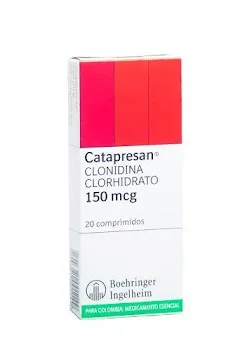
Table of Contents
Patient Information Leaflet
Introduction
Package Leaflet: Information for the Patient
Catapresan 0.150 mg Tablets
clonidine hydrochloride
Read all of this leaflet carefully before you start taking this medicine, as it contains important information for you.
- Keep this leaflet, as you may need to read it again.
- If you have any questions, ask your doctor or pharmacist.
- This medicine has been prescribed for you only, and you should not give it to other people, even if they have the same symptoms as you, because it could harm them.
- If you experience any adverse effects, consult your doctor or pharmacist, even if they are adverse effects not listed in this leaflet. See section 4.
Leaflet Contents
- What Catapresan is and what it is used for
- What you need to know before taking Catapresan
- How to take Catapresan
- Possible side effects
- How to store Catapresan
- Contents of the pack and other information
1. What Catapresan is and what it is used for
Catapresan contains an active substance called clonidine, which belongs to a group of medicines known as imidazoline receptor agonists (medicines that lower blood pressure).
Catapresan is used for the treatment of high blood pressure in all its forms.
2. What you need to know before taking Catapresan
Do not take Catapresan:
- if you are allergic to clonidine hydrochloride or to any of the other ingredients of this medicine (listed in section 6)
- if you have severe bradycardia (slow heart rate).
Warnings and precautions
Talk to your doctor or pharmacist before taking Catapresan:
- if you have mild or moderate bradycardia (slow heart rate)
- if you have cerebral or peripheral circulatory disorders
- if you suffer from depression
- if you have polyneuropathy (a type of nervous system disorder)
- if you suffer from constipation
- if you have renal insufficiency (see section 3)
- if you are considering stopping treatment (see section 3)
- if your treatment includes a beta-blocker (a medicine used to treat high blood pressure and heart problems). In this case, you must follow your doctor's instructions when discontinuing treatment
- if you have heart problems such as heart failure or severe coronary disease. In such cases, as with other medicines used to treat high blood pressure, careful medical monitoring is required
- if you wear contact lenses, as this medicine may reduce tear production.
Clonidine is not expected to have any therapeutic effect if you have hypertension caused by a pheochromocytoma (a condition that may lead to increased blood pressure).
Children and adolescents
Do not give Catapresan to children and adolescents. Specifically, when used outside authorized indications in combination with methylphenidate (a medicine used to treat attention deficit hyperactivity disorder (ADHD) in children), serious adverse reactions, including death, have been observed.
Taking Catapresan with other medicines
Inform your doctor or pharmacist if you are taking, have recently taken, or might need to take any other medicines.
In particular, inform your doctor if you are taking any of the following types of medicines:
-
Other medicines intended to lower blood pressure: the blood pressure-lowering effect of this medicine may be enhanced.
-
Non-steroidal anti-inflammatory drugs (NSAIDs): the effect of this medicine may be reduced.
-
Medicines with alpha-2 blocking properties such as phentolamine or tolazoline: the effect of this medicine may be counteracted.
-
Beta-blockers and digitalis derivatives (medicines used to treat high blood pressure and heart problems) may cause or worsen bradycardia (slow heart rate) when administered together with clonidine. In addition, beta-blockers may cause or worsen peripheral circulatory disturbances.
-
Tricyclic antidepressants (used to treat depression) or neuroleptics (used to treat certain mental illnesses): concomitant administration with this medicine may cause or worsen orthostatic regulation disorders (changes in blood pressure upon changing position), and may also reduce or abolish the hypotensive effect of clonidine.
Clonidine may enhance the effects of central nervous system depressants (also known as sedatives or tranquilizers).
Taking Catapresan with food, drinks and alcohol
Clonidine may enhance the effects of alcohol.
Pregnancy, breast-feeding and fertility
If you are pregnant, breast-feeding, think you may be pregnant, or are planning to become pregnant, consult your doctor or pharmacist before using this medicine.
During pregnancy, clonidine should only be used in cases of extreme necessity, with careful monitoring of both mother and child, since clonidine may reduce the fetal heart rate and cause a transient increase in blood pressure in the newborn after delivery.
There is insufficient data on the long-term effects of prenatal exposure.
During breast-feeding, the use of this medicine is not recommended, as sufficient information is not available.
There are no data on the effect of clonidine on fertility.
Driving and using machines
Catapresan may cause sedation, drowsiness, and accommodation disorders (difficulty of the eye to focus). Therefore, caution is advised when driving or operating machinery.
Catapresan contains lactose.
If your doctor has informed you that you have an intolerance to certain sugars, consult him before taking this medicine.
3. How to take Catapresan
Follow exactly the instructions for use of this medicine as given by your doctor or pharmacist. If in doubt, consult your doctor or pharmacist again.
The treatment of hypertension requires regular medical supervision.
The dose of Catapresan will be determined according to each patient's individual blood pressure response.
Most mild to moderate hypertension cases respond to an average dose of 2 tablets daily, one in the morning and one at night before going to bed. It is recommended to start treatment with 1 tablet at night, and after 10–15 days, proceed with one tablet in the morning and one at night.
If necessary, the dose may be increased after a period of 2–4 weeks to achieve the desired response, preferably by increasing the nighttime dose.
In cases of severe hypertension, it may be necessary to further increase each dose up to 2 tablets (0.3 mg); this dose may be repeated up to four times daily (8 tablets = 1.2 mg).
The tablets should be taken with a little liquid.
The tablet may be divided into equal doses.
Renal impairment
The dose should be adjusted according to:
- the individual antihypertensive response, which may vary significantly in patients with renal impairment
- the degree of renal deterioration
In both cases, careful monitoring is required.
Since only a minimal amount of clonidine is removed during routine hemodialysis, it is not necessary to administer a supplemental dose of clonidine after dialysis.
If you take more Catapresan than you should
Symptoms of overdose may include reduced pupil size, lethargy, slowed heart rate, hypotension, decreased body temperature, drowsiness (including coma), and reduced respiratory rate.
In addition, an increase in blood pressure may also occur.
If you take more Catapresan than you should, contact your doctor, pharmacist, or call the Toxicology Information Service immediately at 91 562 04 20.
If you forget to take Catapresan
Do not take a double dose to make up for forgotten doses.
If you stop taking Catapresan
Do not stop treatment abruptly without first consulting your doctor, as after prolonged treatment with high doses, symptoms such as restlessness, palpitations, rapid rise in blood pressure, nervousness, tremor, headache, or nausea may occur.
If you are taking this medicine in combination with a beta-blocker, follow your doctor's instructions for discontinuing treatment.
If you have any further questions about the use of this medicine, ask your doctor or pharmacist.
4. Possible adverse effects
Like all medicines, this medicine may cause adverse effects, although not everyone experiences them.
The adverse effects are mostly mild and tend to decrease as treatment continues.
Very common adverse effects (occur in more than 1 in 10 patients) are dizziness, sedation, decreased blood pressure upon changing position from sitting to standing (orthostatic hypotension), and dry mouth.
Common adverse effects (occur in 1 to 10 out of every 100 patients) are depression, sleep disorders, headache, constipation, nausea, vomiting, pain in the salivary gland, difficulty achieving or maintaining an erection, and fatigue.
Uncommon adverse effects (occur in 1 to 10 out of every 1,000 patients) are delirium, hallucinations, nightmares, sensation of tingling in the skin (paraesthesia), slowing of the heart rate (sinus bradycardia), blockage of blood circulation causing pain and colour changes, especially in fingers and toes (Raynaud's phenomenon), itching, rash, urticaria, and malaise.
In rare cases (occur in 1 to 10 out of every 10,000 patients), enlargement of the breasts (gynaecomastia), reduced tear production, (atrioventricular block), nasal dryness, generalized intestinal motility disorder (colonic pseudo-obstruction), hair loss, and increased blood sugar levels have been observed.
Adverse effects with unknown frequency are confusion, decreased sexual desire, difficulty focusing of the eye, and decreased heart rate (bradyarrhythmia).
If you experience any adverse effects, consult your doctor or pharmacist, even if they are adverse effects not listed in this leaflet.
Reporting of adverse effects:
If you experience any type of adverse effect, consult your doctor or pharmacist, even if they are possible adverse effects not listed in this leaflet. You may also report them directly through the Spanish Pharmacovigilance System for Human Medicinal Products: https://www.notificaram.es. By reporting adverse effects, you can help provide more information on the safety of this medicine.
5. Storage of Catapresan
No special storage conditions are required.
Keep this medicine out of the sight and reach of children.
Do not use this medicine after the expiry date stated on the packaging. The expiry date is the last day of the month indicated.
Medicines must not be disposed of via wastewater or household waste. Return empty containers and any medicines you no longer need to the SIGRE collection point at your pharmacy. If you are in doubt, ask your pharmacist how to dispose of containers and medicines you no longer need. This will help protect the environment.
6. Contents of the pack and other information
Composition of Catapresan
- The active substance is clonidine hydrochloride. Each tablet contains 0.150 mg of clonidine hydrochloride.
- The other components are lactose, calcium hydrogen phosphate, dried corn starch, soluble corn starch, colloidal siliconic acid, polyvinylpyrrolidone, and stearic acid.
Appearance of the product and contents of the pack
Catapresan tablets are white, round, and bevel-edged on both sides. One side is engraved with 15C/15C or N/150 and has a score line.
Pack containing 30 tablets.
Marketing Authorization Holder
Glenwood GmbH Pharmazeutische Erzeugnisse
Arabellastr.17
81925 Munich
Germany
Manufacturer
Delpharm Reims S.A.S.
10 rue Colonel Charbonneaux
51100 Reims
France
Date of the most recent revision of this leaflet: July 2013
Detailed and up-to-date information on this medicinal product is available on the website of the Spanish Agency of Medicines and Medical Devices (AEMPS) http://www.aemps.gob.es/