Casenglicol powder for oral solution
Spain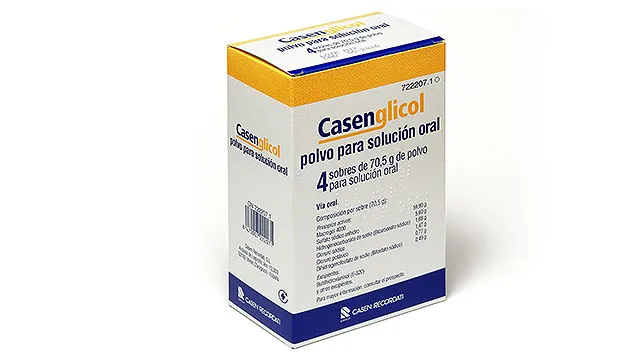
Table of Contents
Package Leaflet: Information for the User
Introduction
Package leaflet: information for the user
Casenglicol powder for oral solution
macrogol 4000, anhydrous sodium sulfate, sodium hydrogen carbonate, sodium chloride, potassium chloride, sodium dihydrogen phosphate
Read the entire leaflet carefully before you start taking this medicine, as it contains important information for you.
- Keep this leaflet, as you may need to read it again.
- If you have any questions, ask your doctor or pharmacist.
- This medicine has been prescribed for you only, and you should not give it to others, even if they have the same symptoms as you, because it could harm them.
- If you experience any adverse effects, consult your doctor or pharmacist, even if they are effects not listed in this leaflet. See section 4.
Contents of the leaflet
- What Casenglicol is and what it is used for
- What you need to know before taking Casenglicol
- How to take Casenglicol
- Possible side effects
- How to store Casenglicol
- Contents of the pack and other information
1. What Casenglicol is and what it is used for
Casenglicol belongs to a group of medicines called osmotic laxatives.
Casenglicol is a bowel evacuant indicated in adults for bowel preparation prior to colonoscopy, surgery, radiology, and other colorectal and genitourinary examinations.
It is sometimes used for the treatment in adults of chronic non-organic constipation that has previously been treated, without satisfactory results, with a high-fluid diet and increased daily physical activity.
2. What you need to know before taking Casenglicol
Do not take Casenglicol
- If you are allergic to the active substances or to any of the other components of this medicine (listed in section 6)
- If you have gastric or intestinal ulcer
- If you have gastric retention
- If you have chronic intestinal disease, ileus, or megacolon
- If you have intestinal obstruction
- If you have intestinal perforation
Warnings and precautions
Talk to your doctor or pharmacist before starting to take Casenglicol.
- Use with caution in patients with impaired nausea reflex and in patients prone to regurgitation or aspiration, as well as in patients with swallowing difficulties. In such cases, consult your doctor.
- Administration of Casenglicol should be closely monitored, especially when administered via nasogastric tube, to prevent regurgitation or aspiration of the solution, particularly in patients with impaired swallowing reflex, gastroesophageal reflux, or in a state of semi-consciousness or unconsciousness.
- If abdominal pain occurs, administration should be slowed down or even interrupted until symptoms resolve.
- If gastrointestinal obstruction or perforation is suspected, appropriate diagnostic investigations must be carried out before administering Casenglicol.
- Casenglicol should be used with caution in patients with severe colitis or proctitis.
- Casenglicol should be used with caution in frail patients, patients with significant renal disease, or known disorders of fluid and electrolyte balance.
- If you experience sudden abdominal pain or rectal bleeding while taking Casenglicol for bowel preparation, contact your doctor or seek immediate medical attention.
- Avoid mixing Casenglicol with starch-based thickeners if you have swallowing difficulties. This may result in an aqueous liquid that could enter your lungs and cause pneumonia if you are unable to swallow properly.
Children
Casenglicol must not be administered to children.
Other medicines and Casenglicol
Inform your doctor or pharmacist if you are taking, have recently taken, or might need to take any other medicines.
Casenglicol acts by accelerating intestinal transit, which may cause concomitantly administered medications to be inadequately absorbed and eliminated through the gastrointestinal tract, potentially reducing their effectiveness.
Pregnancy, breastfeeding, and fertility
If you are pregnant or breastfeeding, think you may be pregnant, or are planning to become pregnant, consult your doctor or pharmacist before using this medicine.
There is no experience with the use of Casenglicol during pregnancy or breastfeeding, and it should only be used if your doctor considers it essential.
Driving and using machines
Not described.
Casenglicol contains sodium and potassium
Consult your doctor or pharmacist if you require Casenglicol or more than 1 sachet daily for a prolonged period, especially if you have been advised to follow a low-salt (sodium) diet.
This medicine contains 10.58 mmol (or 413.7 mg) of potassium per litre of solution, which should be taken into account in patients with renal insufficiency or those on potassium-restricted diets.
3. How to take Casenglicol
Follow exactly the instructions for use of this medicine provided by your doctor or pharmacist. If in doubt, consult your doctor or pharmacist again.
Casenglicol should be taken by dissolving the contents of each 17.6 g sachet in 250 ml of drinking water, or each 70.5 g sachet in one litre of drinking water. The solution should be consumed within 4 hours.
The recommended dose is:
For bowel evacuation for diagnostic or surgical purposes:
Adults
70.5 g sachets: the full dose is 4 sachets of 70.5 g.
Dissolve the contents of one sachet in 1 litre of water.
17.6 g sachets: the full dose is 16 sachets of 17.6 g.
Dissolve the contents of one sachet in 250 ml of water.
Patients with renal impairment: no dose adjustment is required in renal impairment. This medicine should be administered with caution in patients with renal impairment (see section 2).
Patients with hepatic impairment: dose adjustment is not necessary.
Elderly patients: the dosage regimen is the same as for adults.
Use in children:
No data are available. Therefore, this medicine should not be administered to children.
The solution is normally administered orally. It is recommended to take it at a rate of 200 to 250 ml every 10–15 minutes, until the entire volume has been ingested or bowel movements become clear.
No food should be taken during the 3 to 4 hours prior to administration of the solution, and in no case should solid food be ingested within 2 hours before using the solution.
In patients unable to drink the solution, a nasogastric tube may be used at a rate of 20–30 ml per minute.
Bowel movement will occur approximately one hour after starting treatment.
For the treatment of chronic non-organic constipation:
Adults: The recommended dose is 250–500 ml per day of the reconstituted solution prepared from one sachet of 17.6 g in 250 ml of water or one sachet of 70.5 g in one litre of water.
Patients with renal impairment: no dose adjustment is required in renal impairment. This medicine should be administered with caution in patients with renal impairment (see section 2).
Patients with hepatic impairment: dose adjustment is not necessary.
Elderly patients: the dosage regimen is the same as for adults.
Use in children
No data are available. Therefore, this medicine should not be administered to children.
Duration of treatment: as with all laxatives, prolonged use of Casenglicol is not recommended.
Do not use Casenglicol for more than six days without consulting your doctor.
Administer separately when deep intestinal evacuation is required.
If you take more Casenglicol than you should
If you take more Casenglicol than you should, you may experience excessive diarrhoea which may lead to dehydration. Drink plenty of fluids. In case of overdose or accidental ingestion, contact your doctor or pharmacist immediately or call the Toxicology Information Service at 91 562 04 20 (indicating the medicine and the amount ingested).
If you forget to take Casenglicol
Do not take a double dose to make up for a missed dose.
If you have any further questions about the use of this medicine, ask your doctor or pharmacist.
4. Possible adverse effects
Like all medicines, this medicine may cause adverse effects, although not everyone will experience them.
These adverse effects include:
Frequent (may affect up to 1 in 10 people)
- Nausea
- Abdominal fullness
- Abdominal cramps
Uncommon (may affect up to 1 in 100 people)
- Vomiting
- Abdominal cramps
- Anal irritation
These adverse reactions are transient and resolve quickly.
Frequency not known (cannot be estimated from available data)
- Urticaria
- Dermatitis
- Rhinorrhea
These adverse reactions are caused by allergic reactions.
Reporting of adverse effects
If you experience any type of adverse effect, consult your doctor, pharmacist, or nurse, even if it is a possible adverse effect not listed in this leaflet. You may also report them directly through the Spanish Pharmacovigilance System for Human Medicinal Products: www.notificaram.es. By reporting adverse effects, you can help provide more information on the safety of this medicine.
5. Storage of Casenglicol
Keep this medicine out of the sight and reach of children.
Do not store above 30 °C.
When not in use, the solution may be stored in the refrigerator (between 2 °C and 8 °C) and must be discarded 48 hours after preparation.
Do not use this medicine after the expiry date stated on the packaging after EXP. The expiry date refers to the last day of the month indicated.
Do not use Casenglicol if any deterioration of the container is observed.
Medicines must not be disposed of via wastewater or household waste. Dispose of empty containers and unused medicines at the SIGRE collection point at your pharmacy. If in doubt, ask your pharmacist how to properly dispose of unused medicines and their containers. This will help protect the environment.
6. Contents of the pack and other information
Composition of Casenglicol
The active substances per 1 g, per sachet of 17.6 g, and per sachet of 70.5 g are:
Per 1g | Per sachet of 17.6 g | Per sachet of 70.5 g | |
Active ingredients: | |||
Macrogol 4000 | 849.8 mg | 14.97 g | 59.90 g |
Anhydrous sodium sulfate | 79.5 mg | 1.40 g | 5.60 g |
Sodium hydrogen carbonate (sodium bicarbonate) | 23.8 mg | 0.42 g | 1.68 g |
Sodium chloride | 21.0 mg | 0.37 g | 1.47 g |
Potassium chloride | 10.8 mg | 0.19 g | 0.77 g |
Sodium dihydrogen phosphate (sodium biphosphate) | 6.8 mg | 0.12 g | 0.49 g |
The other excipients are:
- Butylhydroxyanisole (E-320)
- Orange flavour
- Potassium acesulfame (E-950)
- Sucralose
Appearance of the medicinal product and contents of the container
Casenglicol is available as single-dose sachets containing powder for oral solution, in different pack sizes: packs of 4 sachets of 70.5 g, 100 sachets of 70.5 g, 16 sachets of 17.6 g, or 500 sachets of 17.6 g.
Only some pack sizes may be marketed.
Marketing Authorization Holder and Manufacturer:
Casen Recordati, S.L.
Autovía de Logroño, Km 13.300
50180 Utebo, (Zaragoza) Spain
Date of the most recent review of this leaflet: February 2025
Detailed information on this medicinal product is available on the website of the Spanish Agency for Medicines and Health Products (AEMPS): http://www.aemps.gob.es/