Carboplatin Pharmacia 10 mg/ml concentrate for infusion solution EFG
Spain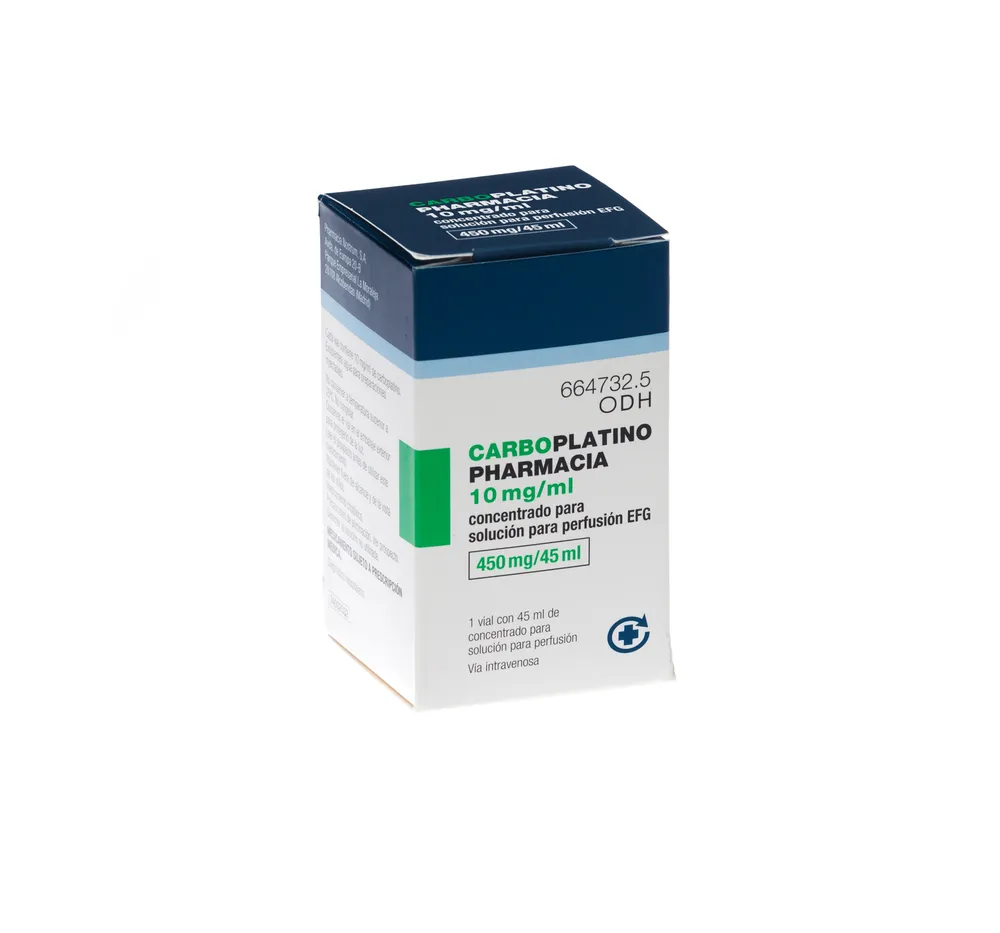
Table of Contents
- Package leaflet: Information for the user
- Introduction
- 1. What Carboplatino Pharmacia is and what it is used for
- 2. What you need to know before using Carboplatino Pharmacia
- 3. How to use Carboplatino Pharmacia
- 4. Possible adverse effects
- 5. Storage of Carboplatin Pharmacia
- 6. Package contents and other information
Package leaflet: Information for the user
Introduction
Package leaflet: information for the patient
Carboplatino Pharmacia 10 mg/ml concentrate for solution for infusion EFG
Read all of this leaflet carefully before you start using this medicine because it contains important information for you.
- Keep this leaflet. You may need to read it again.
- If you have any further questions, ask your doctor, pharmacist or nurse.
- This medicine has been prescribed for you only, and you should not give it to other people even if they have the same symptoms as you. It may harm them.
- If you experience any adverse reactions, talk to your doctor, pharmacist or nurse, even if they are adverse reactions not listed in this leaflet. See section 4.
Contents of this leaflet
- What Carboplatino Pharmacia is and what it is used for
- What you need to know before you use Carboplatino Pharmacia
- How to use Carboplatino Pharmacia
- Possible side effects
- How to store Carboplatino Pharmacia
- Contents of the pack and other information
1. What Carboplatino Pharmacia is and what it is used for
Carboplatino Pharmacia is a medicine used to treat different types of tumours. Carboplatino works by preventing the proliferation of cancer cells.
Carboplatino Pharmacia may be used alone or in combination with other medicines to treat the following types of tumours:
- Advanced ovarian cancer
- Small cell lung cancer
- Advanced head and neck cancer
- Invasive and advanced bladder cancer
2. What you need to know before using Carboplatino Pharmacia
Do not use Carboplatino Pharmacia
- If you are allergic to the active substance or to any of the other components of this medicine (listed in section 6), or to any compound containing platinum.
- If you have severe kidney problems.
- If you have reduced bone marrow function.
- If you have significant bleeding associated with tumors.
- If you are scheduled to receive the yellow fever vaccine (see “Use of Carboplatino Pharmacia with other medicines”).
Warnings and precautions
Consult your doctor, pharmacist, or nurse before starting treatment with Carboplatino Pharmacia.
- If you experience headache, changes in mental function, seizures, or visual disturbances ranging from blurred vision to complete vision loss.
- If during treatment you develop bone marrow suppression leading to reduced numbers of white blood cells (leucopenia, neutropenia) and platelets (thrombocytopenia). This condition and/or impaired kidney function may be worsened if you have previously received or are currently receiving treatment with other anticancer medicines (particularly cisplatin) or radiation therapy.
- If during treatment you develop a reduced number of red blood cells (anemia).
- If during treatment you develop extreme fatigue along with a reduced number of red blood cells and difficulty breathing (hemolytic anemia), alone or in combination with low platelet counts and unusual bruising (thrombocytopenia), and kidney disease characterized by little or no urine output (symptoms of hemolytic uremic syndrome).
- If you develop fever (temperature greater than or equal to 38°C) or chills, which may be signs of infection. This could increase the risk of developing blood infection.
- If you have kidney problems and have previously received treatment with other anticancer medicines or other drugs that may affect kidney function.
- If you have liver problems.
- If during treatment you develop any signs or symptoms of nerve damage such as tingling sensations (paresthesia) or reduced reflexes, particularly deep tendon reflexes, especially if you are over 65 years of age or have previously received treatment with other anticancer medicines such as cisplatin.
- If during treatment you experience vision disturbances (especially if you have kidney problems).
- If during treatment you begin to notice hearing problems, consult your doctor, as this may require dose adjustments or discontinuation of treatment.
- If you experience vomiting during treatment. Since carboplatin may cause vomiting, your doctor may administer medication before treatment to prevent it and/or reduce its frequency and severity.
- If you develop symptoms of an allergic reaction to the drug.
- If you need to be vaccinated while undergoing treatment with this medicine, as live or attenuated virus vaccines should not be administered, and the response to inactivated or killed vaccines may be reduced (see Use of Carboplatino Pharmacia with other medicines).
- If you are an elderly patient receiving treatment in combination with a medicine called cyclophosphamide, as you may develop a more severe reduction in platelet count (thrombocytopenia).
If any of the above situations apply to you, consult your doctor before using Carboplatino Pharmacia.
During treatment with carboplatin, you will be given medications to help reduce the risk of a potentially life-threatening complication known as tumor lysis syndrome, which is caused by chemical changes in the blood due to the destruction of cancer cells releasing their contents into the bloodstream.
Effective contraceptive methods must be used during and after treatment with carboplatin. If patients wish to have children after completing treatment, genetic counseling is recommended (see Pregnancy, breastfeeding, and fertility).
Your doctor will regularly monitor your condition to assess whether Carboplatino is having the intended effect.
Before starting treatment and while receiving Carboplatino, your doctor may periodically perform blood tests, kidney and liver function tests, neurological examinations, and hearing tests (audiometry).
Other medicines and Carboplatino Pharmacia
Inform your doctor or pharmacist if you are taking, have recently taken, or might need to take any other medicines.
Carboplatin may increase adverse effects and/or alter the action of other medicines, such as certain anticancer drugs, radiotherapy, or medicines affecting blood clotting (anticoagulants).
Administration of the yellow fever vaccine is contraindicated during treatment with carboplatin.
Administration of live attenuated virus vaccines (except yellow fever vaccine) and antiepileptic medicines (phenytoin and fosphenytoin) is not recommended during treatment with carboplatin.
Your doctor should carefully evaluate the use of medicines that suppress bone marrow activity (cyclosporine, tacrolimus, sirolimus), certain types of antibiotics (aminoglycosides), and certain types of diuretics (loop diuretics) during carboplatin treatment.
Pregnancy, breastfeeding, and fertility If you are pregnant or breastfeeding, think you may be pregnant, or plan to become pregnant, consult your doctor or pharmacist before using this medicine.
Pregnancy:
Do not use Carboplatino Pharmacia during pregnancy. Your doctor will inform you of the potential risks of using Carboplatino Pharmacia during pregnancy.
Breastfeeding:
Do not breastfeed while being treated with Carboplatino Pharmacia and for at least one month after the last dose.
Fertility:
Due to the potential risk of severe birth defects, women of childbearing age must always use effective contraceptive methods (contraception) during treatment with Carboplatino Pharmacia and for at least seven months after the last dose.
Male patients receiving carboplatin should always be advised to use effective contraception during treatment and for up to 4 months after completion of treatment. Patients should also be counseled before starting treatment about sperm preservation due to the possibility of irreversible infertility caused by carboplatin treatment.
Talk to your doctor about which contraceptive methods are suitable for you and your partner.
Driving and using machines No studies have been conducted on the effects of carboplatin on the ability to drive or operate machinery. However, since carboplatin may cause nausea, vomiting, visual disturbances, and ear problems (ototoxicity), driving vehicles or operating machinery after administration of the medicine is not recommended.
3. How to use Carboplatino Pharmacia
Carboplatino is administered only intravenously and under the supervision of a physician experienced in the use of this type of treatment. If in doubt, consult your doctor or pharmacist again.
Your doctor will determine the most appropriate dose and duration of treatment for you, based on your height and weight, the status of your blood system (hematopoietic system), kidney function, and response to treatment. You will have regular blood tests to monitor your condition.
Your doctor will indicate the number of treatment cycles you require. Typically, there is an interval of 4 weeks between each dose of carboplatin.
If you use more Carboplatino Pharmacia than you should
Although unlikely, if you were to receive more carboplatin than intended, your doctor will stop the treatment and manage any symptoms.
If you forget a dose of Carboplatino Pharmacia
It is highly unlikely that you will miss a dose, as your doctor will have clear instructions on when to administer the medicine. If you think a dose has been missed, contact your doctor as soon as possible.
If you have any further questions about the use of this medicine, ask your doctor or nurse.
4. Possible adverse effects
Immediately inform your doctor if you experience any of the following signs and symptoms which may indicate a severe allergic reaction:
- Chest pain, which may be a sign of a potentially serious allergic reaction called Kounis syndrome.
Like all medicines, this medicine can cause adverse effects, although not everyone will experience them.
Very common adverse effects (may affect more than 1 in 10 patients):
- Decrease in platelets (thrombocytopenia), decrease in different types of white blood cells (neutropenia, leucopenia), decrease in red blood cells (anaemia).
- Vomiting, nausea, abdominal pain.
- Blood test abnormalities (decreased creatinine clearance, increased blood urea levels, increased blood alkaline phosphatase, increased aspartate aminotransferase, decreased blood sodium levels, decreased blood potassium levels, decreased blood calcium levels, decreased blood magnesium levels) and abnormalities in liver function tests.
Common adverse effects (may affect up to 1 in 10 patients):
- Infections.
- Bleeding.
- Hypersensitivity and allergic-type reactions (anaphylactic).
- Nervous system disorders (peripheral neuropathy), tingling sensation (paraesthesia), reduced reflexes such as osteotendinous reflexes, sensory disturbances, loss of taste (dysgeusia).
- Vision disturbances, loss of vision.
- Ear disorders (ototoxicity).
- Heart disorders.
- Breathing problems, lung disorders (interstitial lung disease), bronchial muscle contraction (bronchospasm).
- Diarrhoea, constipation, mucous membrane disorders.
- Hair loss (alopecia), skin disorders.
- Disorders of muscles, tendons, nerves and joints (musculoskeletal disorders).
- Disorders of genital and urinary organs.
- Feeling of tiredness (asthenia).
- Blood test abnormalities (increased bilirubin, increased creatinine, increased uric acid).
Adverse effects of unknown frequency (cannot be estimated from available data):
- Certain types of leukaemia (such as acute myeloid leukaemia) and disorders known as myelodysplastic syndromes.
- Bone marrow failure, decreased white blood cells accompanied by fever (febrile neutropenia), a disorder usually occurring when a gastrointestinal infection produces toxins that destroy red blood cells and cause kidney damage (haemolytic uraemic syndrome), decreased number of red blood cells in blood and difficulty breathing (haemolytic anaemia).
- Dehydration, loss of appetite (anorexia), decreased blood sodium levels (hyponatraemia).
- Reduced blood flow to the brain (stroke).
- Heart failure, chest pain, which may be a sign of a potentially serious allergic reaction called Kounis syndrome.
- Blood clot or bubble in the circulation (embolism), increased or decreased blood pressure.
- Inflammation of the mucosa in the mouth (stomatitis).
- Urticaria, rash, redness (erythema), itching (pruritus).
- Tissue damage (necrosis) at the injection site, reaction at injection site, leakage of medication from the injection site, redness (erythema) at injection site, discomfort.
- Blindness due to brain damage in certain areas (cortical blindness) in patients with kidney disorders.
- Partial hearing loss (hypacusis), ringing in the ears (tinnitus).
- Inflammatory skin disorder (exfoliative dermatitis).
- Muscle pain (myalgia) and joint pain (arthralgia).
- Liver damage which may be fatal (fulminant hepatic necrosis).
- Fever.
- Chills.
- Symptoms such as headache, mental function disturbances, seizures, and vision disturbances ranging from blurred vision to complete vision loss (symptoms of reversible posterior leukoencephalopathy syndrome, a rare neurological disorder).
- Pancreatitis.
- Pulmonary infection.
- Muscle cramps, muscle weakness, confusion, loss or changes in vision, irregular heartbeat, kidney failure or abnormal blood test results (symptoms of tumour lysis syndrome, which may be caused by the rapid destruction of tumour cells) (see section 2).
Reporting of adverse effects
If you experience any type of adverse effect, consult your doctor, pharmacist, or nurse, even if it is a possible adverse effect not listed in this leaflet. You can also report them directly via the Spanish Pharmacovigilance System for Human Medicinal Products: www.notificaRAM.es. By reporting adverse effects, you can help provide more information on the safety of this medicine.
5. Storage of Carboplatin Pharmacia
Keep this medicine out of the sight and reach of children.
Do not store above 25°C. Do not refrigerate or freeze. Store in the original packaging to protect from light.
Do not use this medicine after the expiry date stated on the outer carton and label following EXP. The expiry date refers to the last day of the month indicated.
Do not use any container that is damaged or open.
Medicines should not be disposed of via wastewater or household waste. Ask your pharmacist how to dispose of medicines and containers you no longer need. This will help protect the environment.
6. Package contents and other information
Composition of Carboplatino Pharmacia
- The active substance is carboplatin.
- The other components (excipients) are: water for injections.
Appearance of the medicinal product and contents of the container
Carboplatino Pharmacia 10 mg/ml concentrate for solution for infusion EFG is supplied in containers containing a single 15 ml or 45 ml clear Type I glass vial with a chlorobutyl rubber stopper.
Each 15 ml vial contains 150 mg of the active substance carboplatin.
Each 45 ml vial contains 450 mg of the active substance carboplatin.
Only certain pack sizes may be marketed.
Marketing Authorization Holder and Manufacturer
Marketing Authorization Holder:
Pharmacia Nostrum, S.A.
Avda. de Europa, 20 B
Parque Empresarial La Moraleja
28108 Alcobendas (Madrid)
Spain
Manufacturer:
Pfizer Service Company BV
Hermeslaan 11
1932 Zaventem
Belgium
or
Hospira Australia Pty Ltd
1-5, 7-23, 25-39 Lexia Place
Mulgrave 3170
Victoria
Australia
Date of the most recent revision of this leaflet: October 2023
Detailed and up-to-date information on this medicinal product is available on the website of the Spanish Agency of Medicines and Health Products (AEMPS) http://www.aemps.es.gob/
IMPORTANT INFORMATION FOR HEALTHCARE PROFESSIONALS
Preparation for administration
Carboplatino Pharmacia does not contain any preservative or bacteriostatic agent. Therefore, vials are for single use only and any unused portion must be discarded.
Carboplatin may be diluted in 0.9% sodium chloride solution or 5% dextrose solution to concentrations of 0.5 mg/ml. To reduce the microbiological risk, dilution should be carried out immediately before use. Visual inspection of the solution is recommended prior to administration to ensure the solution is free from particles. The infusion should be completed within 24 hours of preparation and any unused portion must be discarded.
Luer-Lock syringes and large-bore needles are recommended to minimize pressure and the potential for aerosol formation. Aerosols can also be minimized by using a vented needle during preparation.
Precautions for long-duration infusion of the concentrate for solution for infusion:
When Carboplatino Pharmacia concentrate for solution for infusion is dissolved in 0.9% sodium chloride solution and stored for 24 hours at 25°C, degradation of the active substance reaches 5% of the initial concentration. Therefore, dissolution of Carboplatino Pharmacia in 0.9% sodium chloride solution is not considered suitable for long-duration infusions, as, in addition to loss of active substance, conversion of carboplatin to cisplatin may occur, increasing the risk of toxicity.
Needles or intravenous administration devices containing aluminum parts that may come into contact with carboplatin must not be used for preparation or administration. Carboplatin interacts with aluminum, leading to the formation of a precipitate and/or loss of potency.
Protective measures
- Handling of carboplatin must be performed by healthcare personnel trained in the use of chemotherapeutic agents.
- Pregnant women should avoid handling this medicinal product.
- Trained healthcare personnel handling carboplatin should wear protective clothing: safety goggles, gown, disposable gloves, and face masks.
- Dilution should be performed in a designated area (preferably under a laminar airflow system). The work surface should be protected with absorbent, plastic-backed, disposable paper.
- All materials used for reconstitution, administration, or cleaning must be disposed of in high-risk waste material bags for destruction by high-temperature incineration.
- Any spillage or leakage should be treated with diluted sodium hypochlorite solution (1% available chlorine), preferably by soaking, followed by rinsing with water.
- All cleaning materials must be disposed of as indicated above.
- In case of accidental contact with eyes or skin, immediately wash thoroughly with abundant water, with soap and water, or with sodium bicarbonate solution, and seek medical attention. A mild cream may be used to treat transient skin itching. If eyes are affected, medical advice should be sought.
- Always wash hands after removing gloves.
Disposal
Disposal of unused medicinal product and all materials that have come into contact with it must be carried out in accordance with local regulations.