Carboplatin Hikma 10 mg/ml solution for infusion EFG
Spain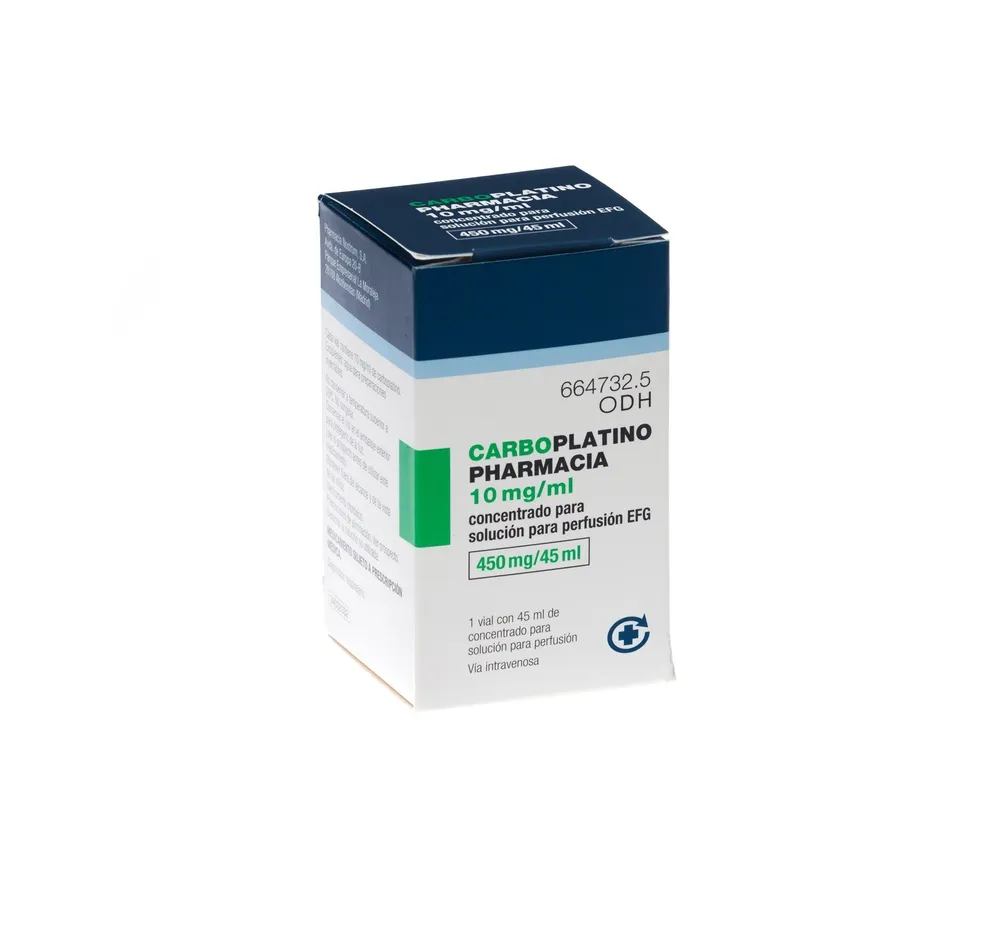
Table of Contents
- Package leaflet: Information for the user
- Introduction
- 1. What Carboplatino Hikma is and what it is used for
- 2. What you need to know before Carboplatin Hikma is administered to you
- **Do not use Carboplatino Hikma**
- **Fertility**
- **Breastfeeding**
- **E** Carboplatin and its metabolites are excreted in human milk. To avoid potential harmful effects in the nursing infant, breastfeeding should be discontinued during carboplatin therapy and for one month after the last dose.
- 3. How to use Carboplatino Hikma
- **Use in children and adolescents**
- **If you receive more Carboplatino Hikma than you should**
- 4. Possible adverse effects
- **Uncommon (may affect up to 1 in 100 people)**
- **Rare (may affect up to 1 in 1,000 people)**
- **Very rare (may affect up to 1 in 10,000 people)**
- **Adverse reactions of unknown frequency (cannot be estimated from available data)**
- 5. Storage of Carboplatin Hikma
- 6. Contents of the container and additional information
- **Appearance of the product and contents of the pack**
Package leaflet: Information for the user
Introduction
Package leaflet: information for the patient
Carboplatino Hikma 10 mg/ml solution for infusion EFG
Read the entire leaflet carefully before you start using this medicine, because it contains important information for you.
- Keep this leaflet, as you may need to read it again. If you have any questions, consult your doctor or nurse.
- This medicine has been prescribed for you only, and you should not give it to other people, even if they have the same symptoms as you, because it may harm them.
- If you experience any adverse effects, consult your doctor or pharmacist, even if they are adverse effects not listed in this leaflet. See section 4.
Contents of the leaflet
- What Carboplatino Hikma is and what it is used for
- What you need to know before using Carboplatino Hikma
- How to use Carboplatino Hikma
- Possible side effects
- How to store Carboplatino Hikma
- Contents of the pack and other information
1. What Carboplatino Hikma is and what it is used for
Carboplatino Hikma is an anticancer medicine containing carboplatin in the form of a perfusion solution (a solution that must be administered as a slow intravenous infusion through an infusion set).
Treatment with an anticancer medicine is sometimes referred to as chemotherapy.
This medicine is used to treat certain types of lung cancer, advanced ovarian cancer, and as an adjuvant in the treatment of testicular germ cell tumors.
2. What you need to know before Carboplatin Hikma is administered to you
Do not use Carboplatino Hikma
- if you are allergic (hypersensitive) to carboplatin or to any of the other ingredients of this medicine (listed in section 6);
- if you have severe kidney problems;
- if you have a blood cell count disorder (your doctor will monitor this);
- if you are breastfeeding;
- if you have bleeding tumors;
- if you have received the yellow fever vaccine.
Warnings and precautions
Talk to your doctor or nurse before you are given Carboplatino Hikma:
- If you experience headache, altered mental function, seizures, or abnormal vision ranging from blurred vision to vision loss.
- If you develop extreme fatigue and shortness of breath due to reduced red blood cell count (symptoms of hemolytic anemia), alone or combined with low platelet count, abnormal bruising (thrombocytopenia), and kidney disease with little or no urine output (symptoms of hemolytic-uremic syndrome).
- If you develop fever (temperature equal to or greater than 38°C) or cramps, which may be signs of infection, or if you may be developing a blood infection.
Carboplatin must be administered with particular caution in:
- Patients with myelosuppression (reduced number of red blood cells produced by the bone marrow). Combination treatment with other myelosuppressive agents (which lead to reduced red blood cells) may require dose adjustment;
- Patients with hematological toxicity (reduced production of red blood cells);
- Patients with impaired kidney function;
- Patients with allergic reactions to platinum-containing drugs;
- Patients over 65 years of age and/or patients previously treated with cisplatin (a medication used to treat cancer);
- Patients receiving treatment with live vaccines;
- Pediatric patients. In this population, follow-up audiometry is recommended.
Carboplatin may react with aluminum; therefore, needles, syringes, catheters, or intravenous administration systems containing aluminum must not be used in the preparation or administration of carboplatin to avoid interactions.
During treatment with carboplatin, medications may be administered to help reduce potentially fatal complications known as tumor lysis syndrome, caused by chemical changes in the blood due to the breakdown of dead cancer cells releasing their contents into the bloodstream.
Use of Carboplatino Hikma with other medicines
Inform your doctor if you are taking, have recently taken, or might need to take any other medicines.
Treatment of patients with oral anticoagulants involves a reduced frequency of monitoring of the International Normalized Ratio (INR).
Administration with Carboplatino Hikma:
- Is contraindicated with concomitant use of the yellow fever vaccine;
- Is not recommended with concomitant use of other live vaccines (except yellow fever), phenytoin, and fosphenytoin (used to treat various types of seizures and convulsions);
- Should be administered with particular caution when used concomitantly with cyclosporine, tacrolimus, and sirolimus (medicines that suppress natural defenses against foreign substances), aminoglycosides, vancomycin, or capreomycin (antibiotics), phenytoin and fosphenytoin (used to treat various types of seizures and convulsions), and loop diuretics (used to treat hypertension and edema).
Treatment combined with other myelosuppressive agents (medications leading to reduced red blood cells) may require dose adjustment.
Pregnancy, breastfeeding, and fertility
If you are pregnant or breastfeeding, think you may be pregnant, or plan to become pregnant, consult your doctor before being treated with this medicine.
Pregnancy
The safety of carboplatin during pregnancy is unknown, but it is suspected that it may cause serious birth defects when administered during pregnancy. Carboplatin is not indicated for use in pregnant women or in women of childbearing potential who intend to become pregnant, unless the potential benefits to the mother outweigh the possible risks to the fetus.
If you are being treated with carboplatin while pregnant, you should discuss the potential risks to the fetus with your doctor.
Women of childbearing potential must be informed of the possible risk to the fetus and advised to avoid pregnancy and use effective contraception during treatment and for at least 7 months after discontinuation of therapy, both before and during treatment with carboplatin.
Men of reproductive age undergoing treatment with carboplatin are advised not to father a child during treatment and to use effective contraceptive methods during treatment and for 4 months after completion of treatment.
Fertility
Gonadal suppression resulting in amenorrhea or azoospermia may occur in patients receiving antineoplastic therapy. These effects appear to be related to the dose and duration of treatment and may be irreversible. Predicting the degree of ovarian or testicular functional impairment is complicated by the frequent use of combinations of multiple antineoplastic agents, making it difficult to assess the effects of individual agents.
Before starting therapy, both male and female patients should seek advice regarding fertility preservation due to the potential for irreversible infertility caused by carboplatin therapy.
Breastfeeding
E Carboplatin and its metabolites are excreted in human milk. To avoid potential harmful effects in the nursing infant, breastfeeding should be discontinued during carboplatin therapy and for one month after the last dose.
Driving and use of machines
Carboplatin does not affect the ability to drive or operate machinery. However, carboplatin may cause nausea, vomiting, visual disturbances, and ototoxicity; therefore, patients should be informed of the potential effects on their ability to drive or operate machinery.
3. How to use Carboplatino Hikma
Always use this medicine exactly as your doctor has told you. If you are unsure, check with your doctor.
The dose prescribed for you depends on your age, health, kidney function, and other medicines you are taking.
The product must be diluted with glucose (sugar solution) or sodium chloride (saline) before administration. It will be given slowly, usually by intravenous infusion over a period of 15 to 60 minutes. You may receive another dose of this medicine after 4 weeks.
While you are receiving carboplatin, your doctor should perform regular blood tests. These will allow your doctor to assess how the medicine is working and whether additional doses are needed.
This medicine will be administered during your hospital stay, so it is unlikely that you will receive too much or too little. However, if you have any doubts, ask your doctor or pharmacist.
Safety measures used in the preparation and administration of substances classified as hazardous must be followed. Preparation must be carried out by trained professionals experienced in safe handling, wearing protective glasses, mask, and protective clothing.
If you have any questions about how to use this medicine, ask your doctor or pharmacist.
Use in children and adolescents
There are insufficient data on the use of carboplatin in children, so its use is not recommended.
If you receive more Carboplatino Hikma than you should
This medicine will be administered to you in the hospital under the supervision of a doctor. Therefore, it is unlikely that you will be given too little or too much of the medicine. However, consult your doctor or nurse administering the medicine, or call the Toxicology Information Service at telephone number: 91 562 04 20, indicating the medicine and the amount administered.
There is no known antidote for carboplatin overdose.
No cases of overdose have occurred during clinical trials. In the event that an overdose occurs, the patient may require appropriate supportive treatment for complications related to myelosuppression, impaired kidney, liver, and hearing function.
Cases have been reported of patients feeling extremely unwell, with diarrhea and alopecia, when doses of up to 1,600 mg/m² were administered. The use of doses above the recommended doses of carboplatin has been associated with loss of vision.
4. Possible adverse effects
Like all medicines, this medicine can cause adverse effects, although not everyone experiences them.
The frequency of observed adverse effects is defined as follows:
Very common (may affect more than 1 in 10 people)
Common (may affect up to 1 in 10 people)
Uncommon (may affect up to 1 in 100 people)
Rare (may affect up to 1 in 1,000 people)
Very rare (may affect up to 1 in 10,000 people)
Not known (cannot be estimated from available data)
Inform your doctor immediately if you experience any of the following adverse effects:
- Unusual bruising, bleeding, or signs of (common) infection such as sore throat and high fever;
- Severe allergic reaction (anaphylaxis/anaphylactic reactions) – you may experience a severe skin rash, itching (urticaria), swelling of the face, lips, mouth, or throat (which may cause difficulty swallowing or breathing), or feel like you are going to faint;
- Chest pain, which may be a sign of a potentially serious allergic reaction called Kounis syndrome;
- Stomatitis/mucositis (e.g., cracked lips or mouth ulcers);
- Haemolytic uraemic syndrome (a condition characterized by acute kidney failure), reduced urination, or blood in the urine;
- Muscle cramps, muscle weakness, confusion, loss or changes in vision, irregular heart rhythms, kidney failure, or abnormal blood test results (symptoms of tumour lysis syndrome, which may be caused by the rapid breakdown of tumour cells) (see section 2);
- Stroke (sudden numbness or weakness in the face, arm, or leg, especially on one side of the body);
- Blockage in a blood vessel (embolism and veno-occlusive disease), swelling or tenderness in the leg/arm.
Other adverse effects that may be detected during treatment include:
Very common (may affect more than 1 in 10 people)
- Thrombocytopenia (reduced platelet count in the blood), neutropenia and leucopenia (reduced white blood cell count), anaemia (reduced number of red blood cells);
- Decreased creatinine clearance;
- Elevated levels of urea, alkaline phosphatase, aspartate aminotransferase;
- Abnormal liver function tests in blood;
- Decreased levels of electrolytes in your blood (sodium, potassium, calcium, magnesium);
- Vomiting, nausea, abdominal pain.
Common (may affect up to 1 in 10 people)
- Infection;
- Bleeding;
- Hypersensitivity (allergies);
- Peripheral neuropathy, reduced osteotendinous reflexes (related to bones and tendons), changes in sensation;
- Paraesthesia (tingling or pins and needles sensation), dysgeusia (altered perception of taste and flavour of food);
- Visual disturbances (including rare cases of vision loss);
- Ringing in the ears (tinnitus), hearing impairment and hearing loss;
- Cardiovascular problems;
- Respiratory problems, interstitial lung disease (lung disease with inflammation), bronchospasm (contraction of bronchial muscle causing difficulty breathing);
- Diarrhoea, constipation;
- Hair loss (alopecia), skin problems;
- Musculoskeletal disorders;
- Urinary or reproductive system disorders;
- Asthenia (extreme tiredness);
- Increased bilirubin, creatine, and uric acid in blood.
Uncommon (may affect up to 1 in 100 people)
- Central nervous system symptoms, often associated with medicines you use to control nausea or vomiting;
- Muscle pain, joint pain;
- Flu-like symptoms, chills, headache.
Rare (may affect up to 1 in 1,000 people)
- Temporary loss of vision;
- Bone marrow-originating white blood cell disease (acute myeloid leukemia);
- Bone marrow disorder in which blood cell production is disrupted (myelodysplastic syndrome (MDS));
- Fever, sepsis/septic shock;
- Angioedema (swelling);
- Dermatitis with skin peeling.
Very rare (may affect up to 1 in 10,000 people)
- Lung scarring causing breathing difficulty and/or cough (pulmonary fibrosis)
Adverse reactions of unknown frequency (cannot be estimated from available data)
- Cancers caused by previous treatments with carboplatin and radiation (secondary neoplasm);
- Bone marrow suppression (reduced ability to produce blood cells);
- Febrile neutropenia (fever accompanied by low levels of white blood cells);
- Disease involving red blood cell loss due to damage to small blood vessels (hemolytic uremic syndrome);
- Reduced red blood cells due to excessive breakdown (hemolytic anemia);
- Mental changes (encephalopathy);
- Blockage in a blood vessel (embolism and veno-occlusive disease), swelling or tenderness in the leg/arm;
- Dehydration, anorexia (loss of appetite), hyponatremia (low sodium levels);
- Stomatitis (inflammation of the mouth);
- A set of symptoms such as headache, altered mental function, seizures, and abnormal vision ranging from blurred vision to vision loss (symptoms of reversible posterior leukoencephalopathy syndrome, a rare neurological disorder);
- Inflammation of the optic nerve;
- Vision loss due to brain damage;
- Stroke (cerebrovascular accident, CVA);
- Heart failure (abnormal heartbeat—faster, slower, or irregular—or chest pain);
- Coronary artery disease (e.g., myocardial infarction, cardiac arrest, angina pectoris, myocardial ischemia), allergic angina (Kounis syndrome);
- Hypertension (higher than normal blood pressure), hypotension (lower than normal blood pressure);
- Pancreatitis;
- Pulmonary infection;
- Urticaria, rash, erythema (redness), pruritus (itching);
- Muscle cramps, muscle weakness, confusion, loss or changes in vision, irregular heartbeats, or abnormal blood test results (symptoms of tumor lysis syndrome, which may be caused by rapid destruction of tumor cells) (see section 2);
- Redness, pain, or swelling at the injection site, malaise.
Reporting of adverse reactions:
If you experience any type of adverse reaction, consult your doctor or pharmacist, even if it is a possible adverse reaction not listed in this leaflet. You may also report them directly via the Spanish Pharmacovigilance System for Human Medicines: https://www.notificaram.es. By reporting adverse reactions, you can help provide more information on the safety of this medicine.
5. Storage of Carboplatin Hikma
Store below 25°C.
Do not refrigerate or freeze.
Keep the vial in the outer packaging to protect it from light.
Keep this medicine out of the sight and reach of children.
Do not use this medicine after the expiry date stated on the packaging after EXP. The expiry date refers to the last day of the month indicated.
Do not dispose of medicines via wastewater or household waste. Ask your pharmacist how to dispose of medicines you no longer need. This will help protect the environment.
6. Contents of the container and additional information
Composition of Carboplatin Hikma
The active substance is carboplatin. Each ml of infusion solution contains 10 mg of carboplatin.
- Each 5 ml vial contains 50 mg of carboplatin.
- Each 15 ml vial contains 150 mg of carboplatin.
- Each 45 ml vial contains 450 mg of carboplatin.
- Each 60 ml vial contains 600 mg of carboplatin.
The other components are water for injections, hydrochloric acid (for pH adjustment) and sodium hydroxide (for pH adjustment).
Appearance of the product and contents of the pack
Carboplatin Hikma is a clear, colourless solution contained in amber glass vials with a rubber stopper and an aluminium seal.
Pack sizes contain one vial of 5 ml, 15 ml, 45 ml or 60 ml of solution for infusion, respectively.
Only certain pack sizes may be marketed.
Marketing Authorisation Holder
Hikma Farmacêutica (Portugal) S.A.
Estrada do Rio da Mó, 8, 8A and 8B, Fervença
2705-906 Terrugem SNT
Portugal
Manufacturer:
Thymoorgan Pharmazie GmbH
Schiffgraben 23, 38690 Goslar
Germany
For further information about this medicinal product, please contact the local representative of the Marketing Authorisation Holder:
Hikma España, S.L.U.
Calle Anabel Segura nº11, Edificio A, planta 1ª, oficina 2
28108 - Alcobendas, Madrid
Spain
Date of the most recent review of this leaflet: May 2025
Detailed and up-to-date information on this medicinal product is available on the website of the Spanish Agency for Medicines and Health Products (AEMPS) http://www.aemps.gob.es/