Caprelsa 300 mg film-coated tablets
Spain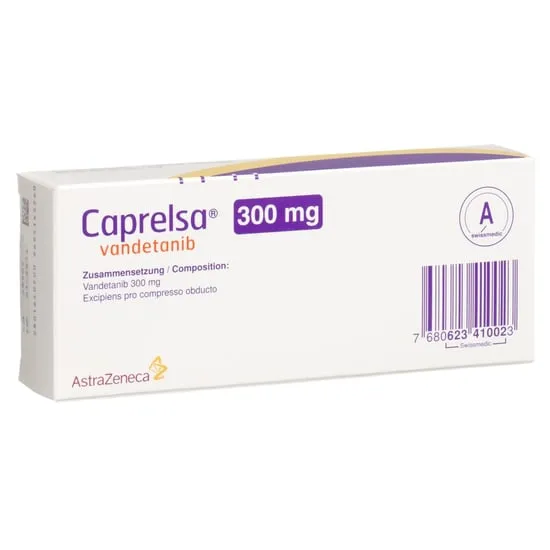
Table of Contents
Patient Information Leaflet
Introduction
Patient Information Leaflet
Caprelsa 100 mg film-coated tablets
Caprelsa 300 mg film-coated tablets
vandetanib
In addition to this leaflet, you will be provided with the Patient Information Card, which contains important safety information you need to know before you are given Caprelsa and during treatment with Caprelsa. |
Read the entire package leaflet carefully before you start taking this medicine, as it contains important information for you.
- Keep this leaflet and the patient information card, as you may need to read them again.
- It is important that you keep the Information Card with you during treatment.
- If you have any questions, consult your doctor or pharmacist.
- This medicine has been prescribed for you only, and you should not give it to others, even if they have the same symptoms as you, because it may harm them.
- If you experience any adverse reactions, consult your doctor or pharmacist, even if they are adverse reactions not listed in this leaflet. See section 4.
Contents of the package leaflet
- What Caprelsa is and what it is used for
- What you need to know before taking Caprelsa
- How to take Caprelsa
- Possible side effects
- How to store Caprelsa
- Contents of the pack and other information
1. What Caprelsa is and what it is used for
Caprelsa is a treatment for adults and children aged 5 years and older with:
A type of medullary thyroid cancer known as rearranged during transfection (RET) mutant, which cannot be removed by surgery or has spread to other parts of the body.
Caprelsa works by slowing down the growth of new blood vessels in tumors (cancers). This interrupts the supply of nutrients and oxygen to the tumor. Caprelsa may also act directly on cancer cells by destroying them or slowing their growth.
2. What you need to know before taking Caprelsa
Do not take Caprelsa:
- if you are allergic to vandetanib or to any of the other ingredients of this medicine (listed in section 6).
- if you have a congenital heart problem called “congenital long QTc syndrome”. This is seen on an electrocardiogram (ECG).
- if you are breastfeeding.
- if you are taking any of the following medicines: arsenic, cisapride (used for heartburn), intravenous erythromycin and moxifloxacin (used to treat infection), toremifene (used to treat breast cancer), mizolastine (used to treat allergies), Class IA and III antiarrhythmics (used to control heart rhythm).
If any of the above apply to you, do not take Caprelsa. If you are unsure, consult your doctor.
Warnings and precautions
Talk to your doctor or pharmacist before starting Caprelsa:
- If you are sensitive to sunlight. Some people taking Caprelsa become more sensitive to sunlight. This may cause sunburn. While taking Caprelsa, protect yourself when going outdoors by always using sunscreen and wearing clothing to avoid sun exposure.
- If you have high blood pressure.
- If you have or have had an aneurysm (a bulge and weakening of the wall of a blood vessel) or a tear in the wall of a blood vessel.
- If you need to undergo surgery. Your doctor may consider stopping Caprelsa if you are undergoing major surgery, as Caprelsa may affect wound healing. Caprelsa may be restarted once adequate wound healing has occurred.
- If you are taking medicines to prevent bone complications from your thyroid cancer or for osteoporosis.
- If you have kidney problems.
Severe cutaneous adverse reactions (SCARs), including Stevens-Johnson syndrome (SJS)/toxic epidermal necrolysis (TEN), have been reported in association with vandetanib treatment. Stop using Caprelsa and seek immediate medical attention if you notice any symptoms related to these severe skin reactions described in section 4.
Your cancer’s RET status must be determined before starting treatment with Caprelsa.
Blood and heart monitoring:
Your doctor or nurse should perform tests to check your blood levels of potassium, calcium, magnesium, and thyroid-stimulating hormone (TSH), as well as the electrical activity of your heart using a test called an electrocardiogram (ECG). These tests should be performed:
- Before starting Caprelsa
- Regularly during treatment with Caprelsa
- 1, 3, and 6 weeks after starting Caprelsa
- 12 weeks after starting Caprelsa
- After that, every 3 months
- If your doctor or pharmacist changes your dose of Caprelsa
- If you start taking medicines that affect the heart
- As directed by your doctor or pharmacist
Children
Caprelsa must not be given to children under 5 years of age.
Taking Caprelsa with other medicines
Tell your doctor or pharmacist if you are taking, have recently taken, or might need to take any other medicines, including those obtained without a prescription and herbal medicines. This is because Caprelsa may affect how some medicines work, and some medicines may affect Caprelsa.
Inform your doctor or pharmacist if you are taking any of the following medicines:
- itraconazole, ketoconazole, ritonavir, clarithromycin, rifampicin, and moxifloxacin (medicines used to treat infections)
- carbamazepine and phenobarbital (used to control seizures)
- ondansetron (used to treat nausea and vomiting)
- cisapride (used to treat heartburn), pimozide (used to treat uncontrolled and repetitive body movements and verbal outbursts), and halofantrine and lumefantrine (used to treat malaria)
- methadone (used to treat addictions), haloperidol, chlorpromazine, sulpiride, amisulpride, and zuclopentixol (used to treat mental illnesses)
- pentamidine (used to treat an infection)
- vitamin K antagonists and dabigatran, commonly called “anticoagulants”
- cyclosporine and tacrolimus (used to prevent transplant rejection), digoxin (used to treat irregular heartbeat), and metformin (used to control blood sugar)
- proton pump inhibitors (used to treat heartburn)
You will also find this information in the Patient Alert Card provided by your doctor. It is important that you keep this Alert Card and show it to your partner or caregivers.
Pregnancy and breastfeeding
If you are pregnant or breastfeeding, think you may be pregnant, or plan to become pregnant, talk to your doctor before using this medicine. This is because Caprelsa may harm the unborn baby. Your doctor will discuss with you the benefits and risks of taking Caprelsa during this time.
- If you could become pregnant, you must use an effective method of contraception while taking Caprelsa and for at least four months after the last dose of Caprelsa. If you are a man with reproductive potential, you must use effective contraception during treatment with Caprelsa and for at least four months after your last dose of Caprelsa.
For your baby’s safety, you must not breastfeed during treatment with Caprelsa.
Driving and using machines
Be cautious before driving or operating machinery. Be aware that Caprelsa may make you feel tired, weak, or cause blurred vision.
3. How to take Caprelsa
Use in adults
Always follow exactly your doctor's instructions for taking this medicine. If in doubt, consult your doctor or pharmacist again.
- The recommended dose is 300 mg daily.
- Take Caprelsa at approximately the same time each day.
- Caprelsa may be taken with or without food.
Use in children and adolescents
Your doctor will inform you how many Caprelsa tablets to give to your child. The amount of Caprelsa administered will depend on your child's body weight and height. The total daily dose in children must not exceed 300 mg. Your child may be given treatment as a once-daily dose, a dose every two days, or a periodic 7-day schedule as indicated in the dosing guide provided by your doctor. It is important that you keep this dosing guide and show it to your caregiver.
If you have difficulty swallowing the tablet
If you have difficulty swallowing the tablet, you may mix it with water as follows:
- Take half a glass of water (non-carbonated). Use water only, do not use any other liquid.
- Place the tablet into the water.
- Stir the tablet until it dissolves in the water. This may take about 10 minutes.
- Then drink it immediately.
To ensure no medicine is left behind, refill the glass with half a glass of water and drink it.
If you experience adverse effects
If you experience adverse effects, always inform your doctor. Your doctor may instruct you to take Caprelsa at a higher or lower dose (such as two 100 mg tablets or one 100 mg tablet). Your doctor may also prescribe other medications to help manage the adverse effects. Caprelsa's adverse effects are listed in section 4.
If you take more Caprelsa than you should
If you have taken more Caprelsa than prescribed, consult a doctor or go to a hospital immediately.
If you forget to take Caprelsa
What you should do if you forget to take a tablet depends on how long it is until your next dose:
- If 12 hours or more remain until your next dose: Take the missed tablet as soon as you remember. Then take the next dose at the usual time.
- If less than 12 hours remain until your next dose: Do not take the missed dose. Then take the next dose at the usual time.
Do not take a double dose (two doses at the same time) to make up for missed doses.
If you have any further questions about the use of this medicine, ask your doctor or pharmacist.
4. Possible adverse effects
Like all medicines, this medicine can cause adverse effects, although not everyone experiences them. If you experience adverse effects, your doctor may advise you to take Caprelsa at a lower dose. Your doctor may also prescribe other medicines to help control the adverse effects.
Contact your doctor immediately if you notice any of the following adverse effects – you may require urgent medical treatment:
- Weakness, dizziness, or changes in heart rate. These may be signs of a change in the electrical activity of the heart. They occur in 8% of people taking Caprelsa for medullary thyroid cancer. Your doctor may recommend that you take Caprelsa at a lower dose or discontinue treatment. Caprelsa has rarely been associated with life-threatening changes in heart rhythm.
- Stop using Caprelsa and seek immediate medical attention if you notice any of the following symptoms: flat, red, target-shaped or circular rashes on the trunk, often with central blisters, skin peeling, or ulcers in the mouth, throat, nose, genitals, and eyes. These severe skin rashes may be preceded by fever and flu-like symptoms (Stevens-Johnson syndrome, toxic epidermal necrolysis).
- Severe diarrhea.
- Severe difficulty breathing, or sudden worsening of breathing difficulty, possibly with cough or high temperature (fever). This may indicate lung inflammation known as "interstitial lung disease." This is uncommon (affects fewer than 1 in 100 people) but may be life-threatening.
- Seizures, headache, confusion, or difficulty concentrating. These may be signs of a condition called RPLS (Reversible Posterior Leukoencephalopathy Syndrome). These symptoms usually resolve when Caprelsa is discontinued. RPLS is uncommon (affects fewer than 1 in 100 people).
Contact your doctor immediately if you experience any of the above adverse effects.
Other adverse effects include:
Very common (affecting more than 1 in 10 people):
- Diarrhea. Your doctor may prescribe a medicine to treat it. If it worsens, contact your doctor immediately.
- Abdominal pain.
- Skin rash or acne.
- Depression.
- Tiredness.
- Nausea.
- Stomach discomfort (dyspepsia).
- Nail changes.
- Vomiting.
- Loss of appetite (anorexia).
- Weakness (asthenia).
- High blood pressure. Your doctor may prescribe a medicine to treat it.
- Headache.
- Fatigue.
- Trouble sleeping (insomnia).
- Inflammation of the nasal passages.
- Inflammation of the main airways to the lungs.
- Upper respiratory tract infections.
- Urinary tract infections.
- Numbness or tingling of the skin.
- Abnormal sensation of the skin.
- Dizziness.
- Pain.
- Swelling due to excess fluid (edema).
- Kidney stones or calcium deposits in the urinary tract (nephrolithiasis).
- Blurred vision, including mild eye changes that may lead to blurred vision (corneal opacity).
- Skin sensitivity to sunlight. While taking Caprelsa, protect yourself when outdoors by always using sunscreen and wearing protective clothing to avoid sun exposure.
Common (affecting less than 1 in 10 people):
- Dehydration.
- Severe high blood pressure.
- Weight loss.
- Stroke or other conditions in which the brain may not receive enough blood.
- A type of rash affecting the hands and feet (hand-foot syndrome).
- Mouth irritation (stomatitis).
- Dry mouth.
- Pneumonia.
- Toxins in the blood as a complication of infection.
- Flu.
- Bladder inflammation.
- Sinus inflammation.
- Inflammation of the voice box (larynx).
- Inflammation of a follicle, especially a hair follicle.
- Boil.
- Fungal infection.
- Kidney infection.
- Loss of body fluids (dehydration).
- Anxiety.
- Tremor.
- Numbness.
- Fainting.
- Feeling of unsteadiness.
- Increased pressure in the eye (glaucoma).
- Coughing up blood.
- Inflammation of lung tissue.
- Difficulty swallowing.
- Constipation.
- Inflammation of the stomach lining (gastritis).
- Gastrointestinal bleeding.
- Gallstones (cholelithiasis).
- Painful urination.
- Kidney failure.
- Frequent urination.
- Urgent need to urinate.
- Fever.
- Nosebleeds (epistaxis).
- Dry eyes.
- Eye irritation (conjunctivitis).
- Visual disturbance.
- Seeing halos.
- Seeing flashes of light (photopsia).
- Eye cornea disorder (keratopathy).
- A type of diarrhea (colitis).
- Hair loss from the head or body (alopecia).
- Changes in taste (dysgeusia).
Uncommon (affecting less than 1 in 100 people):
- Heart failure.
- Inflammation of the appendix (appendicitis).
- Bacterial infection.
- Inflammation of diverticula (small pouches that can form in the digestive system).
- Bacterial skin infection.
- Abscesses in the abdominal wall.
- Malnutrition.
- Involuntary muscle contractions (seizures).
- Rapid alternating contraction and relaxation of muscles (clonus).
- Brain swelling.
- Clouding of the eye lens.
- Changes in heart rate and rhythm.
- Loss of heart function.
- Failure of the lungs to function normally.
- Pneumonia occurring when foreign material is inhaled into the lungs.
- Intestinal obstruction.
- Intestinal perforation.
- Inability to control bowel movements.
- Abnormal urine color.
- Absence of urine.
- Inability to heal properly.
- Inflammation of the pancreas (pancreatitis).
- Blistering skin rash (bullous dermatitis).
Not known (frequency cannot be estimated from available data):
- Enlargement and weakening of a blood vessel wall or tearing of the blood vessel wall (aneurysms and arterial dissections).
- Bone tissue death due to reduced blood flow (osteonecrosis, jaw osteonecrosis).
- Flat, red, target-shaped or circular rashes on the trunk, often with central blisters, skin peeling, or ulcers in the mouth, throat, nose, genitals, and eyes, which may be preceded by fever and flu-like symptoms. These severe skin rashes can potentially be life-threatening (Stevens-Johnson syndrome, toxic epidermal necrolysis).
- A skin reaction causing red spots or patches on the skin, which may resemble a bullseye or "target" with a dark red center surrounded by lighter red rings (erythema multiforme).
The following adverse effects may be observed in laboratory tests your doctor may perform:
- Protein or blood in the urine (detected in a urine test).
- Changes in heart rhythm (detected on an ECG). Your doctor may ask you to stop taking Caprelsa or to take a lower dose.
- Abnormalities in the liver or pancreas (detected in blood tests). These usually do not cause symptoms, but your doctor may want to monitor them.
- Decreased calcium levels in the blood.
- Decreased potassium levels in the blood.
- Increased calcium levels in the blood.
- Increased blood glucose levels.
- Decreased sodium levels in the blood.
- Reduced thyroid function.
- Increased red blood cell count.
If you consider any of the adverse effects you experience to be severe, or if you notice any adverse effects not listed in this leaflet, inform your doctor or pharmacist immediately.
Reporting of adverse effects
If you experience any type of adverse effect, talk to your doctor or pharmacist, even if it is a possible adverse effect not listed in this leaflet. You can also report them directly through the national reporting system detailed in Appendix V. By reporting adverse effects, you can help provide more information on the safety of this medicine.
5. Storage of Caprelsa
Keep this medicine out of the sight and reach of children.
Do not use this medicine after the expiry date which is stated on the blister and on the carton after EXP. The expiry date refers to the last day of the month indicated.
Do not store above 30 °C.
Medicines should not be disposed of via wastewater or household waste. Ask your pharmacist how to dispose of medicines and packaging once they are no longer needed. This will help protect the environment.
6. Contents of the pack and other information
Composition of Caprelsa
- The active substance is vandetanib. Each tablet contains 100 or 300 mg of vandetanib.
- The other components are calcium hydrogen phosphate dihydrate, microcrystalline cellulose, crospovidone (type A), povidone (K29-32), magnesium stearate, hypromellose, macrogol, and titanium dioxide (E171).
Nature of the product and pack contents
Caprelsa 100 mg is a white, film-coated, round tablet marked with "Z100" on one side.
Caprelsa 300 mg is a white, film-coated, oval tablet marked with "Z300" on one side.
Caprelsa is supplied in blister packs containing 30 tablets.
Marketing Authorization Holder
Sanofi B.V.
Paasheuvelweg 25
1105 BP Amsterdam
The Netherlands
Manufacturer
Genzyme Ireland Ltd., IDA Industrial Park, Old Kilmeaden Road, Waterford, Ireland
Sanofi Winthrop Industrie, 30-36 avenue Gustave Eiffel, 37100 Tours, France
For further information about this medicinal product, please contact the local representative of the Marketing Authorization Holder:
Belgium/Belgium/Belgium/ Luxembourg/Luxembourg Sanofi Belgium Tél/Tel: + 32 (0)2 710 54 00 | Hungary SANOFI-AVENTIS Zrt. Tel: +36 1 505 0050 | |
| Malta Sanofi S.r.l. Tel: +39 02 39394275 | |
Czech Republic Sanofi s.r.o. Tel: +420 233 086 111 | Netherlands Sanofi B.V. Tel: +31 20 245 4000 | |
Denmark sanofi A/S Tlf: +45 45 16 70 00 | Norway sanofi-aventis Norge AS Tlf: + 47 67 10 71 00 | |
Germany Sanofi-Aventis Deutschland GmbH Tel.: 0800 52 52 010 Tel. from abroad: +49 69 305 21 131 | Austria sanofi-aventis GmbH Tel: + 43 1 80 185 - 0 | |
Estonia Swixx Biopharma OÜ Tel: +372 640 10 30 | Poland Sanofi Sp. z o.o. Tel.: +48 22 280 00 00 | |
Greece Sanofi-Aventis Μονοπρóσωπη AEBE Tel: +30 210 900 16 00 | Portugal Sanofi – Produtos Farmacêuticos, Lda. Tel: +351 21 35 89 400 | |
Spain sanofi-aventis, S.A. Tel: +34 93 485 94 00 | Romania Sanofi Romania SRL Tel: +40 (0) 21 317 31 36 | |
France Sanofi Winthrop Industrie Tél: 0 800 222 555 Call from abroad: +33 1 57 63 23 23 | Slovenia Swixx Biopharma d.o.o. Tel: +386 1 235 51 00 | |
Croatia Swixx Biopharma d.o.o. Tel: +385 1 2078 500 | Slovak Republic Swixx Biopharma s.r.o. Tel: +421 2 208 33 600 | |
Ireland sanofi-aventis Ireland Ltd. T/A SANOFI Tel: +353 (0) 1 403 56 00 | ||
Iceland Vistor hf. Sími: +354 535 7000 | Finland Sanofi Oy Puh/Tel: + 358 (0) 201 200 300 | |
Italy Sanofi S.r.l. Tel: 800 536 389 | Sweden Sanofi AB Tel: +46 (0)8 634 50 00 | |
Cyprus C.A. Papaellinas Ltd. Tel: +357 22 741741 | ||
Latvia Swixx Biopharma SIA Tel: +371 6 616 47 50 | United Kingdom (Northern Ireland) sanofi-aventis Ireland Ltd. T/A SANOFI Tel: +44 (0) 800 035 2525 | |
Lithuania Swixx Biopharma UAB Tel: +370 5 236 91 40 |

Date of the most recent review of this leaflet:
Other sources of information
Detailed information on this medicinal product is available on the website of the European Medicines Agency: http://www.ema.euopa.eu.