Caosina 1,000 mg powder for oral suspension
Spain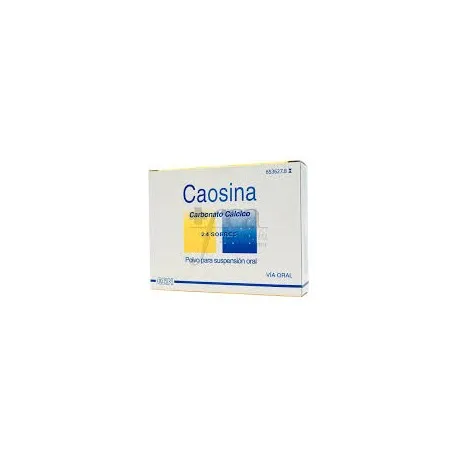
Table of Contents
Package leaflet: Information for the user
Introduction
Package leaflet: information for the user
Caosina 1.000 mg powder for oral suspension
Calcium carbonate
Read the entire leaflet carefully before you start taking this medicine, because it contains important information for you.
- Follow exactly the instructions for taking this medicine provided in this leaflet or those given by your doctor or pharmacist.
- Keep this leaflet, as you may need to read it again.
- If you need advice or more information, consult your pharmacist.
- If you experience any adverse effects, consult your doctor or pharmacist, even if they are effects not listed in this leaflet. See section 4.
Leaflet contents
- What Caosina is and what it is used for
- What you need to know before taking Caosina
- How to take Caosina
- Possible side effects
- How to store Caosina
- Contents of the pack and other information
1. What Caosina is and what it is used for
Caosina is a medicine presented as a powder for oral suspension, and is used for:
- prevention and treatment of calcium deficiency,
- calcium supplementation for the prevention and treatment of osteoporosis,
- treatment of elevated phosphate levels in the blood (hyperphosphatemia).
2. What you need to know before taking Caosina
Do not take Caosina:
- If you are allergic to the active substance or to any of the other ingredients of this medicine (listed in section 6).
- If you have diseases or conditions that cause hypercalcemia (high calcium levels in blood) and/or hypercalciuria (high calcium levels in urine).
- If you have nephrolithiasis (kidney stones).
- If you have ventricular fibrillation (a heart rhythm disorder).
Warnings and precautions
- If you have renal insufficiency, Caosina should only be administered under conditions where hyperphosphatemia is controlled.
- If you have a history of kidney stones (renal calculi).
- During treatment with high doses and especially during concomitant treatment with vitamin D and/or medications or foods containing calcium (such as milk), there may be a risk of hypercalcemia, which could lead to impaired renal function. Your doctor must monitor your serum calcium levels and renal function.
Other medicines and Caosina
Inform your doctor or pharmacist if you are taking, have recently taken, or might need to take any other medicines.
Please note that these instructions may also apply to medicines taken previously or that may be taken in the future.
Thiazide diuretics (medicines used to treat edema and hypertension) reduce urinary calcium excretion. Because of the increased risk of hypercalcemia, serum calcium levels should be monitored regularly during concomitant use of thiazide diuretics.
Systemic corticosteroids (medicines used for their anti-inflammatory and immunosuppressive effects) reduce calcium absorption. During concomitant use, it may be necessary to increase the dose of Caosina. It is recommended to separate administration by 2 hours.
Calcium carbonate may interfere with the absorption of tetracycline preparations (antibiotics) when administered concomitantly. Therefore, tetracycline preparations should be administered at least 2 hours before or 4 to 6 hours after oral calcium intake.
Hypercalcemia may increase the toxicity of cardiac glycosides (medicines used to treat heart conditions) during calcium treatment.
Serum calcium levels and electrocardiogram (ECG) should be monitored.
If you are taking a bisphosphonate (a medicine for prevention and treatment of bone resorption) concomitantly, this preparation should be administered at least 3 hours before taking Caosina, as gastrointestinal absorption may be reduced.
The effectiveness of levothyroxine (thyroid hormone) may be reduced if taken simultaneously with calcium, due to decreased levothyroxine absorption. Administration of calcium and levothyroxine should be separated by at least 4 hours.
The absorption of quinolones (antimicrobials) may be impaired when administered concomitantly with calcium. Quinolones should be taken 2 hours before or 6 hours after calcium intake.
Calcium salts may reduce the absorption of iron, zinc, and strontium ranelate (a medicine for the treatment of osteoporosis). Therefore, iron, zinc, or strontium ranelate preparations should be taken at least 2 hours before or after calcium carbonate.
The absorption of some other medicines may also be reduced due to chelate formation, such as: phenytoin (antiarrhythmic), fosfomycin (antibiotic), iron salts, and doxycycline (antibiotic).
Concomitant administration with gentamicin (antibiotic) may enhance its nephrotoxicity (kidney toxicity).
Administration together with verapamil may reduce its antihypertensive effects.
Taking Caosina with food, drinks, and alcohol
Oxalic acid (found in spinach and rhubarb) and phytic acid (found in whole grains) may inhibit calcium absorption by forming insoluble compounds with calcium. Do not take calcium-containing products within 2 hours after consuming foods high in oxalic acid or phytic acid.
Phosphorus present in milk or other dairy products may also reduce calcium absorption.
Pregnancy and breastfeeding
If you are pregnant or breastfeeding, think you may be pregnant, or are planning to become pregnant, consult your doctor or pharmacist before using this medicine.
The recommended daily intake (including food and supplements) during pregnancy and breastfeeding is 1,000 – 1,300 mg of calcium.
During pregnancy, the daily calcium intake should not exceed 1,500 mg.
In cases of calcium deficiency, Caosina may be used during pregnancy and breastfeeding, as although it passes into breast milk, no effects on newborns are expected at the therapeutic doses used.
Driving and using machines
No studies have been conducted on the ability to drive or operate machinery. However, it is unlikely that Caosina will affect your ability to drive or use machines.
3. How to take Caosina
Follow exactly the instructions for administering this medicine as given by your doctor or pharmacist. If in doubt, consult your doctor or pharmacist again.
The recommended dose is:
Prevention and treatment of calcium deficiency
Adults: 500 – 1,500 mg of calcium per day.
Children: 500 – 1,000 mg of calcium per day.
Treatment of osteoporosis
Adults: 500 – 1,500 mg of calcium per day.
Hyperphosphatemia (elevated blood phosphate levels)
Individual dosage. Usually, 2 – 6 g of calcium (2 to 6 sachets of Caosina) per day divided into 2 – 4 doses are required.
Caosina is administered orally. Pour the contents of one or more sachets, depending on the indication, into half a glass of water (100 ml). Shake until a homogeneous suspension is formed.
If only 500 mg is required, dissolve one sachet uniformly in half a glass of water, and discard approximately half, in order to take only the remainder.
Caosina should be taken with meals in order to bind to the phosphate present in food.
If you take more Caosina than you should
If you have taken more Caosina than you should, or in case of accidental overdose, consult your doctor or pharmacist immediately, or contact the Toxicology Information Service at telephone number: 91 562 04 20, indicating the medicine and the amount ingested. It is recommended to bring the medicine's packaging and leaflet to the healthcare professional.
Overdose may lead to hypervitaminosis and hypercalcemia. Symptoms of hypercalcemia may include anorexia, thirst, nausea, vomiting, constipation, abdominal pain, muscle weakness, fatigue, mental disturbances, excessive urination, bone pain, nephrocalcinosis (calcium deposits in the kidney), kidney stones, and in severe cases, cardiac arrhythmias. Extreme hypercalcemia may result in coma and death. Persistently elevated calcium levels may cause irreversible kidney damage and tissue calcifications.
The milk-alkali syndrome may occur in patients who ingest large amounts of calcium and absorbable alkalis, leading to metabolic imbalance due to increased calcium in the body, which may result in loss of renal function.
If you forget to take Caosina
Do not take a double dose to make up for forgotten doses.
If you forget to take your dose, take it as soon as you remember. However, if it is almost time for your next dose, skip the missed dose and take the next one at the usual time.
If you stop taking Caosina
Remember to take your medicine. Your doctor will advise you on the duration of treatment with this medicine. Avoid stopping treatment without first consulting your doctor.
If you have any further questions about the use of this medicine, ask your doctor or pharmacist.
4. Possible adverse effects
Like all medicines, this medicine may cause adverse effects, although not everyone experiences them.
The adverse reactions listed below are classified by system organ class and frequency. Frequencies are defined as: uncommon (between 1 and 100 in every 1,000 patients), rare (between 1 and 1,000 in every 10,000 patients), or very rare (up to 1 in every 10,000 people).
Metabolism and nutritional disorders
Uncommon: hypercalcemia, hypercalciuria, and metabolic alkalosis (elevated blood bicarbonate levels).
Very rare: milk-alkali syndrome (urgent need to urinate frequently, persistent headache, continuous loss of appetite, nausea or vomiting, unusual tiredness or weakness, hypercalcemia, alkalosis, and renal failure). This usually occurs only in cases of overdose.
Gastrointestinal disorders
Rare: constipation, flatulence, anorexia, nausea, vomiting, abdominal pain, dry mouth, acid regurgitation (if administered on an empty stomach, which is not recommended), and diarrhea.
Frequency not known: Dyspepsia (pain or discomfort in the abdomen).
Nervous system disorders
Very rare: confusion, irritability, delirium, stupor, and coma (high doses).
Renal and urinary disorders
Rare: polyuria (increased urine excretion), renal failure, kidney stones.
Skin and subcutaneous tissue disorders
Rare: itching, rashes, and urticaria.
Reporting of adverse effects
If you experience any type of adverse effect, consult your doctor, pharmacist, or nurse, even if it is a possible adverse effect not listed in this leaflet.
You may also report them directly via the Spanish Pharmacovigilance System for Human Medicines: https://www.notificaram.es. By reporting adverse effects, you can help provide more information on the safety of this medicine.
5. Storage of Caosina
Keep this medicine out of the sight and reach of children.
No special storage conditions are required.
Do not use this medicine after the expiry date stated on the packaging after EXP. The expiry date refers to the last day of the month indicated.
Medicines must not be disposed of via wastewater or household waste. Dispose of empty containers and unused medicines at the SIGRE collection point in your pharmacy. If you are unsure, ask your pharmacist how to dispose of containers and medicines you no longer need. This will help protect the environment.
6. Contents of the pack and other information
Composition of Caosina
- The active substance is calcium carbonate. Each sachet contains 2,500 mg of calcium carbonate, equivalent to 1,000 mg or 25 mmol of calcium.
- The other components are: sodium saccharin and ethyl vanillin.
Nature of the product and pack contents
Caosina is a medicine presented as a powder for oral suspension. Each carton contains 24 or 60 sachets made of a multilayer paper/aluminum/polyethylene composite.
Marketing Authorization Holder
Laboratorios ERN, S.A.
Perú, 228 - 08020 Barcelona, Spain.
Manufacturers
Laboratorios ERN, S.A.
Gorgs Lladó, 188 – 08210 Barberà del Vallès, Barcelona, Spain.
Date of the most recent revision of this leaflet: October 2018.
Detailed and up-to-date information on this medicine is available on the website of the Spanish Agency of Medicines and Health Products (AEMPS) http://www.aemps.gob.es/.