Calcium folinate Kalceks 10 mg/ml solution for injection and infusion EFG
Spain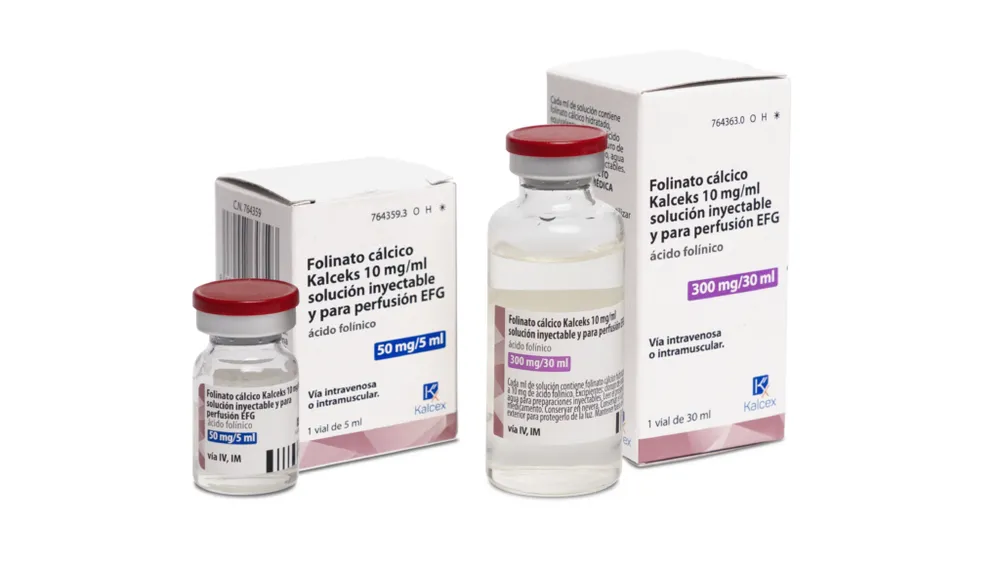
Instructions for Use
Table of Contents
- Introduction
- 1. What Folinanto cálcico Kalceks is and what it is used for
- 2. What you need to know before being administered Folinato cálcico Kalceks
- 3. How to use Folinato cálcico Kalceks
- 4. Possible adverse effects
- 5. Storage of Calcium Folinate Kalceks
- 6. Package contents and additional information
Package leaflet: Information for the user
Introduction
Package leaflet: information for the user
Folinato cálcico Kalceks 10mg/ml solution for injection and infusion EFG
folinic acid
Read all of this leaflet carefully before you start using this medicine, because it contains important information for you.
- Keep this leaflet, as you may need to read it again.
- If you have any questions, ask your doctor or nurse.
- If you experience any side effects, talk to your doctor or nurse, even if they are side effects not listed in this leaflet. See section 4.
Contents of the leaflet
- What Folinato cálcico Kalceks is and what it is used for
- What you need to know before you are given Folinato cálcico Kalceks
- How to use Folinato cálcico Kalceks
- Possible side effects
- How to store Folinato cálcico Kalceks
- Contents of the pack and other information
1. What Folinanto cálcico Kalceks is and what it is used for
Folinato cálcico Kalceks 10 mg/ml solution for injection and infusion contains the active substance acidum folinicum, in the form of calcium folinate hydrate (hereinafter referred to as calcium folinate). Calcium folinate is the calcium salt of folinic acid. It belongs to a group of medicines called 'detoxifying agents'.
This medicine is used:
- to reduce harmful effects and to treat overdose of certain anticancer medicines such as methotrexate and other folic acid antagonists in adults and children. This process is known as "calcium folinate rescue";
- to treat cancer in combination with fluorouracil (an anticancer medicine). Fluorouracil works better when given together with calcium folinate.
2. What you need to know before being administered Folinato cálcico Kalceks
Do not use Folinato cálcico Kalceks
- if you are allergic to calcium folinate or to any of the other ingredients of this medicine (listed in section 6);
- if you have a type of anemia (insufficient red blood cells) caused by vitamin B12 deficiency.
If you are unsure whether any of the above situations apply to you, consult your doctor or nurse before being administered this medicine.
If you are pregnant or breastfeeding, you should not receive Folinato cálcico Kalceks together with certain anticancer drugs (your doctor will know which ones).
This medicine must not be injected into the spinal column (intrathecally).
Warnings and precautions
Talk to your doctor or nurse before being administered this medicine if:
- you have kidney disorders (you may require a higher dose or need this medicine for a longer period of time);
- you have epilepsy.
Use of calcium folinate with fluorouracil
You should not receive this medicine together with fluorouracil if you have noticed that your medication causes you stomach or intestinal problems.
If you are to receive calcium folinate together with fluorouracil, consult your doctor or nurse before being administered this medicine if:
- you have received radiotherapy;
- you have stomach or intestinal disorders;
- you have inflammation inside your mouth;
- you are elderly;
- you feel very weak.
Your doctor will monitor the function of your liver and/or kidneys and will perform periodic blood tests to check them.
Other medicines and Folinato cálcico Kalceks
Inform your doctor or nurse if you are taking, have recently taken, or might need to take any other medicines.
This is especially important if you are taking any of the following medicines, as special care will be required:
- medicines known as folic acid antagonists, such as cotrimoxazole (an antibiotic) or pyrimethamine (used to treat malaria). Calcium folinate may reduce or completely counteract the effect of these medicines;
- fluorouracil (an anticancer medicine). Calcium folinate increases both the effectiveness and the side effects of fluorouracil;
- medicines for treating epilepsy (such as phenobarbital, phenytoin, primidone, or succinimides, for example, ethosuximide). Calcium folinate may reduce the effect of these medicines. Your doctor may check the blood levels of these medicines and adjust their dose to prevent an increase in seizures (epileptic attacks).
Pregnancy and breastfeeding
If you are pregnant or breastfeeding, think you may be pregnant, or plan to become pregnant, consult your doctor before being administered this medicine.
Calcium folinate does not cause harmful effects when used as a single medicine during pregnancy.
You must not receive Folinato cálcico Kalceks together with fluorouracil during pregnancy or breastfeeding, as it could harm the baby.
Folinato cálcico will only be administered together with methotrexate during pregnancy or breastfeeding if your doctor considers it necessary.
Driving and using machines
There is no evidence that calcium folinate affects the ability to drive or use machines.
Folinato cálcico Kalceks contains sodium
This medicine contains 3.15 mg of sodium (main component of table/cooking salt) in each ml of solution. This corresponds to 0.16% of the maximum daily recommended sodium intake for an adult.
3. How to use Folinato cálcico Kalceks
This medicine may be administered as an injection or infusion (drip) into a vein or as an injection into a muscle. If administered by infusion, it must first be diluted.
Your doctor will decide the correct dose of this medicine for you and how often it should be given. The decision will depend on the medical condition being treated, your body surface area, and any other treatments you may be receiving.
If you receive more Folinato cálcico Kalceks than you should
This medicine will be administered to you in a hospital under the supervision of a doctor. It is unlikely that you will be given a dose that is too high or too low. However, if you have any questions, speak to your doctor or nurse.
If you have any further questions about the use of this medicine, consult your doctor or nurse.
4. Possible adverse effects
Like all medicines, this medicine can cause adverse effects, although not everyone will experience them.
Consult your doctor or nurse immediately if you experience:
- sudden rash with itching (urticaria), swelling of hands, feet, ankles, face, lips, mouth or throat (which may cause difficulty swallowing or breathing), and feeling like you are going to faint. These may be signs of a very rare and serious allergic reaction (may affect up to 1 in 10,000 people). You may require urgent medical attention
- flat reddish spots, target-shaped or circular, on the trunk, often with central blisters, skin peeling, ulcers in the mouth, throat, nose, genitals and eyes. These serious skin rashes may be preceded by fever and flu-like symptoms (Stevens-Johnson syndrome, toxic epidermal necrolysis) (frequency cannot be estimated from available data)
Uncommon (may affect up to 1 in 100 people)
- fever
Rare (may affect up to 1 in 1,000 people)
- insomnia
- agitation and depression (after high doses)
- increased seizures (fits) in patients with epilepsy
- gastrointestinal disorders (after high doses)
Only with combination treatment with fluorouracil
If you are receiving calcium folinate in combination with fluorouracil, you are more likely to experience the following adverse effects:
Very common (may affect more than 1 in 10 people)
- bone marrow failure (even life-threatening)
- inflammation of the lining of the intestine and mouth (potentially fatal conditions have occurred)
- nausea, vomiting and diarrhoea (with monthly doses)
- severe diarrhoea and dehydration (with weekly doses)
Common (may affect up to 1 in 10 people)
- redness and swelling of the palms of the hands or soles of the feet, which may lead to skin peeling (palmar-plantar erythrodysesthesia or 'hand-foot syndrome')
Frequency not known (frequency cannot be estimated from available data)
- elevated blood ammonia levels
Inform your doctor if you experience diarrhoea or inflammation of the lining of the mouth, as your doctor may consider reducing the dose of fluorouracil until symptoms have completely disappeared.
Since diarrhoea may be a sign of stomach and intestinal toxicity, if you develop these symptoms, you will be closely monitored until symptoms have completely resolved. These symptoms may signal the onset of rapid deterioration that could lead to death.
Your doctor may carry out tests to check for low calcium levels in the blood.
Reporting of adverse effects
If you experience any adverse effect, talk to your doctor or pharmacist, even if it is a possible adverse effect not listed in this leaflet. You can also report them directly via the Spanish Pharmacovigilance System for Human Medicinal Products: www.notificaRAM.es. By reporting adverse effects, you can help provide more information on the safety of this medicine.
5. Storage of Calcium Folinate Kalceks
Keep this medicine out of the sight and reach of children.
Do not use this medicine after the expiry date stated on the vial and outer carton following EXP. The expiry date refers to the last day of the month indicated.
Store in a refrigerator (between 2 °C and 8 °C).
Keep the vial in the outer packaging to protect it from light.
After opening the vial: the product must be used immediately.
Period of validity after dilution
Chemical and physical in-use stability has been demonstrated for 4 days at 25 °C (protected from light) and at 2 to 8 °C after dilution with 0.9% (9 mg/ml) sodium chloride injection solution.
From a microbiological standpoint, the diluted solution should be used immediately. If not used immediately, storage times and conditions prior to use are the responsibility of the user and should normally not exceed 24 hours at a temperature of 2 to 8 °C, unless the dilution has been carried out under controlled and validated aseptic conditions.
Chemical and physical in-use stability has been demonstrated for 24 hours at 2 to 8 °C after dilution with 5% (50 mg/ml) glucose injection solution.
From a microbiological standpoint, unless the method of opening/dilution prevents the risk of microbial contamination, the medicine should be used immediately. If not used immediately, the storage times and conditions in use are the responsibility of the user.
Medicines must not be disposed of via wastewater or household waste. Ask your pharmacist how to dispose of medicines and containers you no longer need. This will help protect the environment.
6. Package contents and additional information
Composition of Folinato cálcico Kalceks
- The active substance is folinic acid, as calcium folinate hydrate.
Each ml of solution contains calcium folinate hydrate, equivalent to 10 mg of folinic acid.
Each vial containing 5 ml of solution contains calcium folinate hydrate, equivalent to 50 mg of folinic acid.
Each vial containing 10 ml of solution contains calcium folinate hydrate, equivalent to 100 mg of folinic acid.
Each vial containing 20 ml of solution contains calcium folinate hydrate, equivalent to 200 mg of folinic acid.
Each vial containing 30 ml of solution contains calcium folinate hydrate, equivalent to 300 mg of folinic acid.
Each vial containing 50 ml of solution contains calcium folinate hydrate, equivalent to 500 mg of folinic acid.
Each vial containing 100 ml of solution contains calcium folinate hydrate, equivalent to 1,000 mg of folinic acid.
Each 1 mg of folinic acid is equivalent to 1.08 mg of calcium folinate.
- The other components are sodium chloride, sodium hydroxide (for pH adjustment), water for injections.
Appearance of the product and contents of the container
Clear, colourless or slightly yellow solution, free from visible particles.
5 ml, 10 ml, 20 ml, 30 ml, 50 ml or 100 ml of solution in clear glass vials closed with bromobutyl rubber stoppers and sealed with removable aluminium seals (flip-off). The vials are packaged in cardboard boxes.
Pack sizes:
1, 5 or 10 vials of 5 ml
1 or 10 vials of 10 ml
1 or 10 vials of 20 ml
1 or 10 vials of 30 ml
1 or 10 vials of 50 ml
1 or 10 vials of 100 ml
Only certain pack sizes may be commercially available.
Marketing Authorisation Holder and Manufacturer
AS KALCEKS
Krustpils iela 71E,
Riga, LV-1057,
Latvia
Tel.: +371 67083320
E-mail: [email protected]
For further information about this medicinal product, please contact the local representative of the Marketing Authorisation Holder
EVER Pharma Therapeutics Spain SL
C/ Toledo 170
28005 Madrid
Spain
This medicinal product is authorised in the European Economic Area member states under the following names:
Finland, Czech Republic, Denmark, Estonia, Norway, Poland, Sweden: Calcium folinate Kalceks
Austria, Germany: Folinsäure Kalceks 10 mg/ml Injektions-/Infusionslösung
Belgium: Folinic acid Kalceks 10 mg/ml solution injectable/pour perfusion
Folinic acid Kalceks 10 mg/ml oplossing voor injectie/infusie
Folinic acid Kalceks 10 mg/ml Injektions-/Infusionslösung
Bulgaria: Folinic acid Kalceks 10 mg/ml ???????????/?????????? ???????
Croatia: Folinatna kiselina Kalceks 10 mg/ml otopina za injekciju/infuziju
France: FOLINATE DE CALCIUM KALCEKS 10 mg/mL, solution injectable/pour perfusion
Hungary: Calcium folinate Kalceks 10 mg/ml oldatos injekció vagy infúzió
Ireland: Folinic acid (as calcium folinate) 10 mg/ml solution for injection/infusion
Latvia: Calcium folinate Kalceks 10 mg/ml škidums injekcijam/infuzijam
Lithuania: Folinic acid Kalceks 10 mg/ml injekcinis ar infuzinis tirpalas
Netherlands: Folinezuur Kalceks 10 mg/ml oplossing voor injectie/infusie
Spain: Folinato cálcico Kalceks 10 mg/ml solución inyectable y para perfusión EFG
Date of latest revision of this leaflet: November 2023
Detailed information on this medicinal product is available on the website of the Spanish Agency of Medicines and Health Products (AEMPS) (http://www.aemps.gob.es/).
?------------------------------------------------------------------------------------------------------------------------
This information is intended for healthcare professionals only:
Incompatibilities
This medicinal product must not be mixed with other medicinal products except those mentioned in the section "Instructions for use, disposal and other handling" below.
Incompatibilities have been reported between injectable forms of calcium folinate and injectable forms of droperidol, 5-fluorouracil, foscarnet and methotrexate.
Droperidol
- Droperidol 1.25 mg/0.5 ml with calcium folinate 5 mg/0.5 ml: immediate precipitation observed after direct mixing in a syringe over 5 minutes at 25°C followed by 8 minutes of centrifugation.
- Droperidol 2.5 mg/0.5 ml with calcium folinate 10 mg/0.5 ml: immediate precipitation observed when drugs are injected sequentially into a Y-set without flushing the Y-arm between injections.
Fluorouracil
Calcium folinate must not be mixed in the same infusion with 5-fluorouracil, as a precipitate may form. Mixtures of 50 mg/ml fluorouracil with 20 mg/ml calcium folinate, with or without 5% glucose injection solution (50 mg/ml), have been shown to be incompatible when mixed in various proportions and stored at 4°C, 23°C or 32°C in polyvinyl chloride containers.
Foscarnet
A cloudy yellow solution has been observed upon mixing 24 mg/ml foscarnet with 20 mg/ml calcium folinate.
Instructions for use, disposal and other handling
For single use only.
The solution must be used immediately after opening the vial. Any unused portion remaining after use must be discarded.
The solution must be inspected visually before use. Do not use if visible signs of deterioration are present (e.g., particles). The solution should only be used if it is clear and free from particles.
Dilution for intravenous infusion
To administer the required dose to a patient, aseptically withdraw the appropriate volume from the Folinato cálcico Kalceks 10 mg/ml solution for injection and infusion vial and then dilute it with one of the compatible diluents listed below.
For storage conditions and shelf life after dilution, see section 5.
For intravenous infusion, it may be diluted with:
- Sodium chloride 0.9% injection solution (9 mg/ml);
- Glucose 5% injection solution (50 mg/ml).
Disposal of unused medicinal product and of all materials that have come into contact with it must be carried out in accordance with local regulations.
This page has been machine-translated and may contain inaccuracies. The original data is available in the manufacturing country's language.
Last data check: May 18, 2026 · Data source: CIMA — AEMPS