Cafinitrine 1 mg/25 mg sublingual tablets
Spain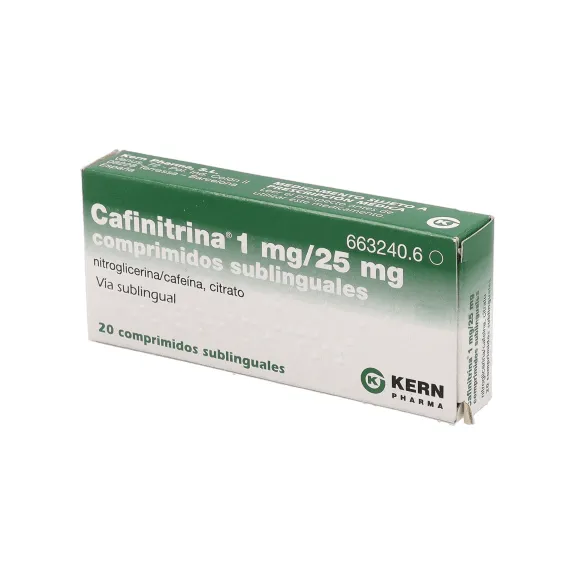
Table of Contents
- Patient Information Leaflet
- Introduction
- **Cafinitrina 1 mg/25 mg sublingual tablets**
- 1. What Cafinitrina is and what it is used for
- 2. What you need to know before starting to take Cafinitrina
- **Pregnancy, breastfeeding, and fertility**
- Pregnancy:
- Breastfeeding:
- 3. How to take Cafinitrina
- 4. Possible adverse effects
- 5. Storage of Cafinitrina
- 6. Contents of the pack and other information
- **Appearance of the product and contents of the pack**
- **Marketing Authorization Holder**
- **Manufacturer**
Patient Information Leaflet
Introduction
Patient Information Leaflet
Cafinitrina 1 mg/25 mg sublingual tablets
nitroglycerin/caffeine citrate
Read this entire leaflet carefully before you start taking this medicine, because it contains important information for you.
- Keep this leaflet, as you may need to read it again.
- If you have any questions, consult your doctor or pharmacist.
- This medicine has been prescribed for you only, and you should not give it to other people, even if they have the same symptoms as you, because it may harm them.
- If you experience any adverse effects, consult your doctor or pharmacist, even if the effects are not listed in this leaflet. See section 4.
Contents of the leaflet:
- What Cafinitrina is and what it is used for
- What you need to know before taking Cafinitrina
- How to take Cafinitrina
- Possible side effects
- How to store Cafinitrina
- Contents of the pack and other information
1. What Cafinitrina is and what it is used for
Cafinitrina belongs to the group of medicines known as vasodilators used in heart diseases, which increase blood flow to the heart and improve its performance when there is reduced blood supply in the coronary arteries (the arteries that carry blood to the heart).
Cafinitrina is administered under the tongue to:
- Treat acute angina attacks urgently. These consist of sudden episodes of chest pain or tightness, which may also be felt in the neck or arm, due to inadequate blood supply in the coronary arteries.
- Prevent angina-related pain when engaging in physical activity or situations that may trigger such pain.
2. What you need to know before starting to take Cafinitrina
Do not take Cafinitrina
- If you are allergic to nitroglycerin, to nitroglycerin derivatives and/or to caffeine citrate, or to any of the other ingredients of this medicine (listed in section 6).
- If you have severe anemia, cerebral hemorrhage, or brain injuries associated with increased intracranial pressure.
- If you have uncorrected low total blood volume or very low blood pressure.
- If you have increased intraocular pressure.
- If you have been diagnosed with obstructive cardiomyopathy (a non-inflammatory heart disease), especially if associated with aortic or mitral stenosis or constrictive pericarditis (heart valve problems).
- If you are being treated with sildenafil or other similar medications used for penile erectile dysfunction.
- If you are taking soluble guanylate cyclase stimulators (for example, riociguat), used in the treatment of pulmonary hypertension, as this increases the risk of hypotension.
Warnings and precautions
Consult your doctor or pharmacist before starting to take Cafinitrina:
- If you have ischemic heart failure or severe cerebral ischemia (cardiac or cerebral circulation problems), as reduced oxygen supply may reduce the effectiveness of nitroglycerin.
- If you are undergoing dialysis, as there is a risk of hypotension.
- If you have early-stage glaucoma (an eye disease caused by high pressure inside the eye), as organic nitrates and nitrites may increase intraocular pressure.
- If you have recently suffered an acute myocardial infarction or have acute heart failure, as careful medical monitoring may be required.
Please bear in mind that with long-term treatment using high doses, the effects of nitroglycerin may decrease.
Abrupt discontinuation of treatment should be avoided.
Children and adolescents
Use of this medicine is not recommended.
Other medicines and Cafinitrina
- Administration of phosphodiesterase-5 inhibitors (sildenafil or other similar medicines for the treatment of erectile dysfunction) or soluble guanylate cyclase stimulators (riociguat) may enhance the hypotensive effect (lowering of blood pressure) occasionally associated with nitroglycerin use. See section 2 “Do not take Cafinitrina”.
- The use of this medicine together with ergotamine or related medicines should be avoided, as it may reduce the effect of both medicines.
- Caution is recommended if administering this medicine simultaneously with other vasodilators (papaverine, vincamine, etc.), antihypertensives (for example, calcium channel blockers, beta-blockers, diuretics, etc.), tricyclic antidepressants, neuroleptics, and alcohol, as they may enhance the hypotensive effect (lowering of blood pressure) of nitroglycerin.
- Taking acetylsalicylic acid and other non-steroidal anti-inflammatory substances (analgesics with anti-inflammatory effects) may reduce the response to nitroglycerin.
Inform your doctor or pharmacist if you are taking, have recently taken, or might need to take any other medicines.
Taking Cafinitrina with food, drinks and alcohol
Avoid consuming alcoholic beverages.
Pregnancy, breastfeeding, and fertility
If you are pregnant or breastfeeding, think you may be pregnant, or are planning to become pregnant, consult your doctor before using this medicine.
Pregnancy:
Your doctor will decide whether or not you should take Cafinitrina, after weighing the benefits for the mother against the risks for the fetus.
Breastfeeding:
Your doctor will decide whether it is necessary to interrupt breastfeeding or to discontinue treatment.
Driving and use of machines
Cafinitrine may cause hot flushes, dizziness or decreased blood pressure, especially at the beginning of treatment. If you experience any of these adverse effects, avoid driving vehicles or operating machinery.
Cafinitrine contains sucrose and lactose
This medicine contains sucrose. If your doctor has informed you of an intolerance to certain sugars, consult him before taking this medicine. It may cause dental caries.
This medicine contains lactose. If your doctor has informed you of an intolerance to certain sugars, consult him before taking this medicine.
3. How to take Cafinitrina
Follow exactly the instructions for administration of this medicine given by your doctor. If in doubt, consult your doctor or pharmacist again.
Remember to take your medicine.
Place one tablet in the mouth, chew it and then place it under the tongue without swallowing.
The recommended dose is:
Acute angina attack treatment
Take 1 tablet at the first symptom or sign of anginal pain. If the pain does not completely subside, the dose may be repeated three or four times at short intervals of 10 minutes.
Prevention of painful episodes due to angina pectoris
Take 1 tablet between 5 and 10 minutes before engaging in or being exposed to known activities or situations that may trigger anginal pain.
Your doctor will indicate the duration of your treatment with Cafinitrina.
Use in children and adolescents
Use of this medicine is not recommended.
If you take more Cafinitrina than you should
A condition of decreased blood pressure, shock, and bluish discoloration of the skin may occur.
In case of overdose or accidental ingestion, consult your doctor or pharmacist immediately or call the Toxicology Information Service at telephone number 91 562 04 20, indicating the medicine and the amount ingested. Alternatively, go to the nearest emergency department. Bring this leaflet with you.
If you forget to take Cafinitrina
Do not take a double dose to make up for the missed dose.
If you stop treatment with Cafinitrina
Do not stop treatment abruptly, as this could cause a possible withdrawal reaction or rebound effect. In such cases, angina pectoris or myocardial infarction could be precipitated. Therefore, it is recommended to gradually reduce the dose over a period of 4–6 weeks.
If you have any further questions about the use of this medicine, ask your doctor or pharmacist.
4. Possible adverse effects
Like all medicines, this medicine can cause adverse effects, although not everyone will experience them.
Below is a list of adverse effects. It is important that you inform your doctor if you notice any discomfort.
Very common (may affect more than 1 in 10 people):
- Headache
Common (may affect up to 1 in 100 people):
- Dizziness, drowsiness
- Rapid heartbeat
- Dizziness upon standing up or getting up
- Fatigue
- Low blood pressure
Uncommon (may affect between 1 and 10 in 1,000 people):
- Fainting (syncope)
- Worsening of angina pectoris, slow heartbeats, bluish skin
- Skin redness, circulatory failure
- Nausea, vomiting
Very rare adverse reactions (may affect up to 1 in 10,000 people):
- Hemoglobin disorder (methemoglobinemia)
- Restlessness
- Lack of blood supply to the brain
- Breathing disturbances
- Stomach burning, bad breath
- Severe skin reaction (exfoliative dermatitis), rash
Adverse effects of unknown frequency:
- Dizziness
- Palpitations
- Pallor
- Excessive sweating, urticaria
Reporting of adverse effects
If you experience any type of adverse effect, consult your doctor or pharmacist, even if it is a possible adverse effect not listed in this leaflet. You may also report them directly via the Spanish Pharmacovigilance System for Human Medicinal Products: www.notificaRAM.es. By reporting adverse effects, you can help provide more information on the safety of this medicine.
5. Storage of Cafinitrina
Keep this medicine out of sight and reach of children.
Do not store above 25°C.
Do not use this medicine after the expiry date stated on the packaging after "EXP:". The expiry date refers to the last day of the month indicated.
If you carry a small number of tablets with you, use an appropriate container and store them in it without removing the tablets from their individual blisters. Avoid carrying the container close to the body, as body heat may affect the medicine.
If these precautions are not followed, the medicine may not retain its activity until the expiry date stated on the packaging.
Medicines must not be disposed of via wastewater or household waste. Dispose of unused containers and medicines at the SIGRE collection point at your pharmacy. If in doubt, ask your pharmacist how to dispose of containers and medicines you no longer need. This will help protect the environment.
6. Contents of the pack and other information
Composition of Cafinitrina
-
The active substances are nitroglycerin and caffeine citrate. Each tablet contains 1 mg of nitroglycerin and 25 mg of caffeine citrate.
-
The other components are:
-
core: colloidal silica, talc, sucrose, lactose, maize starch, semisynthetic solid glycerides,
-
coating: maize starch, talc, sucrose, titanium dioxide (E-171) and ester wax E.
Appearance of the product and contents of the pack
Pack containing 20 film-coated sublingual tablets in PVC/Aluminum blisters.
Marketing Authorization Holder
Kern Pharma, S.L.
Venus, 72 - Pol. Ind. Colón II
08228 Terrassa - Barcelona
Spain
Manufacturer
Industrias Farmacéuticas Almirall Prodesfarma, S.L.
Ctra. Nacional II, Km 593
08740 Sant Andreu de la Barca - Barcelona (Spain)
or
Kern Pharma, S.L.
Venus, 72 - Pol. Ind. Colón II
08228 Terrassa - Barcelona
Spain
Date of the most recent revision of this leaflet: August 2022
Detailed and up-to-date information on this medicine is available on the website of the Spanish Agency for Medicines and Health Products (AEMPS) http://www.aemps.gob.es/