Cabergoline Teva 0.5 mg tablets EFG
Spain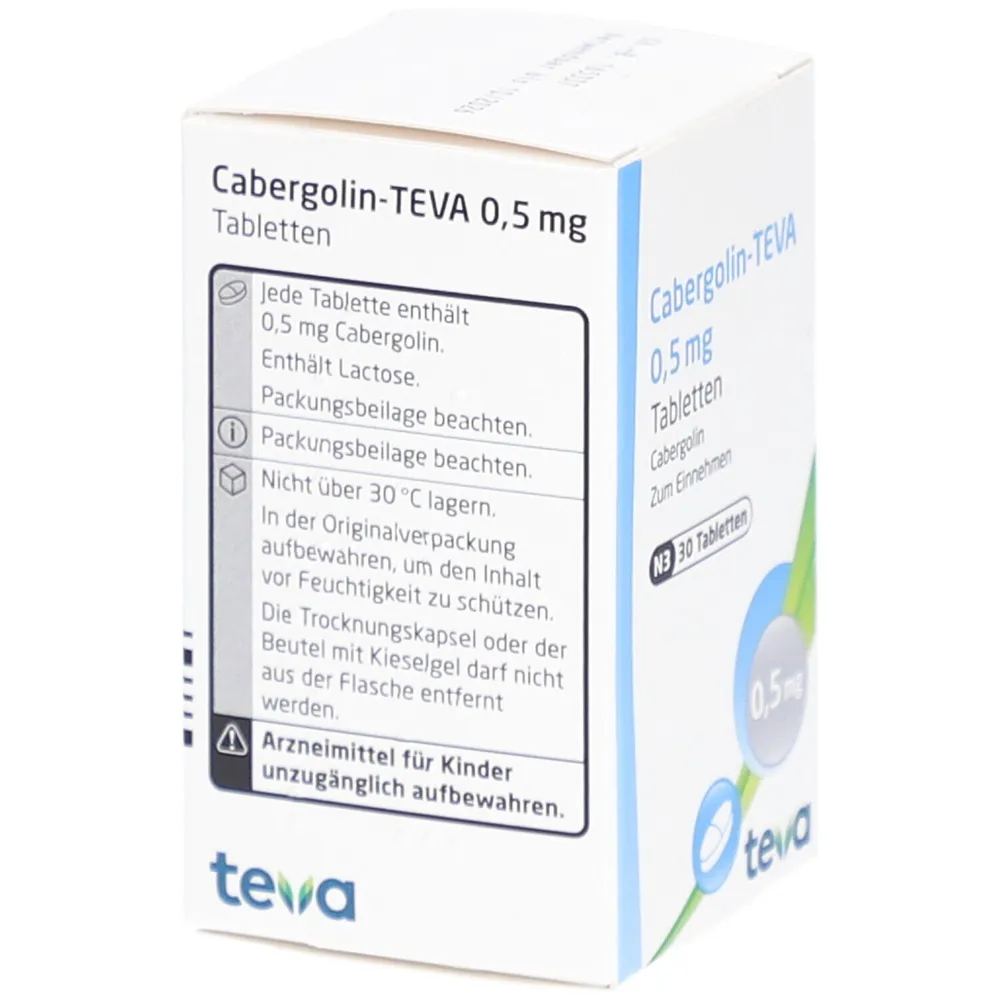
Table of Contents
Package leaflet: Information for the user
Introduction
Package leaflet: information for the user
Cabergoline Teva 0.5 mg tablets EFG
cabergoline
Read the entire leaflet carefully before you start taking this medicine, because it contains important information for you.
- Keep this leaflet, as you may need to read it again.
- If you have any questions, consult your doctor or pharmacist.
- This medicine has been prescribed for you only and must not be given to other people, even if they have the same symptoms as you, because it could harm them.
- If you experience any adverse effects, consult your doctor or pharmacist, even if these are not listed in this leaflet. See section 4.
Contents of the leaflet
- What Cabergoline Teva is and what it is used for
- What you need to know before taking Cabergoline Teva
- How to take Cabergoline Teva
- Possible side effects
- How to store Cabergoline Teva
- Contents of the pack and other information
1. What Cabergoline Teva is and what it is used for
This medicine contains cabergoline, which belongs to a group of medicines called prolactin inhibitors. Prolactin is a hormone produced in the pituitary gland of your brain. Cabergoline lowers the levels of the hormone prolactin.
Cabergoline Teva is used:
- to stop/inhibit lactation (milk production) for medical reasons
- to treat hormonal disorders resulting from high levels of prolactin, such as lack of ovulation or irregular ovulation, infertility, or milk discharge not associated with childbirth.
- to treat high levels of prolactin due to a tumor in the pituitary gland.
- to treat high levels of prolactin of unknown cause
- to treat high levels of prolactin due to the empty sella syndrome
2. What you need to know before taking Cabergoline Teva
Do not take Cabergoline Teva if
- you are allergic to cabergoline or to any other ergoline alkaloid (e.g. bromocriptine), or to any of the other ingredients of this medicine (listed in section 6).
- you have (or have had in the past) psychosis or are at risk of developing psychosis after childbirth.
- you have previously been diagnosed with conditions described as fibrotic reactions (scar tissue) affecting the lungs, the back of the abdomen and kidneys, or the heart.
- you are going to be treated with cabergoline for a long period of time and you have or have had a heart valve disorder identified by echocardiogram.
Warnings and precautions
If you have any of the following health conditions, inform your doctor before taking Cabergoline, as the medicine may not be suitable for you:
- History of severe mental disorder, particularly psychotic disorders
- Impaired liver or kidney function
- Cardiovascular disease
- Stomach ulcer or gastrointestinal bleeding (this condition may cause black stools or vomiting blood)
- Raynaud's disease, in which fingers and toes turn pale blue, become pulseless, cold, numb, and weak when exposed to cold
- Low blood pressure, which may cause dizziness, especially when standing up
- Swelling of hands and feet and high blood pressure during pregnancy (pre-eclampsia, eclampsia)
- High blood pressure after childbirth
- Serious chest illness (e.g. chest pain when breathing, fluid in the lungs, inflammation or infection of the lungs)
- Fibrotic reactions (scar tissue) affecting the heart, lungs, or abdomen. If you are to be treated with Cabergoline Teva for a prolonged period, your doctor will check the condition of your heart, lungs, and kidneys before starting treatment. An echocardiogram (ultrasound of the heart) will also be performed before starting treatment and at regular intervals during treatment. If fibrotic reactions occur, treatment must be discontinued.
Talk to your doctor if you, or your family/caregiver, notice that you are developing urges or cravings to behave in an unusual way and are unable to resist the impulse or temptation to carry out certain activities that could harm you or others. These are called impulse control disorders and may include behaviors such as compulsive gambling, eating, or spending, abnormally increased sex drive, or an increase in sexual thoughts or feelings. Your doctor may adjust or discontinue your dose.
If you have recently given birth, you may be at increased risk of certain conditions. These may include high blood pressure, heart attack, seizures, stroke, or mental health problems. Therefore, your doctor will need to monitor your blood pressure frequently during treatment. Contact your doctor immediately if you experience high blood pressure, chest pain, or unusually severe or persistent headache (with or without vision problems).
The effectiveness of hormonal contraceptives may decrease in women taking cabergoline, and pregnancy may occur before the menstrual cycle has normalized. Therefore, a pregnancy test is recommended at least every 4 weeks until menstruation resumes, and thereafter whenever a menstrual period is delayed by more than 3 days. Adequate contraceptive methods should therefore be used during treatment with cabergoline and for at least one month after stopping treatment (see section "Pregnancy, breastfeeding and fertility").
Children and adolescents
The safety and efficacy of cabergoline have not been established in children and adolescents under 16 years of age.
Taking Cabergoline Teva with other medicines
Tell your doctor or pharmacist if you are taking, have recently taken, or might need to take any other medicines.
Certain medicines used to lower blood pressure, certain medicines (e.g. phenothiazines, butyrophenones, thioxanthenes) used to treat psychological disorders (schizophrenia or psychosis), other ergoline alkaloids, medicines for treating nausea and vomiting (metoclopramide), and macrolide antibiotics (such as erythromycin) may interfere with the effects of cabergoline. Your doctor should be aware of any such concomitant medication.
Pregnancy, breastfeeding and fertility
If you are pregnant or breastfeeding, think you may be pregnant, or are planning to become pregnant, consult your doctor before using this medicine.
Pregnancy
Experience with the use of Cabergoline Teva during pregnancy is limited.
Before starting cabergoline, you must ensure that you are not pregnant. In addition, you must take care not to become pregnant during treatment and for at least one month after stopping treatment with cabergoline.
Effective non-hormonal contraceptive methods should be used. Discuss the choice of contraceptive method with your doctor.
If you are being treated with cabergoline and become pregnant during this time, you should stop treatment and contact your doctor as soon as possible.
Breastfeeding
It is unknown whether cabergoline passes into breast milk. Since Cabergoline Teva will prevent you from producing milk for your baby, you must not take Cabergoline if you plan to breastfeed. If you need to take Cabergoline, you must use an alternative method to feed your baby.
Mothers who are breastfeeding should be aware that milk production may decrease or stop completely.
Fertility
Infertility may be reversed and pregnancy may occur before the menstrual cycle has normalized in women taking cabergoline (see section "Warnings and precautions").
Driving and using machines
Cabergoline Teva may negatively affect reaction ability in some individuals, and this should be taken into account in situations requiring a high level of alertness, e.g. driving vehicles or performing precision work.
Cabergoline may cause somnolence (extreme drowsiness) and sudden onset of sleep.
Therefore, affected individuals must not drive or engage in activities where reduced alertness could pose a high risk of harm (e.g. operating machinery) until such recurrent episodes and somnolence have resolved. If you are affected, consult your doctor.
Cabergoline Teva contains lactose
If your doctor has informed you that you have an intolerance to certain sugars, consult him before taking this medicine.
3. How to take Cabergoline Teva
Follow exactly the instructions given by your doctor for taking this medicine. If in doubt, consult your doctor or pharmacist.
Your doctor will determine the dose and adjust it individually for you.
The tablets may be divided into equal doses.
The tablets should be taken with food to reduce certain adverse effects such as nausea, vomiting, and stomach pain.
- To prevent/inhibit breast milk production (lactation):
You should take 2 tablets (1 mg) as a single dose within 24 hours after giving birth.
- To stop lactation once breastfeeding has already started:
You should take ½ (half) tablet (0.25 mg) every 12 hours for two days.
- To reduce prolactin concentration in the body:
Treatment is usually started with 0.5 mg per week, but higher doses may later be required. Your doctor will evaluate your response to the medicine and adjust your treatment accordingly; they will also inform you about the duration of treatment.
If you take more Cabergoline Teva than you should
If you have taken too many tablets or think that a child has swallowed any, contact your doctor or pharmacist immediately, or call the Toxicology Information Service at telephone number 915 620 420. Symptoms of overdose may include nausea, vomiting, low blood pressure, dizziness, stomach pain, mood changes, confusion, or hallucinations (seeing things that are not real). Take this leaflet and any remaining tablets with you to show your doctor at the nearest hospital.
If you forget to take Cabergoline Teva
If you forget to take a dose on time, take it as soon as you remember. If it is almost time for your next dose, skip the missed dose and take the next dose at the usual time. Do not take a double dose to make up for a forgotten dose.
If you stop taking Cabergoline Teva
Consult your doctor first before stopping or interrupting treatment with cabergoline. If you have been treated for high levels of prolactin, your symptoms will generally return. In some patients, a reduction in prolactin levels has been observed for several months after stopping cabergoline treatment.
If you have any further questions about the use of this medicine, ask your doctor or pharmacist.
4. Possible adverse effects
Like all medicines, this medicine can cause adverse effects, although not everyone gets them.
When used to suppress breast milk production, approximately 14 out of 100 patients will experience some adverse effect. The most common are low blood pressure, dizziness, and headache. In the treatment of elevated prolactin levels, adverse effects are more common because the tablets are taken for a longer period of time. Approximately 70 out of every 100 patients experience adverse effects, but most of these adverse effects disappear or decrease after about 2 weeks.
Serious adverse effects
Very common ( may affect more than 1 in 10 people)
- Heart valve disorders and related disorders, for example, inflammation (pericarditis) or fluid leakage in the pericardium (pericardial effusion). Initial symptoms may include one or more of the following: difficulty breathing, shortness of breath, palpitations, feeling faint, chest or back pain, pelvic pain, or swollen legs. If you experience any of these symptoms, contact a doctor or the nearest hospital emergency department immediately.
Uncommon (may affect up to 1 in 100 people)
- Chest pain, difficulty breathing, cough, and fever due to fluid accumulation in the layers of the membrane lining the lungs and chest cavity (pleural effusion). Contact a doctor or the nearest hospital emergency department immediately.
- Increased difficulty breathing due to scarring tissue formation in the lungs (pulmonary fibrosis). Contact a doctor or the nearest hospital emergency department immediately.
- Development of a widespread rash with itching, difficulty breathing with or without wheezing, feeling faint, unexplained swelling of the body or tongue, or any other symptoms appearing rapidly after taking this medicine and making you feel unwell. These may indicate an allergic reaction. Contact a doctor or the nearest hospital emergency department immediately.
Very rare (may affect up to 1 in 10,000 people)
- Difficulty breathing and cough due to scarring tissue formation in the layers of the membrane lining the lungs and chest cavity (pleural fibrosis). Contact a doctor or the nearest hospital emergency department immediately.
Not known (frequency cannot be estimated from available data)
- Chest pain, possibly radiating to the arm and neck, and difficulty breathing due to inadequate blood supply to the heart muscle. Contact the nearest hospital emergency department immediately.
- Weak breathing, blue lips and nails. Contact the nearest hospital emergency department immediately.
- Mental disorders (aggressive behavior, hallucinations, delusions, psychotic disorder). Contact a doctor.
Very common (may affect more than 1 in 10 people)
- dizziness/vertigo, headache
- nausea, indigestion, stomach pain, inflammation of the stomach wall (gastritis)
- weakness, fatigue
Common (may affect up to 1 in 10 people)
- depression
- somnolence (extreme drowsiness)
- low blood pressure (which may cause dizziness, especially when standing up)
- hot flushes, facial flushing
- vomiting, constipation
- chest pain (mastodynia)
Uncommon (may affect up to 1 in 100 people)
- difficulty breathing. May become serious. Consult your doctor.
- loss of consciousness, fainting. May become serious. With normal heart rate, normal breathing, and rapid recovery. Consult your doctor. In all other cases, call an ambulance.
- swelling due to fluid accumulation in tissues (edema), swelling in feet, ankles, and hands. In some people, serious conditions may occur. Consult your doctor.
- pronounced daytime fatigue and tendency to fall asleep suddenly. May become serious. Consult your doctor.
- increased libido
- temporary partial loss of vision
- tingling/itching sensations in the body
- a strong heartbeat that may be rapid and irregular
- problems with blood vessels in the fingers of the hands and feet (vasospasm)
- nosebleeds
- acne, itching, skin rash, hair loss
- leg cramps
- decrease in hemoglobin values in women whose periods had stopped and then resumed
Rare (may affect up to 1 in 1,000 people)
- pain in the upper middle part of the abdomen
Not known (frequency cannot be estimated from available data)
- tremor
- vision problems
- breathing problems with inadequate oxygen intake, inflammation and pain of the membrane surrounding the lungs (pleuritis), chest pain
- abnormal liver function, abnormal liver function tests
- increased blood levels of a specific enzyme called creatine phosphokinase
You may experience the following adverse effects:
Inability to resist the impulse, urge, or temptation to carry out an action that could be harmful to you or others, which may include:
- Strong urge to gamble excessively despite serious personal or family consequences.
- Altered or increased sexual interest and behavior causing significant concern to you or others, for example, increased sex drive.
- Uncontrollable excessive shopping or spending.
- Overeating (consuming large amounts of food in a short period of time) or compulsive eating (eating more food than normal and more than needed to satisfy hunger).
Inform your doctor if you experience any of these behaviors; they will discuss ways to manage or reduce the symptoms.
Reporting of adverse effects
If you experience any type of adverse effect, talk to your doctor or pharmacist, even if it is a possible adverse effect not listed in this leaflet. You can also report them directly via the Spanish Pharmacovigilance System for Human Medicines, Website: https://www.notificaRAM.es.
By reporting adverse effects, you can help provide more information on the safety of this medicine.
5. Storage of Cabergoline Teva
Keep this medicine out of the sight and reach of children.
Do not use this medicine after the expiry date stated on the packaging after EXP. The expiry date refers to the last day of the month indicated.
Do not store above 30°C. Keep in the original packaging to protect it from moisture. Do not remove the capsule or the silica gel desiccant bag from the bottle.
Any unused tablets of this medicine must be discarded 30 days after first opening the bottle.
Medicines should not be disposed of via wastewater or household waste. Return unused medicines and their containers to your pharmacy's SIGRE collection point. If you are unsure, ask your pharmacist how to dispose of medicines and containers you no longer need. This will help protect the environment.
6. Contents of the pack and other information
Composition of Cabergoline Teva
- The active substance is cabergoline. Each tablet contains 0.5 mg of cabergoline.
- The other components are: lactose, L-leucine and magnesium stearate.
What Cabergoline Teva looks like and contents of the pack
White, smooth, oval-shaped, bevelled tablets. Each tablet is scored on one side and marked with “CBG” on one side of the score and “0.5” on the other side.
Available pack sizes: 2, 8, 14, 15, 16, 20, 28, 30, 32 (2x16), 40 (2x20), 48 (3x16), 50, 60 (3x20), 90 (3x30), 96 (6x16) and 100 (5x20) tablets.
Only certain pack sizes may be marketed.
Marketing Authorization Holder:
Teva Pharma, S.L.U.
C/ Anabel Segura 11, Edificio Albatros B, 1st floor
28108 Alcobendas, Madrid
Spain
Manufacturer:
Teva Czech Industries s.r.o.
Ostravská 29, indication number 305
Opava, Komárov, postal code 747 70
Czech Republic
Or
GALIEN LPS
98 rue Bellocier
89100 Sens
France
Date of the most recent revision of this leaflet: May 2024
Detailed and up-to-date information on this medicinal product is available on the website of the Spanish Agency of Medicines and Medical Devices (AEMPS): http://www.aemps.gob.es/
You can access detailed and up-to-date information about this medicine by scanning with your mobile phone (smartphone) the QR code included in the packaging. You may also access this information at the following internet address: https://cima.aemps.es/cima/dochtml/p/69669/P_69669.html
QR Code + URL