Butylscopolamine Kalceks 20 mg/ml solution for injection EFG
Spain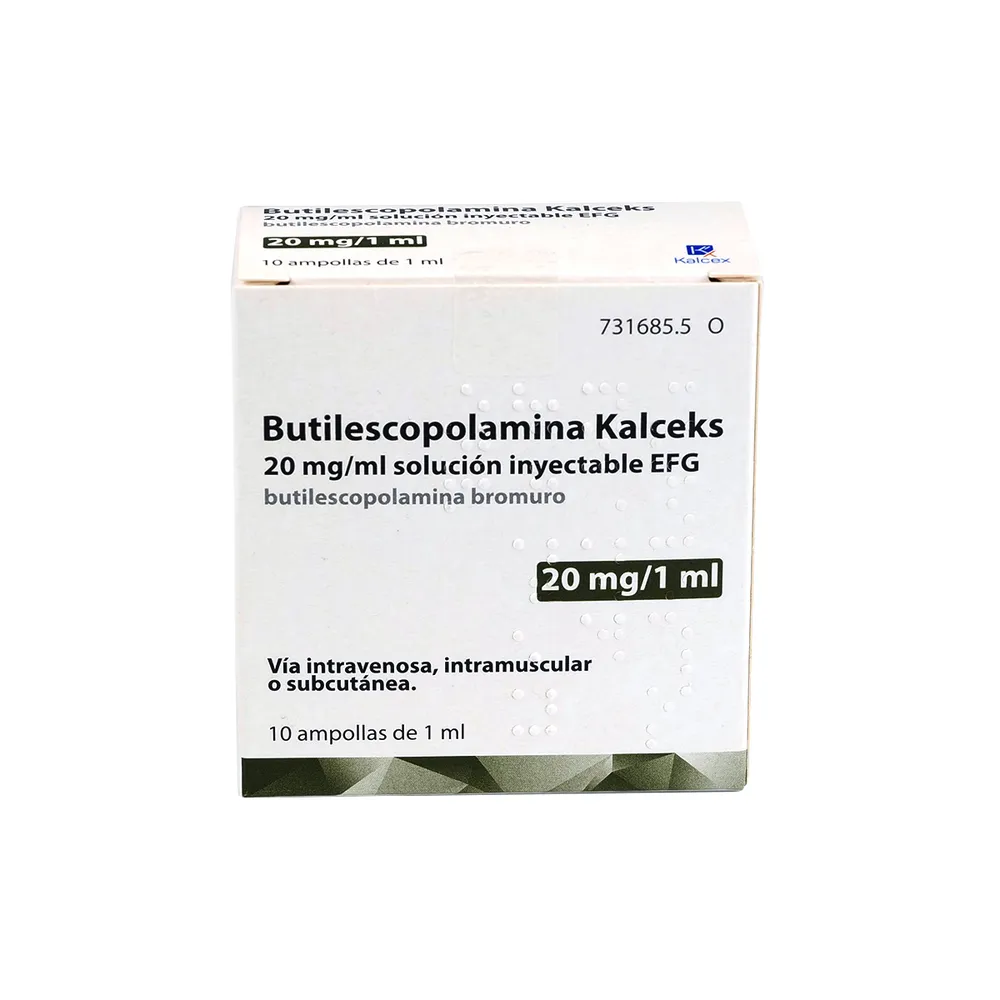
Table of Contents
- Package leaflet: Information for the user
- Introduction
- 1. What Butilescopolamina Kalceks is and what it is used for
- 2. What you need to know before you are given Butilescopolamine Kalceks
- 3. How Butilescopolamine Kalceks is administered
- 4. Possible adverse effects
- 5. Storage of Butilescopolamine Kalceks
- 6. Contents of the pack and other information
Package leaflet: Information for the user
Introduction
Package leaflet: information for the user
Butilescopolamine Kalceks 20mg/ml solution for injection EFG
butylscopolamine bromide
Read the entire leaflet carefully before you start using this medicine, because it contains important information for you.
- Keep this leaflet, as you may need to read it again.
- If you have any questions, consult your doctor, pharmacist or nurse.
- This medicine has been prescribed for you only, and you should not give it to other people, even if they have the same symptoms as you, since it may harm them.
- If you experience any adverse reactions, consult your doctor, pharmacist or nurse, even if they are adverse reactions not listed in this leaflet. See section 4.
Contents of the leaflet
- What Butilescopolamine Kalceks is and what it is used for
- What you need to know before you are given Butilescopolamine Kalceks
- How Butilescopolamine Kalceks is administered
- Possible side effects
- How to store Butilescopolamine Kalceks
- Contents of the pack and other information
1. What Butilescopolamina Kalceks is and what it is used for
Butilescopolamina Kalceks contains the active substance butylscopolamine bromide. It belongs to a group of medicines called antispasmodics. These medicines relieve spasms (cramp-like contractions) in internal organs and alleviate the pain resulting from them.
This medicine is used to relieve spasms in the smooth muscles of the gastrointestinal and genitourinary tracts (stomach, intestines, bile ducts, pancreas, and urinary tract).
Butilescopolamina Kalceks may also be used during medical diagnostic procedures.
2. What you need to know before you are given Butilescopolamine Kalceks
Do not use Butilescopolamine Kalceks
- if you are allergic to butylscopolamine bromide or to any of the other ingredients of this medicine (listed in section 6)
- if you have glaucoma (an eye disease)
- if you have an enlarged prostate and have difficulty or pain when urinating
- if you have intestinal obstruction
- if you have an abnormally enlarged intestine (megacolon)
- if you have an increased heart rate
- if you have a disease called myasthenia gravis (characterized by extreme muscle weakness).
You must not receive any butylscopolamine bromide injection into the muscle if you are taking medicines to prevent blood clots (anticoagulants), as this may cause a bruise (haematoma).
Warnings and precautions
Talk to your doctor, pharmacist or nurse before you are given this medicine:
- if you have abdominal pain of unknown origin that persists or worsens, or appears with symptoms such as fever, nausea, vomiting, changes in bowel movements, abdominal tenderness, low blood pressure, fainting, or blood in the stool
- if your intestine stops functioning properly (intestinal atony)
- if you have inflammation of the oesophagus associated with acid reflux (when stomach acid rises and enters the oesophagus)
- if you have severe inflammation of the colon that frequently recurs (ulcerative colitis)
- if you have liver or kidney problems
- if you have hyperthyroidism (when the thyroid gland produces too many thyroid hormones)
- if you have chronic bronchitis (inflammation of the bronchi).
You must see a doctor immediately if, after receiving butylscopolamine bromide injection, you develop eye pain and redness with loss of vision. This may be a sign of increased pressure inside the eye due to previously undiagnosed and therefore untreated narrow-angle glaucoma.
Allergic reactions have been observed after butylscopolamine bromide injection (see section 4). Therefore, you will be monitored after the injection of butylscopolamine bromide and treated appropriately if such reactions occur.
Other medicines and Butilescopolamine Kalceks
Tell your doctor or pharmacist if you are taking, have recently taken or might need to take any other medicines, even those obtained without a prescription, including herbal medicines.
Especially inform your doctor or pharmacist if you are taking any of the following:
- medicines used to treat depression called tricyclic antidepressants or tetracyclic antidepressants
- medicines used to treat allergies (antihistamines)
- medicines used to treat mental illnesses
- medicines used to treat heart failure or asthma (beta-mimetics)
- medicines used to treat heart rhythm disorders (quinidine or disopyramide)
- amantadine (a medicine used to treat Parkinson's disease)
- medicines used to treat respiratory disorders (such as tiotropium, ipratropium and atropine-like substances)
- metoclopramide (used to treat nausea, vomiting or gastrointestinal disorders).
If you are unsure whether any of the above situations apply to you, speak with your doctor or pharmacist before you are given this medicine.
Pregnancy, breastfeeding and fertility
If you are pregnant or breastfeeding, think you may be pregnant or plan to become pregnant, consult your doctor before you are given this medicine.
Pregnancy
Available data on the use of this product in pregnant or breastfeeding women are limited. Therefore, as a precaution, use of this medicine during pregnancy is not recommended.
During pregnancy, the medicine may only be used under the advice of a doctor who will assess the risk-benefit ratio.
Breastfeeding
During breastfeeding, the medicine may only be used under the advice of a doctor who will assess the risk-benefit ratio.
Driving and using machines
Some people may experience vision disturbances and dizziness after being treated with this medicine. If you experience these effects, do not drive or operate machinery until your vision returns to normal or the dizziness stops.
Butilescopolamine Kalceks contains sodium
This medicine contains less than 23 mg of sodium (1 mmol); this is essentially “sodium-free”.
3. How Butilescopolamine Kalceks is administered
Butilescopolamine Kalceks will be administered by a doctor or nurse as a slow injection into a vein, into a muscle, or under the skin. The dose will be determined by the physician.
This medicine must not be administered continuously on a daily basis or for prolonged periods without investigating the cause of abdominal pain.
Adults and children over 12 years of age
The dose is 20 to 40 mg (1–2 vials), administered several times a day. The maximum daily dose is 100 mg (5 vials).
Use in children
In severe cases in infants and children, the dose is 0.3 to 0.6 mg/kg of body weight, administered several times a day. The maximum daily dose must not exceed 1.5 mg/kg of body weight.
If you have been given an excessive amount of Butilescopolamine Kalceks
If you think you have been given too much, inform your doctor or nurse immediately. In case of overdose or accidental ingestion, consult your doctor or pharmacist immediately, go to a medical center, or call the Toxicology Information Service at 91 562 04 20, indicating the medicine and the amount ingested.
The following symptoms may occur: dry mouth, skin flushing, difficulty urinating, rapid heartbeat, and vision disturbances.
If you miss a dose of Butilescopolamine Kalceks
Do not receive a double dose to make up for the missed dose. You will only receive the next dose if necessary, according to your health status.
If you stop using Butilescopolamine Kalceks
Your doctor will administer an injection only in acute cases. If continued treatment is necessary, your doctor will switch you to butylescopolamine bromide tablets.
If you have any further questions about the use of this medicine, ask your doctor or pharmacist.
4. Possible adverse effects
Like all medicines, this medicine may cause adverse effects, although not everyone experiences them.
Many of the adverse reactions may be associated with the anticholinergic properties of butylscopolamine bromide, which are generally mild and transient.
Adverse reactions have been tabulated using the following frequency convention:
Very common: may affect more than 1 in 10 people
Common: may affect up to 1 in 10 people
Uncommon: may affect up to 1 in 100 people
Rare: may affect up to 1 in 1,000 people
Very rare: may affect up to 1 in 10,000 people
Frequency not known: cannot be estimated from the available data
Immune system disorders
Frequency not known: anaphylactic shock (a severe and sudden allergic reaction, manifested by breathing difficulties, circulatory failure, and swelling, which may be fatal), anaphylactic reactions, breathing difficulties, skin reactions (e.g., urticaria, rash, redness of the skin, itching), other hypersensitivity reactions.
Psychiatric disorders
Frequency not known: confusion in elderly people, excitability, irritability.
Eye disorders
Common: visual accommodation disorders (focusing problems).
Frequency not known: pupil dilation, increased pressure inside the eye, reduced tear secretion.
Cardiac disorders
Common: increased heart rate.
Frequency not known: palpitations.
Vascular disorders
Common: dizziness.
Frequency not known: decreased blood pressure, flushing.
Respiratory disorders
Frequency not known: thickening of bronchial secretions.
Gastrointestinal disorders
Common: dry mouth.
Frequency not known: constipation.
Skin and subcutaneous tissue disorders
Frequency not known: abnormal sweating.
Renal and urinary disorders
Frequency not known: difficulty urinating.
Reporting of adverse effects
If you experience any type of adverse effect, consult your doctor or nurse, even if it is a possible adverse effect not listed in this leaflet. You can also report them directly through the Spanish Pharmacovigilance System for Human Medicines: www.notificaRAM.es. By reporting adverse effects, you can help provide more information on the safety of this medicine.
5. Storage of Butilescopolamine Kalceks
Keep this medicine out of the sight and reach of children.
This medicine does not require any special storage conditions.
Do not use this medicine after the expiry date stated on the carton and on the ampoule after EXP. The expiry date refers to the last day of the month indicated.
Validity period after opening the ampoule: The medicine should be administered immediately.
Validity period after dilution: Chemical and physical in-use stability has been demonstrated for 24 hours at 25°C and 2-8°C.
From a microbiological standpoint, the product should be used immediately, unless the method of opening/subsequent dilution precludes the risk of microbial contamination. If not used immediately, the times and conditions of in-use storage are the responsibility of the user.
Medicines must not be disposed of via wastewater or household waste. Unused containers and medicines should be handed over to the SIGRE collection point at the pharmacy. If in doubt, ask your pharmacist how to dispose of containers and medicines you no longer need. This will help protect the environment.
6. Contents of the pack and other information
Composition of Butilescopolamina Kalceks
- The active substance is butylscopolamine bromide.
Each ampoule (1 ml) contains 20 mg of butylscopolamine bromide.
- The other components are sodium chloride, concentrated hydrochloric acid (for pH adjustment), sodium hydroxide (for pH adjustment), water for injections.
Appearance of Butilescopolamina Kalceks and contents of the pack
Injectable solution (injectable).
Clear, colourless or almost colourless solution, free from visible particles.
Transparent type I glass ampoules of 1 ml.
The ampoules are placed in a PVC tray. The trays are packed in cardboard boxes.
Pack sizes: 5 or 10 ampoules
Only certain pack sizes may be marketed.
Marketing Authorization Holder
AS KALCEKS
Krustpils iela 71E, Riga, LV-1057,
Latvia
Tel.: +371 67083320
E-mail: [email protected]
Manufacturer
Akciju sabiedriba “Kalceks”
Krustpils iela 71E, Riga, LV-1057, Latvia
More information about this medicinal product is available upon request to the local representative of the Marketing Authorization Holder
EVER Pharma Therapeutics Spain SL
c/ Toledo 170
28005 Madrid
Spain
This medicinal product is authorized in the Member States of the European Economic Area under the following names:
Czech Republic Butylskopolaminium bromid Kalceks
Austria Butylscopolaminiumbromid Kalceks 20 mg/ml Injektionslösung
Belgium Scopolamine butylbromide Kalceks 20 mg/ml solution injectable
Scopolamine butylbromide Kalceks 20 mg/ml oplossing voor injectie
Scopolamine butylbromide Kalceks 20 mg/ml Injektionslösung
Bulgaria Scopolamine butylbromide Kalceks 20 ??/?? ??????????? ???????
France SCOPOLAMINE BUTYLBROMURE KALCEKS 20 mg/mL, solution injectable
Italy Scopolamina butilbromuro Kalceks
Latvia Hyoscine butylbromide Kalceks 20 mg/ml škidums injekcijam
Poland Scopolamine butylbromide Kalceks
Portugal Butilescopolamina Kalceks
Norway Skopolaminbutylbromid Kalceks
Slovakia Scopolamine butylbromide Kalceks 20 mg/ml injekcný roztok
Spain Butilescopolamina Kalceks 20 mg/ml solución inyectable EFG
Sweden Hyoscine butylbromide Kalceks
Netherlands Scopolamine butylbromide Kalceks 20 mg/ml oplossing voor injectie
Date of the most recent review of this summary of product characteristics: October 2022.
Detailed information on this medicinal product is available on the website of the Spanish Agency of Medicines and Health Products (AEMPS) (http://www.aemps.gob.es/).
This information is intended for healthcare professionals only:
Method of administration
Intravenous, intramuscular or subcutaneous injection.
Instructions for use, disposal and other handling
For single use only. Any unused solution must be discarded after opening.
The medicine should be inspected visually before use. It should only be used if the solution is clear and free from particles.
It may be used diluted with dextrose or with a 0.9% sodium chloride injectable solution.
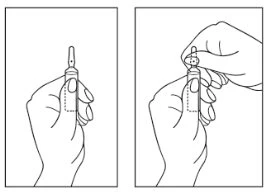
Instructions for opening the ampoule:
- Turn the ampoule with the coloured dot facing upwards. If any solution remains in the upper part of the ampoule, gently tap with the finger to allow all the solution to flow down to the bottom.
- Use both hands to open; while holding the lower part of the ampoule with one hand, break off the top part in the direction opposite to the coloured dot (see images below).
Disposal of unused medicine and of all materials that have been in contact with it must be carried out in accordance with local regulations.