Bupivacaine/adrenaline Physan 2.5 mg/ml + 0.005 mg/ml solution for injection
Spain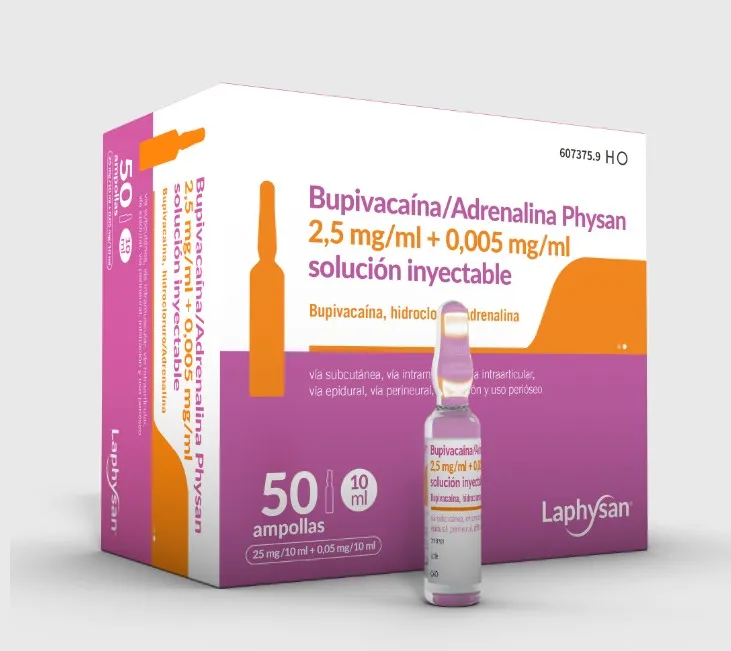
Table of Contents
- Package leaflet: Information for the user
- Introduction
- 1. What Bupivacaine/Adrenaline Physan 2.5 mg/ml + 0.005 mg/ml is and what it is used for
- 2. What you need to know before using Bupivacaine/Adrenaline Physan 5 mg/ml + 0,005 mg/ml
- 3. How to use Bupivacaine/Adrenaline Physan 2.5 mg/ml + 0.005 mg/ml
- 4. Possible adverse effects
- 5. Storage of Bupivacaine/Adrenaline Physan 2.5 mg/ml + 0.005 mg/ml
- Medicines should not be disposed of via sewage systems or in household waste. Ask your pharmacist how to properly dispose of unused medicines and their packaging. This will help protect the environment.
- 6. Contents of the pack and other information
- **This information is intended for doctors or healthcare professionals only**
- **Incompatibilities**
Package leaflet: Information for the user
Introduction
Package leaflet: information for the user
Bupivacaine/Adrenaline Physan 2.5 mg/ml + 0.005 mg/ml injection solution
Bupivacaine hydrochloride / Adrenaline
Read the entire leaflet carefully before you start using this medicine, because it contains important information for you.
- Keep this leaflet, as you may need to read it again.
- If you have any questions, ask your doctor, pharmacist, or nurse.
- This medicine has been prescribed for you only. Do not pass it on to other people, even if they have the same symptoms as you, since it could harm them.
- If you experience any adverse reactions, consult your doctor, pharmacist, or nurse, even if they are adverse reactions not listed in this leaflet. See section 4.
Leaflet contents:
- What Bupivacaine/Adrenaline Physan 2.5 mg/ml + 0.005 mg/ml is and what it is used for
- What you need to know before using Bupivacaine/Adrenaline Physan 2.5 mg/ml + 0.005 mg/ml
- How to use Bupivacaine/Adrenaline Physan 2.5 mg/ml + 0.005 mg/ml
- Possible adverse effects
- How to store Bupivacaine/Adrenaline Physan 2.5 mg/ml + 0.005 mg/ml
- Contents of the pack and other information
1. What Bupivacaine/Adrenaline Physan 2.5 mg/ml + 0.005 mg/ml is and what it is used for
This medicine contains bupivacaine hydrochloride, a local anaesthetic (an agent that reduces or eliminates sensations, affecting a particular region) belonging to the amide subgroup, and adrenaline, a vasoconstrictor agent that narrows blood vessels, reducing blood flow in the area where the doctor injects the needle (local anaesthesia), thereby prolonging the anaesthetic effect at the injection site.
It has been prescribed for you to provide anaesthetic effect.
2. What you need to know before using Bupivacaine/Adrenaline Physan 5 mg/ml + 0,005 mg/ml
Do not use Bupivacaine/Adrenaline Physan 2.5 mg/ml + 0.005 mg/ml:
-
If you are allergic to bupivacaine hydrochloride, adrenaline, or any of the other components of Bupivacaine/Adrenaline Physan 2.5 mg/ml + 0.005 mg/ml (listed in section 6).
-
If you are allergic to any other local anesthetic of the same group (e.g., articaine, mepivacaine, lidocaine, or prilocaine).
-
If used for intravenous regional anesthesia (Bier block), as accidental leakage of bupivacaine into the bloodstream may lead to acute systemic toxic reactions.
-
If you have any of the following conditions, epidural anesthesia should not be performed:
-
Pre-existing central nervous system disease due to infection, tumors, or other causes.
-
Spinal deformity and active spinal disease (e.g., spondylitis, tumor, tuberculosis) or recent spinal injury (e.g., fracture).
-
Skin infection at or near the injection site.
-
Cardiovascular disease, especially cardiac block or hypovolemic shock.
-
Coagulation disorders or ongoing anticoagulant therapy.
Warnings and precautions
Consult your doctor before using Bupivacaine/Adrenaline Physan 2.5 mg/ml + 0.005 mg/ml if:
- You have any type of heart block
- You have heart rhythm disorders
- You have low blood pressure
- You are experiencing bleeding
- You have any type of infection
- You have liver or kidney impairment
- You have severe or untreated hypertension (high blood pressure)
- You have uncontrolled thyroid gland disease
- You have impaired cerebral circulation
- You have advanced diabetes
Children
Bupivacaine should be used with caution in children aged 1 to 12 years, as they have a higher risk of systemic toxicity.
Other medicines and Bupivacaine/Adrenaline Physan 2.5 mg/ml + 0.005 mg/ml
Inform your doctor or pharmacist if you are currently using, have recently used, or might need to use any other medicines, including those obtained without a prescription.
Bupivacaine should be used with caution in patients receiving treatment with agents structurally similar to amide-type local anesthetics, as this may increase the risk of systemic toxic effects.
Inform your doctor if you are taking any of the following medicines, as they may alter the effects of Bupivacaine/Adrenaline Physan 2.5 mg/ml + 0.005 mg/ml:
- Anticoagulants, such as heparin
- Non-steroidal anti-inflammatory drugs (NSAIDs) such as ibuprofen, used to treat inflammation, pain, or fever
- Plasma substitutes (dextran)
- Tricyclic antidepressants
- Ergot-type oxytocics (medications used to induce labor)
- Phenothiazines and butyrophenones used to treat psychotic disorders
- Non-selective beta-blockers such as propranolol, used to treat high blood pressure
- Inhaled general anesthetics, such as halothane
Pregnancy and breastfeeding
If you are pregnant or breastfeeding, think you may be pregnant, or are planning to become pregnant, consult your doctor or pharmacist before using this medicine.
Pregnancy
If you are pregnant, your doctor will prescribe Bupivacaine/Adrenaline Physan 2.5 mg/ml + 0.005 mg/ml only after carefully weighing the potential benefits against the risks to your baby.
Breastfeeding
Bupivacaine is excreted in breast milk, but at therapeutic doses, no effects are expected in breastfed infants. There is insufficient information regarding the excretion of adrenaline in breast milk, but it is unlikely to affect the infant.
Driving and use of machines
Bupivacaine/Adrenaline Physan 2.5 mg/ml + 0.005 mg/ml may temporarily affect your motor ability, attention, and coordination. Your doctor will advise you whether you may drive or operate machinery.
Bupivacaine/Adrenaline Physan 2.5 mg/ml + 0.005 mg/ml contains sodium metabisulfite and sodium
This medicine may cause severe allergic reactions and bronchospasm (sudden sensation of suffocation) because it contains sodium metabisulfite.
This medicine contains 32.8 mg of sodium (a main component of table/cooking salt) per 10 ml vial. This corresponds to 1.64% of the maximum daily sodium intake recommended for an adult.
3. How to use Bupivacaine/Adrenaline Physan 2.5 mg/ml + 0.005 mg/ml
This medicinal product must be administered only under the supervision of a physician experienced in the use of this type of medication.
Bupivacaine/Adrenaline Physan 2.5 mg/ml + 0.005 mg/ml is administered as an injection via infiltration, subcutaneously, intramuscularly, epidurally, intraarticularly, perineurally, and for periosteal use.
The dose, rate of administration, and duration of treatment will vary depending on the anesthetic procedure being performed, the area to be anesthetized, and the patient's weight, clinical condition, and response.
If more Bupivacaine/Adrenaline Physan 2.5 mg/ml + 0.005 mg/ml than recommended is administered
As with other local anesthetics, excessive dosage, rapid absorption, or accidental intravascular injection may lead to signs of toxicity, which may manifest as:
- Effects on the central nervous system:
Tingling, numbness of the tongue, mild dizziness, tinnitus, blurred vision, and muscle tremors. This may be followed by seizures and loss of consciousness, accompanied by respiratory difficulties.
- Effects on the cardiovascular system:
Low blood pressure (hypotension),
slowed heart rate, arrhythmia, and cardiac arrest.
If toxic effects occur, the first step is to stop the administration of the local anesthetic. Subsequent treatment consists of controlling seizures and ensuring adequate respiration with oxygen, using assisted ventilation if necessary. Seizures may be treated with 100–150 mg of thiopental i.v. or 5–10 mg of diazepam i.v. If hypotension occurs, a vasopressor should be administered intravenously, for example, 5–10 mg of ephedrine. If circulatory arrest occurs, immediate cardiopulmonary resuscitation must be initiated, and a dose of 0.1–0.2 mg of adrenaline should be administered intravenously or intracardially as soon as possible. In the event of cardiac arrest, prolonged resuscitation efforts should be undertaken.
In case of overdose or accidental administration, consult your physician or pharmacist immediately or call the Toxicology Information Service at telephone number 91 562 04 20, specifying the medicinal product and the amount administered.
4. Possible adverse effects
Like all medicines, Bupivacaine/Adrenaline Physan 2.5 mg/ml + 0.005 mg/ml may cause adverse effects, although not everyone experiences them.
The adverse effects you may experience can be classified according to their frequency as follows:
- Very common (may affect more than 1 in 10 people): decrease in blood pressure and nausea.
- Common (may affect up to 1 in 10 people): tingling, dizziness, decreased heart rate, increased blood pressure, vomiting, urinary retention.
- Uncommon (may affect up to 1 in 100 people): seizures, tingling around the mouth, numbness of the tongue, increased sensitivity to sound, visual disturbances, loss of consciousness, tremors, mild headache, ringing in the ears, difficulty speaking properly.
- Rare (may affect up to 1 in 1,000 people): allergic reactions, anaphylactic shock, nervous system disturbances, double vision, cardiac arrest, arrhythmias, difficulty breathing.
Reporting of adverse effects
If you experience any type of adverse effect, consult your doctor, even if it is a possible adverse effect not listed in this leaflet. You may also report them directly through the Spanish Pharmacovigilance System for Human Medicines at www.notificaram.es. By reporting adverse effects, you can help provide more information on the safety of this medicine.
5. Storage of Bupivacaine/Adrenaline Physan 2.5 mg/ml + 0.005 mg/ml
Keep this medicine out of the sight and reach of children.
Do not store above 25°C. Do not freeze. Protect from light.
Do not use this medicine after the expiry date stated on the ampoule and on the product carton. The expiry date refers to the last day of the month indicated.
The solutions do not contain preservatives and must be used immediately after opening. Any remaining solution should be discarded.
Medicines should not be disposed of via sewage systems or in household waste. Ask your pharmacist how to properly dispose of unused medicines and their packaging. This will help protect the environment.
6. Contents of the pack and other information
Composition of Bupivacaína/Adrenalina Physan 2.5 mg/ml + 0.005 mg/ml
- The active substances are bupivacaine hydrochloride and epinephrine (adrenaline). One ml contains 5 mg of bupivacaine hydrochloride and 0.005 mg of epinephrine (adrenaline) (as bitartrate). Each 10 ml vial contains 25 mg of bupivacaine hydrochloride and 0.05 mg of epinephrine (adrenaline) (as bitartrate).
- The other components are: sodium chloride, sodium metabisulfite (E-223), sodium hydroxide (E-524) and/or hydrochloric acid (for pH adjustment), and water for injections.
Appearance of the product and contents of the pack
Bupivacaína/Adrenalina Physan 2.5 mg/ml + 0.005 mg/ml is supplied in glass vials.
This medicine is available in clinical packs containing 50 or 100 glass vials of 10 ml.
Only certain pack sizes may be marketed.
Marketing Authorization Holder
LAPHYSAN S.A.U.
Anabel Segura, 11, Building A, 4th Floor, Door D,
28108 Alcobendas
MADRID. SPAIN
Manufacturer
Laboratórios Basi - Indústria Farmacêutica S.A.
Parque Industrial Lourenço Ferreira, Nº8, Nº15 and Nº16.
3450-232 Mortágua, Portugal
This information is intended for doctors or healthcare professionals only
Solutions should be used immediately after opening. Any remaining solution must be discarded.
Due to the instability of adrenaline, products containing it must not be sterilized.
Appropriate precautions should be taken to avoid prolonged contact between anesthetic solutions containing adrenaline (low pH) and metallic surfaces (e.g., needles and metal parts of syringes), as metal ions—primarily copper ions—may dissolve, potentially causing local irritation (swelling, edema) at the injection site and accelerated degradation of adrenaline.
Precautions must be taken to prevent acute toxic reactions by avoiding intravascular injection. Aspiration should be performed before and during administration. When administering high doses, for example in the case of epidural block, it is advisable to perform a test dose with 3–5 mL of bupivacaine with epinephrine. Accidental intravascular injection may be detected by a transient increase in heart rate. The maximum dose should be administered very slowly, at a rate of 25–50 mg/min, or in incremental doses, maintaining constant verbal contact with the patient. If symptoms of toxicity occur, administration must be stopped immediately.
Regional or local anesthesia procedures, except those of a trivial nature, must always be performed by appropriately trained professionals and in areas with immediate access to resuscitation equipment and medications. When performing major blocks, an intravascular catheter should be inserted prior to injection of the local anesthetic. Physicians must receive adequate training according to the procedure they are performing and must be familiar with the diagnosis and treatment of adverse effects, systemic toxicity, and other complications.
In any case, and considering that dosage must be calculated based on several factors, we recommend consulting the information provided in the Summary of Product Characteristics before using this medicinal product.
Incompatibilities
Bupivacaine has limited solubility at pH above 6.5. This should be taken into account when adding alkaline solutions, e.g. carbonates, as precipitation may occur. Since it contains adrenaline, mixing with alkaline solutions leads to rapid degradation of the latter.
Last revision of the summary: October 2020
Detailed and up-to-date information on this medicinal product is available on the website of the Spanish Agency of Medicines and Health Products (AEMPS) http://www.aemps.es/