Bucometasana lozenges for sucking
Spain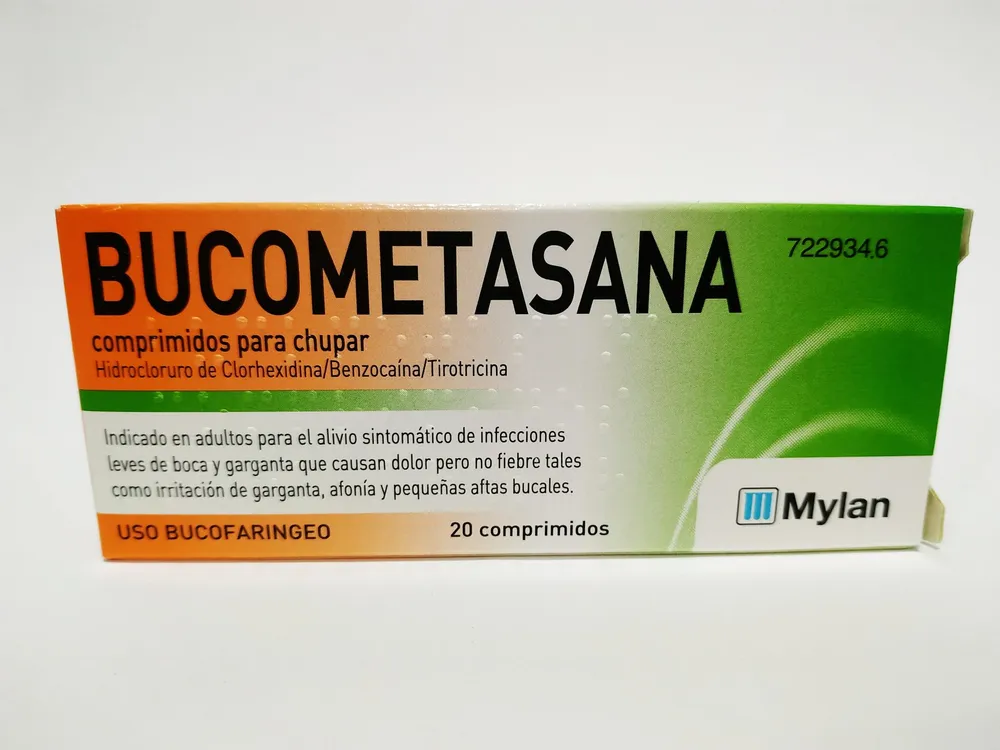
Table of Contents
Package leaflet: Information for the user
Introduction
Package leaflet: information for the user
BUCOMETASANA lozenges for sucking
Chlorhexidine hydrochloride, benzocaine, tyrothricin
Read the entire leaflet carefully before you start taking this medicine, as it contains important information for you.
Follow exactly the instructions for taking this medicine as described in this leaflet or as directed by your doctor, pharmacist, or nurse.
- Keep this leaflet, as you may need to read it again.
- If you need advice or more information, consult your pharmacist.
- If you experience any adverse reactions, consult your doctor, pharmacist, or nurse, even if they are not listed in this leaflet. See section 4.
- You should consult a doctor if your condition worsens or if you do not improve after 2 days.
Contents of the leaflet:
- What Bucometasana is and what it is used for
- What you need to know before taking Bucometasana
- How to take Bucometasana
- Possible side effects
- How to store Bucometasana
- Contents of the pack and other information
1. What Bucometasana is and what it is used for
Bucometasana is a medicine that combines in its formulation the antiseptic action of chlorhexidine and tyrothricin with the local anesthetic action of benzocaine.
While the antiseptics provide disinfection of the oropharyngeal area, the local anesthetic relieves pain.
Bucometasana is indicated in adults for the symptomatic relief of mild mouth and throat infections that cause pain but not fever, such as sore throat, hoarseness, and minor mouth ulcers.
You should consult a doctor if symptoms worsen or do not improve after 2 days.
2. What you need to know before taking Bucometasana
Do not take Bucometasana
- If you are allergic to chlorhexidine, benzocaine, tyrothricin, or any of the other ingredients of this medicine (listed in section 6).
- If you are allergic to other ester-type local anesthetics such as para-aminobenzoic acid, parabens, or paraphenylenediamine (a component of hair dyes).
Warnings and precautions
- Children must not take this medicine due to the dose of benzocaine, as it could lead to methemoglobinemia (abnormally high levels of methemoglobin in the blood).
- People with congenital disorders, including glucose-6-phosphate dehydrogenase deficiency, hemoglobin-M disease, NADH-methemoglobin reductase deficiency, and pyruvate kinase deficiency, have an increased risk of developing methemoglobinemia.
- You must consult your doctor immediately if you experience symptoms and signs of methemoglobinemia, such as headache, dizziness, shallow breathing, nausea, fatigue, or tachycardia.
- If your symptoms worsen, persist for more than 2 days, or if new symptoms such as high fever, headache, nausea, or vomiting appear, you should consult your doctor.
- If you take higher doses or use the medicine more frequently than recommended, there is a possibility of seizures.
- In rare cases, local hypersensitivity or generalized hypersensitivity may occur. If this happens, discontinue treatment immediately.
The use of this medicine may cause discoloration of oral surfaces (teeth, tongue, dental fillings, dentures, and other oral appliances). This staining may become visible within a week of starting treatment. Discoloration of teeth and tongue disappears spontaneously, is not dangerous, and can be removed by oral hygiene measures. However, staining of dental fillings may be permanent.
Consult your doctor or pharmacist before starting to take Bucometasana:
- If you do not tolerate other local anesthetics such as para-aminobenzoic acid (PABA), parabens, or paraphenylenediamine (a component of hair dyes).
- If you have asthma, bronchitis, or emphysema.
- Stop taking the medicine and consult your doctor immediately if you notice: headache, dizziness, shallow breathing, nausea, fatigue, or tachycardia.
- If you are an elderly patient, suffering from an acute phase of any illness, or are debilitated, as you may be more sensitive to the toxicity of benzocaine, and lower concentrations of this medicine may be required.
- If you have a local infection in the treatment area, as changes in pH may reduce the local anesthetic effect.
- If you have severe mucosal trauma, as this increases the absorption of the anesthetic.
- If you suffer from periodontitis, since chlorhexidine may increase supragingival calculus formation. You will need to maintain adequate oral hygiene, using an anti-calculus toothpaste, to reduce tartar buildup and tooth discoloration caused by chlorhexidine.
Interference with diagnostic tests:
If you are scheduled to undergo any diagnostic tests, inform your doctor that you are taking Bucometasana.
Children and adolescents
Children must not take this medicine due to the benzocaine content. They are more sensitive to the systemic toxicity of benzocaine and may develop a blood disorder called methemoglobinemia.
Taking Bucometasana with other medicines
Inform your doctor or pharmacist if you are taking, have recently taken, or might need to take any other medicines.
- Do not use other oropharyngeal antiseptics without consulting your doctor.
This medicine may interfere with:
- Sulfonamides (a type of antibiotic), because benzocaine may reduce the antibacterial activity of sulfonamides.
- Medicines containing hyaluronidase: these should not be used at the same time as benzocaine, as it may increase the adverse effects of benzocaine.
- Medicines containing cholinesterase inhibitors (used in myasthenia gravis and Alzheimer's disease), as they inhibit the metabolism of benzocaine, increasing the risk of systemic toxicity.
- Other local anesthetics.
- Medicines containing proteolytic enzymes such as clostridiopeptidase or combinations thereof, as they may be inhibited by the antiseptic action of tyrothricin.
Taking Bucometasana with food and drink
Do not take this medicine before eating or drinking.
Pregnancy and breastfeeding
If you are pregnant or breastfeeding, think you may be pregnant, or are planning to become pregnant, consult your doctor or pharmacist before taking this medicine.
The use of this medicine during pregnancy or breastfeeding is not recommended, as its safety in these populations has not been established.
Driving and using machines
The effect on driving or operating machinery is negligible or none.
Bucometasana contains aspartame and sorbitol.
This medicine may be harmful to people with phenylketonuria, as it contains aspartame, a source of phenylalanine.
Bucometasana contains sorbitol. If your doctor has diagnosed you with an intolerance to certain sugars, consult with them before taking this medicine.
3. How to take Bucometasana
Follow exactly the instructions for use provided in this leaflet or those given by your doctor or pharmacist. If in doubt, consult your doctor or pharmacist.
Recommended dose:
Adults: 1 tablet every 6–8 hours if necessary. Do not take more than 4 tablets per day.
How to take it
Oropharyngeal use
The tablet should be sucked. Do not break it with your teeth, chew, or swallow it, as its action is local and will only be effective if there is direct contact with the affected area.
Do not take before eating or drinking.
If your condition worsens or symptoms persist for more than 2 days, or if you develop high fever, headache, nausea, or vomiting, consult your doctor as soon as possible.
Use in children and adolescents
This medicine is intended for adults. Children must not take this medicine due to the benzocaine dose. They are more sensitive to the systemic toxicity of benzocaine and may develop a blood disorder called methemoglobinemia.
If you take more Bucometasana than you should
If you have taken more Bucometasana than you should, contact your doctor or pharmacist immediately.
Signs of overdose may include: symptoms resembling alcohol intoxication (slurred speech, drowsiness, unsteady gait), bluish discoloration of the skin, slurred speech, numbness, unsteady gait, blurred or double vision, dizziness, excitement, or seizures, ringing in the ears, and increased sweating. Blood pressure may also decrease.
If high doses are taken or the medicine is used more frequently than recommended, seizures may occur.
In case of overdose or accidental ingestion, go to a medical center, indicating the product and amount ingested, or call the Toxicology Information Service at telephone number 91 562 04 20.
4. Possible adverse effects
Like all medicines, Bucometasana may cause adverse effects, although not everyone will experience them.
The following adverse effects have been reported during the use of medicinal products containing chlorhexidine, tyrothricin and benzocaine, although their frequency cannot be precisely determined:
- Alteration of pigmentation of oral surfaces (teeth, tongue, dental fillings, dentures and other oral appliances); this discoloration may become visible within one week of starting treatment. Discoloration of the teeth and tongue disappears spontaneously, is not dangerous, and can be removed by oral cleaning. However, discoloration of dental fillings may be permanent.
- Increased dental tartar (calculus) formation.
- Burning sensation in the mouth.
- Dehydration of the epithelium, hardening of the mucous membranes, taste disturbances, unpleasant taste, and swallowing difficulties, generally due to prolonged use.
- Methemoglobinemia, primarily due to prolonged use and also in cases of overdose. Individuals with congenital defects including glucose-6-phosphate dehydrogenase deficiency, hemoglobin-M disease, NADH-methemoglobin reductase deficiency, and pyruvate kinase deficiency have an increased risk of developing methemoglobinemia.
- In some cases, urticaria, edema, anaphylactoid reactions (including contact dermatitis), cross-reactions with other ester-type local anesthetics, and photosensitivity have been reported.
- In rare cases, local hypersensitivity or generalized hypersensitivity may occur. In such cases, treatment must be immediately discontinued and medical advice sought.
Reporting of adverse effects
If you experience any type of adverse effect, consult your doctor, pharmacist, or nurse, even if it is a possible adverse effect not listed in this leaflet. You may also report them directly via the Spanish Pharmacovigilance System for Human Medicinal Products: https://www.notificaram.es. By reporting adverse effects, you can help provide more information on the safety of this medicine.
5. Storage of Bucometasana
No special storage conditions are required.
Keep this medicine out of the sight and reach of children.
Do not use Bucometasana after the expiry date stated on the packaging. The expiry date is the last day of the month indicated.
Medicines must not be disposed of via wastewater or household waste. Dispose of unused medicines and their packaging at the SIGRE collection point at your pharmacy. Ask your pharmacist how to properly dispose of medicines and packaging you no longer need. This will help protect the environment.
6. Contents of the pack and other information
Composition of Bucometasana
The active substances are chlorhexidine hydrochloride, benzocaine and tyrothricin.
Each tablet contains 5 mg of chlorhexidine hydrochloride, 15 mg of benzocaine and 1 mg of tyrothricin.
The other components (excipients) are sorbitol (E420), aspartame (E951), colloidal silica, mannitol (E421), magnesium stearate and peppermint flavour.
Appearance of the product and contents of the pack
White, round, peppermint-flavoured lozenges.
Carton packs containing 20 or 30 tablets in blisters of 10 tablets.
Marketing Authorization Holder and Manufacturer
Marketing Authorization Holder:
Cooper Consumer Health B.V.
Verrijn Stuartweg 60,
1112 AX Diemen,
The Netherlands
Manufacturer:
Recipharm Parets, S.L.
Ramón y Cajal, 2
08150 Parets del Vallés (Barcelona)
Further information on this medicinal product is available upon request by contacting the local representative of the Marketing Authorization Holder:
Vemedia Pharma Hispania, S.A.
C/ Aragón, 182, 5th floor
08011 - Barcelona
Spain
Date of the most recent review of this leaflet: May 2016
Detailed and up-to-date information on this medicinal product is available on the website of the Spanish Agency for Medicines and Health Products (AEMPS) http://www.aemps.gob.es/