Buccolam 10 mg oromucosal solution
Spain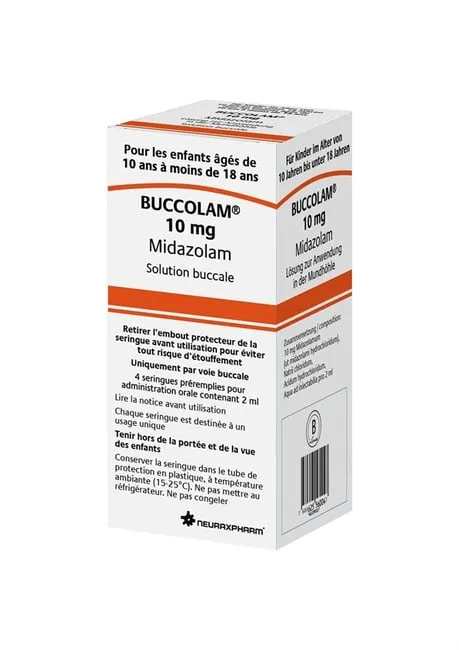
Table of Contents
Package leaflet: Information for the user
Introduction
Package leaflet: information for the user
BUCCOLAM 2.5mg oral solution
For children from 3 months to less than 1 year
BUCCOLAM 5mg oral solution
For children from 1 year to less than 5 years
BUCCOLAM 7.5mg oral solution
For children from 5 years to less than 10 years
BUCCOLAM 10mg oral solution
For children from 10 years to adults
Midazolam
Read the entire leaflet carefully before starting to administer this medicine, as it contains important information for you.
- Keep this leaflet, as you may need to read it again.
- If you have any questions, consult your doctor or pharmacist.
- This medicine has been prescribed for you only, and you should not give it to other people, even if they have the same symptoms as you, because it may harm them.
- If you experience adverse effects, consult your doctor or pharmacist, even if they are adverse effects not listed in this leaflet. See section 4.
Leaflet contents
- What BUCCOLAM is and what it is used for
- What you need to know before administering BUCCOLAM
- How to administer BUCCOLAM
- Possible adverse effects
- How to store BUCCOLAM
- Contents of the pack and other information
1. What BUCCOLAM is and what it is used for
BUCCOLAM contains a medicine called midazolam. Midazolam belongs to a group of medicines known as benzodiazepines.
BUCCOLAM is used to stop sudden prolonged seizures in infants from 3 months of age up to adults.
In infants from 3 months to less than 6 months of age, treatment should be administered only in a hospital setting where the patient can be monitored and resuscitation equipment is available.
This medicine should be used only by parents/caregivers when the patient has been diagnosed with epilepsy.
2. What you need to know before administering BUCCOLAM
Do not administer BUCCOLAM if the patient:
- is allergic to midazolam, to benzodiazepines (such as diazepam), or to any of the other ingredients of this medicine (listed in section 6);
- has a nerve and muscle disorder causing muscle weakness (myasthenia gravis);
- has serious breathing difficulties at rest (BUCCOLAM may worsen breathing difficulties);
- has a condition that causes frequent interruptions in breathing during sleep (sleep apnea syndrome);
- has severe liver problems.
Warnings and precautions
Children:
Consult your doctor or pharmacist before administering BUCCOLAM if the patient:
- has kidney, liver, or heart disease;
- has a lung condition causing periodic breathing difficulties.
Adults:
Consult your doctor or pharmacist before administering BUCCOLAM if:
- you are over 60 years of age;
- you have a chronic illness (such as respiratory failure, or renal, hepatic, or cardiac insufficiency);
- you are debilitated (have an illness causing you to feel very weak, exhausted, and lacking energy).
This medicine may cause patients to forget what happened after it was administered. Patients should be closely observed after administration of this medicine.
This medicine should be avoided in patients with a history of alcoholism or drug addiction.
Potentially life-threatening events are more likely to occur in patients with respiratory difficulties or heart problems, especially when higher doses of BUCCOLAM are administered.
Children under 3 months: BUCCOLAM must not be given to children under 3 months of age due to lack of data in this age group.
Elderly patients:
Elderly patients are more sensitive to the effects of benzodiazepines.
If you have any doubts about whether any of the above apply to the patient, consult your doctor or pharmacist before administering this medicine.
Use of BUCCOLAM with other medicines
Inform your doctor or pharmacist if the patient is taking, has recently taken, or might need to take any other medicines. If you have any questions about any medicine the patient is taking that might affect the use of BUCCOLAM, consult your doctor or pharmacist.
This is extremely important, as using more than one medicine at the same time may increase or reduce the effect of the medicines taken.
The effects of BUCCOLAM may be increased by the following medicines:
- antiepileptic drugs (for treating epilepsy), e.g.: phenytoin;
- antibiotics, e.g.: erythromycin, clarithromycin;
- antifungal medicines, e.g.: ketoconazole, voriconazole, fluconazole, itraconazole, posaconazole;
- medicines for ulcers, e.g.: cimetidine, ranitidine, omeprazole;
- medicines used to treat high blood pressure, e.g.: diltiazem, verapamil;
- some medicines used for HIV and AIDS, e.g.: saquinavir, lopinavir/ritonavir combination;
- narcotic analgesics (strong painkillers), e.g.: fentanyl;
- medicines used to lower blood fat, e.g.: atorvastatin;
- medicines used to treat nausea, e.g.: nabilone;
- hypnotics (medicines to induce sleep);
- sedative antidepressants (medicines for depression that cause drowsiness);
- sedatives (medicines to help relax);
- anesthetics (medicines to relieve pain);
- antihistamines (medicines for treating allergies).
The effects of BUCCOLAM may be reduced by the following medicines:
- rifampicin (used to treat tuberculosis);
- xanthines (used to treat asthma);
- St. John’s wort (a herbal medicine). This should be avoided in patients taking BUCCOLAM.
BUCCOLAM may increase the effect of certain muscle relaxants, e.g.: baclofen (causing increased drowsiness). This medicine may also cause some medicines to become less effective, e.g.: levodopa (a medicine used to treat Parkinson’s disease).
Consult your doctor or pharmacist for further information about medicines the patient should avoid while taking BUCCOLAM.
Use of BUCCOLAM with food and drink
The patient must not drink alcohol while taking BUCCOLAM. Alcohol may increase the sedative effects of this medicine and cause excessive drowsiness.
The patient must not drink grapefruit juice while taking BUCCOLAM. Grapefruit juice may increase the sedative effects of this medicine and cause excessive drowsiness.
Pregnancy
If the patient to receive this medicine is pregnant or breastfeeding, thinks she might be pregnant, or intends to become pregnant, consult your doctor before using this medicine.
Administration of high doses of BUCCOLAM during the last 3 months of pregnancy may cause abnormal fetal heart rate. Infants born after administration of this medicine during delivery may also experience difficulty breastfeeding, breathing problems, and poor muscle tone at birth.
Breast-feeding
Inform the doctor if the patient is breast-feeding. Although small amounts of BUCCOLAM may pass into breast milk, it may not be necessary to discontinue breast-feeding. The doctor will advise whether the patient should breast-feed after receiving this medicine.
Driving and use of machines
BUCCOLAM may make the patient feel drowsy, forgetful, or affect concentration and coordination. This may interfere with tasks requiring skill, such as driving, cycling, or operating machinery.
After receiving this medicine, the patient must not drive, cycle, or operate machinery until fully recovered. Ask your doctor if you need further information.
BUCCOLAM contains sodium
This medicine contains less than 1 mmol of sodium (23 mg) per oral syringe; i.e., essentially “sodium-free”.
3. How to administer BUCCOLAM
Follow exactly the administration instructions for this medicine given by your doctor. If in doubt, consult your doctor or pharmacist again.
Dosage
Your doctor will prescribe the appropriate BUCCOLAM dose for the patient, which normally depends on the patient's age. Each dose has a different color, shown on the box, tube, and syringe containing the medicine.
Depending on age, the patient will receive one of the following age-specific doses in a color-coded container:
3 months to less than 1 year: 2.5 mg – yellow labeled container
1 year to less than 5 years: 5 mg – blue labeled container
5 years to less than 10 years: 7.5 mg – purple labeled container
10 years and adults: 10 mg – orange labeled container
One oral syringe contains one complete dose. Do not administer more than one dose.
Infants from 3 months to less than 6 months should only be treated in a hospital setting where the patient can be monitored and resuscitation equipment is available.
Preparation for administering this medicine
If the patient is having a seizure, allow their body to move freely; do not try to restrain them. Move them only if they are in danger due to proximity to, for example, deep water, fire, or sharp objects.
Support the patient's head on a soft object such as a pillow or on your lap.
Check that the medicine contains the correct dose for the patient, specific to their age.
How to administer this medicine
Ask a doctor, pharmacist, or nurse to show you how to take or administer this medicine. If in doubt, always ask your doctor, pharmacist, or nurse.
Information on how to administer this medicine is also provided on the label of the tube.
BUCCOLAM must not be injected. Do not attach any needle to the syringe.
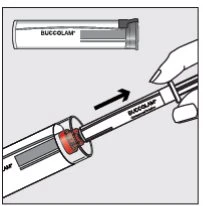
Step 1
| Hold the plastic tube and remove the sealing capsule. Remove the syringe from the tube. |
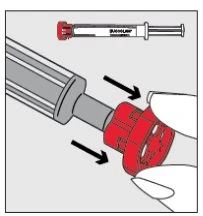
Step 2
| Remove the red cap from the tip of the syringe and dispose of it safely. |
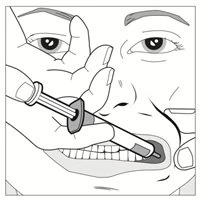
Step 3
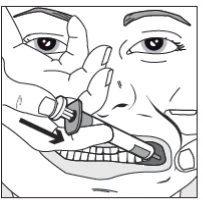
| Using the index finger and thumb, gently pinch and pull back the patient's cheek. Place the tip of the syringe at the back of the space between the inside of the cheek and the lower gum. |
Step 4
| Slowly press the syringe plunger until it stops. The entire solution should be slowly introduced into the space between the gum and the cheek (oral cavity). If directed by your physician (for larger volumes and/or smaller patients), approximately half of the dose may be slowly administered on one side of the mouth, followed by the other half on the opposite side of the patient's mouth. |
When to call an ambulance ALWAYS follow the treatment recommendations provided by the patient's doctor or as instructed by a healthcare professional. If in doubt, seek urgent medical assistance if:
Keep the syringe to show it to the ambulance or medical personnel. Do not administer more medication than prescribed by the patient's doctor. |
If the patient vomits
- Do not administer another dose of BUCCOLAM to the patient.
- If the seizure does not stop within 10 minutes, call an ambulance.
If you have any further questions about the use of this medicine, ask your doctor or pharmacist.
4. Possible adverse effects
Like all medicines, this medicine can cause adverse effects, although not everyone experiences them.
Serious adverse effects
Seek immediate medical attention or call for an ambulance by telephone if the patient experiences any of the following adverse effects:
- Severe breathing difficulty, e.g.: slow or shallow breathing or blue lips. In very rare cases, breathing may stop.
- Myocardial infarction. Signs may include chest pain that may spread to the patient's neck and shoulders and extend to the left arm.
- Swelling of the face, lips, tongue or throat causing difficulty swallowing or breathing, or pale skin, weak and rapid pulse, or feeling of loss of consciousness. The patient may be experiencing a severe allergic reaction.
Other adverse effects
If the patient experiences any adverse effect, consult a doctor, pharmacist or nurse, even if it is a possible adverse effect not listed in this leaflet.
Frequent adverse effects (may affect up to 1 in 10 people):
- Nausea and vomiting
- Drowsiness or reduced level of consciousness
Uncommon adverse effects (may affect up to 1 in 100 people):
- Skin rash, urticaria (hives), itching
Very rare adverse effects (may affect up to 1 in 10,000 people):
- Agitation, restlessness, hostility, anger or aggression, excitement, confusion, euphoria (excessive feeling of happiness or excitement) or hallucinations (seeing and possibly hearing things that are not real)
- Muscle spasms and muscle tremors (uncontrollable shaking of muscles)
- Reduced level of alertness
- Headache
- Dizziness
- Difficulty coordinating muscles
- Seizures (convulsions)
- Transient memory loss. Duration depends on the amount of BUCCOLAM administered.
- Low blood pressure, slow heart rate or redness of the face and neck (rubefaction)
- Laryngospasm (contraction of the vocal cords causing breathing difficulty and noisy breathing)
- Constipation
- Dry mouth
- Fatigue
- Hiccups
Reporting of adverse effects
If you experience any adverse effect, consult your doctor, pharmacist or nurse, even if it is a possible adverse effect not listed in this leaflet.
You may also report them directly through the national reporting system included in Appendix V. By reporting adverse effects, you can help provide more information on the safety of this medicine.
5. Storage of BUCCOLAM
Keep this medicine out of the sight and reach of children.
Do not use this medicine after the expiry date stated on the carton and on the labels of the tube and the oral syringe under EXP. The expiry date refers to the last day of the month indicated.
Do not refrigerate or freeze.
Keep the oral syringe in the protective plastic tube.
Do not use this medicine if the packaging is open or damaged.
Disposal of oral syringes
Medicines should not be disposed of via wastewater or household waste. Ask your pharmacist how to dispose of medicines and packaging that you no longer need. This will help protect the environment.
6. Contents of the pack and other information
Composition of BUCCOLAM
-
The active substance is midazolam.
-
Each 2.5 mg pre-filled oral syringe contains 2.5 mg of midazolam (as hydrochloride) in 0.5 ml of solution.
-
Each 5 mg pre-filled oral syringe contains 5 mg of midazolam (as hydrochloride) in 1 ml of solution.
-
Each 7.5 mg pre-filled oral syringe contains 7.5 mg of midazolam (as hydrochloride) in 1.5 ml of solution.
-
Each 10 mg pre-filled oral syringe contains 10 mg of midazolam (as hydrochloride) in 2 ml of solution.
The other components are sodium chloride, water for injections, hydrochloric acid, and sodium hydroxide (to adjust pH).
Nature of the product and pack contents
3 months to less than 1 year: 2.5 mg – pack with yellow label
1 year to less than 5 years: 5 mg – pack with blue label
5 years to less than 10 years: 7.5 mg – pack with purple label
10 years to adults: 10 mg – pack with orange label
BUCCOLAM oral solution is a colourless to yellowish, clear liquid. It is supplied in an amber-coloured, single-use, pre-filled oral syringe. Each oral syringe is individually packaged in a protective plastic tube.
BUCCOLAM is available in cartons containing 2 or 4 pre-filled oral syringes/tubes (of the same dose).
Only certain pack sizes may be marketed.
Marketing Authorization Holder
Neuraxpharm Pharmaceuticals, S.L.
Avda. Barcelona 69
08970 Sant Joan Despí - Barcelona
Spain
Tel: +34 93 475 96 00
E-mail: [email protected]
Manufacturer
Neuraxpharm Pharmaceuticals, S.L.
Avda. Barcelona 69
08970 Sant Joan Despí
Barcelona – Spain
neuraxpharm Arzneimittel GmbH
Elisabeth-Selbert-Str. 23
40764 Langenfeld
Germany
For further information about this medicinal product, please contact the local representative of the Marketing Authorization Holder:
Belgium/Belgium/Belgium Neuraxpharm Belgium Tel/Tel: +32 (0)2 732 56 95 | Lithuania Neuraxpharm Pharmaceuticals, S.L. Tel: +34 93 475 96 00 |
| Luxembourg/Luxembourg Neuraxpharm France Tel/Tel: +32 474 62 24 24 |
Czech Republic Neuraxpharm Bohemia s.r.o. Tel: +420 739 232 258 | Hungary Neuraxpharm Hungary Kft. Tel.: +3630 464 6834 |
Denmark Neuraxpharm Sweden AB Tlf: +46 (0)8 30 91 41 (Sweden) | Malta Neuraxpharm Pharmaceuticals, S.L. Tel.: +34 93 475 96 00 |
Germany neuraxpharm Arzneimittel GmbH Tel: +49 2173 1060 0 | Netherlands Neuraxpharm Netherlands B.V. Tel.: +31 70 208 5211 |
Estonia Neuraxpharm Pharmaceuticals, S.L. Tel: +34 93 475 96 00 | Norway Neuraxpharm Sweden AB Tlf: +46 (0)8 30 91 41 (Sweden) |
Greece Brain Therapeutics IKE Tel: +302109931458 | Austria Neuraxpharm Austria GmbH Tel.: +43 (0)1 208 07 40 |
Spain Neuraxpharm Spain, S.L.U. Tel: +34 93 475 96 00 | Poland Neuraxpharm Polska Sp. z.o.o. Tel.: +48 783 423 453 |
France Neuraxpharm France Tél: +33 1.53.62.42.90 | Portugal Neuraxpharm Portugal, Unipessoal Lda Tel: +351 910 259 536 |
Croatia Salvus d.o.o. T: +385 49 326 550 Ireland Neuraxpharm Ireland Ltd Tel: +353 (0)1 428 7777 | Romania Direct Pharma Logistics SRL Telefon/Fax: +40 217 961 566 Slovenia Salvus MED d.o.o. T: +386 51 334 197 |
Iceland Neuraxpharm Sweden AB Sími: +46 (0)8 30 91 41 (Sweden) | Slovakia Neuraxpharm Slovakia a.s. Tel: +421 255 425 562 |
Italy Neuraxpharm Italy S.p.A. Tel: +39 0736 980619 | Finland Neuraxpharm Sweden AB Puh/Tel: +46 (0)8 30 91 41 (Sweden) |
Cyprus Brain Therapeutics IKE Tel: +302109931458 | Sweden Neuraxpharm Sweden AB Tel: +46 (0)8 30 91 41 |
Latvia Neuraxpharm Pharmaceuticals, S.L. Tel: +34 93 475 96 00 | United Kingdom (Northern Ireland) Neuraxpharm Ireland Ltd Tel: +353 (0)1 428 7777 |
Date of the most recent review of this leaflet:
Detailed information on this medicine is available on the website of the European Medicines Agency: http://www.ema.europa.eu.