Bretaris Genuair
Spain
Table of Contents
Patient Information Leaflet
Introduction
Patient Information Leaflet
Bretaris Genuair 322 micrograms inhalation powder
aclidinium (aclidinium bromide)
Read the entire leaflet carefully before you start using this medicine, as it contains important information for you.
- Keep this leaflet as you may need to read it again.
- If you have any questions, ask your doctor, pharmacist, or nurse.
- This medicine has been prescribed for you only. Do not give it to others, even if they have the same symptoms as you, because it may harm them.
- If you experience any adverse reactions, consult your doctor, pharmacist, or nurse, even if they are adverse reactions not listed in this leaflet. See section 4.
Leaflet Contents:
- What Bretaris Genuair is and what it is used for
- What you need to know before using Bretaris Genuair
- How to use Bretaris Genuair
- Possible side effects
- How to store Bretaris Genuair
- Contents of the pack and other information
Instructions for use
1. What Bretaris Genuair is and what it is used for
What Bretaris Genuair is
The active substance in Bretaris Genuair is aclidinium bromide, which belongs to a class of medicines called bronchodilators. Bronchodilators relax the airways and help keep the bronchioles open. Bretaris Genuair is a dry powder inhaler that uses your breath to deliver the medicine directly into the lungs. This helps patients with chronic obstructive pulmonary disease (COPD) to breathe more easily.
What Bretaris Genuair is used for
Bretaris Genuair is indicated to help open the airways and relieve symptoms of COPD, a serious, long-term lung disease characterized by difficulty in breathing. Regular use of Bretaris Genuair can help when you experience ongoing breathing difficulties due to the disease, helping to minimize the impact of the disease on your daily life and reduce the number of flare-ups (worsening of COPD symptoms for several days).
2. What you need to know before starting to use Bretaris Genuair
Do not use Bretaris Genuair:
- if you are allergic to aclidinium bromide or to any of the other ingredients of this medicine (listed in section 6).
Warnings and precautions
Consult your doctor, pharmacist, or nurse before starting to use Bretaris Genuair:
- if you have heart problems;
- if you see halos around lights or colored images (glaucoma);
- if you have prostate enlargement, problems with urination, or a bladder obstruction.
Bretaris Genuair is indicated for maintenance treatment and should not be used to treat a sudden attack of breathing difficulty or wheezing. If your COPD symptoms (difficulty breathing, wheezing, or cough) do not improve or worsen, you should consult your doctor as soon as possible.
Dry mouth, which has been observed with medicines like Bretaris Genuair, may be associated with dental caries after prolonged use of the medicine. Therefore, remember to maintain good oral hygiene.
Stop using Bretaris Genuair and seek immediate medical help if:
- you experience chest tightness, cough, wheezing, or difficulty breathing immediately after using this medicine. These may be signs of a condition called bronchospasm.
Children and adolescents
Bretaris Genuair must not be used in children or adolescents under 18 years of age.
Use of Bretaris Genuair with other medicines
Inform your doctor or pharmacist if you are taking, have recently taken, or might need to take any other medicines.
Inform your doctor if you have used or are currently using similar medicines for breathing problems, such as medicines containing tiotropium or ipratropium. If in doubt, consult your doctor or pharmacist. The use of Bretaris Genuair with these medicines is not recommended.
Pregnancy and breastfeeding
If you are pregnant or breastfeeding, think you may be pregnant, or are planning to become pregnant, consult your doctor or pharmacist before using this medicine. You must not use Bretaris Genuair during pregnancy or breastfeeding unless your doctor has advised you to do so.
Driving and using machines
The effect of Bretaris Genuair on the ability to drive and operate machinery is minor. This medicine may cause headache, dizziness, or blurred vision. If you experience any of these adverse reactions, do not drive or operate machinery until your headache resolves, dizziness subsides, and your vision returns to normal.
Bretaris Genuair contains lactose
If your doctor has informed you that you have an intolerance to certain sugars, consult him before taking this medicine.
3. How to use Bretaris Genuair
Follow exactly the instructions for administering this medicine as given by your doctor or pharmacist. If in doubt, consult your doctor or pharmacist.
The recommended dose is one inhalation twice daily, in the morning and in the evening.
The effects of Bretaris Genuair last for 12 hours; therefore, you should try to use the Bretaris Genuair inhaler at the same time every morning and evening. This ensures that there is always enough medicine in your body to help you breathe more easily throughout the day and night. It will also help you remember to take it.
The recommended dose can be used in elderly patients and in patients with kidney or liver problems. Dose adjustment is not necessary.
COPD is a long-term condition; therefore, it is recommended that Bretaris Genuair be used every day, twice daily, and not only when you have difficulty breathing or other COPD symptoms.
Route of administration
This medicine is for inhalation use only.
Refer to the Instructions for Use to learn how to use the Genuair inhaler. If you are unsure about how to use Bretaris Genuair, consult your doctor or pharmacist.
You may use Bretaris at any time, before or after food or drinks.
If you use more Bretaris Genuair than you should
If you think you have used more Bretaris Genuair than you should, consult your doctor or pharmacist.
If you forget to use Bretaris Genuair
If you forget a dose of Bretaris Genuair, inhale the dose as soon as you remember. However, if it is almost time for your next dose, skip the missed dose.
Do not take a double dose to make up for forgotten doses.
If you stop using Bretaris Genuair
This medicine is for long-term treatment. If you wish to stop treatment, consult your doctor first, as your symptoms may worsen.
If you have any further questions about the use of this medicine, ask your doctor, pharmacist, or nurse.
4. Possible adverse effects
Like all medicines, Bretaris Genuair can cause adverse effects, although not everyone experiences them.
Allergic reactions may occur rarely (may affect up to 1 in 1,000 patients). Stop using the medicine and contact your doctor immediately if you experience swelling of the face, throat, lips or tongue (with or without difficulty breathing or swallowing), dizziness or fainting, rapid heartbeat, or severe swelling with itching of the skin (hives), as these may be symptoms of an allergic reaction.
The following adverse effects may occur with the use of Bretaris Genuair:
Frequent: may affect up to 1 in 10 patients
- Headache
- Inflammation of the sinuses (sinusitis)
- Common cold (nasopharyngitis)
- Cough
- Diarrhea
- Nausea
Uncommon: may affect up to 1 in 100 patients
- Dizziness
- Dry mouth
- Inflammation of the mouth (stomatitis)
- Hoarseness (dysphonia)
- Increased heart rate (tachycardia)
- Sensation of the heart beating strongly (palpitations)
- Abnormal or irregular heartbeat (cardiac arrhythmias)
- Difficulty passing urine (urinary retention)
- Blurred vision
- Rash
- Itching of the skin
Reporting of adverse effects
If you experience any type of adverse effect, consult your doctor, pharmacist or nurse, even if it is a possible adverse effect not listed in this leaflet. You can also report them directly through the national reporting system listed in Appendix V. By reporting adverse effects, you can help provide more information on the safety of this medicine.
5. Storage of Bretaris Genuair
Keep this medicine out of the sight and reach of children.
Do not use this medicine after the expiry date stated on the label of the inhaler and the outer packaging, following “EXP”. The expiry date refers to the last day of the month indicated.
Keep the Genuair inhaler inside the pouch until treatment is initiated.
Use within 90 days after opening the pouch.
Do not use Bretaris Genuair if you notice that the packaging is damaged or shows signs of tampering.
Once the last dose has been used, the inhaler should be discarded. Medicines must not be disposed of via wastewater or household waste. Ask your pharmacist how to dispose of medicines you no longer need. This will help protect the environment.
6. Contents of the pack and other information
Composition of Bretaris Genuair
- The active substance is aclidinium bromide. Each delivered dose contains 375 micrograms of aclidinium bromide, equivalent to 322 micrograms of aclidinium.
- The other ingredient is lactose monohydrate (see section 2, “Bretaris Genuair contains lactose”).
Nature and contents of the container
Bretaris Genuair is a white or almost white powder.
The Genuair inhaler device is white in colour with an integrated dose indicator and a green dosing button. The mouthpiece is covered by a removable green protective cap. It is supplied in a plastic pouch.
Pack sizes available:
Pack containing 1 inhaler with 30 doses.
Pack containing 1 inhaler with 60 doses.
Pack containing 3 inhalers with 60 doses each.
Not all pack sizes may be marketed.
Marketing Authorisation Holder
Covis Pharma Europe B.V.
Gustav Mahlerplein 2
1082MA Amsterdam
The Netherlands
Manufacturer
Industrias Farmacéuticas Almirall, S.A.
Ctra. de Martorell 41-61
08740 Sant Andreu de la Barca, Barcelona
Spain
For more information about this medicine, please contact the local representative of the Marketing Authorisation Holder:
Belgium/Belgium/Belgium Covis Pharma Europe B.V. Tel/Tel: 80013067 | Lithuania UAB “BERLIN-CHEMIE MENARINI BALTIC” Tel: +370 52 691 947 |
| Luxembourg/Luxembourg Covis Pharma Europe B.V. Tel/Tel: 80024119 |
Czech Republic Berlin-Chemie/A.Menarini Czech Republic s.r.o. Tel: +420 267 199 333 | Hungary Berlin-Chemie/A. Menarini Kft. Tel.: +36 23501301 |
Denmark Covis Pharma Europe B.V. Tlf: 80711260 | Malta Covis Pharma Europe B.V. Tel: 80065149 |
Germany Berlin-Chemie AG Tel: +49 (0) 30 67070 Covis Pharma Europe B.V. Tel: +49 (0) 3031196978 | Netherlands Covis Pharma Europe B.V. Tel: 08000270008 |
Estonia OÜ Berlin-Chemie Menarini Eesti Tel: +372 667 5001 | Norway Covis Pharma Europe B.V. Tlf: 80031492 |
Greece MENARINI HELLAS AE Tel: +30 210 8316111-13 | Austria
Tel: +43 1 879 95 85-0 |
Spain Menarini Laboratories S.A. Tel: +34-93 462 88 00 | Poland Covis Pharma Europe B.V. Tel.: 0800919353 |
France MENARINI France Tél: +33 (0)1 45 60 77 20 | Portugal
Tel: +351 210 935 500 |
Croatia Berlin-Chemie Menarini Croatia d.o.o. Tel: + 385 1 4821 361 | Romania Berlin-Chemie A.Menarini S.R.L. Tel: +40 21 232 34 32 |
Ireland Covis Pharma Europe B.V. Tel: 1800937485 | Slovenia Berlin-Chemie / A. Menarini Distribution Ljubljana d.o.o. Tel: +386 01 300 2160 |
Iceland Covis Pharma Europe B.V. Sími: 8007279 | Slovakia Berlin-Chemie / A. Menarini Distribution Slovakia s.r.o. Tel: +421 2 544 30 730 |
Italy Laboratori Guidotti S.p.A. Tel: +39- 050 971011 | Finland/Suomi Covis Pharma Europe B.V. Puh/Tel: 0800413687 |
Cyprus Covis Pharma Europe B.V. Tel: 80091079 | Sweden Covis Pharma Europe B.V. Tel: 0200898678 |
Latvia SIA Berlin-Chemie/Menarini Baltic Tel: +371 67103210 | United Kingdom (Northern Ireland) Covis Pharma Europe B.V. Tel: 08004334029 |

Date of the most recent review of this leaflet:
Detailed information on this medicine is available on the European Medicines Agency website: http://www.ema.europa.eu.
Instructions for use
This section contains information on how to use your Genuair inhaler. It is important that you read this information, as Genuair may work differently from inhalers you have used previously. If you have any questions about how to use your inhaler, please ask your doctor, pharmacist, or nurse for assistance.
The instructions for use are divided into the following sections:
- Getting started
- Step 1: Prepare your dose
- Step 2: Inhale your medicine
- Additional information
Disposal of unused medicine and of all materials that have been in contact with it must be carried out in accordance with local regulations.
Getting started:
Read these instructions for use before starting to use the medicine
Become familiar with the parts of your Genuair inhaler
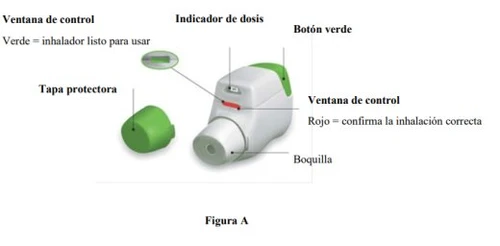
Before use:
- Before first use, open the sealed bag and remove the inhaler. Dispose of the bag and the desiccant.
- Do not press the orange button until you are ready to inhale a dose.
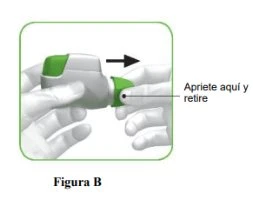
- Remove the cap by gently pressing the arrows on each side (Figure B).
STEP 1: Prepare your dose
-
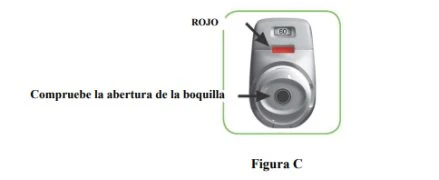
Check the mouthpiece opening and make sure nothing is blocking it (Figure C).
-
Check the control window (it should be red, Figure C).
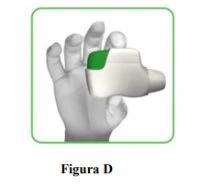
- Hold the inhaler horizontally with the mouthpiece facing towards you and the orange button on top (Figure D).
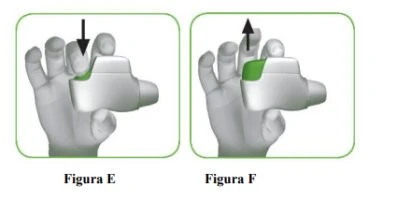
- Press the orange button fully downwards to load your dose (Figure E).
When you press the orange button fully down, the control window will change from red to green.
Make sure the orange button is on top. Do not tilt it. |
- Release the orange button (Figure F).
Make sure to release the button so the inhaler can function properly. |
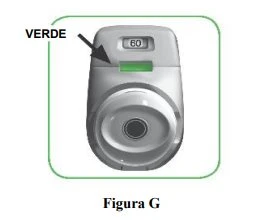
Stop and check:
- Make sure the control window is now green (Figure G).
Your medicine is ready to be inhaled.
Proceed to "STEP 2: Inhale your medicine".
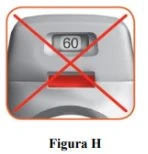
What to do if the control window remains red after pressing the button (Figure H).
The dose is not ready. Go back to “STEP 1 Prepare your dose” and repeat steps 1.1 to 1.6. |
STEP 2: Inhale your medication
Read steps 2.1 to 2.7 completely before use. Do not tilt. |
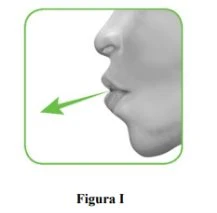
2.1 Keep the inhaler away from the mouth and breathe out fully. Never breathe out into the inhaler (Figure I).
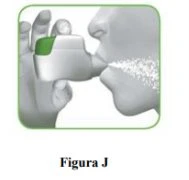
2.2 Keep the head upright, place the mouthpiece between the lips, and close lips firmly around the mouthpiece (Figure J).
Do not hold the orange button down while inhaling. |
2.3 Take a strong, deep breath in through the mouth. Continue inhaling for as long as possible.
A "click" will let you know that you have inhaled correctly. Continue inhaling for as long as possible after hearing the "click". Some patients may not hear the "click". Use the control window to ensure that you have inhaled correctly. |
2.4 Remove the inhaler from your mouth.
2.5 Hold your breath for as long as possible.
2.6 Slowly breathe out away from the inhaler.
Some patients may experience a sandy sensation in the mouth, or a slightly sweet or bitter taste. Do not inhale an extra dose if you do not taste anything or do not feel anything after inhaling. |
Stop and check:
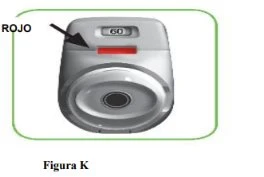
2.7 Make sure the control window is now red (Figure K). This means you have inhaled your medication correctly.
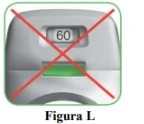
What to do if the control window remains green after inhaling (Figure L).
This means you have not inhaled your medicine correctly. Go back to “STEP 2 Inhale your medicine” and repeat steps 2.1 to 2.7. If the control window still does not turn red, you may have forgotten to release the orange button before inhaling, or you may not have inhaled strongly enough. If this happens, try again. Make sure you have released the orange button and that you have fully exhaled. Then take a strong, deep breath in through the mouthpiece. Please contact your doctor if the control window remains green after several attempts. |
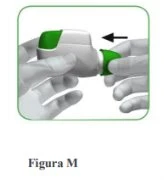
Replace the protective cap on the mouthpiece after each use (Figure M) to prevent contamination of the inhaler with dust or other materials. You must discard your inhaler if you lose the cap.
Additional Information:
What should you do if you accidentally load a dose?
Store your inhaler with the protective cap in place until it is time to inhale your medication, then remove the cap and start again at step 1.6.
How does the dose indicator work?
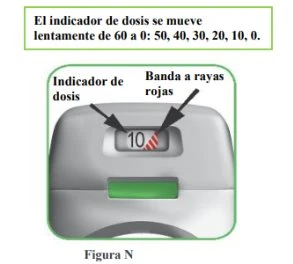
- The dose indicator shows the total number of doses remaining in the inhaler (Figure N).
- At first use, each inhaler contains at least 60 or 30 doses, depending on the package size.
- Each time a dose is loaded by pressing the orange button, the dose indicator moves slightly to the next number (50, 40, 30, 20, 10, or 0).
When should you get a new inhaler?
You should get a new inhaler:
- If your inhaler appears damaged or if you lose the cap, or
- When a red striped band appears in the dose indicator, indicating you are approaching the last dose (Figure N), or
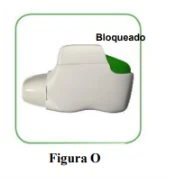
- If your inhaler is empty (Figure O).
How can you tell if your inhaler is empty?
When the orange button does not fully return to its upper position and remains stuck in a middle position, you have reached the last dose (Figure O). Even when the orange button is stuck, you may still inhale the final dose. After that, the inhaler can no longer be used and you must start using a new inhaler.
How should you clean the inhaler?
NEVER use water to clean the inhaler, as this could damage your medication.
If you wish to clean your inhaler, simply wipe the outside of the mouthpiece with a dry cloth or paper towel.