Bisoprolol Teva 2.5 mg tablets EFG
Spain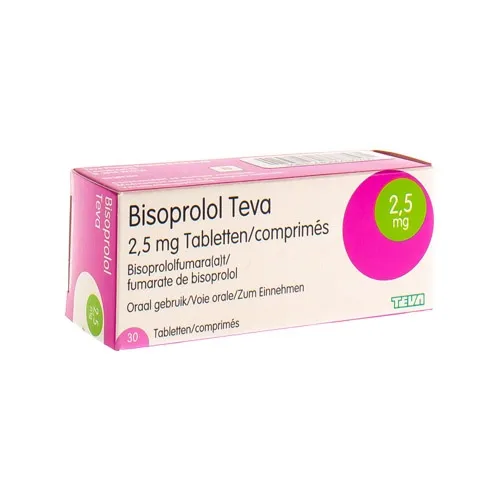
Table of Contents
Package leaflet: Information for the user
Introduction
Package leaflet: information for the user
Bisoprolol Teva 2.5 mg tablets EFG
bisoprolol fumarate
Read the entire leaflet carefully before you start taking this medicine, because it contains important information for you.
|
Package leaflet contents
- What Bisoprolol Teva is and what it is used for
- What you need to know before taking Bisoprolol Teva
- How to take Bisoprolol Teva
- Possible side effects
- Storage of Bisoprolol Teva
- Package contents and additional information
1. What Bisoprolol Teva is and what it is used for
Bisoprolol Teva contains the active substance bisoprolol fumarate. Bisoprolol belongs to a group of medicines called beta-blockers. Bisoprolol prevents irregular heartbeats (arrhythmia) during stress and reduces the workload of the cardiovascular system. Bisoprolol also dilates blood vessels and therefore improves blood flow.
Bisoprolol is used to:
- Treat high blood pressure (hypertension).
- Treat coronary artery disease and chest pain (angina pectoris) caused by insufficient oxygen supply to the heart muscle.
- Treat heart failure in combination with other medicines. Heart failure is the inability of the heart to pump enough blood to meet the body's needs, leading to swelling (edema) of the limbs and difficulty breathing.
2. What you need to know before taking Bisoprolol Teva
Do not take Bisoprolol Teva
- if you are allergic to bisoprolol or any of the other ingredients of this medicine (listed in section 6),
- if you have heart failure that has just occurred or has recently worsened, or if you are receiving treatment for circulatory shock due to acute heart failure via intravenous infusion to help your heart work,
- if you have very low blood pressure or a slow heart rate due to severe heart dysfunction (also called cardiogenic shock),
- if you have heart rhythm disorders such as sinus node dysfunction, sinoatrial block, or second- or third-degree atrioventricular block,
- if you have a slow heart rate,
- if you have very low blood pressure,
- if you have an untreated tumor that can increase blood pressure (also called pheochromocytoma),
- if you suffer from severe forms of asthma,
- if you have severe blood circulation problems in the limbs, such as intermittent claudication (easily provoked leg pain when walking) or Raynaud's syndrome (whitish, bluish, and finally reddish discoloration in fingers or toes associated with pain),
- if you have metabolic acidosis, which is an acid-base imbalance as seen in diabetic patients when blood glucose levels become too high.
Warnings and precautions
Tell your doctor or pharmacist before taking this medicine, as special precautions may be needed (for example, additional treatment or more frequent monitoring):
- if you have asymptomatic and well-controlled heart failure,
- kidney or liver problems,
- if you have heart valve problems or a congenital heart condition,
- if you have had a heart attack within the last three months,
- if you have chronic obstructive pulmonary disease or less severe asthma (if you use bronchodilators, dose adjustments may be needed and your lung function may need to be monitored),
- if you are undergoing surgery or another procedure under sedation or spinal anesthesia (you must inform the anesthetist that you are taking bisoprolol),
- if you have diabetes mellitus and your blood glucose levels fluctuate widely, bisoprolol may mask symptoms of hypoglycemia and slow the recovery of blood glucose levels,
- if you are following a strict diet,
- if you have overactive thyroid gland (hyperthyroidism), bisoprolol may mask symptoms of hyperthyroidism,
- if you are receiving desensitization treatment, bisoprolol may intensify allergic reactions and more medication may be needed to treat the allergic reaction,
- if you have a mild heart conduction disorder (first-degree atrioventricular block),
- if you have chest pain caused by spasms of the coronary arteries (also called Prinzmetal's angina),
- if you wear contact lenses (bisoprolol may reduce tear secretion and cause dry eyes),
- history of scaly skin rash (psoriasis).
If you have chronic lung disease or less severe asthma, inform your doctor immediately if you start experiencing breathing difficulties, cough, wheezing after exercise, etc., while taking bisoprolol.
Children and adolescents
This medicine is not recommended for use in children or adolescents.
Other medicines and Bisoprolol Teva
Tell your doctor or pharmacist if you are taking, have recently taken, or might need to take any other medicines.
Do not take the following medicines with Bisoprolol Teva without special advice from your doctor:
- Quinidine, disopyramide, lidocaine, phenytoin; flecainide, propafenone (used to treat irregular or abnormal heartbeat)
- Verapamil, diltiazem (used to treat irregular heartbeat and blood pressure)
- Clonidine, methyldopa, guanfacine, moxonidine, and rilmenidine (to treat blood pressure and certain neurological conditions)
However, do not stop taking these medicines without first consulting your doctor.
Consult your doctor before taking the following medicines with Bisoprolol Teva; your doctor may need to monitor your condition more frequently:
- nifedipine, felodipine, and amlodipine (used to treat high blood pressure, angina, or abnormal heartbeat),
- amiodarone (used to treat irregular or abnormal heartbeat),
- beta-blockers, including beta-blockers contained in eye drops such as timolol for glaucoma treatment,
- digitalis, used to treat heart failure,
- donepezil or tacrine (for treating dementia),
- neostigmine or pyridostigmine (for treating myasthenia gravis, a disease causing muscle weakness),
- physostigmine for treating elevated intraocular pressure, glaucoma,
- ergot alkaloids (used to treat migraine or high blood pressure),
- other antihypertensive drugs,
- other drugs that may lower blood pressure such as tricyclic antidepressants (e.g., imipramine or amitriptyline), phenothiazines (e.g., levomepromazine (for treating psychosis)) or barbiturates such as phenobarbital (for treating epilepsy),
- adrenaline (epinephrine) for treating allergic reactions,
- baclofen and tizanidine (muscle relaxants),
- amifostine (a protective agent during certain cancer treatments),
- mefloquine (for treating malaria),
- rifampicin (an antibiotic),
- insulins and other preparations for treating diabetes mellitus,
- anesthetic agents (used during surgery),
- oral or intravenous cortisone,
- monoamine oxidase inhibitors (MAOIs), except MAO-B inhibitors, such as moclobemide or phenelzine (for depression).
Non-steroidal anti-inflammatory drugs such as acetylsalicylic acid, diclofenac, ibuprofen, ketoprofen, naproxen, celecoxib, or etoricoxib (especially if used long-term or regularly) may reduce the effectiveness of bisoprolol in treating hypertension. However, low daily doses of acetylsalicylic acid, for example 100 mg, can be safely used concomitantly with bisoprolol to prevent blood clots.
Pregnancy and breastfeeding
If you are pregnant or breastfeeding, think you may be pregnant, or plan to become pregnant, consult your doctor or pharmacist before using this medicine.
Bisoprolol should not be used during pregnancy unless clearly necessary. If you are pregnant or planning to become pregnant while being treated with bisoprolol, inform your doctor so they can advise you on appropriate treatment.
It is unknown whether bisoprolol is excreted in breast milk. Therefore, breastfeeding is not recommended during treatment with this medicine.
Driving and using machines
Bisoprolol has minimal or no impact on the ability to drive. Adverse effects related to low blood pressure may include dizziness, headache, fatigue, or other adverse effects (see section 4) that could impair your ability to drive or operate machinery. If you experience these adverse effects, do not drive or operate machinery requiring full attention. Particular caution is required at the beginning of treatment and after dose increases. Bisoprolol generally does not affect driving ability if the treatment is well balanced.
Bisoprolol Teva contains sodium
This medicine contains less than 1 mmol of sodium (23 mg) per tablet; this is essentially “sodium-free”.
3. How to take Bisoprolol Teva
Follow exactly the instructions given by your doctor for taking this medicine. If you are unsure, consult your doctor or pharmacist again.
Recommended dose
Adults:
For treating hypertension and angina pectoris
- The starting dose is 5 mg once daily.
- Your doctor may increase the dose in small increments (usually every few weeks) to 10 mg or up to a maximum of 20 mg if necessary.
For treating chronic stable heart failure
Treatment with bisoprolol should be initiated at a low dose and gradually increased. Your doctor will decide how to increase the dose, which is usually done as follows:
- 1.25 mg of bisoprolol once daily for one week.
- 2.5 mg of bisoprolol once daily for one week.
- 3.75 mg of bisoprolol once daily for one week.
- 5 mg of bisoprolol once daily for four weeks.
- 7.5 mg of bisoprolol once daily for four weeks.
- 10 mg of bisoprolol once daily as maintenance therapy (ongoing treatment).
The maximum recommended daily dose is 10 mg of bisoprolol.
Depending on how well you tolerate the medicine, your doctor may decide to extend the time between dose increases. If your condition worsens or you no longer tolerate the medicine, it may be necessary to reduce the dose again or discontinue treatment. In some patients, a maintenance dose lower than 10 mg of bisoprolol may be sufficient. Your doctor will advise you accordingly. Normally, if treatment needs to be completely discontinued, your doctor will advise you to gradually reduce the dose, as otherwise your condition may worsen.
Elderly patients
Dose adjustment is not necessary in elderly patients unless they have renal or hepatic impairment—see below.
Patients with renal or hepatic impairment
The dose should be increased gradually and cautiously in patients with severe liver or kidney problems. The dose must not exceed 10 mg once daily in patients with severe renal or hepatic impairment.
Method of administration
Swallow the tablets with sufficient liquid (e.g., a glass of water), usually once daily in the morning. The tablets should not be chewed. Food does not affect the absorption of the medicine.
The tablet may be divided into equal doses. Divide the tablets as follows: place the tablets with the break line facing upwards on a flat, hard surface (e.g., a table) and press with the index fingers of both hands on the outer sides of the tablet, one on each side of the break line, towards the surface.
If you take more Bisoprolol Teva than you should
If you have taken an overdose of Bisoprolol Teva, contact your doctor or go to a hospital immediately.
In case of nausea or dizziness, lie the patient down and seek medical assistance. An unconscious patient should be placed in the recovery position, but the legs may be elevated.
In case of overdose or accidental ingestion, contact the Toxicology Information Service. Telephone 91 562 04 20, indicating the medicine and the amount taken. It is recommended to bring the medicine packaging and patient information leaflet to the healthcare professional.
If you forget to take Bisoprolol Teva
Take the next tablet at your usual time. Do not take a double or higher dose to make up for forgotten doses.
If you stop taking Bisoprolol Teva
Treatment must not be stopped abruptly, especially if the patient has ischemic heart disease. The dose should be gradually reduced, for example over 1–2 weeks. Otherwise, symptoms of heart disease may worsen.
If you have any further questions about the use of this medicine, ask your doctor or pharmacist.
4. Possible adverse effects
Like all medicines, this medicine may cause adverse effects, although not everyone will experience them.
To prevent serious reactions, speak to a doctor immediately if an adverse effect is severe, occurs suddenly, or worsens rapidly.
The most serious adverse effects are related to heart function. Among these, the most common have been slowing of the heartbeat, excessive lowering of blood pressure, dizziness, and fatigue.
Other adverse effects, listed below according to their possible frequency of occurrence:
Very common (may affect more than 1 in 10 people)
- Slowing of the heartbeat (in patients with heart failure)
Common (may affect up to 1 in 10 people)
- Dizziness, headache
- Worsening of heart failure symptoms (in patients with pre-existing heart failure)
- Cold sensation or numbness in the extremities
- Blood pressure too low (in patients with heart failure)
- Stomach or intestinal problems such as nausea, vomiting, diarrhoea or constipation
- Asthenia (in patients with heart failure), fatigue
Uncommon (may affect up to 1 in 100 people)
- Depression, sleep disturbances
- Heart block (disorders of the heart's electrical conduction)
- Excessive slowing of heart rate (in patients with hypertension or coronary heart disease)
- Bronchospasm (wheezing in patients with asthma or chronic obstructive pulmonary disease)
- Muscle weakness, muscle cramps
- Asthenia (in patients with hypertension or angina pectoris)
- Low blood pressure when standing (orthostatic hypotension)
Rare (may affect up to 1 in 1,000 people)
- Nightmares, hallucinations
- Fainting (syncope)
- Reduced tear production (take into account if wearing contact lenses)
- Hearing disturbances
- Hepatitis (causing upper abdominal pain)
- Hypersensitivity reactions, such as itching, flushing or rash. You must contact your doctor immediately if you experience more severe allergic reactions, which may include swelling of the face, neck, tongue, mouth or throat, or difficulty breathing.
- Sexual dysfunction
- Elevated liver enzyme levels (laboratory tests (ALAT or ASAT))
- Allergic rhinitis (runny nose, nasal congestion and itching)
Very rare (may affect up to 1 in 10,000 people):
- Conjunctivitis (inflammation of the eyes)
- Hair loss (alopecia), worsening of psoriasis or psoriasis with rash
Reporting of adverse effects
If you experience any type of adverse effect, consult your doctor or pharmacist, even if they are adverse effects not listed in this leaflet. You may also report them directly through the Spanish Pharmacovigilance System for Human Medicinal Products: https://www.notificaram.es. By reporting adverse effects, you can help provide more information on the safety of this medicine.
5. Storage of Bisoprolol Teva
Keep this medicine out of the sight and reach of children.
This medicine does not require any special storage conditions.
Do not use this medicine after the expiry date stated on the packaging and on the blister after "EXP". The expiry date refers to the last day of the month indicated.
This medicine does not require any special storage conditions.
Medicines must not be disposed of via wastewater or household waste. Dispose of empty containers and unused medicines at the SIGRE collection point at your pharmacy. If you have any doubts, ask your pharmacist how to dispose of containers and unused medicines. This will help protect the environment.
6. Storage and Additional Information
Composition of Bisoprolol Teva 2.5 mg Tablets
The active substance is bisoprolol fumarate.
Each Bisoprolol Teva 2.5 mg tablet contains 2.5 mg of bisoprolol fumarate.
The other components are: microcrystalline cellulose (E 460), colloidal anhydrous silica, sodium croscarmellose, sodium starch glycolate type A (derived from potato), and magnesium stearate (E 572).
Appearance of the medicinal product and content of the container
Bisoprolol Teva 2.5 mg tablets are white to off-white, round, biconvex tablets with a break line on one side.
Pack sizes contain 20, 21, 28, 30, 50, 56, 60, 90 or 100 tablets.
Not all pack sizes may be marketed.
Marketing Authorization Holder and Manufacturer
Marketing Authorization Holder
Teva Pharma, S.L.U.
C/ Anabel Segura 11, Edificio Albatros B, 1st floor
28108 Alcobendas, Madrid, Spain
Manufacturer:
Merckle GmbH
Ludwig-Merckle-Straße 3
89143 Blaubeuren, Germany
This medicinal product is authorized in the European Economic Area (EEA) Member States and in the United Kingdom (Northern Ireland) under the following names:
Germany: Bisoprolol AbZ 2.5 mg Tabletten
Belgium: Bisoprolol Teva 2.5 mg tabletten
Spain: Bisoprolol Teva 2.5 mg comprimidos EFG
Netherlands: Bisoprololfumaraat 2.5 mg Teva, tabletten
Italy: Bisoprololo Doc 2.5 mg compressa
Sweden: Bisoprolol Teva 2.5 mg tabletter
United Kingdom (Northern Ireland): Bisoprolol Fumarate 2.5 mg tablets
Date of latest revision of this leaflet: May 2024
Detailed and up-to-date information on this medicinal product is available on the website of the Spanish Agency of Medicines and Health Products (AEMPS) http://www.aemps.gob.es/