Biphozyl solution for hemodialysis/hemofiltration
Spain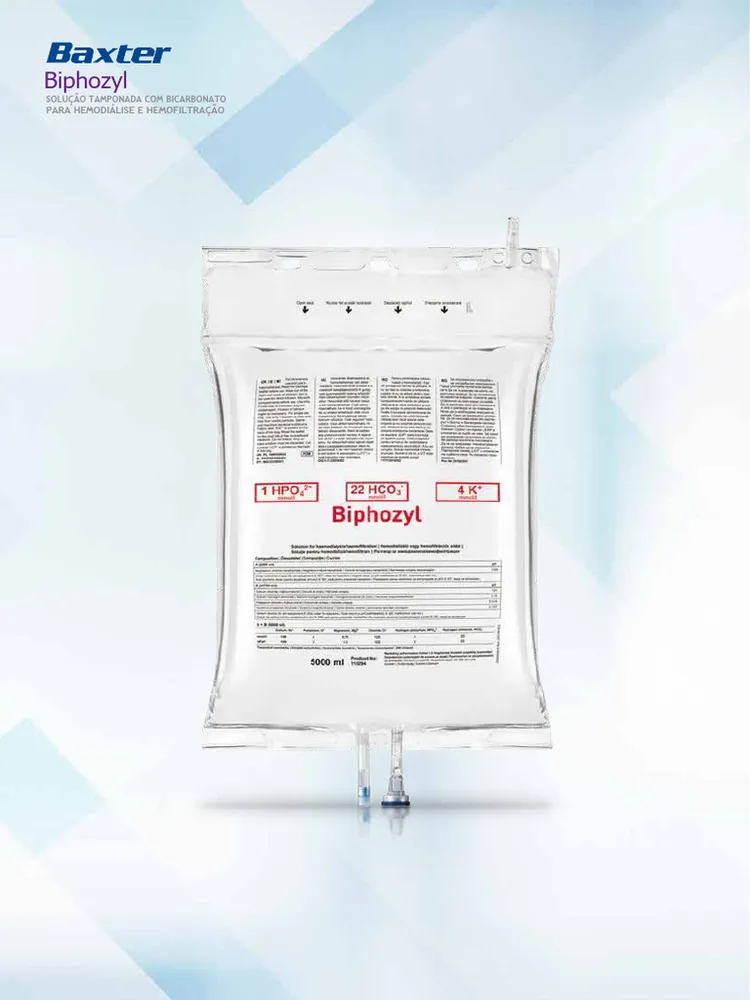
Table of Contents
Package leaflet: Information for the user
Introduction
Package leaflet: information for the user
Biphozyl solution for haemodialysis/haemofiltration
Magnesium chloride (hexahydrate), sodium chloride, sodium bicarbonate, potassium chloride, disodium hydrogenphosphate (dihydrate)
Read the entire leaflet carefully before you start using this medicine, because it contains important information for you.
- Keep this leaflet, as you may need to read it again.
- If you have any questions, ask your doctor, pharmacist or nurse.
- If you experience any adverse effects, consult your doctor, pharmacist or nurse, even if they are possible adverse effects not listed in this leaflet. See section 4.
Contents of the leaflet
- What Biphozyl is and what it is used for
- What you need to know before using Biphozyl
- How to use Biphozyl
- Possible adverse effects
- How to store Biphozyl
- Contents of the pack and other information
1. What Biphozyl is and what it is used for
This medicinal product is a solution for dialysis treatment (hemofiltration, hemodialysis, and hemodiafiltration), used to remove waste products from the blood when the kidneys are not functioning. This medicine is used in hospitals during intensive care treatment with continuous renal replacement therapy (CRRT). Specifically, this medicine is used to treat critically ill patients with acute kidney injury who have:
- normal blood potassium levels (normal potassium concentration)
- normal blood pH
- normal blood phosphate levels (normal phosphatemia)
- high blood calcium levels (hypercalcemia)
This medicine may also be used:
- when alternative sources of bicarbonate are available or when the extracorporeal circuit is anticoagulated with citrate
in cases of intoxication with dialyzable or filterable substances.
2. What you need to know before using Biphozyl
Do not use Biphozyl if:
- You are allergic to any of the active substances or to any of the other components of this medicine (listed in section 6)
- Low calcium levels in the blood (hypocalcemia)
- High potassium levels in the blood (hyperkalemia)
- High phosphate levels in the blood (hyperphosphatemia)
Warnings and precautions
Warnings
Consult your doctor, pharmacist, or nurse before starting to use Biphozyl.
Biphozyl must not be used in patients with elevated potassium levels in the blood. Your blood potassium concentration will be monitored regularly before and during treatment.
Biphozyl contains potassium and may therefore cause high potassium levels in the blood after starting treatment. In such a case, your doctor will reduce the infusion rate and ensure that the desired potassium concentration is achieved. If this condition does not resolve, your doctor will have to discontinue administration immediately. A potassium-free solution may be used temporarily to restore your blood potassium level.
Biphozyl contains phosphate and may therefore cause high phosphate levels in the blood after starting treatment. In such a case, your doctor will reduce the infusion rate and ensure that the desired phosphate concentration is achieved. If this condition does not resolve, your doctor will have to discontinue administration immediately.
Biphozyl does not contain glucose and may therefore cause a decrease in blood glucose levels during treatment. Blood glucose levels will be monitored regularly. If blood glucose drops, your doctor may use a glucose-containing solution. Other corrective measures may be necessary to maintain the desired blood glucose concentration.
Your doctor must periodically monitor electrolytes and acid-base parameters in the blood of patients treated with Biphozyl. Biphozyl contains bicarbonate, a weak acid that may affect your acid-base balance. If a reduction in plasma bicarbonate occurs or worsens during treatment with Biphozyl, your doctor will reduce the infusion rate. If this condition does not resolve, your doctor will have to discontinue administration immediately.
The instructions for use must be strictly followed.
The solutions from the two compartments must be mixed before use.
Use only with a dialysis system for CRRT (Continuous Renal Replacement Therapy).
Use only if the packaging and solution bag are intact. All seals must be undamaged. Use of a contaminated solution may cause sepsis and shock.
Use the product only with appropriate extracorporeal renal replacement equipment.
Precautions
This medicine does not contain calcium and may cause hypocalcemia. Calcium infusion may be required.
To increase patient comfort, Biphozyl may be warmed to 37°C. Pre-warming of the solution before use should be performed before reconstitution and only using dry heat. Solutions must not be warmed in water or in a microwave oven. Before administration, visually inspect Biphozyl to ensure it contains no particles and has not changed color. Do not administer the solution unless it is clear and the seal is intact.
Your doctor will carefully monitor the patient's hemodynamic status, as well as fluid balance, acid-base balance, and electrolyte balance, including all fluid inputs (intravenous infusions) and outputs (urine output), even those not directly related to CRRT treatment.
This medicine contains bicarbonate at a concentration at the lower end of the normal blood concentration range. This is appropriate when citrate anticoagulation is used, since citrate is metabolized into bicarbonate, or once normal pH values have been restored. Assessment of buffer requirements by repeated measurement of blood acid-base values and review of overall therapy is mandatory. A solution with a higher bicarbonate content may be required.
In case of abnormally high fluid volume in the body (hypervolemia), the prescribed net ultrafiltration rate for the CRRT device may be increased and/or the administration rate of solutions other than replacement fluid and/or dialysate may be reduced.
In case of abnormally low fluid volume in the body (hypovolemia), the prescribed net ultrafiltration rate for the CRRT device may be reduced and/or the administration rate of solutions other than replacement fluid and/or dialysate may be increased.
Children
No specific adverse effects are expected in children during the use of this medicine.
Elderly patients
No specific adverse effects are expected in elderly patients during the use of this medicine.
Use of Biphozyl with other medicines
Inform your doctor, pharmacist, or nurse if you are taking, have recently taken, or might need to take any other medicines. This is because the concentration of other medicines may be reduced during dialysis treatment. Your doctor will decide whether the doses of your medicines need to be adjusted.
In particular, inform your doctor if you are taking any of the following:
- Phosphate supplements (e.g., nutritional liquids), which could increase the risk of high phosphate levels in the blood (hyperphosphatemia).
- Sodium bicarbonate, which could increase the risk of excess bicarbonate in the blood (metabolic alkalosis).
- Citrate used as an anticoagulant, which may reduce plasma calcium levels.
Pregnancy, breastfeeding, and fertility
Pregnancy and breastfeeding:
There are no documented clinical data on the use of this medicine during pregnancy and breastfeeding.
This medicine should only be administered to pregnant and breastfeeding women if clearly necessary.
Fertility:
No effect on fertility is expected, as sodium, potassium, magnesium, chloride, hydrogenphosphate, and bicarbonate are normal components of the body.
Driving and use of machines
It is unknown whether this medicine affects the ability to drive or use machines.
3. How to use Biphozyl
For intravenous use and use in hemodialysis. This medicine will be used in hospitals and shall be administered exclusively by medical professionals. The volume used, and therefore the dose of this medicine, will depend on the patient's condition. The physician must determine the dose volume.
Follow exactly the administration instructions for this medicine provided by your doctor, pharmacist, or nurse. If in doubt, consult your doctor, pharmacist, or nurse again.
It is the physician's responsibility to determine the compatibility of any additional medication with this medicine by checking for possible color change and/or precipitation. Before adding a medication, verify that it is soluble and stable in this medicine.
Dosage
The flow rate range when used as replacement solution in hemofiltration and hemodiafiltration is:
Adults: 500 - 3000 ml/h
Children <18 years of age: 1000 to 4000 ml/h/1.73 m²
The flow rate range when used as dialysis fluid in continuous hemodialysis and continuous hemodiafiltration is:
Adults: 500 - 2500 ml/h
Children <18 years of age: 1000 to 4000 ml/h/1.73 m²
In adolescents (12 to 18 years of age), when the calculated pediatric dose exceeds the maximum adult dose, the recommended adult dose should be used.
Instructions for use
This medicine will be administered to you in a hospital setting, and the physician will know how to use the product.
For instructions on use, refer to the end section of this leaflet.
If you use more Biphozyl than you should
Contact your doctor or nurse immediately if you have used an amount of this medicine greater than recommended in this leaflet or prescribed by your doctor and experience discomfort.
Symptoms of overdose include fatigue, edema, and dyspnea (difficulty breathing).
4. Possible adverse effects
Like all medicines, this medicine can cause adverse effects, although not everyone will experience them. Your doctor or nurse will regularly monitor your blood tests and clinical condition to detect any adverse effects. The use of this solution may cause the following adverse effects:
- Changes in blood electrolyte concentrations (electrolyte imbalances), such as low calcium levels (hypocalcemia), high potassium levels (hyperkalemia), and high phosphate levels (hyperphosphatemia).
- Decreased plasma bicarbonate concentration (metabolic acidosis)
There are also some adverse effects that may be related to the dialysis treatment itself, for example:
- Abnormally high (hypervolemia) or low (hypovolemia) fluid volume in the body
- Low blood pressure
- Nausea, vomiting
- Muscle cramps
Reporting of adverse effects
If you experience any type of adverse effect, consult your doctor, pharmacist, or nurse, even if it is a possible adverse effect not listed in this leaflet.
You may also report them directly via the Spanish Pharmacovigilance System for Human Medicinal Products: www.notificaRAM.es. By reporting adverse effects, you can help provide more information on the safety of this medicine.
5. Storage of Biphozyl
Keep this medicine out of the sight and reach of children.
Do not use this medicine after the expiry date stated on the label and packaging. The expiry date refers to the last day of the month indicated.
No special storage conditions are required.
Do not freeze.
Chemical and physical in-use stability has been demonstrated for the reconstituted solution for 24 hours at +22°C. If not used immediately, storage periods and conditions prior to use are the responsibility of the user and must not exceed 24 hours, including the duration of administration.
The solution may be disposed of via wastewater without any harmful effect on the environment.
Do not use this medicine if damage to the product or particles in the solution are observed. All seals must be intact.
6. Contents of the pack and other information
Composition of Biphozyl
Active substances before reconstitution:
In the small compartment, A (250 ml):
Magnesium chloride (hexahydrate) 3.05 g/l
In the large compartment, B (4750 ml):
Sodium chloride 7.01 g/l
Sodium bicarbonate 2.12 g/l
Potassium chloride 0.314 g/l
Disodium hydrogen phosphate (dihydrate) 0.187 g/l
Active substances after reconstitution:
Reconstituted solution, A+B:
Active substances mmol/l mEq/l
Sodium, Na+ 140 140
Potassium, K+ 4 4
Magnesium, Mg2+ 0.75 1.5
Chloride, Cl- 122 122
Hydrogenphosphate, HPO4 2- 1 2
Bicarbonate, HCO3- 22 22
Theoretical osmolarity: 290 mOsm/l
pH = 7.0 – 8.0
Other components are:
Dilute hydrochloric acid (for pH adjustment) E 507
Water for injections
Carbon dioxide (for pH adjustment) E 290
Appearance of the product and contents of the pack
This medicine is a solution for hemodialysis/hemofiltration packed in a dual-compartment bag made from a multilayer film containing elastomers and polyolefins. The final reconstituted solution is obtained after opening the hermetic seal and mixing the solutions from the small and large compartments. The solution is clear and colourless.
Each bag contains 5000 ml of solution and is wrapped in a transparent film.
Each carton contains two bags and a package leaflet.
Marketing Authorization Holder
Vantive Belgium SRL
Boulevard d'Angleterre 2
1420 Braine-l'Alleud
Belgium
Manufacturer
Bieffe Medital S.P.A.
Via Stelvio, 94
23035 Sondalo (SO)
Italy
This medicine is authorized in the Member States of the European Economic Area and in the United Kingdom (Northern Ireland) under the following names: Germany, Austria, Belgium, Croatia, Cyprus, Czech Republic, Denmark, Slovakia, Slovenia, Spain, Estonia, Finland, France, Greece, Netherlands, Hungary, Iceland, Ireland, Italy, Latvia, Lithuania, Luxembourg, Malta, Norway, Poland, Portugal, Romania, Sweden, United Kingdom (Northern Ireland): BIPHOZYL. Bulgaria: BIPHOZYL (???????).
Further information on this medicine can be requested from the local representative of the Marketing Authorization Holder.
Vantive Health, S.L.
C/Pouet de Camilo, 2
46394 Ribarroja del Turia (Valencia)
Spain
Date of the most recent review of this leaflet: April 2019
This information is intended for healthcare professionals only:
Dosage
The volume and rate at which Biphozyl is administered depend on the phosphate and other electrolyte concentrations in the blood, acid-base balance, fluid balance, and the patient's overall clinical condition. The volume of replacement solution and/or dialysate to be administered will also depend on the desired treatment intensity (dose). The administration regimen (dose, infusion rate, and cumulative volume) of Biphozyl must be determined solely by a physician experienced in intensive care and continuous renal replacement therapy (CRRT).
Flow rate range when used as replacement solution in hemofiltration and hemodiafiltration:
Adults: 500 – 3000 ml/h
Flow rate range when used as dialysate in continuous hemodialysis and continuous hemodiafiltration:
Adults: 500 – 2500 ml/h
The combined total flow rate commonly used for CRRT (dialysate and replacement solutions) in adults is approximately 2000 ml/h to 2500 ml/h, corresponding to an approximate daily fluid volume of 48 to 60 L.
Paediatric population
In children, from neonates up to adolescents up to 18 years of age, the flow rate range when used as replacement solution in hemofiltration and hemodiafiltration, and as dialysis solution (dialysate) in continuous hemodialysis and continuous hemodiafiltration, is between 1000 and 4000 ml/h/1.73 m².
In adolescents (12 to 18 years), when the calculated paediatric dose exceeds the maximum adult dose, the recommended adult dose should be used.
Elderly population
Adults over 65 years: Study data and clinical experience suggest that use in the elderly population is not associated with differences in safety or efficacy.
Overdose
Symptoms of overdose
Overdose of Biphozyl may lead to serious clinical conditions such as congestive heart failure or disturbances in electrolyte or acid-base balance.
Treatment of overdose
-
Hypervolemia or hypovolemia:
In case of hypervolemia or hypovolemia, follow carefully the instructions for managing hypervolemia or hypovolemia (section 2). -
Metabolic acidosis
In case of metabolic acidosis and/or hyperphosphatemia resulting from overdose, discontinue administration immediately. There is no specific antidote for overdose. The risk can be minimized by careful monitoring during treatment.
Preparation and/or handling
The solution from the small compartment is added to the solution in the large compartment after breaking the peelable seal and immediately before use. The reconstituted solution must be clear and colourless.
Aseptic technique must be used throughout the administration process.
Use only if the packaging is intact, seals are undamaged, the peelable seal is unbroken, and the solution is clear. Squeeze the bag to ensure there are no leaks. If any leakage is detected, discard the solution immediately, as sterility cannot be guaranteed.
The large compartment has an injection port through which necessary drugs may be added after reconstitution of the solution. It is the physician's responsibility to assess the compatibility of any medication added by checking for possible changes in colour and/or precipitation, insoluble complexes, or crystals. Before adding any drug, verify that it is soluble and stable in this medicine and that the pH range of Biphozyl is suitable (the pH range of the reconstituted solution is 7.0–8.0).
Additives may be incompatible. Refer to the instructions for use of the medication to be added.
Mix the solution thoroughly after adding any additive. The addition and mixing of additives must always be performed before connecting the solution bag to the extracorporeal circuit.
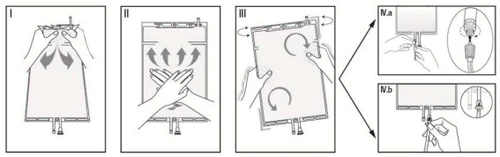
I Break the seal by holding the small compartment between both hands and pressing until the hermetic seal separating the two compartments opens (see figure I below).
II Press the large compartment with both hands until the hermetic seal between the two compartments is fully open (see figure II below).
III Ensure complete mixing by gently agitating the bag. The solution is now ready for use and the bag can be hung on the equipment (see figure III below).
IV The dialysate or replacement fluid line can be connected to either of the two access ports.
IVa If using the luer connector, remove the cap by twisting and pulling it off, then connect the male luer of the dialysate or replacement line to the female luer connector on the bag with a push-and-turn motion. Ensure the connection is secure and tight. The connector is now open. Check that fluid flows freely (see figure IV.a below).
When the dialysis or replacement line is disconnected from the luer connector, the connector will close automatically and the solution will stop flowing. The luer port is a needle-free, alcohol-disinfectable port with a septum.
IVb If using the spike connector (or injection port), first remove the cap by lifting it off. The injection port can be disinfected. Then insert the spike through the rubber wall. Check that fluid flows freely (see figure IV.b below).
The reconstituted solution is for single use only. Any unused solution must be discarded. The solution may be disposed of via wastewater without causing harm to the environment.