Biocoryl 100 mg/ml solution for injection
Spain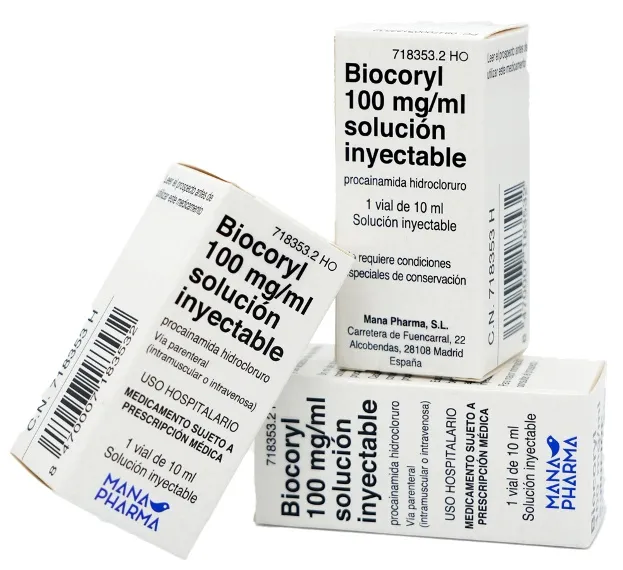
Table of Contents
Package leaflet: Information for the user
Introduction
Package leaflet: information for the patient
Biocoryl 100 mg/ml injection solution
procainamide hydrochloride
Read all of this leaflet carefully before you start using this medicine, because it contains important information for you.
-
Keep this leaflet, as you may need to read it again.
- If you have any questions, ask your doctor or nurse.
-
This medicine has been prescribed for you only, and you should not give it to other people, even if they have the same symptoms as you, because it could harm them.
- If you experience any adverse effects, consult your doctor, pharmacist, or nurse, even if these are effects not listed in this leaflet. See section 4.
Contents of the package leaflet
- What Biocoryl is and what it is used for
- What you need to know before using Biocoryl
- How to use Biocoryl
- Possible side effects
- How to store Biocoryl
- Contents of the pack and other information
1. What Biocoryl is and what it is used for
This medicine contains procainamide as the active substance, which belongs to a group of medicines called class IA antiarrhythmics.
Biocoryl is used for the treatment in adults of a type of heart rhythm disorder, ventricular arrhythmias.
2. What you need to know before using Biocoryl
Do not use Biocoryl:
- if you are allergic to procainamide or to any of the other components of this medicine (listed in section 6),
- if you have systemic lupus erythematosus (a disease in which the body's immune system mistakenly attacks healthy tissue. It may affect the skin, joints, kidneys, brain, and other organs),
- if you have torsades de pointes (a serious heart rhythm problem),
- if you have complete atrioventricular block.
Warnings and precautions
Talk to your doctor before using Biocoryl:
- if you have first- or second-degree atrioventricular block,
- if you have congestive heart failure,
- if you have acute ischemic heart disease or cardiomyopathy,
- if you have atrial flutter or fibrillation,
- if you have QT interval prolongation (a heart problem seen on an electrocardiogram),
- if you have renal insufficiency (your kidneys do not function properly),
- if you have myasthenia gravis (a disease causing extreme weakness of certain muscles).
Children and adolescents
Biocoryl is not recommended for use in children and adolescents.
Use of Biocoryl with other medicines
Tell your doctor if you are taking, have recently taken, or might need to take any other medicines.
In particular, inform your doctor if you are taking:
- a medicine for peptic ulcer or gastroesophageal reflux called cimetidine,
- a muscle relaxant medicine,
- a medicine for myasthenia gravis, such as neostigmine and pyridostigmine,
- a medicine to control blood pressure,
- a medicine that prolongs the QT interval,
- a medicine that causes hypokalemia (lowers potassium levels in the blood),
- a medicine to control certain types of arrhythmias, such as amiodarone and Class I antiarrhythmics,
- a medicine to treat infections, such as trimethoprim and ofloxacin,
- a medicine containing para-aminobenzoic acid.
Use of Biocoryl with food, drinks and alcohol
Do not drink alcohol while being treated with this medicine, as it may reduce the effectiveness of the treatment.
Pregnancy, breastfeeding and fertility
If you are pregnant or breastfeeding, think you may be pregnant, or are planning to become pregnant, consult your doctor or pharmacist before using this medicine.
Procainamide is not recommended during pregnancy or breastfeeding.
Driving and using machines
The effect of Biocoryl on the ability to drive and use machines is unknown.
Biocoryl contains benzyl alcohol, sodium bisulfite and sodium
This medicine contains 100 mg of benzyl alcohol in each vial (10 ml). Benzyl alcohol may cause allergic reactions.
This medicine may cause severe allergic reactions and bronchospasm (sudden sensation of suffocation) because it contains sodium bisulfite.
This medicine contains less than 1 mmol of sodium (23 mg) per 10 ml of this medicine; i.e., it is essentially "sodium-free".
3. How to use Biocoryl
Follow exactly the instructions for administration of this medicine as given by your doctor. If in doubt, consult your doctor again.
Your doctor will decide how much Biocoryl you should be given and how often you need it.
Biocoryl must only be administered by intramuscular or intravenous route. The intravenous route should be reserved for emergency cases.
- Intramuscular route:
The recommended intramuscular dose is 0.5 g of procainamide (5 ml of Biocoryl), followed by 0.5 to 1.0 g at intervals of 1 to 6 hours, depending on response.
- Intravenous route:
The intravenous dose ranges from 0.2 g to 1.0 g of procainamide. The injection must be administered very slowly (no more than 1 ml of Biocoryl per minute), with monitoring of blood pressure and a vasoconstrictor (e.g., adrenaline) readily available in case hypotension occurs. An interval of 4 to 6 hours should elapse before administering a new dose, if necessary.
Use in children and adolescents
Use of Biocoryl is not recommended in children and adolescents.
If you use more Biocoryl than you should
If you take more Biocoryl than you should, contact your doctor immediately.
In case of overdose or accidental ingestion, contact your doctor, pharmacist, or call the Toxicology Information Service at telephone number: 91 562 04 20, indicating the medicine and the amount taken.
It is recommended to bring the medicine's packaging and package leaflet to the healthcare professional.
Information for the physician:
Management of overdose or toxic manifestations includes general supportive measures, strict monitoring, control of vital signs, and possibly intravenous administration of pressor agents and mechanical cardiorespiratory support.
Generally, if necessary, treatment may involve administration of vasopressor agents after adequate volume replacement. Intravenous infusion of sodium lactate 1/6 M has been reported to reduce the cardiotoxic effects of procainamide. Procainamide can be removed from the circulation by hemodialysis, but not by peritoneal dialysis. There is no known specific antidote for procainamide overdose.
If you forget to use Biocoryl
Do not administer a double dose to make up for missed doses.
If you stop treatment with Biocoryl
Your doctor will advise you on the duration of your treatment with this medicine. Do not stop treatment prematurely.
If you have any further questions about the use of this medicine, ask your doctor, pharmacist, or nurse.
4. Possible adverse effects
Like all medicines, this medicine can cause adverse effects, although not everyone will experience them.
The adverse effects observed are described below according to their frequency of occurrence:
- Common (affects at least 1 in 100 patients):
Drug-induced lupus-like syndrome (symptoms resembling those of a disease that may affect the skin, joints, kidneys, brain, and other organs).
- Uncommon (affects at least 1 in 1,000 patients):
Hypotension.
- Rare (affects at least 1 in 10,000 patients):
Neutropenia, thrombocytopenia, haemolytic anaemia, agranulocytosis, second-degree atrioventricular block.
- Frequency not known (cannot be estimated from available data):
Decreased appetite, depression, psychotic disorder (delusions and hallucinations), hallucination, dizziness, impaired balance, dysgeusia (altered taste sensation), flushing, nausea, vomiting, abdominal pain, diarrhoea, hepatomegaly (liver enlargement), angioedema (skin swelling), urticaria, pruritus (itching), maculopapular rash, asthenia (weakness or fatigue), increased transaminases (elevation of certain liver enzymes known as transaminases).
Reporting of adverse effects
If you experience any adverse effect, consult your doctor, pharmacist, or nurse, even if it is a possible adverse effect not listed in this leaflet. You may also report them directly via the Spanish Pharmacovigilance System for Human Medicines: www.notificaram.es. By reporting adverse effects, you can help provide more information on the safety of this medicine.
5. Storage of Biocoryl
Keep this medicine out of the sight and reach of children.
Do not use this medicine after the expiry date stated on the packaging after EXP. The expiry date refers to the last day of the month indicated.
This medicine does not require any special storage conditions.
Medicines must not be disposed of via wastewater or household waste. Ask your pharmacist how to dispose of medicines and containers you no longer need. This will help protect the environment.
6. Contents of the pack and other information
Composition of Biocoryl
- The active substance is procainamide hydrochloride.
- The other components (excipients) are benzyl alcohol, sodium bisulfite (E222), and water for injection solutions.
Nature of the product and contents of the pack
Biocoryl is presented as a colorless or slightly yellowish, transparent injectable solution.
Biocoryl is available in packs containing 1 vial.
Marketing Authorization Holder and Manufacturer
Marketing Authorization Holder
Mana Pharma, S.L.
Carretera de Fuencarral, 22
Alcobendas, 28108 Madrid
Spain
Manufacturer
- Braun Medical, S.A.
Ronda de Los Olivares, parcela 11
23009 Jaén
Spain
Date of the most recent review of this leaflet: April 2022.
Other sources of information
Detailed information on this medicinal product is available on the website of the Spanish Agency for Medicines and Health Products (AEMPS) (http://www.aemps.gob.es/).