Bimeox 0.3 mg/ml eye drops solution in single-dose container
Spain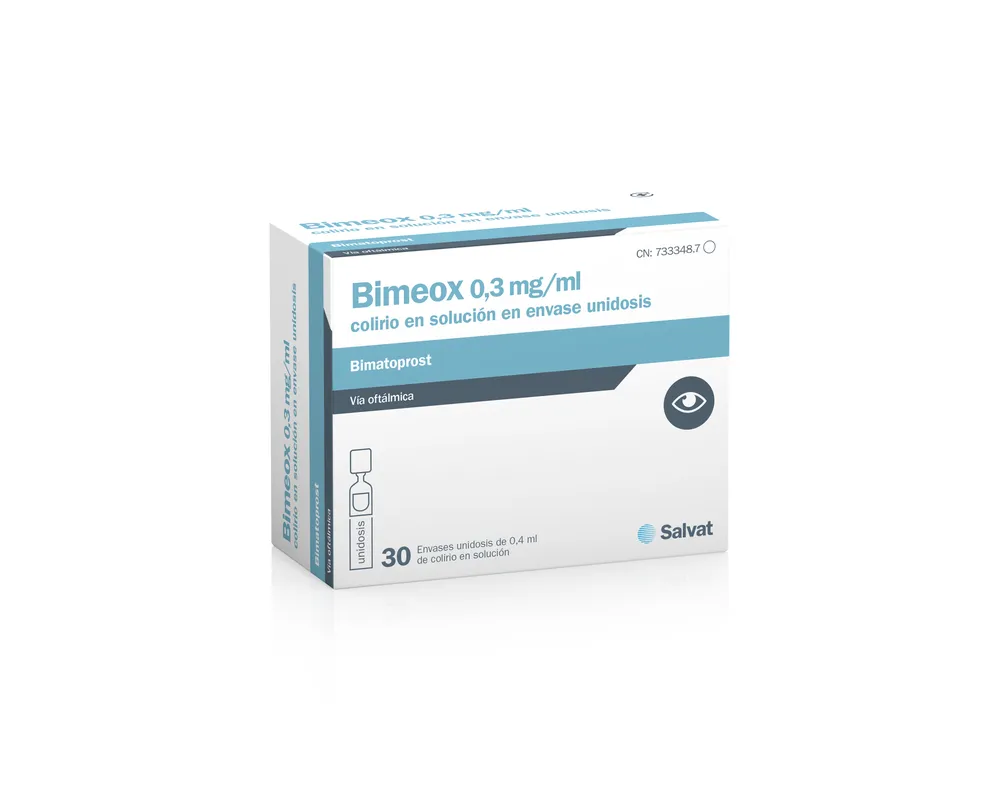
Table of Contents
- Package leaflet: Information for the user
- Introduction
- **Read the entire leaflet carefully before you start using this medicine, as it contains important information for you.**
- **Package leaflet**:
- 1. What Bimeox is and what it is used for
- 2. What you need to know before starting to use Bimeox
- **Do not use this medicine:**
- **Warnings and precautions:**
- **Consult your doctor or pharmacist if:**
- **Children and adolescents**
- **Other medicines and Bimeox**
- **Pregnancy, breastfeeding, and fertility**
- **Driving and Use of Machines**
- 3. How to use Bimeox
- **If you use more Bimeox than you should**
- **If you forget to use Bimeox**
- **If treatment with Bimeox is interrupted**
- 4. Possible adverse effects
- **Very common adverse effects**
- **Frequent adverse effects**
- **Uncommon adverse effects**
- **Adverse reactions of unknown frequency**
- **Reporting of Adverse Reactions**
- 5. Storage of Bimeox
- Keep this medicine out of the sight and reach of children.
- 6. Contents of the pack and other information
- **Composition of Bimeox**
- **Appearance of the product and contents of the package**
- **Marketing Authorization Holder and Manufacturing Responsible Party:**
Package leaflet: Information for the user
Introduction
Package leaflet: information for the user
Bimeox 0.3 mg/ml eye drops solution in single-dose container
bimatoprost
Read the entire leaflet carefully before you start using this medicine, as it contains important information for you.
- Keep this leaflet, as you may need to read it again.
- If you have any questions, consult your doctor or pharmacist.
- This medicine has been prescribed for you only, and you should not give it to others, even if they have the same symptoms as you, because it may harm them.
- If you experience any adverse effects, consult your doctor or pharmacist, even if these effects are not listed in this leaflet. See section 4.
Package leaflet:
- What Bimeox is and what it is used for
- What you need to know before using Bimeox
- How to use Bimeox
- Possible side effects
- How to store Bimeox
- Contents of the pack and other information
1. What Bimeox is and what it is used for
Bimeox is a medication for glaucoma. It belongs to a group of medicines called prostamides.
Bimeox is used to reduce elevated eye pressure. This medicine can be used alone or in combination with other eye drops called beta-blockers, which also reduce pressure.
The eye contains a clear, aqueous fluid that maintains the inner structure of the eye. This fluid continuously drains out of the eye, and new fluid is produced to replace it. If the fluid does not drain quickly enough, pressure inside the eye increases. This medicine works by increasing the drainage of the fluid, thereby reducing the pressure within the eye. If this pressure is not reduced, it may lead to a condition called glaucoma and cause damage to your vision.
This medicine does not contain preservatives.
2. What you need to know before starting to use Bimeox
Do not use this medicine:
- If you are allergic to bimatoprost or to any of the other components of this medicine (listed in section 6).
Warnings and precautions:
Consult your doctor or pharmacist before starting to use Bimeox.
Consult your doctor or pharmacist if:
- you have any respiratory problems,
- you have liver or kidney problems,
- you have previously undergone cataract surgery,
- you have or have had low blood pressure or a slow heart rate,
- you have had or currently have a viral infection or inflammation of the eye.
During treatment, Bimeox may cause loss of fat around the eye, which can lead to deepening of the eyelid groove, sunken eyes (enophthalmos), drooping of the upper eyelids (ptosis), stretching of the skin around the eye (involution of dermatochalasis), and increased visibility of the lower white part of the eye (inferior scleral show). These changes are usually mild, but if they become more pronounced, they may affect your field of vision. The changes may resolve if you stop using Bimeox. Bimeox may also cause darkening and growth of eyelashes, as well as darkening of the skin around the eyelid. Over time, it may darken the color of the iris. These changes may be permanent. These effects may be more noticeable if only one eye is being treated.
Children and adolescents
Bimeox has not been studied in individuals under 18 years of age and therefore should not be used in patients under 18 years of age.
Other medicines and Bimeox
Inform your doctor or pharmacist if you are taking, have recently taken, or might need to take any other medicines.
Pregnancy, breastfeeding, and fertility
If you are pregnant or breastfeeding, think you may be pregnant, or are planning to become pregnant, consult your doctor or pharmacist before using this medicine.
Bimeox may pass into breast milk; therefore, you should not use it if you are breastfeeding.
Driving and Use of Machines
After instillation of Bimeox, blurred vision may occur for a short period of time. Do not drive or operate machinery until you see clearly.
Bimeox contains:
This medicine contains 0.95 mg of phosphates per ml of solution, equivalent to 2.68 mg/ml of dibasic sodium phosphate heptahydrate.
If you suffer from severe damage to the transparent layer at the front of the eye (cornea), treatment with phosphates may, in very rare cases, cause cloudy patches in the cornea due to calcium deposition.
3. How to use Bimeox
Follow exactly the instructions for administration of this medicine given by your doctor or pharmacist. If in doubt, consult your doctor or pharmacist.
The recommended dose is one drop in each eye requiring treatment, once daily, in the late afternoon. This medicine should be used only in the eye.
If you are using Bimeox together with other eye medication, wait at least 5 minutes between using Bimeox and the other eye medication.
Do not use the medicine more than once a day, as this may reduce the effectiveness of the treatment.
Wash your hands before use. Make sure the single-dose container is intact before using this medicine. The solution should be used immediately after opening the container. To avoid contamination, do not let the tip of the single-dose container touch the eye or any other surface.
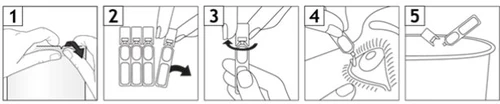
1,2 3. Take a single-dose container from the pouch and hold it vertically (with the cap facing upwards) and twist the cap until it comes off.
-
Gently pull down the lower eyelid to form a pouch. Invert the single-dose container and squeeze it until one drop falls into the affected eye or eyes.
-
Discard the single-dose container after use, even if there is some solution left inside.
Wipe away any excess that runs down your cheek.
If you wear contact lenses, you must remove them before using this medicine. Wait 15 minutes after using the drops before reinserting your contact lenses.
If you use more Bimeox than you should
If you use more of this medicine than you should, it is unlikely to cause you any serious harm. Apply the next dose at your usual time. If you are concerned, speak to your doctor or pharmacist.
In case of overdose or accidental ingestion, contact your doctor or pharmacist immediately or call the Toxicology Information Service, telephone: 91 562 04 20, indicating the medicine and the amount ingested.
If you forget to use Bimeox
If you forget to apply this medicine, instill a single drop as soon as you remember and then return to your usual routine. Do not apply a double dose to make up for the missed dose.
If treatment with Bimeox is interrupted
Bimeox should be used daily for it to work properly. If you stop using Bimeox, the pressure inside the eye may increase; therefore, consult your doctor before interrupting treatment.
If you have any further questions about the use of this medicine, ask your doctor or pharmacist.
4. Possible adverse effects
Like all medicines, this medicine can cause adverse effects, although not everyone will experience them.
Very common adverse effects
These may affect more than 1 in 10 people
Affecting the eye:
- Mild redness (up to 24% of people)
- Loss of fat in the eye area which may cause deepening of the eyelid groove, sunken eyes (enophthalmos), drooping of the eyelids (ptosis), stretching of the skin around the eye (dermatocalasis involution), and increased visibility of the lower white part of the eye (inferior scleral show).
Frequent adverse effects
These may affect up to 1 in every 10 people
Eye-related effects
- Small erosions on the surface of the eye, with or without inflammation
- Irritation
- Itching of the eyes
- Pain
- Dryness
- Sensation of having something in the eye
- Longer eyelashes
- Darker skin around the eye
- Redness of the eyelids
Uncommon adverse effects
These may affect up to 1 in 100 patients
Affecting the eye
- Tired eyes
- Light sensitivity
- Darker iris
- Swollen and itchy eyelids
- Watery eyes
- Inflammation of the transparent layer covering the surface of the eye
- Blurred vision
Affecting other parts of the body
- Headaches
- Growth of hair around the eye
Adverse reactions of unknown frequency
Affecting the eye
- Sticky eyes
- Eye discomfort
Affecting other parts of the body
- Asthma
- Worsening of asthma
- Worsening of the lung disease known as chronic obstructive pulmonary disease (COPD)
- Difficulty breathing
- Symptoms of allergic reaction (swelling, eye redness, and skin rash)
- Dizziness
- Elevated blood pressure
- Skin discoloration (periorbital)
In addition to the adverse reactions of Bimeox, the following adverse reactions have been observed with the multidose formulation containing the preservative of bimatoprost 0.3 mg/ml and may occur in patients using Bimeox:
- Burning sensation in the eye
- Allergic reaction in the eye
- Eyelid inflammation
- Difficulty seeing clearly
- Worsening of vision
- Darker eyelashes
- Retinal hemorrhage
- Inflammation inside the eye
- Cystoid macular edema (swelling of the retina within the eye leading to worsening of vision)
- Iris inflammation
- Eyelid twitching
- Eyelid contraction and separation from the surface of the eye
- Nausea
- Redness of the skin around the eye
- Weakness
- Increase in certain blood test values indicating liver function
Other adverse reactions reported with eye drops containing phosphate:
Very rarely, some patients with severe damage to the transparent layer at the front of the eye (the cornea) have developed cloudy spots in the cornea due to calcium accumulation during treatment.
Reporting of Adverse Reactions
If you experience any type of adverse reaction, consult your doctor or pharmacist, even if it is a possible adverse reaction not listed in this leaflet. You may also report them directly via the Spanish Pharmacovigilance System for Human Medicinal Products: www.notificaram.es.
By reporting adverse reactions, you can help provide more information on the safety of this medicine.
5. Storage of Bimeox
Keep this medicine out of the sight and reach of children.
This medicine is for single use only and does not contain preservatives. Do not keep any unused solution.
Do not use this medicine after the expiry date stated on the single-dose pouch and on the outer carton after EXP. The expiry date refers to the last day of the month indicated.
This medicine does not require any special storage conditions. However, once the pouch is opened, the medicine should be used within 30 days.
Medicines should not be disposed of via wastewater or household waste. Return any unused medicines and their packaging to your pharmacist for proper disposal. If you are unsure, ask your pharmacist how to dispose of medicines and packaging you no longer need. This will help protect the environment.
6. Contents of the pack and other information
Composition of Bimeox
- The active substance is bimatoprost. One ml of solution contains 0.3 mg of bimatoprost.
- The other components are sodium chloride, disodium phosphate heptahydrate (E339), citric acid monohydrate (E330), and water for injections. Small amounts of hydrochloric acid or sodium hydroxide may be added to maintain a normal acidity level (pH levels).
Appearance of the product and contents of the package
Bimeox is a clear, colourless solution supplied in single-dose plastic containers, each containing 0.4 ml of solution.
The carton contains 3 aluminium sachets, each with 10 single-dose containers, making a total of 30 single-dose containers in the carton.
Marketing Authorization Holder and Manufacturing Responsible Party:
Laboratorios Salvat, S.A.
C/ Gall, 30-36 – 08950
Esplugues de Llobregat
Barcelona - Spain
Date of the most recent review of this leaflet: May 2022
Detailed and up-to-date information on this medicinal product is available on the website of the Spanish Agency for Medicines and Health Products (AEMPS):
http://www.aemps.gob.es/