Bidutam 0.5 mg/0.4 mg hard capsules EFG
Spain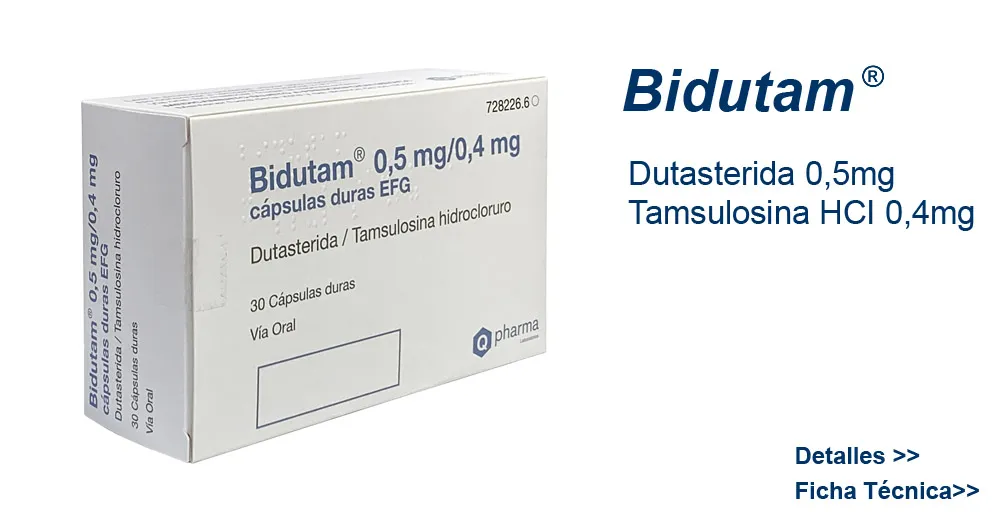
Table of Contents
Patient Information Leaflet
Introduction
B.PACKAGE LEAFLET
Package leaflet: Information for the patient
Bidutam 0,5 mg/0,4 mg hard capsules EFG
Dutasteride/Tamsulosin hydrochloride
Read all of this leaflet carefully before you start taking this medicine, because it contains important information for you.
- Keep this leaflet, as you may need to read it again.
- If you have any questions, ask your doctor or pharmacist.
- This medicine has been prescribed for you only. Do not give it to other people, even if they have the same symptoms as you, because it may harm them.
- If you experience any adverse effects, talk to your doctor or pharmacist, even if they are adverse effects not listed in this leaflet. See section 4.
Contents of this leaflet
- What Bidutam is and what it is used for
- What you need to know before taking Bidutam
- How to take Bidutam
- Possible side effects
- How to store Bidutam
- Contents of the pack and other information
1. What Bidutam is and what it is used for
This medicine is used in men to treat enlarged prostate (benign prostatic hyperplasia) – a non-cancerous growth of the prostate caused by overproduction of a hormone called dihydrotestosterone.
This medicine is a combination of two different medicines called dutasteride and tamsulosin. Dutasteride belongs to a group of medicines known as 5-alpha reductase inhibitors, and tamsulosin belongs to a group of medicines known as alpha blockers.
As the prostate enlarges, it can cause urinary problems such as difficulty in urine flow and a need to urinate more frequently. It may also cause the urine stream to become weaker and less forceful. If benign prostatic hyperplasia is not treated, there is a risk that urine flow may become completely blocked (acute urinary retention), which requires immediate medical treatment. In some cases, surgery may be needed to reduce the size of the prostate or to remove it.
Dutasteride reduces the production of dihydrotestosterone, helping to shrink the size of the prostate and relieve symptoms. This reduces the risk of acute urinary retention and the need for surgery. Tamsulosin works by relaxing the muscles in the prostate, making urination easier and rapidly improving symptoms.
2. What you need to know before taking Bidutam
Do not take Bidutam
-
if you are a woman (because this medicine is for men only)
-
if you are a child or adolescent under 18 years of age
-
if you are allergic (hypersensitive) to dutasteride, other 5-alpha reductase enzyme inhibitors, tamsulosin, soy, peanut, or to any of the other components of this medicine (listed in section 6)
-
if you suffer from fainting, dizziness, or lightheadedness due to a drop in blood pressure when changing posture (sitting or standing up) (orthostatic hypotension)
-
if you have severe liver disease
-
If you think you fall into any of these categories, do not take this medicine until you have consulted your doctor.
Warnings and precautions
Talk to your doctor before starting this medicine.
-
In some clinical studies, the number of patients who developed heart failure was higher in those taking dutasteride together with another medicine called an alpha-blocker, such as tamsulosin, compared to patients taking only dutasteride or only an alpha-blocker. Heart failure means that your heart does not pump blood properly.
-
if you have liver problems. If you have any condition affecting your liver, you may need additional monitoring during treatment with this medicine.
-
Tell your doctor if you have severe kidney problems.
-
Cataract surgery (cloudy lens). If you are scheduled for cataract surgery, your doctor may advise you to stop taking this medicine for a period before the operation. Inform your ophthalmologist before surgery that you are currently taking or have previously taken this medicine or tamsulosin. Your ophthalmologist should take appropriate precautions to avoid complications during surgery.
-
Women, children, and adolescents must avoid contact with broken capsules of this medicine, as the active ingredient can be absorbed through the skin. If any contact occurs, the affected area should be washed immediately with soap and water.
-
Use a condom during sexual intercourse. Dutasteride has been found in the semen of men taking dutasteride/tamsulosin. If your partner is pregnant or suspects she might be, you must avoid exposing her to your semen, as dutasteride may affect the normal development of a male fetus. Dutasteride causes a reduction in sperm count, sperm motility, and semen volume. This may reduce your fertility.
-
This medicine affects the blood PSA test (prostate-specific antigen), which is sometimes used to detect prostate cancer. Your doctor may still use this test to screen for prostate cancer, but must be aware of this effect. If you have a blood test to measure your PSA, inform your doctor that you are taking this medicine. Men being treated with this medicine should have regular PSA monitoring.
-
In a clinical study in men at high risk of developing prostate cancer, men taking dutasteride developed a higher frequency of a more serious type of prostate cancer than those not taking dutasteride. The effect of dutasteride on this more serious type of prostate cancer is not fully understood.
-
This medicine may cause breast enlargement and tenderness. If this causes discomfort, or if you notice lumps in the breast or nipple discharge, consult your doctor, as these changes may be signs of a serious condition, such as breast cancer.
Talk to your doctor or pharmacist if you have any questions about how to take this medicine.
Other medicines and Bidutam
Tell your doctor or pharmacist if you are taking, have recently taken, or might need to take any other medicines.
Do not take dutasteride/tamsulosin with the following medicines:
- other alpha-blockers (used for enlarged prostate or high blood pressure)
It is not recommended to take this medicine with the following medicines:
- ketoconazole (used to treat fungal infections)
Certain medicines may interact with this medicine and increase the risk of adverse effects. Some of these medicines are:
- PDE5 enzyme inhibitors (used to achieve or maintain an erection), such as vardenafil, sildenafil citrate, and tadalafil
- verapamil or diltiazem (for high blood pressure)
- ritonavir or indinavir (for HIV)
- itraconazole or ketoconazole (for fungal infections)
- nefazodone (an antidepressant)
- cimetidine (for stomach ulcers)
- warfarin (for blood clotting)
- erythromycin (an antibiotic used to treat infections)
- paroxetine (an antidepressant)
- terbinafine (used to treat fungal infections)
- diclofenac (used to treat pain and inflammation)
Tell your doctor if you are taking any of these medicines.
Taking Bidutam with food and drink
You should take this medicine 30 minutes after the same meal each day.
Pregnancy, breastfeeding and fertility
This medicine must not be taken by women.
Pregnant women (or those who may be pregnant) must avoid contact with broken capsules. Dutasteride can be absorbed through the skin and may affect the normal development of a male fetus. This risk is particularly important during the first 16 weeks of pregnancy.
Consult your doctor if a pregnant woman has been exposed to Bidutam.
Use a condom during sexual intercourse. Dutasteride has been found in the semen of men taking dutasteride/tamsulosin. If your partner is pregnant or suspects she might be, you must avoid exposing her to your semen.
Dutasteride/tamsulosin has been shown to reduce sperm count, sperm motility, and semen volume. This may reduce male fertility.
Driving and using machines
Some people may experience dizziness during treatment with this medicine, which could affect their ability to drive or operate machinery safely.
Do not drive or operate machinery if you are affected in this way.
Mood changes and depression
Depressed mood, depression, and, less frequently, suicidal thoughts have been reported in patients treated with another medicine in the same therapeutic class (oral 5-alpha-reductase inhibitor). If you experience any of these symptoms, contact your doctor for medical advice as soon as possible.
Bidutam contains soy lecithin, Orange Yellow S (E110), and sodium
This medicine may cause allergic reactions because it contains Orange Yellow S (E110). It may cause asthma, especially in patients allergic to acetylsalicylic acid.
This medicine contains soy lecithin, which may contain soybean oil. It should not be used if you are allergic to peanut or soy.
This medicine contains less than 23 mg of sodium (1 mmol) per capsule; this is essentially “sodium-free”.
3. How to take Bidutam
Follow exactly the instructions for taking this medicine given by your doctor or pharmacist. If you do not take this medicine regularly, control of your PSA levels may be affected. If in doubt, consult your doctor or pharmacist again.
What dose should you take
The recommended dose is one capsule once daily, taken 30 minutes after the same meal each day.
How to take it
The capsules must be swallowed whole with water. Do not chew or open the capsules. Contact with the capsule contents may irritate your mouth or throat.
If you take more Bidutam than you should
In case of overdose or accidental ingestion, contact your doctor or pharmacist immediately or call the Toxicology Information Service at: 91 562 04 20, indicating the medicine and the amount ingested.
If you forget to take Bidutam
Do not take a double dose to make up for missed doses. Take the next dose at the usual time.
Do not stop Bidutam treatment without advice
Do not interrupt treatment with this medicine without first consulting your doctor.
If you have any further questions about the use of this medicine, ask your doctor or pharmacist.
4. Possible adverse effects
Like all medicines, this medicine can cause adverse effects, although not everyone will experience them.
Allergic reaction
Symptoms of an allergic reaction may include:
- rash (which may be itchy)
- hives (like urticaria)
- swelling of the eyelids, face, lips, arms, or legs
Contact your doctor immediately if you experience any of these symptoms and stop taking this medicine.
Dizziness, lightheadedness, and fainting
This medicine may cause dizziness, lightheadedness, and, rarely, fainting. You should be cautious when standing up quickly after sitting or lying down, especially if you need to get up during the night, until you know how this medicine affects you. If you feel dizzy or lightheaded during treatment, sit or lie down until the symptoms have passed.
Serious skin reactions
Signs of serious skin reactions may include:
- widespread rash with blisters and peeling of the skin, particularly around the mouth, nose, eyes, and genitals (Stevens-Johnson syndrome)
Contact your doctor immediately if you have these symptoms and stop using this medicine.
Common adverse effects (may affect more than 1 in 10 people)
- impotence (inability to achieve or maintain an erection)*
- decreased sex drive (libido)*
- difficulty with ejaculation, such as reduced amount of semen released during sexual intercourse*
- enlargement of the breast and tenderness to touch (gynecomastia)
- dizziness
*In a small number of people, some of these adverse events may continue after stopping this medicine.
Uncommon adverse effects (may affect up to 1 in 100 people)
- heart failure (the heart becomes less efficient at pumping blood around the body. This could cause symptoms such as difficulty breathing, excessive tiredness, and swelling in the ankles and legs)
- reduction in blood pressure upon standing
- faster than normal heartbeat (palpitations)
- constipation, diarrhoea, vomiting, feeling sick (nausea)
- weakness or loss of strength
- headache
- itching, blockage, or runny nose (rhinitis)
- rash, hives, itching
- hair loss (usually of the body) or hair growth
Rare adverse effects (may affect up to 1 in 1,000 people)
- swelling of the eyelids, face, lips, arms, or legs (angioedema)
- fainting
Very rare adverse effects (may affect up to 1 in 10,000 people)
- prolonged and painful erection of the penis (priapism)
- serious skin reactions (Stevens-Johnson syndrome)
Other adverse effects
Other side effects have been reported in a small number of men, but their exact frequency is unknown (frequency cannot be estimated from the available data):
- abnormal or rapid heartbeat (arrhythmia, tachycardia, or atrial fibrillation)
- difficulty breathing (dyspnea)
- depression
- pain and swelling in the testicles
- nosebleeds
- severe rash
- changes in vision (blurred vision or visual impairment)
- dry mouth
Reporting of adverse effects
If you experience any kind of adverse effect, talk to your doctor or pharmacist, even if it is a possible adverse effect not listed in this leaflet. You can also report them directly via the Spanish Pharmacovigilance System for Human Medicines: https://www.notificaRAM.es. By reporting adverse effects, you can help provide more information on the safety of this medicine.
5. Storage of Bidutam
Keep this medicine out of the sight and reach of children.
Do not use this medicine after the expiry date stated on the packaging, blister, or bottle after CAD or EXP. The expiry date refers to the last day of the month indicated.
Do not store above 30°C.
Medicines should not be disposed of via wastewater drains or household waste. Dispose of unused medicines and their containers at the SIGRE collection point at your pharmacy. If you are unsure, ask your pharmacist how to properly dispose of unused medicines and their packaging. This will help protect the environment.
6. Contents of the pack and other information
Composition of Bidutam
The active substances are dutasteride and tamsulosin hydrochloride. Each capsule contains 0.5 mg of dutasteride and 0.4 mg of tamsulosin hydrochloride.
The other components are:
- Hard capsule shell: hypromellose, carrageenan (E407), potassium chloride, titanium dioxide (E171), iron oxide red (E172), sunset yellow FCF (E110).
- Hard capsule contents: glyceryl monocaprylocaprate and butylated hydroxytoluene (E321), gelatin, glycerol, titanium dioxide (E171), yellow iron oxide (E172), medium-chain triglycerides, lecithin (may contain soybean oil) (E322), microcrystalline cellulose, copolymer of methacrylic acid and ethyl acrylate (1:1) dispersion 30 percent, magnesium stearate, sodium hydroxide, triacetin, talc, titanium dioxide (E171).
Appearance of the product and contents of the pack
This medicine is a hard, oblong capsule approximately 24 mm in length, with a brown body and an orange cap.
Available in packs of 30 and 90 capsules in HDPE bottles or aluminum/aluminum blisters.
Only certain pack sizes may be marketed.
Marketing Authorization Holder and Manufacturer
Marketing Authorization Holder
LABORATORIOS Q PHARMA S.L.
C/ Moratín, nº 15, Entlo. Oficinas 6-7
03008 Alicante
Spain
Manufacturer
SAG MANUFACTURING, S.L.U.
Ctra. N-I, km 36
28750 San Agustín de Guadalix (Madrid)
Spain
GALENICUM HEALTH, S.L.
Sant Gabriel, 50
Esplugues de Llobregat
08950 Barcelona
Spain
This medicinal product is authorized in the Member States of the European Economic Area under the following names:
Malta | Dutasteride/Tamsulosin Q Pharma 0.5 mg/0.4 mg Hard Capsules |
Spain | Bidutam 0.5 mg/0.4 mg Hard Capsules EFG |
Date of the most recent review of this leaflet: December 2025.
Detailed and up-to-date information on this medicinal product is available on the website of the Spanish Agency of Medicines and Health Products (AEMPS) http://www.aemps.gob.es